
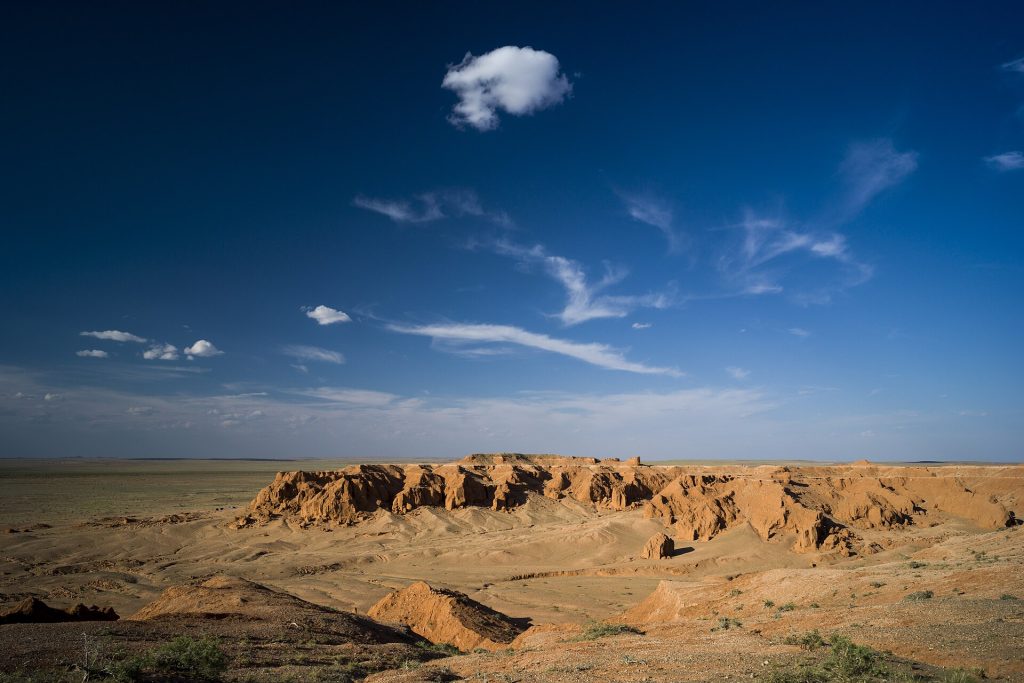
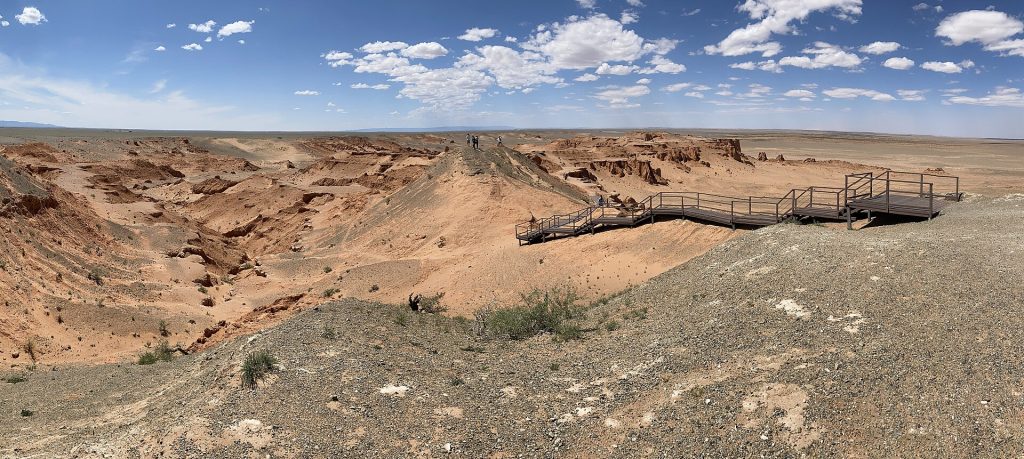
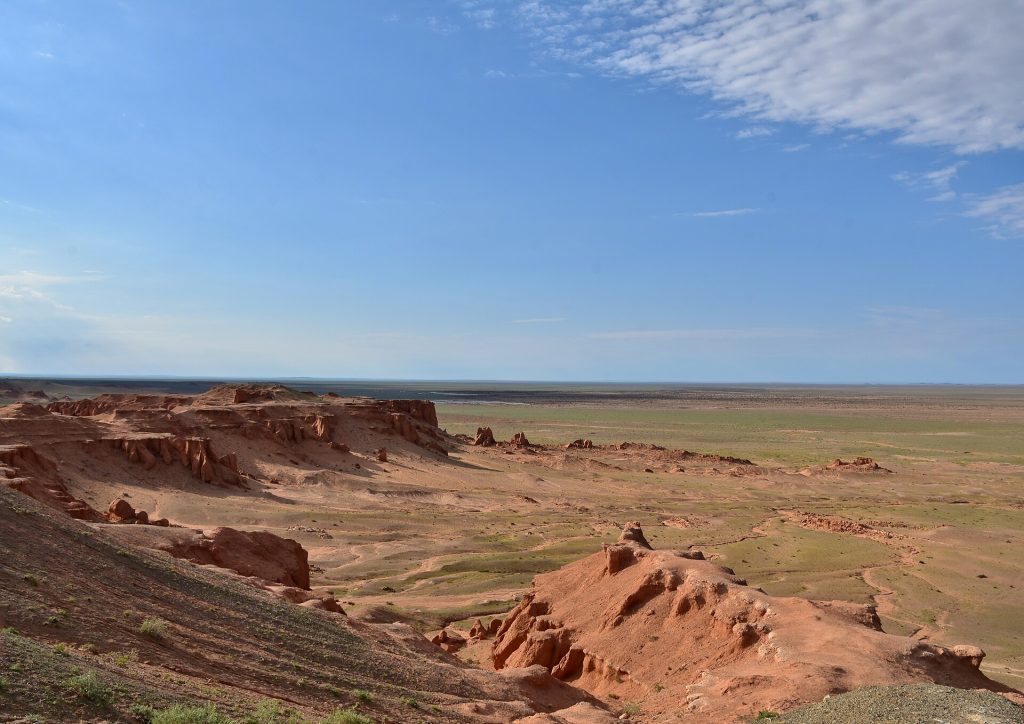
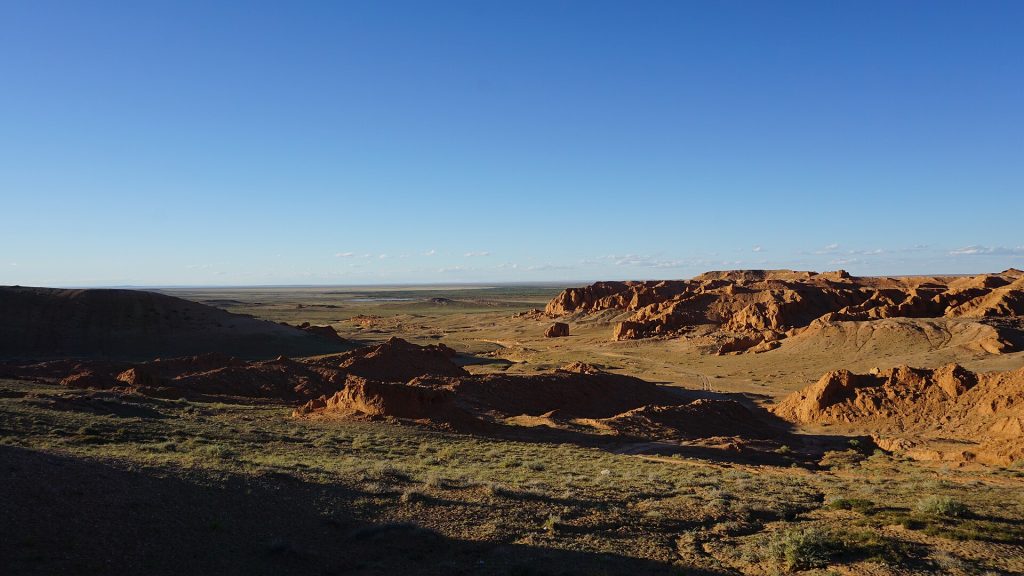
In the Gobi Desert of southern Mongolia, a wall of red sandstone rises from the plain at Bayanzag. These are the Flaming Cliffs—the classic exposure of the Djadokhta Formation. In the 1920s, expeditions from the American Museum of Natural History collected the first well-documented clutches of dinosaur eggs here. The same red sand also gave science Protoceratops, Velociraptor and Oviraptor.
A century later, the Djadokhta beds are still giving. Sister localities have produced two dinosaurs locked in combat, parents crouched over their nests, and more than a thousand skulls of mammals, lizards and dinosaurs. They have also drawn poachers—and a slow stream of smuggled fossils is now finding its way home.
Where the Flaming Cliffs Lie
Bayanzag lies in Bulgan district of Ömnögovi, Mongolia’s South Gobi province, at about 44 degrees north and just under 104 degrees east. Geologists place it on the southern margin of the Ulan Nur Basin. Older papers spell the name Bayn Dzak or Bayan Zag. The American expeditions, meanwhile, knew the place as Shabarakh Usu.
The cliffs themselves are a line of deeply cut scarps. Their central block rises more than 30 meters (100 feet) above the basin floor, and the American team named it the Flaming Cliffs. The name refers to the color of the red sandstone, which glows at sunset.
Two sister sites matter just as much. Tugrugyin Shireh—also written Tögrögiin Shiree or Tugrik—lies about 50 kilometers (31 miles) to the northwest. Ukhaa Tolgod, in contrast, sits far away in the Nemegt Basin, about 650 kilometers (400 miles) southwest of Ulaanbaatar.

The Djadokhta Beds
Dunes, Ponds and Red Sand
The Djadokhta Formation is at least 80 meters (260 feet) thick in the Ulan Nur Basin. In 2005, geologist Demberelyin Dashzeveg and colleagues split it into two members. The lower Bayn Dzak Member consists of reddish orange sands with some mudstone. Above it, the Tugrugyin Member is pale orange to light gray.
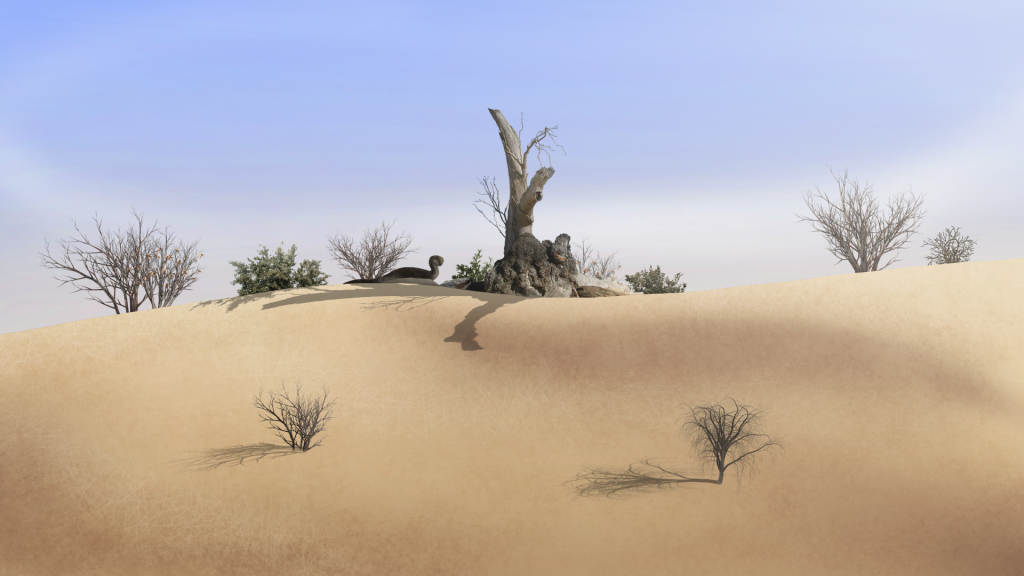
Both members record a field of sand dunes. Steeply tilted layers, known as crossbeds, mark the faces of migrating dunes. At Tugrugyin Shireh, they show that the winds blew mainly from the west. Between the dunes, lenses of brown mudstone point to shallow ponds, and beds of caliche (a hard, limy crust) record streams. Fossil root traces also show that plants grew on the dunes. The setting was arid to semi-arid—but not lifeless.

How Old Are the Beds?
No radiometric dates exist for the beds at Bayn Dzak, so their age rests on fossils and magnetism. Earlier estimates ranged widely, from the Cenomanian to the earliest Maastrichtian. Dashzeveg’s team instead measured a quick series of magnetic reversals in the rock. In their words, this “suggests, but does not clearly establish,” deposition late in the Campanian stage, between about 75 and 71 million years ago.
Other evidence fits a Campanian age. The Bayan Mandahu redbeds of Inner Mongolia share similar rocks and fossils, and a 1993 study treated them as a Campanian counterpart. Geologist Lowell Dingus and colleagues also assigned the Ukhaa Tolgod fauna tentatively to the Campanian in 2008. However, a 2021 study argued that the Djadokhta, Baruungoyot and Nemegt faunas partly reflect neighboring habitats—dune field, interdune and river plain—rather than a simple succession in time.
Buried Where They Stood
Djadokhta skeletons are often complete and still articulated, which implies fast burial. But what buried them? In 1924, Henry Fairfield Osborn already pictured an animal “overtaken by a sandstorm.” Later geologists reached a similar verdict for Bayan Mandahu, where many animals seemingly died in place during sandstorms. At Tugrugyin Shireh, sedimentologist David Fastovsky and colleagues took a mixed view in 1997. Some Protoceratops probably suffocated in sandstorms, while others died in less dramatic ways.
Ukhaa Tolgod pointed to a different culprit. There, nearly all skeletons come from sandstone with no internal layering, whereas the wind-laid dune strata hold tracks but no skeletons. Geologist David Loope and colleagues therefore proposed that rain soaked the dunes until sand slid down their faces. Such sandslides, they argued, buried nests and animals at the foot of the slope. Because both ideas involve sudden burial, the debate concerns the trigger—wind or water.
Andrews, Granger and the First Nests
1922: A Skull by the Trail
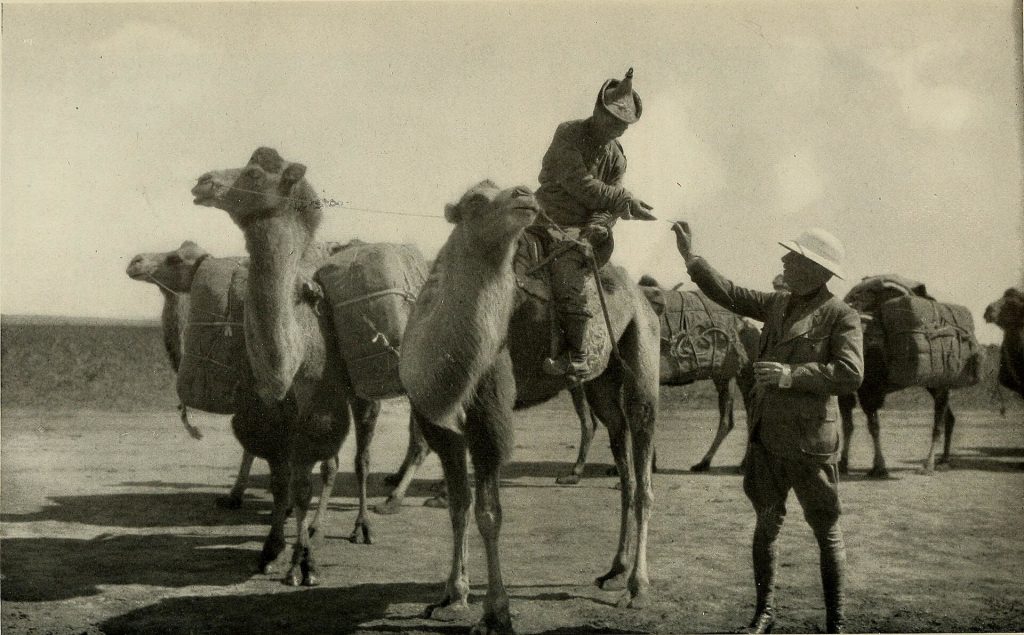
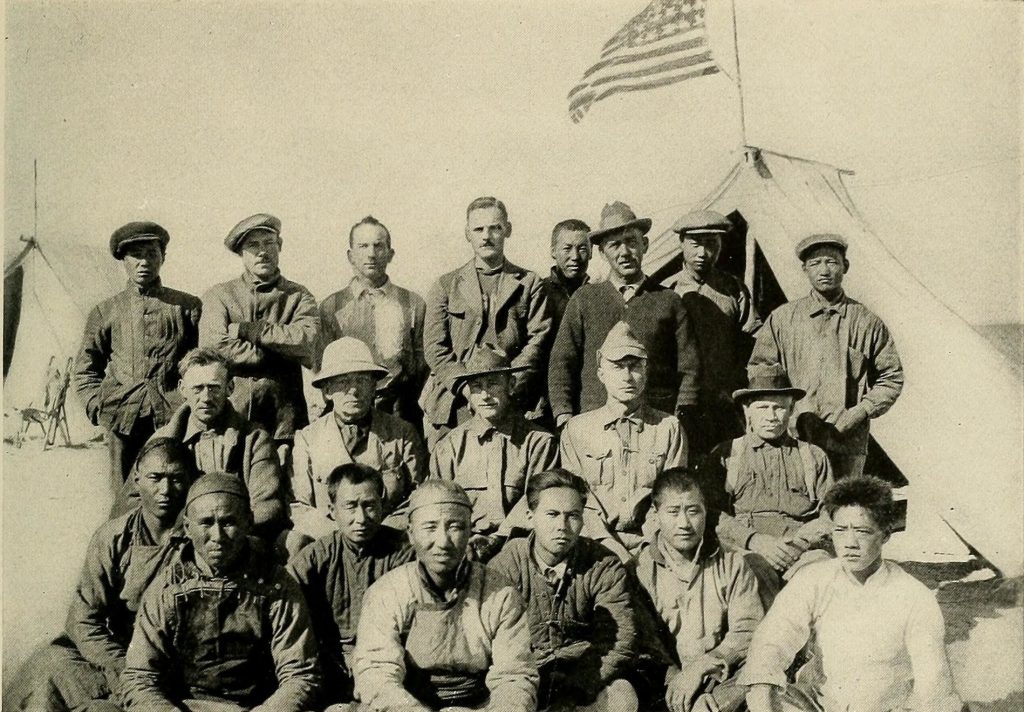
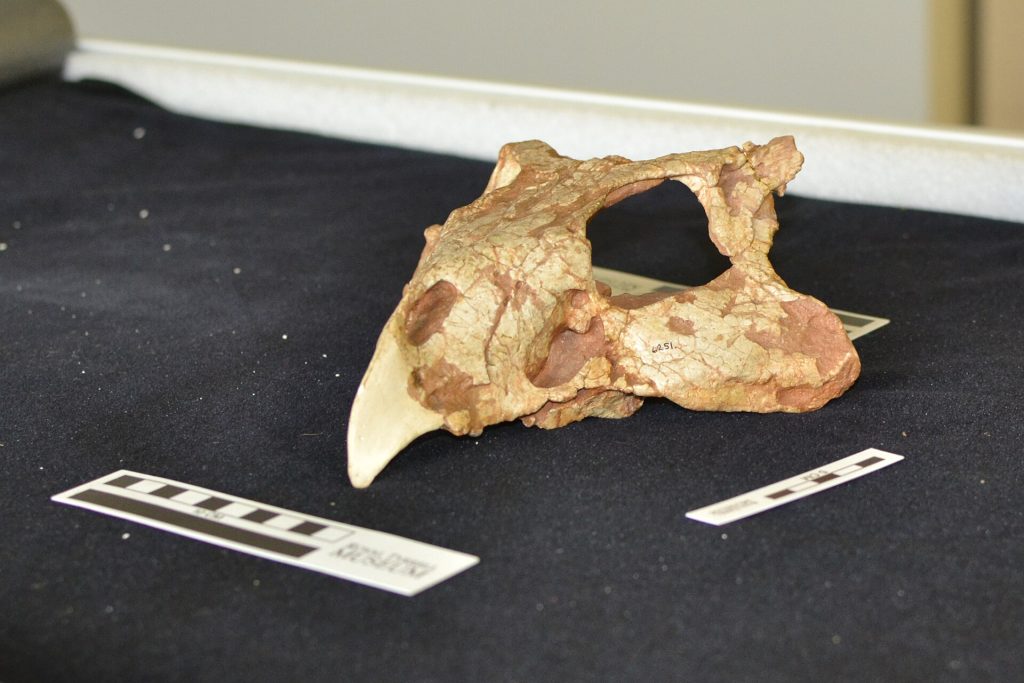
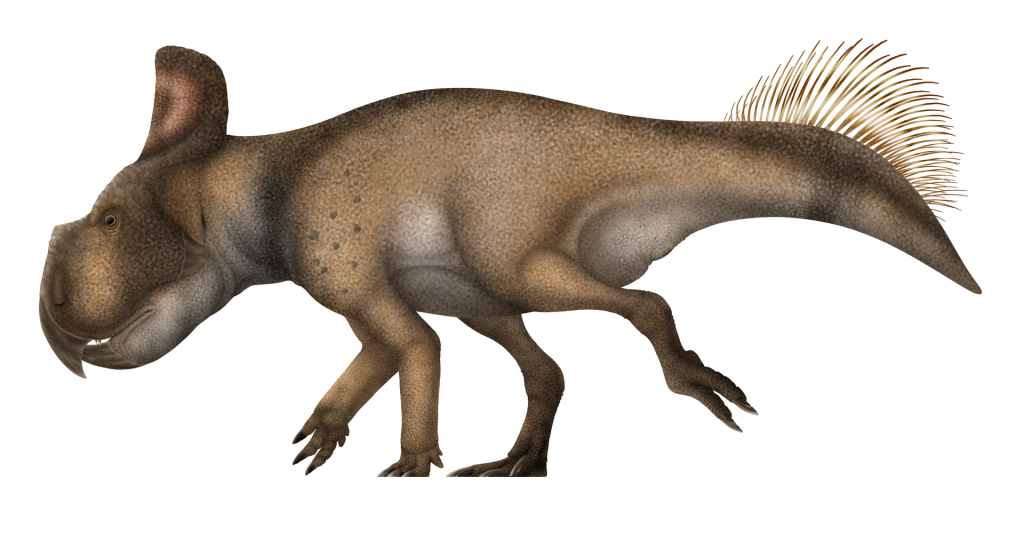
Roy Chapman Andrews led the museum’s Central Asiatic Expeditions, which worked in the basin in 1922, 1923 and 1925. The original goal was to find fossils of ancient humans. Instead, on September 2, 1922, a team member named Shackelford wandered off the trail while waiting for the rest of the party. He returned with a small, hornless skull.
The party then spent the last two hours of daylight collecting before moving on. In 1923, Walter Granger and William K. Gregory named the skull Protoceratops andrewsi. They saw in it a forerunner of the great horned dinosaurs.

1923: Eggs and Three New Hunters
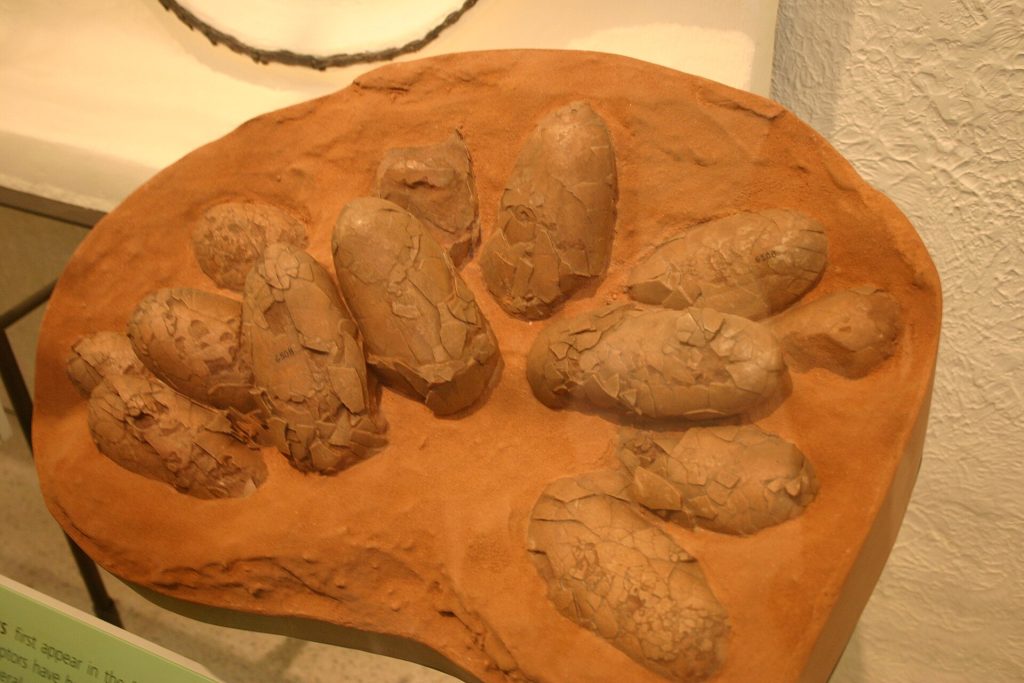
The expedition returned in the summer of 1923, and the cliffs delivered. In July, George Olsen told his colleagues that he had found fossil eggs. They doubted him at first. Yet the eggs were real, and the museum still counts them as the first clutch confirmed as dinosaurian.
The same weeks brought three small theropods. On July 9, a Chinese assistant named Chih collected a slender, toothed skull. Four days later, Olsen dug out a toothless skull lying just four inches above a nest of eggs. Then, on August 11, Peter Kaisen collected a small, sharp-toothed skull with a hand claw.
Osborn named all three in 1924. The first became Saurornithoides, the “birdlike theropod.” The second became Oviraptor, the “egg seizer,” and the third Velociraptor. Granger also collected the crushed skull that Charles Gilmore named Pinacosaurus grangeri in 1933.

The Egg Thief That Wasn’t
Protoceratops bones were by far the most common at the cliffs, so the team assigned the eggs to that animal. The toothless skull above the nest therefore looked guilty. Osborn named it Oviraptor philoceratops, yet he warned that the name “may entirely mislead us as to its feeding habits and belie its character.”
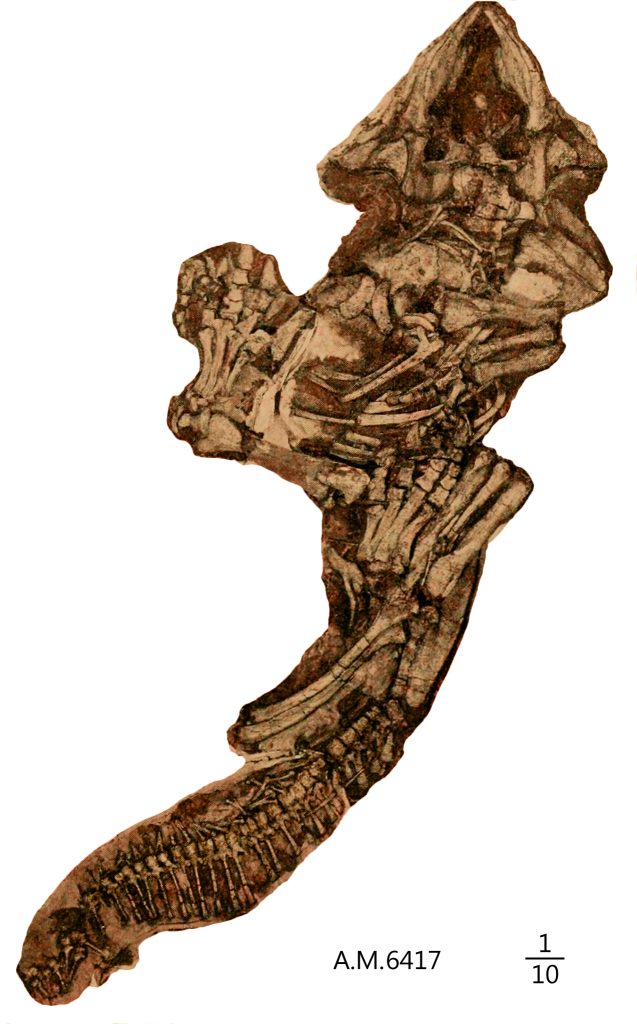
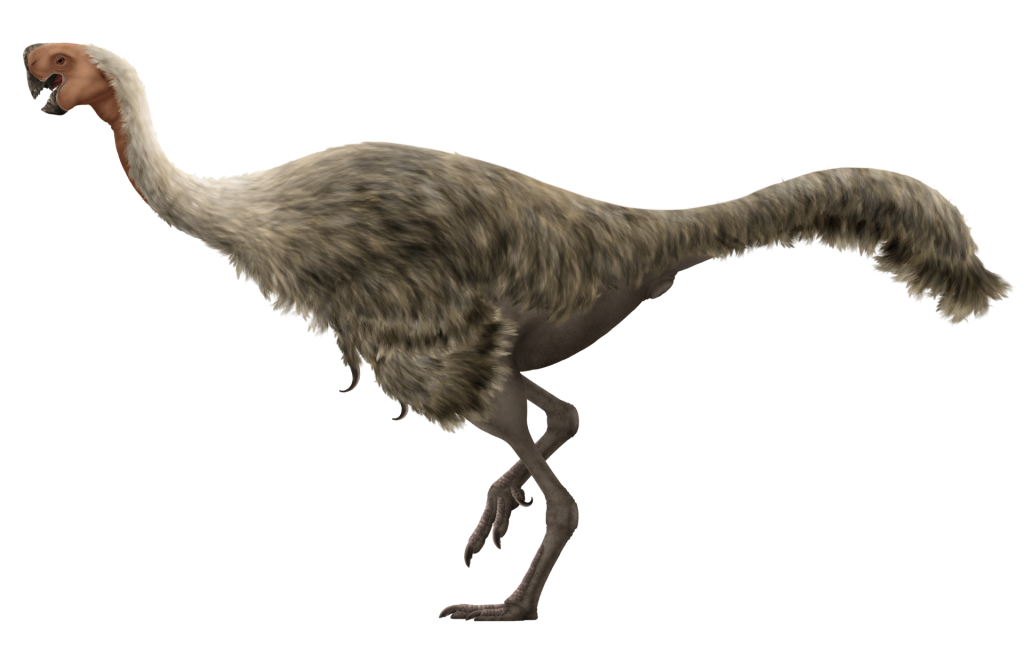
He was right to worry. In 1993, the joint Mongolian–American expedition discovered Ukhaa Tolgod. One egg there held the embryo of an oviraptorid, and its shell matched the common Flaming Cliffs type. The “Protoceratops” eggs, in other words, belonged to oviraptorids. Soon afterward, the team reported an adult sitting on a nest, with its arms spread around the eggs. By 1999, four oviraptorid skeletons on nests were on record. The 1923 Oviraptor had most likely died as a parent—not a thief.
The Ukhaa Tolgod animal later received its own name, Citipati osmolskae. Real Protoceratops eggs turned up as well—and a 2020 study found that they were soft-shelled. A nest with 15 young Protoceratops, described in 2011, hints at parental care in that species too.
The Fighting Dinosaurs of Tugrik
After the Americans left, a Soviet expedition reinvestigated Bayn Dzak in 1946. Then, between 1963 and 1971, the Polish–Mongolian Paleontological Expeditions worked the Gobi. Zofia Kielan-Jaworowska directed all but one of the main expeditions. At Bayn Dzak, the Polish teams collected mainly mammals and lizards.
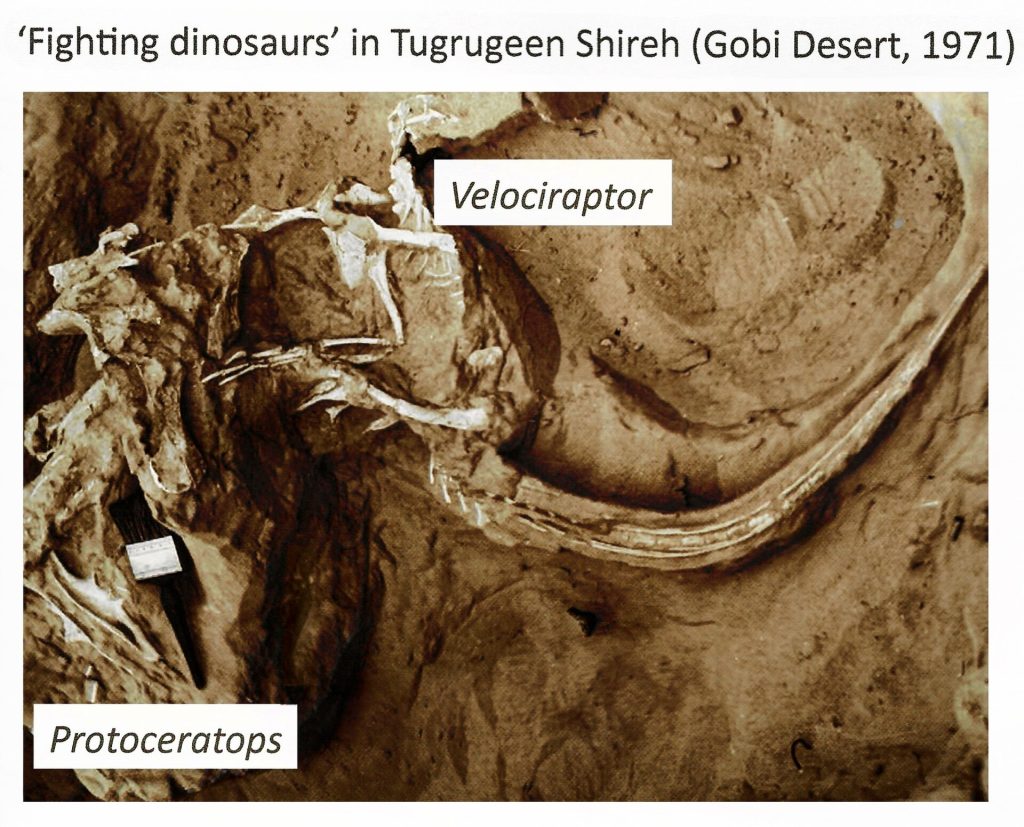
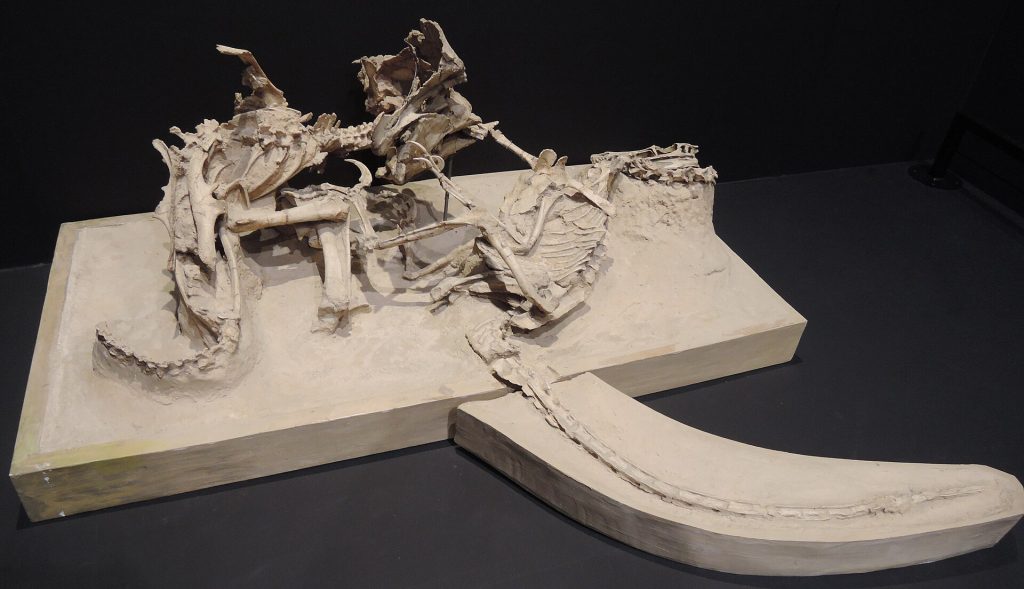
Their most famous find came on August 3, 1971, at Tugrugyin Shireh. The team uncovered a Velociraptor and a Protoceratops preserved together—the Fighting Dinosaurs. One sickle claw of the predator’s foot lies in the neck region of its opponent. Meanwhile, the Protoceratops has the predator’s right arm clamped in its beak.
The usual reading is that the pair died in mid-struggle, buried alive by a sandstorm or by a collapsing, rain-soaked dune. A 2025 review of Velociraptor called the fossil a rare instance of a predator and its prey captured in the rock record. Paleontologist Halszka Osmólska, however, raised another possibility—that the Velociraptor was scavenging a Protoceratops that was already dead. Later authors considered this unlikely, because the two animals appear to have died together.

Ukhaa Tolgod and the Modern Expeditions
In 1990, the American Museum returned to the Gobi in partnership with the Mongolian Academy of Sciences. Three years later, the team came upon Ukhaa Tolgod, whose name means “Brown Hills.” It ranks among the richest Late Cretaceous vertebrate sites in the world.
By 2008, the site had yielded more than 1,000 skulls of mammals, lizards and dinosaurs—many with skeletons attached. They included more than 100 skeletons of theropods, ankylosaurs and protoceratopsians—a count that takes in early birds. Dingus and colleagues also credited it with the highest concentration of mammal skulls and skeletons from any known Mesozoic site.
Its place in the sequence is less settled. Dingus’s team referred the beds to the Bayn Dzak Member of the Djadokhta Formation. In contrast, paleontologist Peter Makovicky has suggested that Ukhaa Tolgod may be younger than the other Djadokhta localities.
The Dinosaurs of the Djadokhta Beds
Plant-Eaters
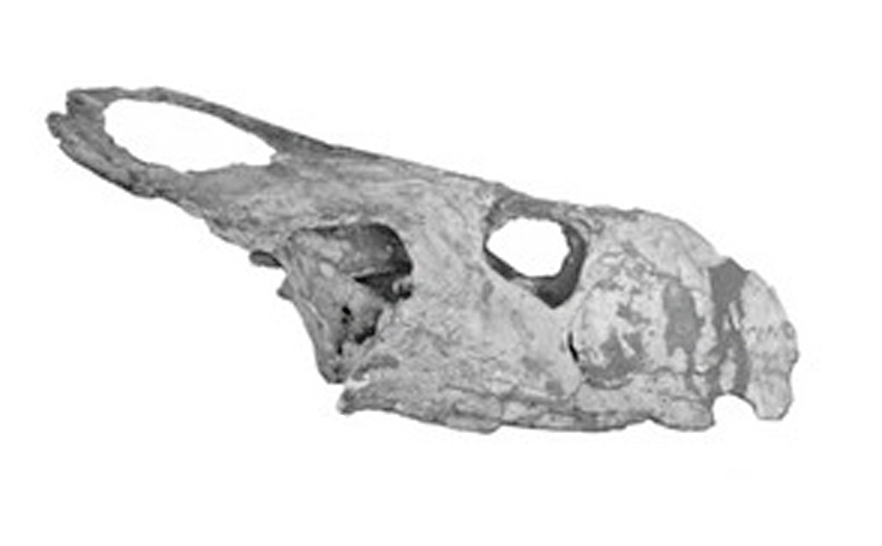
Protoceratops andrewsi is the signature animal, known from Bayanzag, Tugrugyin Shireh and Zamyn Khond. Bainoceratops efremovi, named in 2003 from a few back vertebrae found at Bayanzag, may be nothing more than Protoceratops. In addition, the abundant protoceratopsid of Ukhaa Tolgod plausibly represents a new, still unnamed form. Bagaceratops belongs mainly to the Baruungoyot and Bayan Mandahu formations, although one Bagaceratops-like specimen comes from Üüden Sair. That locality also yielded Udanoceratops, yet researchers disagree on which formation its beds belong to.
Armored dinosaurs are present too. A 2026 revision by Paul Penkalski kept the Bayn Dzak specimens in Pinacosaurus grangeri. The hadrosauroid Plesiohadros, finally, comes from Alag Teeg. Geologists once assigned those beds to the Djadokhta Formation but now place them in the underlying Alagteeg Formation.
Raptors and Troodontids
Velociraptor mongoliensis occurs at both Bayanzag and Tugrugyin Shireh. Two more dromaeosaurids joined it in the 2000s. Tsaagan mangas, named in 2006, rests on a skull and neck from Ukhaa Tolgod. Mahakala omnogovae, named in 2007, comes from Tugrugyin Shireh.
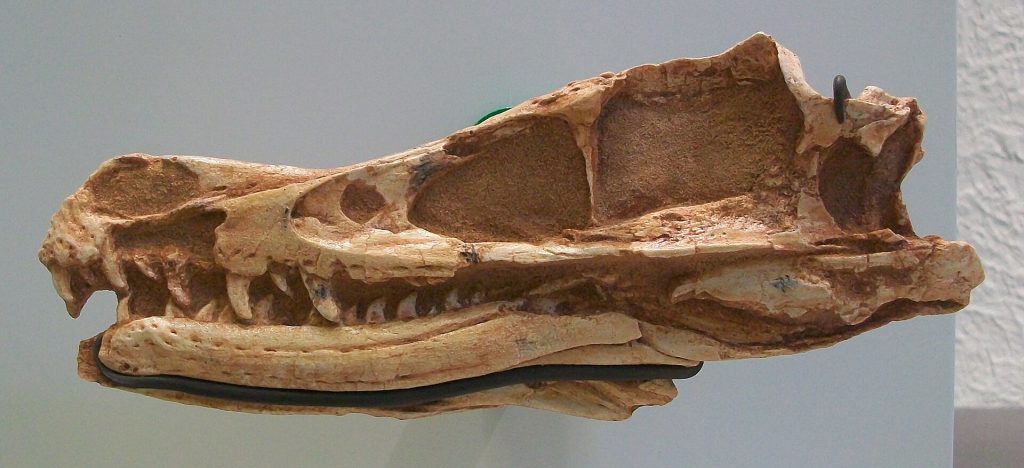

Two further relatives reached science through the fossil trade. According to its describers, poachers took Halszkaraptor escuilliei from Ukhaa Tolgod. It then passed through private collections before its naming in 2017. Shri rapax, named in 2025, has unusually robust hands and likely came from the Djadokhta Formation. Its exact locality is unknown, however, and its documentation points only tentatively to Ukhaa Tolgod.
Among the troodontids, Saurornithoides mongoliensis is still known only from its 1923 holotype. Byronosaurus jaffei (2000) and Almas ukhaa (2017) both come from Ukhaa Tolgod, while Gobivenator mongoliensis comes from Zamyn Khond. A larger relative, Zanabazar, belongs to the younger Nemegt Formation instead.
Oviraptorids, Alvarezsaurs and a Rare Ornithomimid
Oviraptor philoceratops itself remains a Bayanzag animal. At Ukhaa Tolgod, in contrast, the oviraptorids are Citipati osmolskae and Khaan mckennai, both named in 2001. The small, bird-like Shuvuuia deserti, named in 1998, also occurs there. It shares the site with a much larger animal described as an alvarezsaurid, Kol ghuva—known from a single foot.
Ornithomimosaurs are extremely rare in these beds. Aepyornithomimus tugrikinensis, named in 2017 from a foot and ankle, is the first ornithomimid identified from Tugrugyin Shireh.
Smaller Neighbors
Dinosaurs shared the dunes with many small animals. They include multituberculate mammals such as Kryptobaatar, the eutherian mammal Zalambdalestes, and lizards such as Estesia. Crocodile relatives such as Gobiosuchus and Shamosuchus lived here too, as did early birds.
Poachers and Homecomings
Mongolia treats its fossils as public property. Under the 2014 Law on the Protection of Cultural Heritage, finds from the land and its subsoil belong to the state. The law also prohibits the sale of paleontological finds. United States prosecutors trace that principle back to 1924.
Nevertheless, Gobi fossils have long reached the black market. The best-known case, a Tarbosaurus skeleton, went home in 2013. A year later, the United States returned more than 18 skeletons, including a Protoceratops and several animals listed as “oviraptors.” Another handover followed in 2016, with pieces of a baby Protoceratops among the items. Later, in December 2025, France formally handed over fossils its customs officers had seized years earlier. The 29 sets, mostly from other Gobi formations, are now back in Ulaanbaatar.
Djadokhta specimens keep surfacing in this way. A new owner acquired Halszkaraptor in 2015 so that scientists could study it and prepare its return to Mongolia. The Shri rapax skeleton is officially going back as well. Its skull went missing along the way, however, so the description relied on 3-D scans. As Mongolian paleontologist Bolortsetseg Minjin has put it, once a fossil leaves the country, knowledge leaves with it.
Visiting Bayanzag Today
The Flaming Cliffs belong to Bayanzag Park in Ömnögovi, which protects fossils, archaeology and the zag trees of the surrounding desert. A 2017 report in EARTH Magazine, however, described enforcement as underfunded. Since December 2014, Bayanzag and Tugrugyin Shireh have also stood on Mongolia’s UNESCO Tentative List. They are 2 of 13 localities in a proposed World Heritage property, the Cretaceous Dinosaur Fossil Sites in the Mongolian Gobi.
One rule matters above all. Because fossils are state property, visitors should leave every bone and eggshell where it lies. Photographs travel better anyway.
Museums fill in the rest. In Ulaanbaatar, the Central Museum of Mongolian Dinosaurs opened as a home for repatriated fossils. In New York, meanwhile, the American Museum keeps Andrews’s original finds. Its exhibition Fossils of the Flaming Cliffs, which opened in April 2026, adds casts and 3-D prints from the modern expeditions.
Flaming Cliffs Gallery
More views of Bayanzag, the expeditions and the animals of the Djadokhta beds.










Frequently Asked Questions
They lie at Bayanzag in Bulgan district, Ömnögovi Province, in the Gobi Desert of southern Mongolia. The cliffs expose red sandstone of the Late Cretaceous Djadokhta Formation.
Protoceratops, Velociraptor, Oviraptor, Saurornithoides and Pinacosaurus all come from Bayanzag itself. Other Djadokhta sites added Citipati, Khaan, Shuvuuia, Byronosaurus, Tsaagan, Mahakala and others.
George Olsen of the American Museum’s Central Asiatic Expeditions found a nest at the Flaming Cliffs in July 1923. Roy Chapman Andrews led the expedition.
No. An embryo found at Ukhaa Tolgod in 1993 showed that the common Flaming Cliffs eggs belonged to oviraptorids. True Protoceratops eggs, described in 2020, were soft-shelled.
They are a Velociraptor and a Protoceratops preserved locked together. A Polish–Mongolian expedition found them at Tugrugyin Shireh on August 3, 1971.
The beds are generally assigned to the Campanian stage of the Late Cretaceous. Magnetic evidence suggests, but does not firmly establish, an age between about 75 and 71 million years.
Sources
The information in this article is based on various sources, drawing on scientific research, fossil evidence, and expert analysis. The aim is to provide a comprehensive and accurate overview of the Flaming Cliffs and the Djadokhta beds. However, please be aware that our understanding of dinosaurs and their world is constantly evolving as new discoveries are made.
- https://digitallibrary.amnh.org/handle/2246/5667
- https://digitallibrary.amnh.org/handle/2246/5916
- https://digitallibrary.amnh.org/handle/2246/4670
- https://digitallibrary.amnh.org/handle/2246/3223
- https://digitallibrary.amnh.org/handle/2246/2076
- https://digitallibrary.amnh.org/handle/2246/3102
- https://digitallibrary.amnh.org/handle/2246/2853
- https://digitallibrary.amnh.org/handle/2246/6858
- https://digitallibrary.amnh.org/handle/2246/2828
- https://digitallibrary.amnh.org/handle/2246/6818
- https://digitallibrary.amnh.org/handle/2246/5823
- https://digitallibrary.amnh.org/handle/2246/6130
- https://digitallibrary.amnh.org/handle/2246/5967
- https://digitallibrary.amnh.org/handle/2246/5973
- https://doi.org/10.1126/science.266.5186.779
- https://doi.org/10.1038/378774a0
- https://doi.org/10.1038/s41586-020-2412-8
- https://doi.org/10.1666/11-008.1
- https://doi.org/10.2307/3515294
- https://doi.org/10.1139/e93-190
- https://doi.org/10.1139/cjes-2020-0148
- https://doi.org/10.4202/app.00701.2019
- https://doi.org/10.3301/IJG.2025.22
- https://doi.org/10.1038/s41598-017-05272-6
- https://doi.org/10.1038/nature24679
- https://www.esrf.fr/home/news/general/content-news/general/synchrotron-sheds-light-on-the-amphibious-lifestyle-of-a-new-raptorial-dinosaur.html
- https://doi.org/10.1080/08912963.2025.2530148
- https://www.naturalsciences.be/en/science/news/newly-described-shri-rapax-hunted-with-stronger-hands-than-cousin-velociraptor
- https://www.sci.news/paleontology/shri-rapax-14130.html
- https://doi.org/10.1080/08912963.2026.2633178
- https://www.amnh.org/explore/ology/ology-cards/038-fighting-dinosaurs
- https://www.amnh.org/explore/ology/paleontology/fighting-dinos2
- https://www.amnh.org/about/press-center/exhibition-announcement-fossils-flaming-cliffs
- https://www.amnh.org/exhibitions/fossils-flaming-cliffs-gobi
- https://www.iloveny.com/thebeat/post/the-american-museum-of-natural-history-announces-fossils-of-the-flaming-cliffs/
- https://blogs.egu.eu/geolog/2023/07/21/100-years-since-we-learned-dinosaurs-laid-eggs-what-do-we-know-now/
- https://paleo.pan.pl/research-department/excavations/gobi-desert-mongolia.html
- https://whc.unesco.org/en/tentativelists/5944/
- https://legalinfo.mn/en/edtl/16760257047231
- https://www.justice.gov/usao-sdny/pr/manhattan-us-attorney-announces-return-mongolia-fossils-over-18-dinosaur-skeletons
- https://www.justice.gov/usao-edny/pr/us-attorney-announces-return-mongolia-looted-dinosaur-fossils
- https://www.popsci.com/science/stolen-fossils-returned-mongolia/
- https://www.earthmagazine.org/article/saving-mongolias-dinosaurs-and-inspiring-next-generation-paleontologists
- https://mongoliandinosaurs.org/project/a-dinosaur-museum-research-center-at-the-flaming-cliffs/
This article was last fact checked: TheDinosaurs Team, 26-11-2026
Featured Image Credit: Bernard Gagnon, CC0, via Wikimedia Commons
