South of Boulemane, in Morocco’s Middle Atlas Mountains, the floodplain mudstones of the El Mers Group hold North Africa’s first known stegosaur. Named Adratiklit boulahfa in 2020, this plated dinosaur lived during the Bathonian stage of the Middle Jurassic—roughly 168 to 165 million years ago. Its describers called it the oldest definitive stegosaur from anywhere in the world. Later work by its own lead author calls it, more cautiously, one of the oldest stegosaurs. Even that title makes it a key witness to the group’s early history.
Unusually, the original description names no collector and gives no date of discovery. Instead, Martin Munt alerted the research team, and the Natural History Museum in London acquired the bones from Moussa Direct of Cambridge. In 2020, paleontologist Susannah Maidment and three colleagues described the material in Gondwana Research. Only a handful of vertebrae and one arm bone survive, yet they tie this African stegosaur to a European lineage.
Adratiklit Key Facts
| Keyword | Fact |
|---|---|
| Pronunciation | Not specified |
| Meaning of name | Mountain Lizard |
| Group | Stegosauria |
| Type Species | Adratiklit boulahfa |
| Diet | Herbivore |
| When it Lived | 168 to 165 MYA |
| Period | Jurassic |
| Epoch | Middle Jurassic (Bathonian stage) |
| Length | Not specified |
| Height | Not specified |
| Weight | Not specified |
| Mobility | Quadrupedal (inferred from relatives) |
| First Discovery | Year not specified, acquired by the Natural History Museum, London, from Moussa Direct, Cambridge |
| Described by | 2020 by S.C.R. Maidment, T.J. Raven, D. Ouarhache, and P.M. Barrett (published online 2019) |
| Holotype | NHMUK PV R37366 |
| Location of first find | Boulahfa, south of Boulemane, El Mers Group, Fès-Meknès, Morocco |
Adratiklit Origins, Taxonomy and Timeline
The name Adratiklit draws on Berber. Its describers give “Adras” as Berber for “mountain,” while “tiklit” is a Berber word for lizard. The museum’s press release rendered the whole as “mountain lizard.” Meanwhile, the species name boulahfa refers to Boulahfa, the find locality. Together, the name ties the animal firmly to the Middle Atlas Mountains of Morocco.
Adratiklit belongs to Ornithischia, the “bird-hipped” dinosaurs, and within it to Stegosauria. In the original analysis, it emerged as the sister taxon—the closest relative—of a pair of European stegosaurs, Dacentrurus and Miragaia. That result placed it nearer to Europe’s plated dinosaurs than to Tanzania’s Kentrosaurus and South Africa’s Paranthodon. More recent studies place it in Dacentrurinae, a stegosaurid subgroup within the clade Neostegosauria. However, a 2025 analysis by Sánchez-Fenollosa and Cobos puts Kentrosaurus in that same subgroup. Adratiklit boulahfa is the type and only known species.
The original paper assigns the beds to the Bathonian stage, roughly 168 to 165 million years ago. However, other studies date the El Mers Group as a whole to the “Bathonian–?Callovian,” the query marking the Callovian as uncertain. That leaves some room for a slightly younger age. Its “oldest” label also faces rivals, starting with the same 2020 paper, which calls Isaberrysaura from Patagonia “also the earliest stegosaur.” At the time, though, it treated that animal as only a probable stegosaur. Isaberrysaura had first been described as a different kind of ornithischian, though later studies support it as a stegosaur. Meanwhile, Dai and colleagues, Maidment among them, describe Bashanosaurus from China as one of the group’s earliest records. Both rivals come from the older Bajocian stage.
Discovery & Fossil Evidence
Since the bones reached science through an acquisition rather than an excavation, the original paper records no collector or date of discovery. Instead, Moha and Said Ouhuiss told the team where the specimens came from. The authors believe the site matches a dinosaur locality southwest of Boulemane reported in 1992. There, the fossil horizon appears to be a charcoal-rich green siltstone, halfway up a badland section some 360 feet (110 meters) thick. It lies just below a dark red paleosol—an ancient soil.
Even the formation remains less settled than it sounds. In 2020, Maidment and colleagues wrote that the bones came “probably” from the El Mers II Formation. Yet a figure caption in the same paper labels the section as El Mers I. Later work by Zafaty and colleagues in 2024 and Maidment’s own team in 2025 places Adratiklit in the El Mers III Formation instead. Even so, one 2025 study still wrote “?El Mers II.”
The holotype, NHMUK PV R37366, is a single dorsal (back) vertebra housed at the Natural History Museum, London. Referred material adds three cervical (neck) vertebrae—one isolated and two still articulated. A second dorsal and a left humerus, or upper arm bone, complete the set. Only that second dorsal shares a diagnostic feature with the holotype, while the others rely on stegosaurian features and a shared locality.
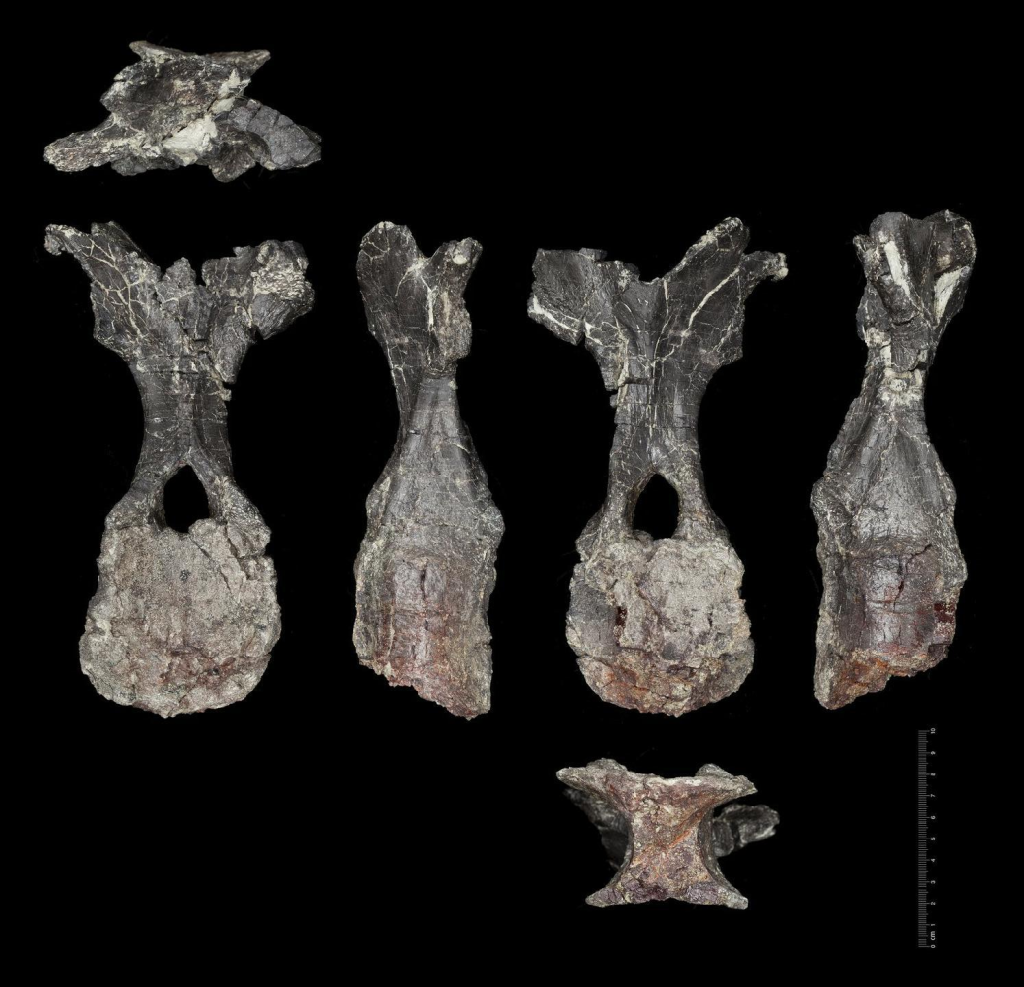

The bones differ in color, from dark gray to pale pink-gray, which suggests they came from different horizons or depths. On that basis, the describers concluded that they likely represent more than one individual. They also cautioned that nobody knows whether the specimens lay together. It is a stegosaur whose paperwork begins in a museum acquisitions file rather than a field notebook.
Adratiklit Size and Description
With no skull, no armor, and only one limb bone, any portrait of Adratiklit leans on its vertebrae and its relatives.
Short description of Adratiklit
Its neck vertebrae had centra, or vertebral bodies, that were longer than wide. Each also bore a keel along the underside, as in Stegosaurus and Dacentrurus. The neural spine was long and blade-like, and rough ridges called epipophyses capped the joints of the rear cervicals. In other ornithischians, such ridges occur only near the front of the neck, if at all. The describers therefore called their presence on rear neck vertebrae unique, but they left these neck features out of the formal diagnosis.
Farther back, the dorsal centra were slightly wider than long, as in Hesperosaurus and Dacentrurus. They were also flat at each end and more strongly spool-shaped than in other stegosaurs. The dorsals also had an elongate neural arch pedicel, the stalk joining the arch to the vertebral body. Meanwhile, the humerus was dumbbell-shaped, with a small, semicircular head and a scar for the latissimus dorsi, a large back muscle. It also bore a triceps tubercle and descending ridge—a combination the describers treat as a hallmark of Stegosauria.
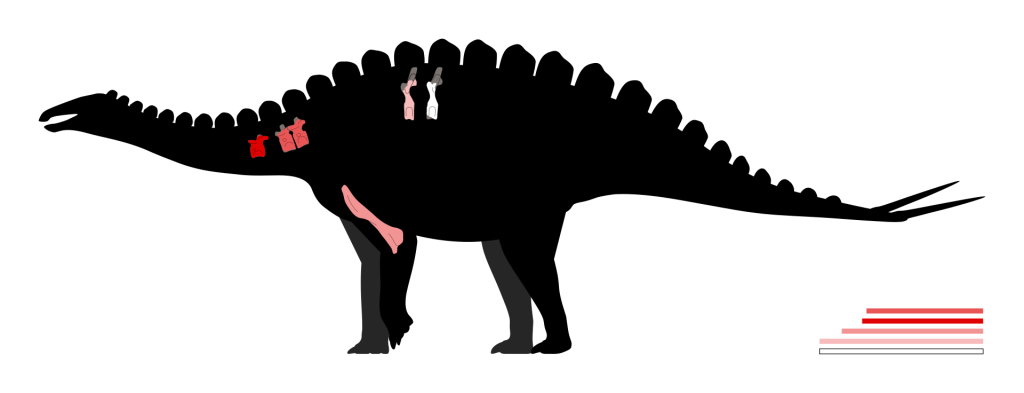

Like its relatives, it probably walked on all four legs. In thyreophorans—the armored dinosaurs—forelimb changes coincide with the evolution of that posture. Stegosaurs as a group carried two rows of plates and spines from the neck to the tail tip. However, no armor survives for Adratiklit, so any plates or spikes in reconstructions are speculative.
Size and Weight of Type Species
Its original description gives no body length, height, or weight, only bone measurements. Its humerus is 24 inches (61 centimeters) long, while the holotype’s dorsal centrum is just 2.4 inches (6.1 centimeters) long. The longest neck centrum reaches about 4.7 inches (12 centimeters).
Comparisons offer only an indirect sense of scale. In 2024, Zafaty and colleagues found the back vertebrae of Thyreosaurus, a second Moroccan stegosaur, comparatively larger. That comparison concerns individual bones, however, and is not a body-size estimate.
Without a more complete skeleton, any body size must come from comparisons with better-known relatives such as Dacentrurus and Miragaia. The original paper offers no such estimate, so its size remains open.
The Dinosaur in Detail
Two small features on its back vertebrae set this dinosaur apart. The first is a small, triangular, rugose bump on top of the prezygapophysis—the forward-facing joint of a vertebra—just behind its joint surface. The second involves the anterior centroparapophyseal laminae, bony struts drawn into forward-projecting rugosities on either side of the spinal canal.
Not everyone finds those features convincing. Zafaty and colleagues noted that the laminae vary among stegosaurs. The triangular bump, they added, appears only on one left prezygapophysis of the holotype, and similar structures seem present in other stegosaurs. Despite those doubts, they kept Adratiklit as a distinct genus. The original authors had also admitted that the neck vertebrae could belong to an ankylosaur, the other great armored lineage. They kept the cervicals for three reasons—the dorsals and humerus bear clear stegosaurian traits, and the cervicals came from the same location. Besides, the El Mers Group had then yielded no ankylosaur—a point made before one turned up there.
Its family tree has shifted with each new analysis. The original 25-taxon analysis made it the sister taxon to Dacentrurus plus Miragaia. In 2023, however, Raven and colleagues’ preferred analysis paired it with Miragaia alone, though another of their analyses found the two distantly related. With only 8.8 percent of its characters scored, it ranked among their unstable taxa.
A year later, the picture narrowed toward one subgroup. Zafaty’s team recovered both Moroccan stegosaurs within Dacentrurinae, but not as each other’s closest relatives. Sánchez-Fenollosa and Cobos then grouped Adratiklit, Thyreosaurus, and Dacentrurus in 2025 on one shared trait—dorsal centra wider than long. A 2026 study by Francisco Costa called the two Moroccan taxa likely dacentrurines and urged care. Taken together, these studies sketch a fragmentary animal with European ties—its exact branch still open to debate.
Interesting Points about Adratiklit
- Its describers identified it as the first eurypodan, a member of the armored group uniting stegosaurs and ankylosaurs, found in North Africa.
- Its bones came to the Natural History Museum from Moussa Direct of Cambridge, and the original paper names no collector or date of discovery.
- The same 2020 paper re-identified an earlier possible stegosaur tooth from Morocco’s High Atlas as an indeterminate archosaur.
- Across Gondwana, eurypodan finds track the number of dinosaur-bearing formations, a record its describers called biased by geological and human factors.
Contemporary Dinosaurs
According to Zafaty and colleagues, who named it in 2024, Thyreosaurus atlasicus comes from “the same stratigraphic levels” as Adratiklit. This second Moroccan stegosaur left a partial skeleton at Boulahfa North, north of the Boulahfa quarry. Its armor stands out—osteoderms, or bony skin plates, up to 1.6 inches (4 centimeters) thick that its describers think lay flat rather than standing upright. However, the Adratiklit bones arrived with no record of their exact level, so this tie rests on that 2024 statement alone. No source records any interaction, so the two are best pictured simply as plated dinosaurs that may have shared the landscape.
Also known from the El Mers III Formation (exact level relative to Adratiklit not known): Spicomellus, described as the world’s oldest and first African ankylosaur. The formation dates to the Bathonian and possibly the Callovian. That allows a window of up to about 3 million years, or about 7 million with the younger stage. As a result, these animals may not all have lived at the same time.
Adratiklit in its Natural Habitat
The world Adratiklit roamed was one of Middle Jurassic floodplains, laid down in what had been a Triassic rift basin. Across the El Mers Group, shallow-marine and continental deposits mix. Its own formation consists of green and red mudstones alongside gray marls rich in fossil wood and pyrite. Those marls point to a continental setting with reducing conditions—low in free oxygen. Sauropod footprints mark the base of the series, while the locality’s charcoal and rooted paleosol suggest a vegetated landscape.
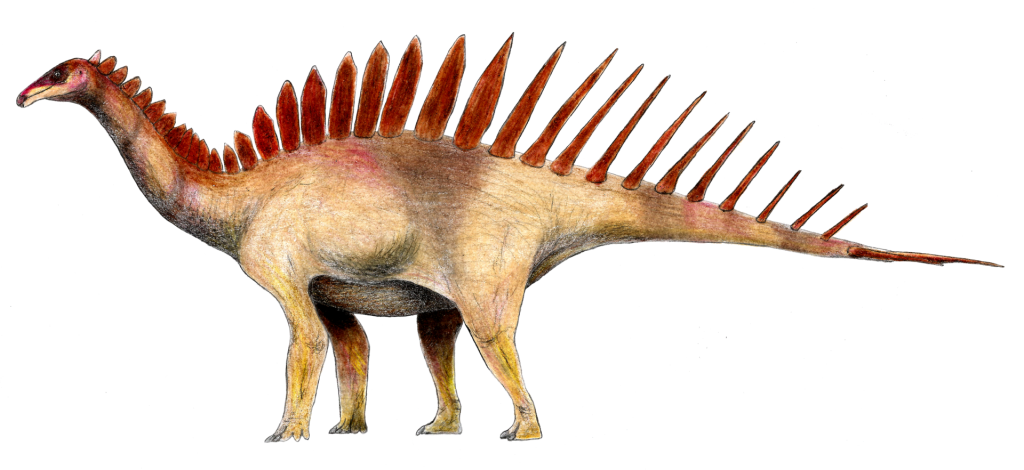

While there is no direct evidence of what Adratiklit ate, it was most likely a herbivore like other thyreophorans. Scientists usually interpret these armored dinosaurs as soft-plant feeders, and most had relatively simple, up-and-down jaw mechanisms. In 2023, Raven and colleagues, citing Mallon and Anderson, noted that their skulls were poorly adapted for high-fiber plants.
No fossils reveal its social life, and more than one individual among the bones says nothing about herding. Other El Mers III finds fill out the scene. A thigh bone billed as the world’s oldest cerapodan—the lineage leading to horned and duck-billed dinosaurs—remains unnamed. Teeth of turiasaurian sauropods, described as the oldest from mainland Africa, add a long-necked plant eater. According to Woodruff and colleagues, this fauna resembles Late Jurassic communities such as Tanzania’s Tendaguru and Portugal’s Lourinhã. Middle Jurassic land faunas are poorly known, so they call El Mers III critical to understanding how those communities arose. Lower in the sequence, the middle Bathonian El Mers I Formation yielded “Cetiosaurus mogrebiensis,” now a nomen dubium, or doubtful name.
Frequently Asked Questions
It combines “Adras,” given as Berber for “mountain,” with “tiklit,” a Berber word for lizard, and the species name refers to Boulahfa.
It lived in the Bathonian stage of the Middle Jurassic, roughly 168 to 165 million years ago.
No body length or weight has been published. Its upper arm bone measures about 24 inches (61 centimeters) long.
It was most likely a herbivore, an inference drawn from its relatives because no skull or teeth are known.
Its fossils come from the El Mers Group at Boulahfa, south of Boulemane in Morocco’s Middle Atlas Mountains.
It is one of the oldest known stegosaurs, diagnosed by two small features on its back vertebrae.
Sources
The information in this article is based on various sources, drawing on scientific research, fossil evidence, and expert analysis. The aim is to provide a comprehensive and accurate overview of Adratiklit. However, please be aware that our understanding of dinosaurs and their world is constantly evolving as new discoveries are made.
- https://doi.org/10.1016/j.gr.2019.07.007
- https://nhm.openrepository.com/items/1f3ffd30-67b8-4448-ad00-28dfeb853592
- https://doi.org/10.1016/j.gr.2024.03.009
- https://hal.science/hal-04781064
- https://doi.org/10.1098/rsos.241624
- https://doi.org/10.4202/app.01214.2024
- https://doi.org/10.1080/14772019.2023.2205433
- https://doi.org/10.3897/vz.75.e146618
- https://www.mdpi.com/1424-2818/18/3/143
- https://doi.org/10.1080/02724634.2021.1995737
- https://doi.org/10.1038/s41559-021-01553-6
- https://www.nhm.ac.uk/press-office/press-releases/new-species-of-stegosaur-is-oldest-found-anywhere-in-the-world.html
- https://data.nhm.ac.uk/dataset/collection-specimens/resource/05ff2255-c38a-40c9-b657-4ccb55ab2feb/record/8784877
- https://stratigraphy.org/ICSchart/ChronostratChart2024-12.pdf
This article was last fact checked: TheDinosaurs Team, 17-11-2026
Featured Image Credit: Connor Ashbridge, CC BY-SA 4.0, via Wikimedia Commons
