In the Gobi Desert of southern Mongolia, the sandstones of the Udan-Sayr locality have produced one of Asia’s more puzzling horned dinosaurs. Many researchers assign these beds to the Djadokhta Formation, while others favor the Baruungoyot Formation or an age between the two. Named Udanoceratops tschizhovi in 1992, this herbivore probably lived during the Campanian stage of the Late Cretaceous—perhaps 75 to 71 million years ago. Its describer called it a “gigantic protoceratopsid,” but later studies moved it into Leptoceratopsidae, a family with only a handful of Asian members.
Soviet-Mongolian Paleontological Expeditions discovered the Udan-Sayr locality in the 1980s. Sergei M. Kurzanov then described the genus on his own, based on a partial skull and skeleton. Since then, other researchers have revisited his specimen and a disputed referred one. They have argued over its age, its posture and even whether it spent time in water. Because Asia has yielded so few leptoceratopsids, every bone of Udanoceratops may help show how the family spread.
Udanoceratops Key Facts
| Keyword | Fact |
|---|---|
| Pronunciation | oo-dahn-oh-serra-tops |
| Meaning of name | Udan Sayr Horned Face |
| Group | Ceratopsia |
| Type Species | Udanoceratops tschizhovi |
| Diet | Herbivore |
| When it Lived | Perhaps 75 to 71 MYA (age debated) |
| Period | Cretaceous |
| Epoch | Late Cretaceous (Campanian stage) |
| Length | Not specified |
| Height | Not specified |
| Weight | Not specified |
| Mobility | Moved mainly on all four legs (quadrupedal), per Słowiak and colleagues in 2019, with bipedal walking also proposed |
| First Discovery | Locality found in the 1980s by the Soviet-Mongolian Paleontological Expeditions (finder and year of the holotype not published) |
| Described by | 1992 by S.M. Kurzanov |
| Holotype | PIN 3907/11 |
| Location of first find | Bed 2, Udan-Sayr (Üüden Sair) locality, Ömnögovi Province, Gobi Desert, Mongolia (formation disputed) |
Udanoceratops Origins, Taxonomy and Timeline
The name Udanoceratops points straight to its home locality. “Udan” refers to the Udan-Sayr locality—also spelled Üüden Sair or Udyn Sayr—while “-ceratops” completes the meaning “Udan Sayr horned face.” Together, the name ties the animal to one small corner of the Gobi.
Kurzanov placed his new dinosaur among the protoceratopsids, the family of Protoceratops, as his 1992 title makes plain. Later work moved it into Leptoceratopsidae, a family of neoceratopsians (advanced horned dinosaurs). Makovicky and Norell’s 2006 analysis found it in an unresolved trio with Leptoceratops and Prenoceratops, with Montanoceratops as the next closest relative. In 2010, Xu and colleagues placed Zhuchengceratops in an unresolved clade with Udanoceratops and Leptoceratops. In 2014, Farke and colleagues noted that both Asian genera sit “nested deeply” within the family, though branch support was low. Udanoceratops tschizhovi is the type and only known species.
Its age depends on which formation the Udan-Sayr beds belong to. Farke’s team called it “probably Campanian in age, perhaps 71–75 Ma,” a figure resting on the Djadokhta assignment. Magnetic dating of the Djadokhta itself suggests, but does not clearly establish, deposition between about 75 and 71 million years ago. In 2020, however, Czepiński argued that these beds are plausibly intermediate in age between the Djadokhta and Baruungoyot formations. His evidence came from a newer collecting area, which may not be the site that yielded Udanoceratops. Earlier, Watabe and colleagues had suggested that the Soviet-Mongolian finds came from nearby Yagaan Khovil, which exposes the Nemegt Formation. If so, Udanoceratops would be the only ceratopsian known from the Nemegt.
Discovery & Fossil Evidence
The Udan-Sayr locality lies in Ömnögovi Province, in the southern Gobi Desert. It sits about 65 kilometers (40 miles) west of Bayan Zag, the area that includes the Flaming Cliffs. Who found the holotype, and when, has not been published in any openly available source. According to Kurzanov, the specimen came from “Bed 2” of the section. It lay in a lens—a pocket of rock that thins out at its edges. Layers just below and above it yielded the theropod Avimimus.
The holotype, PIN 3907/11, now rests at the Paleontological Institute of the Russian Academy of Sciences in Moscow. It consists of a partial skull and a partial postcranial skeleton—the bones behind the head. Later authors have compared its jugal (cheekbone), maxilla (upper jaw bone), tail and forearm with those of its relatives. Its claws, by contrast, are known mainly from a disputed referred specimen.
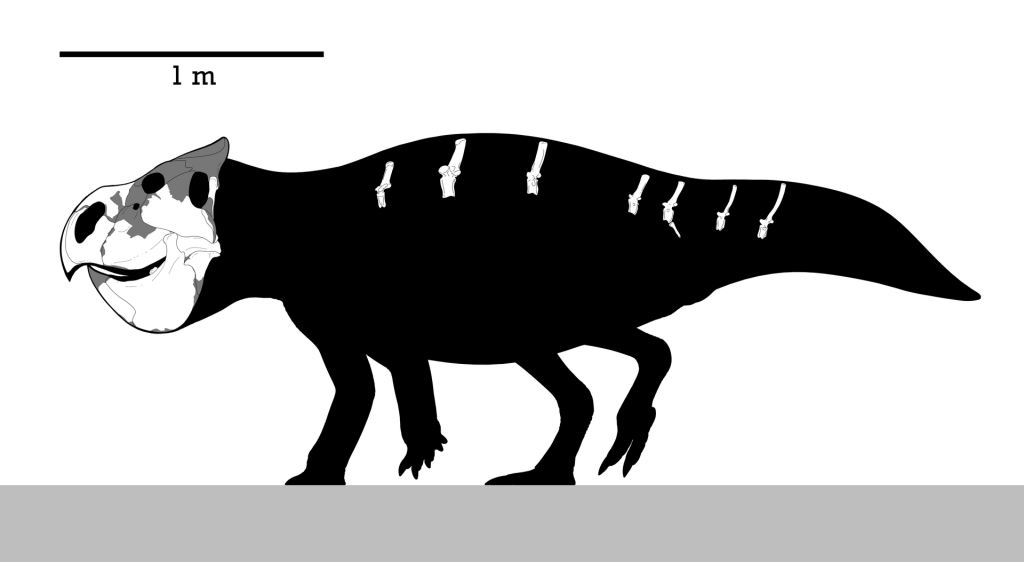

That specimen, PIN 4046/11, comes from Baga Tariach in Dornogovi Province, and Tereschenko assigned it to “Udanoceratops sp.” in 2008. Czepiński calls it “a ceratopsian tarsal” (ankle bone), while Słowiak and colleagues figure the same number as foot and toe bones of U. tschizhovi. In 2019, Arbour and Evans noted that no reason had been given for referring it to Udanoceratops rather than Protoceratops. In 2022, Son and colleagues, citing Tereschenko, listed it as an indeterminate leptoceratopsid—”formerly ‘Udanoceratops.'” Thus the holotype remains the only secure anchor for the genus.
Udanoceratops Size and Description
Short description of Udanoceratops
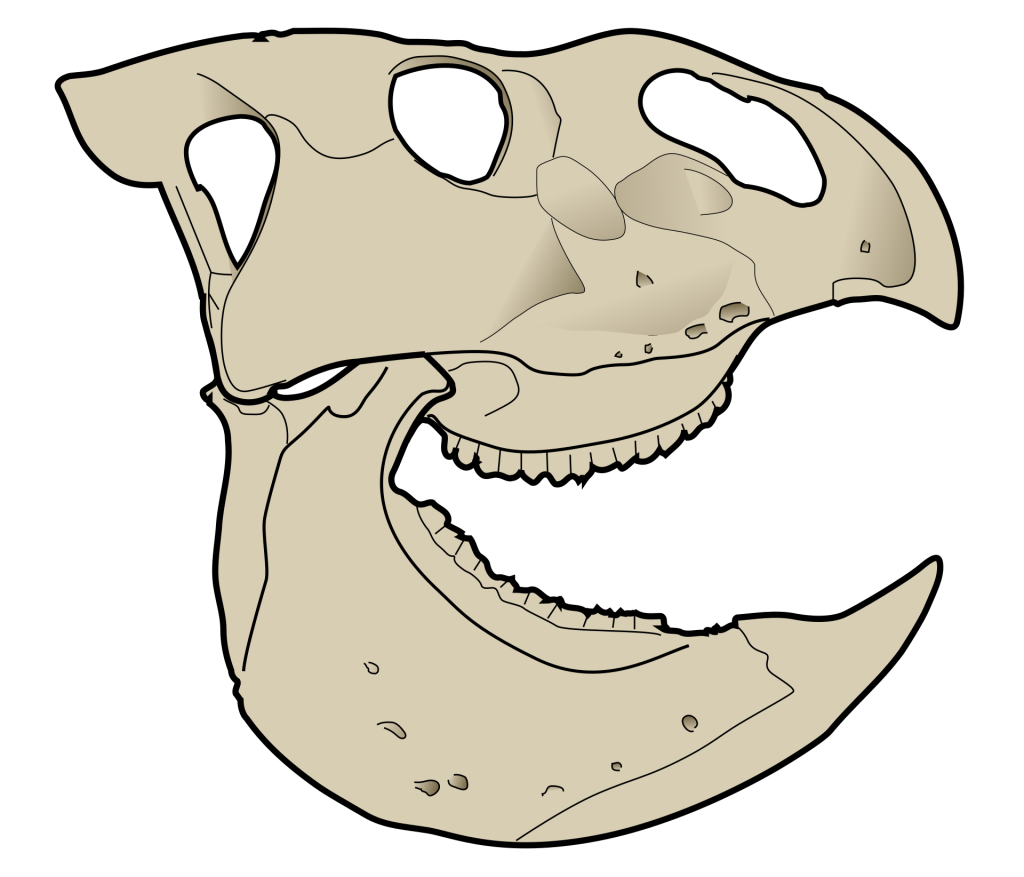
By one popular account, this dinosaur had hardly any head frill. Its jugal was more evenly deep below the eye and behind it than in some relatives. The front tip of the jugal was also expanded and formed part of the rim of the antorbital fossa—a hollow in front of the eye. A robust, triangular process on the maxilla slotted into the cheekbone, much as in Yamaceratops. Like other leptoceratopsids, it also bore a prominent epijugal ridge (a raised crest on the cheekbone). Farther back, the lower jaw showed at most a faint ridge on the surangular, a bone near the jaw joint.
Its tail had chevrons (small bones beneath the tail vertebrae) slightly shorter than the matching neural spines on top. Meanwhile, the forearm’s ulna had a pronounced bend near the wrist. Claws from the disputed Baga Tariach specimen are flat and pointed. Any discussion of its skin or other covering remains speculative.

Size and Weight of Type Species
Kurzanov’s 1992 title called the animal “gigantic.” In 2020, Czepiński noted that very large specimens of Protoceratops hellenikorhinus are similar in size to the Udanoceratops holotype. That likeness, he argued, may explain why Jerzykiewicz and colleagues reported the genus from Bayan Mandahu, in Inner Mongolia, China, in 1993. In his view, “no single described specimen” there belongs to it.
The scientific description of its size is not openly available. Even so, secondhand sources credit Tereschenko in 2008 with a length of about 3–4 meters (10–13 feet). They credit Paul in 2016 with about 700 kilograms (1,500 pounds).
Until those figures are confirmed, a modern comparison would be guesswork. Its best yardstick is therefore the holotype itself—a match in size for the biggest individuals of a famous Gobi relative.
The Dinosaur in Detail
What sets this dinosaur apart are traits that may echo protoceratopsids rather than its own family. Unguals (claw and hoof bones) from the Baga Tariach specimen are flat and pointed, like those of Protoceratops and Bagaceratops. Other leptoceratopsids, by contrast, have claw-like unguals. That would make Udanoceratops the exception—if the specimen belongs to it. Likewise, its tail spines stood taller than those of Leptoceratops but lower than those of Protoceratops, according to Tereschenko and Singer in 2013.
How it moved is one of the livelier debates. Chinnery proposed in 2004 that Udanoceratops was better adapted for walking on two legs. In 2007, Chinnery and Horner noted a bent lower ulna in Cerasinops and Udanoceratops and linked it to bipedality. In contrast, Słowiak and colleagues argued in 2019 that the bend let the palms face down. That trait, in their words, “supports their mainly quadrupedal gait.”
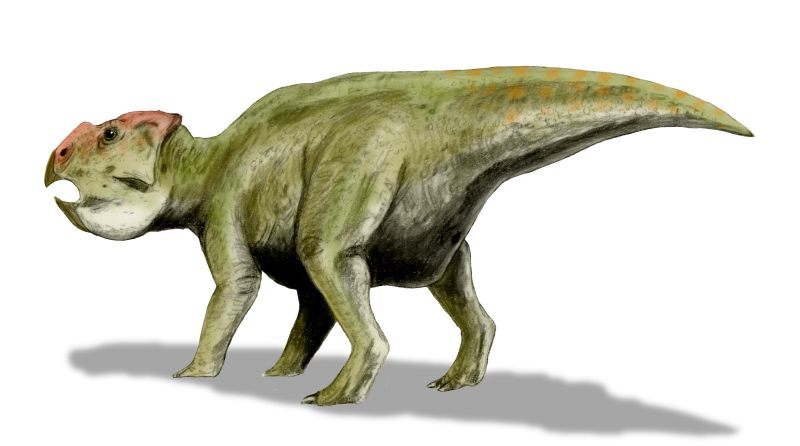

Tereschenko had earlier treated Udanoceratops and its kin as four-legged walkers that relied mainly on the hind limbs. In his 2008 view, they probably used slow or rapid trot-like gaits, and galloping was most likely impossible. He also suggested that Udanoceratops and Leptoceratops used rapid and slow modes about equally, although Leptoceratops could run for longer.
Its placement holds questions too. In 2015, He and colleagues recovered Leptoceratops as its sister, although they coded it from the literature rather than from the bones. In 2019, Arbour and Evans again left it in an unresolved clade. Farke’s team, meanwhile, saw its deep position as raising the possibility of one or two dispersals from North America into Asia. Taken together, these studies paint a picture of an Asian leptoceratopsid that may carry protoceratopsid-like traits—a reminder of how much depends on one specimen.
Interesting Points about Udanoceratops
- Kurzanov first described Udanoceratops as a “gigantic protoceratopsid,” and only later analyses moved it into Leptoceratopsidae.
- Claws referred to it, from a disputed specimen, are flat and pointed, unlike the claw-like unguals of other leptoceratopsids.
- At least eight specimens of the theropod Avimimus portentosus, including its holotype, came from the layers just below and above the Udanoceratops lens.
- Researchers still disagree whether its home rocks belong to the Djadokhta Formation, the Baruungoyot Formation, or a level between the two.
- Tereschenko proposed in 2008 that it was partly aquatic, yet he later co-authored the idea that the wide claws referred to it suited loose soil.
Contemporary Dinosaurs
Sharing the Udan-Sayr section was Avimimus, an oviraptorosaurian theropod—a member of the group that includes Oviraptor. In 1988, Ivakhnenko and Kurzanov reported at least eight specimens of Avimimus portentosus, including its holotype. All came from the layers just below and above the Udanoceratops lens. These layers bracket the lens rather than lie inside it. Avimimus was once considered typical of Nemegt-age deposits, but Nemegt material now goes under a separate species, A. nemegtensis. In 2019, Funston and colleagues labeled Udan-Sayr “?Djadokhta Fm” on a map, and Czepiński noted that this fits that split. No interaction between the two is known, although they may have shared the same landscape.
Also known from the Udan-Sayr area (exact level relative to Udanoceratops not known): Protoceratops and Pinacosaurus. Czepiński reports P. andrewsi as abundant there, alongside Pinacosaurus sp., but both come from a later expedition’s collecting area. He questions whether that area is the Soviet-Mongolian site and calls for work to confirm that these animals occur together. If the beds belong to the Djadokhta, they may date to about 75 to 71 million years ago. Researchers still debate their formation and age, however, so these animals may not all have lived at the same time.
Udanoceratops in its Natural Habitat
Udan-Sayr’s exposures are scattered across more than 60 square kilometers (23 square miles). According to Rougier and colleagues in 2016, the lower strata are fluvial (river-laid) sandstones and mudstones. Dinosaur footprints are their most common fossils. Above them lie red sandstones that are likely eolian (windblown). Which setting Udanoceratops lived in is not known. In its type area, the Djadokhta Formation records a Cretaceous dunefield, with debris flows on dune faces and shallow ponds between dunes. There, flowing water also laid down lime-rich beds of caliche. Moreover, the Djadokhta formed under more arid conditions than the Baruungoyot. So the age debate also shapes how dry this world may have been.
Udanoceratops was a herbivore—a plant-eater—although the plants it ate remain unknown. In 2008, Tereschenko interpreted it as “facultatively aquatic,” able to enter water at times. Tereschenko and Singer later linked taller tail spines to swimming ability. By contrast, Słowiak and colleagues suggested in 2019 that the flat, wide claws referred to it were “an adaptation to moving on loose soil without sinking.”
While there is no direct evidence of herding or other social behavior, the wider Udan-Sayr area has produced a varied fauna. Several expeditions have worked it, so these animals need not share one level or age. Soviet-Mongolian collecting yielded the crocodyliform Gobiosuchus parvus, while a later expedition’s area produced the lizard Gobiderma pulchra. In 1997, a Mongolian-American team collected the multituberculate mammal Mangasbaatar udanii in the easternmost exposures. Its beds resemble the Baruungoyot Formation in rock type and age. The metatherian mammal Asiatherium reshetovi also comes from Udan-Sayr.
Frequently Asked Questions
It means “Udan Sayr horned face,” after the Mongolian locality that yielded its fossils.
It probably lived in the Campanian stage of the Late Cretaceous, perhaps 75 to 71 million years ago, though its age is debated.
Its holotype rivals very large Protoceratops hellenikorhinus in size. Secondhand figures give about 3–4 meters and 700 kilograms, but the original size description is not openly available.
It was a herbivore, a plant-eating member of the horned dinosaur group Ceratopsia.
Its holotype comes from the Udan-Sayr locality in Ömnögovi Province, in the Gobi Desert of southern Mongolia.
It is a large Asian leptoceratopsid with hardly any frill. Claws referred to it, from a disputed specimen, are flat like those of Protoceratops.
Sources
The information in this article is based on various sources, drawing on scientific research, fossil evidence, and expert analysis. The aim is to provide a comprehensive and accurate overview of Udanoceratops. However, please be aware that our understanding of dinosaurs and their world is constantly evolving as new discoveries are made.
- Kurzanov, S.M. 1992. A gigantic protoceratopsid from the Upper Cretaceous of Mongolia. Paleontological Journal 26(3): 103–116.
- https://doi.org/10.4202/app.00701.2019
- https://www.app.pan.pl/archive/published/app65/app007012019.pdf
- https://digitallibrary.amnh.org/handle/2246/5808
- https://doi.org/10.1371/journal.pone.0144148
- https://doi.org/10.1371/journal.pone.0112055
- https://peerj.com/articles/7324/
- https://doi.org/10.1134/S003103010803009X
- https://doi.org/10.1134/S0031030113060105
- https://digitallibrary.amnh.org/items/0bc869cd-8fa4-4dfd-b1aa-9a7cf0f2cbae
- https://doi.org/10.1038/s41598-019-55038-5
- https://paleobiodb.org/classic/basicCollectionSearch?collection_no=65344
- https://www.nhm.ac.uk/discover/dino-directory/udanoceratops.html
- https://doi.org/10.1371/journal.pone.0013835
- https://peerj.com/articles/7926/
- https://peerj.com/articles/13176/
- https://www.palaeontologia.pan.pl/pp67.htm
This article was last fact checked: TheDinosaurs Team, 17-11-2026
Featured Image Credit: PaleoNeolitic, CC BY 4.0, via Wikimedia Commons
