In the Sichuan Basin of southwestern China, the purplish-red sandstones and mudstones of the Lower Shaximiao Formation hold one of the most puzzling theropods of the Jurassic. Named Xuanhanosaurus qilixiaensis in 1984, it comes from Xuanhan County in Sichuan Province. Its age is disputed. Older studies say Middle Jurassic, but a 2019 analysis used Late Jurassic dates and a 2024 study calls it Oxfordian. What it lacks in bones, it makes up for in quality. In Rauhut’s 2003 assessment, its forelimb ranks among the best preserved of any Middle Jurassic theropod.
Paleontologist Dong Zhiming described the animal in the journal Vertebrata PalAsiatica, writing in Chinese. Since then, a string of analyses has tried to place it, and they rarely agree. Some have recovered it among the megalosauroids, others among the allosauroids, and several simply removed it as a “wildcard”—a taxon that jumps around the family tree. Its story shows how much a single well-preserved arm can reveal—and how much it cannot.
Xuanhanosaurus Key Facts
| Keyword | Fact |
|---|---|
| Pronunciation | Not specified |
| Meaning of name | Not specified |
| Group | Theropoda |
| Type Species | Xuanhanosaurus qilixiaensis |
| Diet | Not specified |
| When it Lived | Disputed: Middle Jurassic (Bajocian–Callovian) or Late Jurassic (Oxfordian), about 171 to 155 MYA depending on the study |
| Period | Jurassic |
| Epoch | Middle Jurassic (Bajocian to Callovian stages) or Late Jurassic (Oxfordian stage) |
| Length | Not specified |
| Height | Not specified |
| Weight | Not specified |
| Mobility | Not specified |
| First Discovery | Year not specified |
| Described by | 1984 by Dong Zhiming |
| Holotype | IVPP V 6729 |
| Location of first find | Lower Shaximiao Formation, Xuanhan County, Sichuan Province, China |
Xuanhanosaurus Origins, Taxonomy and Timeline
The meaning of the name is harder to pin down than it looks. The 1984 paper that coined it is in Chinese, and later English studies do not explain it. Even so, the genus name appears to echo Xuanhan County, the county that yielded the fossils. Together, the name seems to tie the animal to its home county.
Xuanhanosaurus is a theropod and, more precisely, a basal tetanuran—an early-branching member of the large theropod group Tetanurae. In 2003, paleontologist Oliver Rauhut diagnosed it on one possibly unique feature of the humerus (upper arm bone). He also wrote that it seems clearly different from all other Middle Jurassic theropods, with the possible exception of “Szechuanosaurus” zigongensis. Beyond that, consensus fades. In 2010, Benson recovered it near the base of Megalosauroidea, in the same part of the tree as Marshosaurus, Condorraptor and Piatnitzkysaurus. Two years later, however, Carrano and colleagues found it to be a metriacanthosaurid allosauroid and treated it as a “wildcard”. Then in 2016, Rauhut and colleagues placed it as the most basal piatnitzkysaurid. Still, a metriacanthosaurid position cost them only one extra step—one more evolutionary change. Xuanhanosaurus qilixiaensis is the type and only known species.
Pinning down its age is just as tricky. Rauhut assigned it to the Bathonian–Callovian in 2003, whereas Rauhut and colleagues listed it as Bajocian in 2016. The Paleobiology Database also gives a Bajocian window. In 2019, however, Rauhut and Pol used 161 to 157 million years ago—an early Late Jurassic, Oxfordian, interval. Then in 2024, Rauhut and colleagues referred in passing to Xuanhanosaurus “from the Oxfordian of China.” Taken together, the figures run roughly 171 to 155 million years ago, depending on the study and time scale.
Discovery & Fossil Evidence
The fossils come from the Lower Shaximiao Formation, also called the Xiashaximiao Formation, in Xuanhan County. Little is on record about the find itself, including who found the bones and when. The species name hints at a more precise spot called Qilixia, but the later studies name only the county and the formation. Dong named the genus and species together in 1984, in a six-page description in Vertebrata PalAsiatica. Today, most of that description reaches English readers through later work—above all Rauhut’s 2003 review, which revisited several of Dong’s interpretations.
The holotype, IVPP V 6729, belongs to the Institute of Vertebrate Paleontology and Paleoanthropology in Beijing. It includes a few anterior dorsal vertebrae—back vertebrae from just behind the neck—and an almost complete forelimb with a partial manus, or hand. The material also includes posterior cervical (neck) vertebrae, among them the eighth. Dong identified one element as a sternum, or breastbone. Rauhut, however, reinterpreted it as an impression of part of the right coracoid, a shoulder-girdle bone. As a result, the coracoid turns out much larger than Dong figured it.
Even this partial skeleton has limits. In 2003, Rauhut noted that the hand was still embedded in a slab of rock, which restricted detailed study. In Rauhut and colleagues’ 2024 analysis, it was one of six taxa with 10 percent or less of the characters scored. None of the studies reports a skull or teeth. No additional specimens of Xuanhanosaurus have been confirmed beyond this single find.
Xuanhanosaurus Size and Description
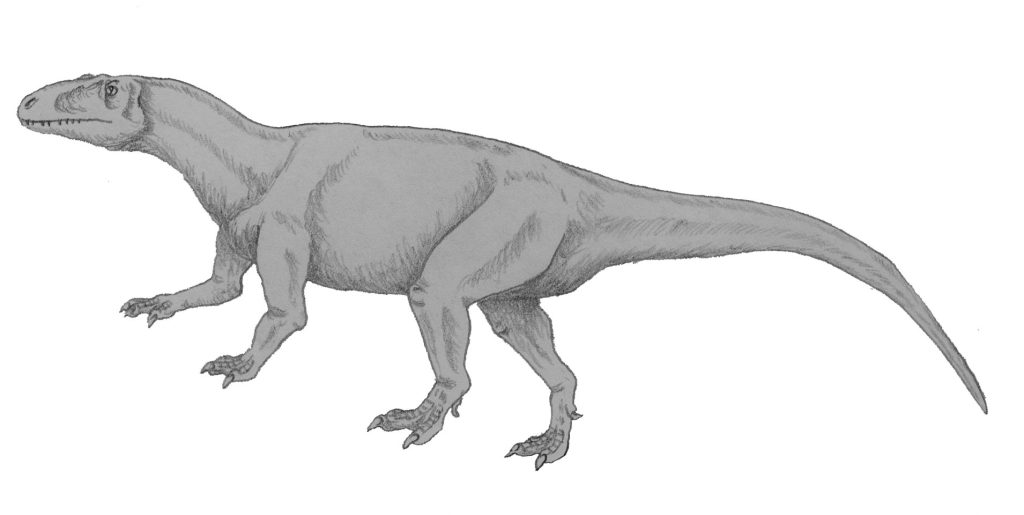
With so little of the skeleton known, any portrait of Xuanhanosaurus rests on its forelimb and a handful of vertebrae.
Short description of Xuanhanosaurus
The frontmost known bones are posterior neck vertebrae. Their centra—the spool-shaped vertebral bodies—lack a second, rear pneumatic foramen, an opening linked to air sacs. Behind them, the anterior dorsal vertebrae carried very strong keels (ridges along the underside), a feature Rauhut compared with Torvosaurus and baryonychids. Meanwhile, the coracoid was high and oval, with a moderate, rounded ventral process.
The humerus was very robust, with strongly expanded upper and lower ends. Yet it was only moderately sigmoid, or S-curved, as in some large basal tetanurans. In the wrist, an enlarged distal carpal overlapped the first and part of the second metacarpals, or palm bones. The hand also kept a vestigial fourth metacarpal, while its first ungual, or claw bone, was rather broad and not very strongly curved.
Posture has sparked debate as well. Dong argued in 1984 that the animal used its robust forelimbs in walking. In 2003, however, Rauhut found this “rather unlikely” because the humerus is short relative to the vertebrae. His view implies that it walked on two legs, like other theropods.

Size and Weight of Type Species
No length, height, or weight for Xuanhanosaurus appears in the peer-reviewed studies behind this article. Without a fuller skeleton, any such figure would have to be scaled from relatives, and none of these studies tries.
What the sources do offer is qualitative. In 2018, Dal Sasso and colleagues grouped it among “large-sized basal tetanuran taxa.” Rauhut had earlier observed that the humerus is “rather short” compared with the size of the vertebrae—a proportion central to the posture debate.
For now, the safest summary is a modest one. Xuanhanosaurus has been described as a large basal tetanuran, but how large it grew remains unknown.
The Dinosaur in Detail
One of the most distinctive features of Xuanhanosaurus is its wrist. In 2014, Xu and colleagues described distal carpal 2, a wrist bone, as significantly enlarged. It covers the bases of two metacarpals, with a tiny separate distal carpal beside it. The big carpal’s upper surface is convex, yet it lacks the transverse groove of a true semilunate carpal—the half-moon-shaped wrist bone of later theropods. For Xu’s team, Xuanhanosaurus therefore documents the second stage in the evolution of that bone.
The hand was flexible, too. According to Rauhut, the base of the second finger allowed a great degree of extension and flexion, and the first finger was “somewhat opposable.” Dal Sasso’s team later noted a short first phalanx, or finger bone, on the second digit, much like those of ceratosaurs. To them, this and the vestigial fourth metacarpal were primitive traits, and they counted Xuanhanosaurus among “the basalmost tetanurans.” In 2024, Rauhut and colleagues found that this phalanx closely resembles the one in Alpkarakush, a theropod from Kyrgyzstan. That resemblance, they wrote, “might lend support to a metriacanthosaurid identification.” Yet one version of their analysis placed it in Piatnitzkysauridae.
Other teams have pulled it in still more directions. In 2019, Rauhut and Pol’s strict consensus tree recovered it as the most basal allosauroid. They also listed it among 20 highly unstable taxa. In 2025, Zou and colleagues made it a basal metriacanthosaurid, in an unresolved split with Yuanmouraptor and the Yangchuanosaurus–Sinraptor group. However, they called this placement poorly supported, and a piatnitzkysaurid position cost only two extra steps. Taken together, these results describe a theropod whose arm is well understood but whose relatives are not. As Rauhut’s 2024 team concluded, “a more detailed analysis of Xuanhanosaurus would be needed.”
Interesting Points about Xuanhanosaurus
- Its forelimb is one of the best preserved of any Middle Jurassic theropod, even though most of the skeleton is missing.
- A bone that Dong called a sternum is, in Rauhut’s view, an impression of part of the right coracoid.
- At least three studies left Xuanhanosaurus out of their analyses or final trees as an unstable “wildcard” taxon.
- Xu and colleagues argued in 2014 that its wrist records the second stage in the evolution of the half-moon-shaped semilunate carpal.
- In 2003, its hand was still embedded in a slab of rock, which limited how closely researchers could study it.
Dinosaurs from the Same Formation
Also known from the Lower Shaximiao Formation (exact level relative to Xuanhanosaurus not known): the theropods Gasosaurus and Kaijiangosaurus, the sauropods Shunosaurus and Omeisaurus, and the ornithischians Huayangosaurus and Agilisaurus. According to Li and colleagues (2011), this Shunosaurus–Omeisaurus assemblage comes mostly from Dashanpu near Zigong and Jinji in Kaijiang County. Proposed ages for the formation run from the Bajocian to the Callovian or later. As a result, these animals may not all have lived at the same time.
Xuanhanosaurus in its Natural Habitat
The Lower Shaximiao Formation as a whole consists of massive purplish-red sandstones and mudstones laid down on land, possibly around a shallow lake. Across the Sichuan Basin, the Jurassic rocks are continental red beds of river and lake origin. In the lower part of the Shaximiao Formation, the sandstones show conspicuous cross bedding—layers tilted by moving water—and often fill old channels. Little has been published on the plants or climate of the Xuanhan site itself. The age of these rocks remains in dispute, too—invertebrate fossils point to the Bajocian–Bathonian, but detrital zircons, tiny datable mineral grains, suggest younger ages. Summarizing these results in 2024, Rauhut and colleagues judged the Shaximiao faunas “most probably latest Middle to Late Jurassic in age.”
With no skull or teeth known, there is no direct evidence of what Xuanhanosaurus ate. Its hand does show a flexible second finger and a partly opposable first finger. However, none of the studies discussed here ties these traits to feeding, so its menu remains a blank page.
Similarly, nothing in the fossils speaks to whether it lived alone or in groups. Its broader ecological role depends partly on where it belongs in the tree. In 2016, Rauhut and colleagues noted that piatnitzkysaurids, counting Xuanhanosaurus among them, had so far been found only in inland settings. Until more bones turn up, Xuanhanosaurus remains a formidable arm attached to an open question.
Frequently Asked Questions
Later studies do not explain it, but the genus name appears to refer to Xuanhan County, Sichuan, where the fossils came from.
Estimates run from about 171 to 155 million years ago. Older studies say Middle Jurassic, but a 2019 analysis and a 2024 study point to the early Late Jurassic (Oxfordian).
Its exact size is unknown, but researchers have grouped it among large-sized basal tetanurans.
It was a basal tetanuran theropod whose family is debated, with studies placing it among piatnitzkysaurids, metriacanthosaurids, or the earliest allosauroids.
Its fossils come from the Lower Shaximiao Formation in Xuanhan County, Sichuan Province, China.
Its humerus has a possibly unique raised ridge at the shoulder joint, and its forelimb is among the best preserved of any Middle Jurassic theropod.
Sources
The information in this article is based on various sources, drawing on scientific research, fossil evidence, and expert analysis. The aim is to provide a comprehensive and accurate overview of Xuanhanosaurus. However, please be aware that our understanding of dinosaurs and their world is constantly evolving as new discoveries are made.
- Dong, Z. 1984. A new theropod dinosaur from the Middle Jurassic of Sichuan Basin. Vertebrata PalAsiatica 22(3): 213–218 [in Chinese, no online copy]
- https://tb.plazi.org/GgServer/html/77323C29FFD1B427FEED9D65FD8DF6D3
- https://palaeo-electronica.org/content/pdfs/654.pdf
- https://doi.org/10.1038/s41598-019-53672-7
- https://doi.org/10.1093/zoolinnean/zlae090
- https://doi.org/10.7717/peerj.19218
- https://doi.org/10.1038/srep06042
- https://doi.org/10.7717/peerj.5976
- https://doi.org/10.1038/s41598-019-56959-x
- https://doi.org/10.1098/rsos.220794
- https://revistas.ucm.es/index.php/JIGE/article/download/JIGE1010220275A/32716
- https://vjs.pgi.gov.pl/article/download/26567/18275
- https://ora.ox.ac.uk/objects/uuid:56ce0443-6cef-4842-930a-ea0b80b2e249
- https://pmc.ncbi.nlm.nih.gov/articles/PMC10427828/
- https://pmc.ncbi.nlm.nih.gov/articles/PMC3943790/
- https://pmc.ncbi.nlm.nih.gov/articles/PMC4614847/
- https://paleobiodb.org/classic/checkTaxonInfo?taxon_no=38588
- https://stratigraphy.org/ICSchart/ChronostratChart2024-12.pdf
This article was last fact checked: TheDinosaurs Team, 17-11-2026
Featured Image Credit: Audrey.m.horn, CC BY-SA 4.0, via Wikimedia Commons
