Just east of Chilton Chine, on the Isle of Wight’s southwest coast, the cliffs expose the river-laid Wessex Formation. From these beds, about 0.6 miles (1 kilometer) from the village of Brighstone, came parts of a new spinosaurid’s skull and tail. Spinosaurids were a family of long-snouted theropods, and this one was named Riparovenator milnerae in 2021. It lived during the Barremian stage of the Early Cretaceous, and it shares its formation and coastline with a second new spinosaurid, Ceratosuchops. As a result, its describers suggested that sympatry—related species sharing one region—was present and potentially common among baryonychines.
The bones came out at beach level between 2013 and 2017. According to a university news release, fossil collectors first found parts of two skulls, while a Dinosaur Isle Museum crew later recovered much of a tail. In 2021, paleontologist Chris Barker and eight colleagues described the material in Scientific Reports. Their analysis also supported a European origin for the whole spinosaurid family. Since then, however, one later study has questioned whether the Wessex bones really belong to two different species.
Riparovenator Key Facts
| Keyword | Fact |
|---|---|
| Pronunciation | Not specified |
| Meaning of name | Riverbank Hunter |
| Group | Theropoda (Spinosauridae) |
| Type Species | Riparovenator milnerae |
| Diet | Carnivore (inferred for spinosaurids as a group) |
| When it Lived | About 126.5 to 121.4 MYA (Barremian stage limits, bed not dated directly) |
| Period | Cretaceous |
| Epoch | Early Cretaceous (Barremian stage) |
| Length | Not specified |
| Height | Not specified |
| Weight | Not specified |
| Mobility | Not specified |
| First Discovery | 2013 to 2017 by fossil collectors, including co-authors Jeremy Lockwood and Brian Foster, and a Dinosaur Isle Museum crew (no record of who found each bone) |
| Described by | 2021 by C.T. Barker, D.W.E. Hone, D. Naish, A. Cau, J.A.F. Lockwood, B. Foster, C.E. Clarkin, P. Schneider, and N.J. Gostling |
| Holotype | IWCMS 2014.95.6, IWCMS 2014.96.1–3, and IWCMS 2020.448.1–2 |
| Location of first find | Chilton Chine, near Brighstone, Isle of Wight, UK (Wessex Formation) |
Riparovenator Origins, Taxonomy and Timeline
The name Riparovenator joins two Latin words—rīpārius, “relating to the riverbank,” and vēnātor, “hunter.” Meanwhile, the species name milnerae honors Angela Milner and her contributions to spinosaurid paleobiology. The University of Southampton’s release rendered the full name as “Milner’s riverbank hunter.” Together, the name pairs a riverside setting with a tribute to a spinosaurid specialist.
Within Theropoda, Riparovenator falls in Tetanurae, the family Spinosauridae, and the subfamily Baryonychinae. Barker and colleagues also coined a new clade—a group made up of an ancestor and all its descendants—called Ceratosuchopsini. They defined it as the widest branch containing Ceratosuchops but not Baryonyx or Spinosaurus, and it also includes Suchomimus. In their Bayesian analysis, which weighs the probability of different trees, Riparovenator and Ceratosuchops came out as sister taxa, or closest relatives. However, the authors called support for this grouping limited. In their parsimony analysis, forcing the Wessex pair outside a Baryonyx and Suchomimus group cost only two extra steps. Riparovenator milnerae is the type and only known species.
The describers treated the Wessex Formation as entirely Barremian. For their dating analysis, they gave Riparovenator an age of roughly 130 to 125 million years ago, and a 2026 study repeated that range. Other figures differ, however. In 2021, Lockwood and colleagues, citing earlier work, dated the base of the Barremian inside the formation to 126.5 million years ago. They put the stage’s end at 121.4 million years ago, while the Paleobiology Database gives 125.77 to 121.4 million years ago. In 2023, Jacobs and colleagues called the formation “Hauterivian–Barremian” in their title. A university release adds that their study gave the first radiometric date from a Wessex fossil—about 127 million years, from a turtle found at Brook Bay. In 2026, Morrison and colleagues wrote that the formation spans 15 million years, without citing a source.
Discovery & Fossil Evidence
The type locality is an exposure of the Wessex Formation just east of Chilton Chine. According to the describers, the in-situ braincase and tail most likely came from an unnamed layer between the Chilton Chine and Brighstone Sandstones. Since the first finds, however, coastal processes have reshaped the site. Its strata have also undergone a substantial rotational slump—a block of rock sliding and tilting as it moves. The paper thanks volunteers who helped excavate the site in 2017 and collectors who donated finds. It credits Kai Bailey with finding Ceratosuchops remains, but it does not say who found each Riparovenator bone. Meanwhile, the university release says co-author Jeremy Lockwood discovered several bones, without saying which.
The holotype—the name-bearing specimen—includes the front of both premaxillae (front snout bones), catalogued as IWCMS 2014.95.6. It also includes a disarticulated braincase, numbered IWCMS 2014.96.1, 2014.96.2, 2020.448.1, and 2020.448.2. In addition, a left fragment from in front of the eye socket, IWCMS 2014.96.3, preserves parts of the lacrimal and prefrontal bones. The braincase and tail lay in situ and in close association, about 33 feet (10 meters) apart. By contrast, the snout pieces and eye-socket fragment turned up as surface finds.
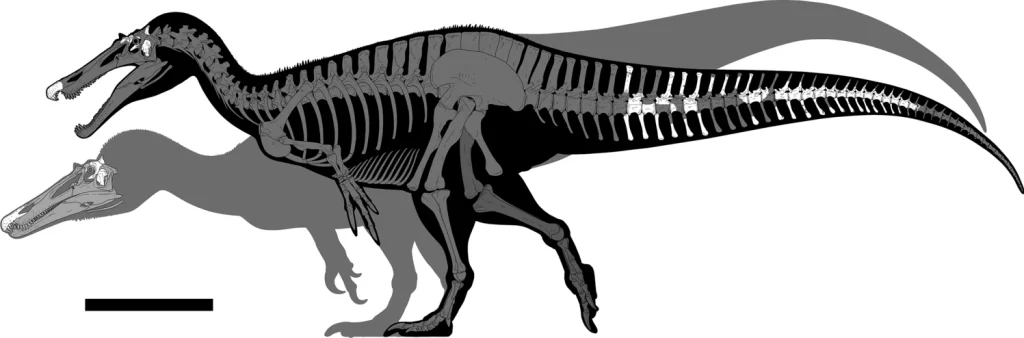

Barker’s team referred two more pieces to the species—a rear nasal fragment, IWCMS 2014.95.7, and a tail series catalogued as IWCMS 2020.447.1–39. The tail holds at least 22 vertebrae, mostly in good condition. Overall, though, the Riparovenator bones are less well preserved than those of Ceratosuchops, with extensive cracking on the skull pieces in particular. All of the material sits at Dinosaur Isle Museum in Sandown, and the Friends of Dinosaur Isle supported its acquisition. The describers also reported more Chilton Chine bones that fit neither taxon, with a fuller osteology in preparation.
Riparovenator Size and Description
Known only from parts of the skull and tail, Riparovenator must be pieced together with help from its relatives.
Short description of Riparovenator
At the tip of the snout, the premaxilla preserves only its rounded “terminal rosette,” with seven tooth sockets per side. Small openings for nerves and blood vessels pepper its outer surfaces. Its teeth were conical, slightly compressed, and recurved, with five to eight denticles (tiny serration points) per millimeter. In addition, their enamel was fluted on both faces, and the first socket was notably smaller than the second.
Farther back, the nasal bones fused along the midline into a low crest whose ornament looks cross-shaped from above. Above the eye, the prefrontal carried a boss-like cornual process—a small, horn-like bump. From the shape of the bony facets, the authors inferred a brow built like that of Suchomimus. This rugose, roughened brow region appears in both Wessex specimens.
The tail carried tall neural spines—the bony blades rising from each vertebra. Although they shrank toward the tip, they stayed taller than the vertebral bodies well into the middle of the series. Nothing in the known material addresses posture or coloring, so any life restoration of those details is speculative.
Size and Weight of Type Species
Barker and colleagues gave no body length or mass for Riparovenator. Their skeletal drawing carries a 100-centimeter scale bar, but that is a drawing aid rather than an estimate. In contrast, the University of Southampton’s news release said researchers put both new spinosaurids at about 29.5 feet (9 meters) long. It also credited them with skulls of roughly 3.3 feet (1 meter).
The paper itself compares size only in relative terms. While discussing maturity, it notes “relatively comparable body sizes” among the Wessex specimens and Baryonyx. Direct caliper measurements give a sense of scale. For example, the occipital condyle—the knob where skull meets neck—is 46.4 millimeters (1.8 inches) wide. That compares with 45.8 millimeters in Ceratosuchops and 44.8 millimeters in Baryonyx.
Later work added tail figures, as Barker and colleagues in 2022 measured the rear facet of one tail vertebra at 125.6 millimeters (4.9 inches) tall. Even so, no published estimate of hip height or body weight has turned up.
The Dinosaur in Detail
What sets this dinosaur apart lies mostly in its braincase, where the describers listed four unique traits. First, a notch marks the upper rim of the eye socket between the prefrontal and the frontal. Second, the opening for the facial nerve is deeply inset, largely hidden in side view. Third, the subcondylar recess, a hollow beneath the skull’s neck joint, is deeper than a third of its width, while other baryonychines stay under a fifth. Finally, the basipterygoid processes, struts that brace the braincase against the palate, show little of their underside in side view.
Other features count only in combination—unlike that of Baryonyx, its nasal has a curved upper margin. Its dorsum sellae, a bony wall in the braincase floor, is straight rather than V-shaped as in Baryonyx and Ceratosuchops. In 2026, Morrison and colleagues added that both Wessex spinosaurids share a triangular basituberal web—a sheet of bone under the braincase.
The tail may matter more. Its relatively elongate spines, the authors wrote, “push back the appearance of a dorsoventrally deep tail in spinosaurids.” Earlier finds showed that trait in the Aptian Ichthyovenator and Suchomimus.
Still, not everyone accepts two Wessex species. Even the describers noted that some differences track individual or growth variation in other theropods, and one notch may be an immature trait. In 2022, Sereno and colleagues tentatively scored the Wessex material as one taxon, Ceratosuchops inferodios. In their view, the braincase differences could well be individual variation, while the snout bones offer no fair test, since one lacks the key feature. They also questioned whether each specimen is one individual, since neither turned up together at a single site. That was a choice for one analysis, not a formal synonymy, and later papers still list both genera. Taken together, the evidence leaves the question open.
Interesting Points about Riparovenator
- The species name milnerae honors Angela Milner, recognizing her contributions to spinosaurid paleobiology.
- Fossil collector Brian Foster called the find the rarest and most exciting of his more than 30 years of fossil collecting.
- Its tall-spined tail pushes the first known deep spinosaurid tail back before the Aptian Ichthyovenator and Suchomimus.
- The describers’ parsimony analysis drew on 1,810 anatomical characters scored across 40 taxa, producing 2,660 equally short trees.
- According to a 2021 statement, the new fossils were to go on display at Dinosaur Isle Museum in Sandown.
Dinosaurs from the Same Formation
Also known from the Wessex Formation are Ceratosuchops, Invictibellatrix, Neovenator, Eotyrannus, Polacanthus, and Hypsilophodon. Morrison and colleagues’ 2026 log does not plot Riparovenator, but the interval that held its in-situ bones falls around plant debris bed L6. Ceratosuchops came from loose foreshore blocks, so the log places it only approximately, near the Chilton Chine Sandstone. Similarly, the megaraptoran Invictibellatrix most likely came from the lower beds L1 to L5, though its exact position is unknown. Higher up, the log places Neovenator in bed L9, Eotyrannus in L11, and Polacanthus around L14 and L15. Finally, Hypsilophodon comes from the Hypsilophodon Bed near the top of the formation. No published dates show how far apart in time these levels are. The formation may span several million years—a 2026 study gives 15 million, without a supporting reference—so these animals may not all have lived at the same time.
Riparovenator in its Natural Habitat
The world Riparovenator inhabited was a floodplain within a narrow valley, part of the Wealden Group of the Wessex sub-basin. Across it wound a perennial, moderately sized, and highly sinuous river flowing from west to east. Its rocks are sandstones and varicolored mudstones with plant debris beds, and some layers record lakes. Calcrete nodules, drought-adapted ferns, and the conifers Pseudofrenelopsis and Watsoniocladus point to a climate considered semi-arid. Most vertebrate fossils come from plant debris beds, which researchers read as flash-flood fills of features such as oxbow lakes. Charcoal in them hints at seasonal wildfires. Riparovenator‘s own bones, however, came from a fine-grained sandstone with little plant debris.
While there is no direct evidence of what Riparovenator ate, its describers noted that several lines of evidence point to semi-aquatic niches for spinosaurids. In their view, the group’s varied diet may have included both land and water prey. Morrison and colleagues read the formation’s lower beds, near the Riparovenator level, as lowland or coastal habitats.
Its overbuilt brow may have served in socio-sexual signaling or in clashes between rivals of the same species, the describers proposed. Similarly, they suggested that the Wessex and Weald baryonychines may have been separated by habitat choice—or else by geological time. In the neighboring Weald sub-basin, the Upper Weald Clay of Surrey yielded Baryonyx walkeri, which they called broadly contemporaneous. Back at Wessex, an indeterminate tetanuran, a theropod not identified to genus, adds to the formation’s roster of meat-eaters.
Frequently Asked Questions
It means “riverbank hunter” in Latin, and the species name milnerae honors Angela Milner.
It lived in the Barremian stage of the Early Cretaceous, about 126.5 to 121.4 million years ago, though no one has dated its bed directly.
No peer-reviewed size estimate has been found, so its length is not specified. A 2021 university news release said it was about 29.5 feet (9 meters) long.
Its diet is not known directly, but spinosaurids as a group may have eaten both land and water prey.
It was found at Chilton Chine, near Brighstone, on the Isle of Wight in southern England.
Its describers named it as a distinct genus. In 2022, Sereno and colleagues tentatively scored it and Ceratosuchops as one taxon for one analysis, without a formal synonymy.
Sources
The information in this article is based on various sources, drawing on scientific research, fossil evidence, and expert analysis. The aim is to provide a comprehensive and accurate overview of Riparovenator. However, please be aware that our understanding of dinosaurs and their world is constantly evolving as new discoveries are made.
- https://www.nature.com/articles/s41598-021-97870-8
- https://static-content.springer.com/esm/art%3A10.1038%2Fs41598-021-97870-8/MediaObjects/41598_2021_97870_MOESM1_ESM.pdf
- https://doi.org/10.7717/peerj.13543
- https://doi.org/10.7554/eLife.80092
- https://doi.org/10.1098/rsos.260937
- https://doi.org/10.1098/rsos.260994
- https://zenodo.org/records/5701348
- https://doi.org/10.1016/j.cretres.2023.105590
- https://paleobiodb.org/data1.2/taxa/single.json?name=Riparovenator
- https://www.southampton.ac.uk/news/2021/09/new-spinosaurid-dinosaurs.page
- https://tetzoo.com/blog/2021/9/27/two-new-spinosaurid-dinosaurs-from-the-english-cretaceous
- https://www.sciencedaily.com/releases/2023/06/230613190825.htm
This article was last fact checked: TheDinosaurs Team, 17-11-2026
Featured Image Credit: Connor Ashbridge, CC BY-SA 4.0, via Wikimedia Commons
