Along Alberta’s Red Deer River, the Dinosaur Park Formation preserved the hips of a remarkably small predator. Named Hesperonychus elizabethae, it lived roughly 75 million years ago, in the late Campanian stage of the Late Cretaceous. Its describers estimated a weight of about 4.2 pounds (1.9 kilograms). That made it the smallest carnivorous, nonavian dinosaur then known from North America. In their analysis, it belonged among the microraptorines, a mainly Asian group of small dromaeosaurids.
Paleontologist Elizabeth Nicholls collected the fossil in 1982, but it then lay unstudied for 25 years. Eventually, paleontologist Nicholas R. Longrich recognized it while studying the University of Alberta’s collections, and in 2009 he and paleontologist Philip J. Currie named the genus. The holotype is only a fused pelvis, yet it stretched the microraptorine record by about 45 million years—a reminder that museum drawers still hold surprises.
Hesperonychus Key Facts
| Keyword | Fact |
|---|---|
| Pronunciation | Not specified |
| Meaning of name | Western Claw |
| Group | Theropoda |
| Type Species | Hesperonychus elizabethae |
| Diet | Carnivore |
| When it Lived | Around 75 MYA |
| Period | Cretaceous |
| Epoch | Late Cretaceous (Campanian stage) |
| Length | Not specified |
| Height | Not specified |
| Weight | About 4.2 pounds (1.9 kilograms), indirect estimate |
| Mobility | Not specified |
| First Discovery | 1982 by Elizabeth Nicholls |
| Described by | 2009 by N.R. Longrich and P.J. Currie |
| Holotype | UALVP 48778 |
| Location of first find | Dinosaur Park Formation, south side of the Red Deer River, about 20 km (12 miles) east of Dinosaur Provincial Park, Alberta, Canada |
Hesperonychus Origins, Taxonomy and Timeline
The name Hesperonychus blends the Latin hesperus, meaning “west,” with the Greek onychos, meaning “claw.” The species name elizabethae honors the late Dr. Elizabeth Nicholls, who discovered the holotype. She later served as curator of marine reptiles at the Royal Tyrrell Museum and died in 2004.
In 2009, Longrich and Currie placed Hesperonychus within Theropoda, Coelurosauria, and Maniraptora, and more narrowly in Dromaeosauridae. Their analysis recovered it in Microraptorinae, a subgroup that includes the feathered Sinornithosaurus and the four-winged Microraptor. Three pubic traits supported that placement—a lateral process, a strongly back-curved shaft, and a spatulate (broad, spoon-like) pubic symphysis. By contrast, it was not closely related to previously described North American dromaeosaurids such as Dromaeosaurus and Saurornitholestes. The same paper also named two new clades, Saurornitholestinae and Eudromaeosauria, the derived group that includes Dromaeosaurus. Hesperonychus elizabethae is the type and only known species.
The original paper dates the formation to between 76.5 and 74.8 million years ago, within the late Campanian. A 2022 age model by geologist Jahandar Ramezani and colleagues spans roughly 76.5 to 74.4 million years ago. Either way, Hesperonychus was the youngest microraptorine known in 2009—the previous record holder came from China’s Jiufotang Formation, about 120 million years old. Its describers also saw it as evidence of faunal ties between North America and Asia.
Discovery & Fossil Evidence
The holotype came from about 20 kilometers (12 miles) east of Dinosaur Provincial Park, on the Red Deer River’s south side. A 2012 review by paleontologist Alan Turner and colleagues listed the park itself, contrary to the original description. By Longrich’s account, he found the specimen in the last drawer of the last case he searched. At first he took the bone for something like a chevron (one of the V-shaped bones beneath the tail). Soon, though, he saw that it resembled the pubis of Sinornithosaurus. A University of Calgary press release dates that find to 2007.
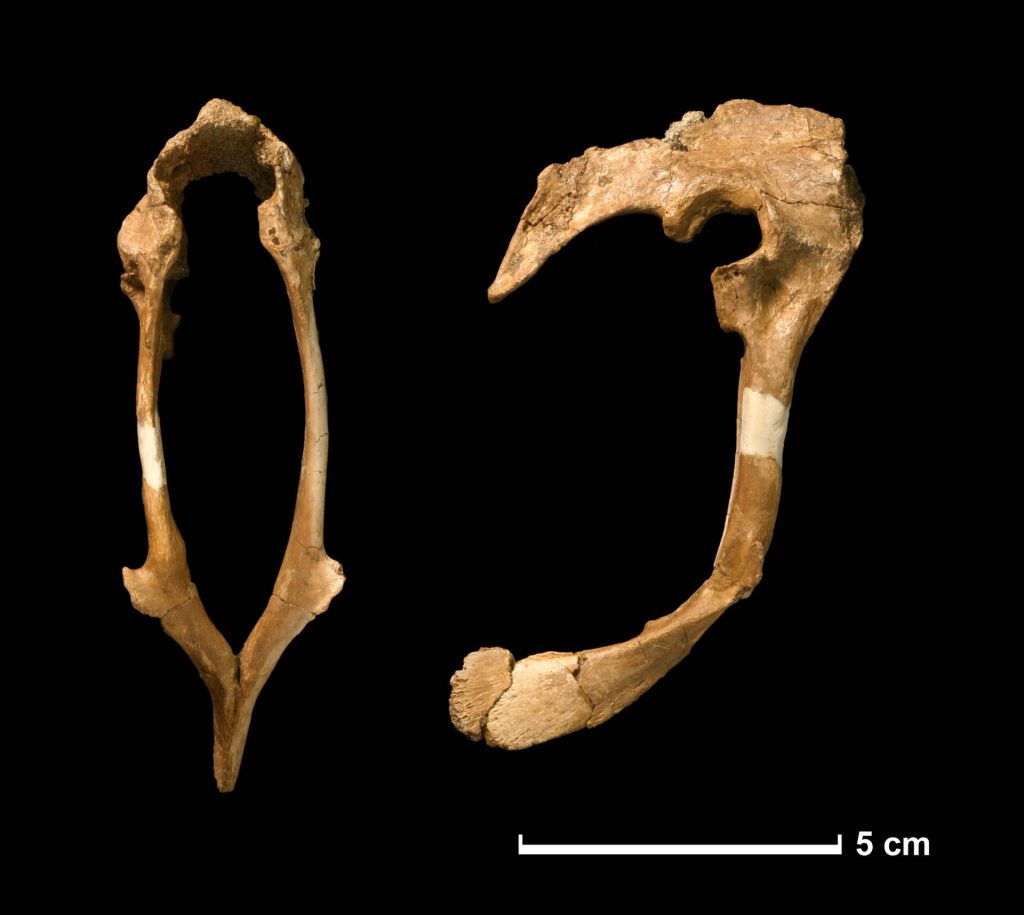
Catalogued as UALVP 48778 at the University of Alberta in Edmonton, the holotype is a partial pelvic girdle. It comprises the pubes (the paired lower hip bones) and the ilia (the upper hip blades). Preparator Clive Coy freed it from the rock. Because the pubes and ilia are coossified (fused together), the describers judged the animal somatically mature—it had reached adult body size.

Longrich and Currie also referred isolated bones from the second toe, which bore the sickle claw. They came from Dinosaur Provincial Park and nearby badlands, plus Devil’s Coulee, Manyberries, Onefour, Irvine, and Sandy Point. All lie within 200 kilometers (124 miles) of the type locality. Precisely dated specimens come from the Dinosaur Park Formation and the coeval (same-age) uppermost Oldman Formation. The describers put that interval at no more than 1.7 million years, but Ramezani’s 2022 age model gives the Dinosaur Park Formation alone about 2 million years. In 2021, paleontologist Thomas Cullen and colleagues placed one referred sickle claw (TMP 2000.012.0100, from bonebed 54) 37 meters (121 feet) above the Oldman–Dinosaur Park contact. It is the only Hesperonychus specimen whose level is known. Still, the describers cautioned that referral of these toe bones must be considered tentative.
Hesperonychus Size and Description
Short description of Hesperonychus
No skull, teeth, arms, or feathers are known, so reconstructions borrow from relatives—but the hips themselves are revealing. The ilia were strongly tilted inward and may have met at the midline. Their rear wings tapered and curved downward, as in basal paravians—early members of the group uniting birds, dromaeosaurids, and troodontids. Each pubis angled down and back, then curved sharply rearward, much as in Microraptor and Sinornithosaurus. A greatly reduced pubic apron (the bony sheets linking the pubes), shifted onto the posterior surface of the shafts, left a deep, broad pelvic canal.
The right pubic shaft also carries a swelling that apparently represents a well-healed fracture. Like other theropods, it presumably walked on two legs. The describers noted that the hip socket opened partly upward rather than straight sideways. In their view, this suggests it could partially swing its hind limbs outward. They found this of interest given proposals that Microraptor gui spread its feathered hind limbs as airfoils. Whether it was four-winged or flightless remains unknown, but its describers favored flightlessness, as in the similar-sized Sinornithosaurus.
Size and Weight of Type Species
The scientific description gives no length or height, but on his website Longrich called it “maybe a meter long” (about 3.3 feet). Meanwhile, the 2009 press release had it standing about 20 inches (50 centimeters) tall. Neither figure comes from the scientific paper.
The weight estimate is firmer—though still indirect. Longrich and Currie regressed pubis length against body mass, using mass estimates for Archaeopteryx and dromaeosaurids. The result was about 4.2 pounds (1.9 kilograms), which they likened to roughly half the weight of a domestic cat. For scale, the holotype pubis is 80 percent as long as that of a Sinornithosaurus millennii specimen. The referred toe bones range from 71 to 105 percent of the matching elements.
Before its discovery, the smallest known Late Cretaceous North American carnivorous dinosaur was Saurornitholestes, at about 22 pounds (10 kilograms). Hesperonychus was almost an order of magnitude smaller than any other carnivorous dinosaur in the formation. By Mesozoic mammal standards, however, it was large—Eodelphis cutleri, perhaps the assemblage’s largest mammal, weighed about 1.3 pounds (600 grams).
The Dinosaur in Detail
This dinosaur’s pelvis is packed with unusual details. Its diagnosis includes a pubic peduncle (the stalk of the ilium that meets the pubis) deeply hollowed on its inner face. Wing-like, forward-curving tubercles project from the sides of the pubes, and the pubic symphysis—where the pubes meet—looks teardrop-shaped in side view. Unlike those of Velociraptor, its rear iliac wings ran roughly parallel instead of diverging.
Longrich and Currie found the referred toe bones “virtually identical” to the second-toe bones of Sinornithosaurus and Microraptor. The sickle claw is broad for its depth and semilunate (half-moon-shaped) in cross-section—less blade-like than in eudromaeosaurs and closer to Rahonavis and microraptorines.
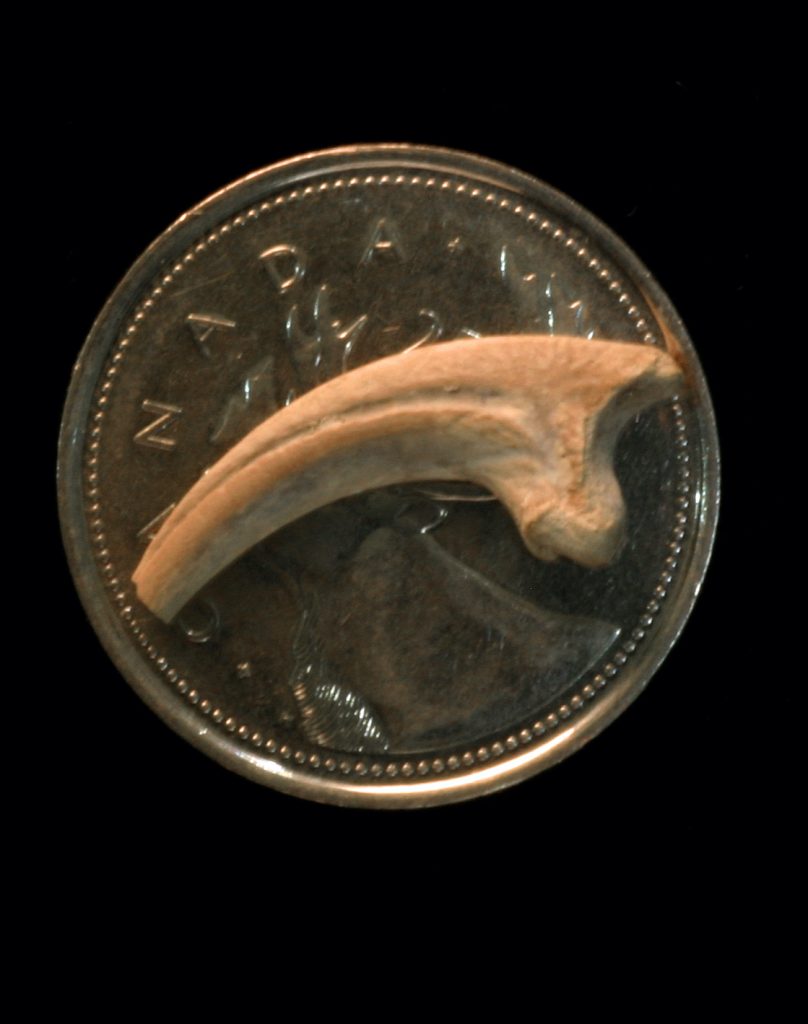

If the referral holds, Hesperonychus was not rare. The authors counted at least 10 of its sickle claws in Royal Tyrrell Museum collections, compared with about 30 for Saurornitholestes and just two for Dromaeosaurus. Their formal list of referred material, however, names only six such claws. Even so, they concluded that small dromaeosaurids were a significant component of the carnivore community.
Its family tree remains unsettled. In 2012, Turner and colleagues called the pelvis “convincingly microraptorine in aspect.” A 2014 analysis by Gang Han and colleagues also recovered it within Microraptorinae. In 2019, however, paleontologist Scott Hartman and colleagues recovered it as an avialan—a member of the bird lineage. There, it sat at least as close to Aves as Balaur, and forcing it into Microraptoria cost three extra steps. Earlier, in 2015, Andrea Cau and colleagues had noted that its pelvic fusion differs from that of Balaur and avialans. In Hesperonychus, the joint between ilium and ischium stays unfused. In 2020, Jasinski and colleagues again reported it as sister to the Asian microraptorines. Several other studies prune it as an unstable “wildcard” taxon. Taken together, one pelvis has fueled over a decade of debate.
Interesting Points about Hesperonychus
- Its name means “western claw,” yet the holotype preserves no claw at all, only a fused pelvis.
- The holotype lay unstudied for 25 years after Elizabeth Nicholls collected it in 1982.
- At about 4.2 pounds, it weighed roughly three times as much as Eodelphis cutleri, perhaps the largest mammal of its assemblage.
- Its discovery extended the known history of microraptorines by about 45 million years. Its describers suggested the group held the small-predator niche for at least 50 million years.
Dinosaurs from the Same Formation
Also known from the Dinosaur Park Formation (exact level relative to Hesperonychus not known): Dromaeosaurus albertensis, Gorgosaurus libratus, Chirostenotes pergracilis, Styracosaurus albertensis, Chasmosaurus belli, and Lambeosaurus lambei. The formation spans about 2 million years, so these animals may not all have lived at the same time.
Hesperonychus in its Natural Habitat
The world Hesperonychus inhabited was an alluvial-coastal plain, laid down as the Western Interior Seaway advanced during its Bearpaw phase. River channels dominate the formation’s lower half, which is rich in bonebeds and skeletons. Higher up, the Lethbridge Coal Zone records tidally influenced wetlands and shorelines, beneath marine shales of the Bearpaw Formation. At the park, the formation is about 70 meters (230 feet) thick. Together with the Oldman Formation, it has yielded more than 140 species of vertebrates.
Longrich and Currie cast it as a carnivore in the small-carnivore niche, though no gut contents or bite marks are reported. In the 2009 press release, Longrich informally suggested it “probably hunted and ate whatever it could for its size”—insects, mammals, amphibians, and maybe even baby dinosaurs. As the describers noted, isolated microfossils show that amphibians, squamates (lizards and their relatives), birds, and mammals were all part of the region’s small-vertebrate fauna. Yet strong preservation and collecting biases work against small skeletons.
Its size hints at a distinct ecological niche. The authors saw its size gap from other dromaeosaurids as consistent with predators being segregated by body size to reduce competition. In 2021, Cullen and colleagues found that most of the formation’s small-theropod specimens come from its lower 30 meters. Unlike its ornithischians, its theropods showed no broad pattern of faunal zonation, though several taxa, Hesperonychus included, have only one specimen of known level. In 2019, paleontologist Jordan Mallon noted that over 30 herbivorous and omnivorous dinosaur species are recognized from the formation, with different species restricted to different horizons. Other finds include a proposed unnamed large ornithomimid and material compared with Qiupalong.
Frequently Asked Questions
It means “western claw,” from Latin hesperus and Greek onychos, and elizabethae honors Elizabeth Nicholls, who discovered the holotype.
It lived around 75 million years ago, in the Campanian stage of the Late Cretaceous.
Its describers estimated about 4.2 pounds (1.9 kilograms) from the length of its pubis. The scientific description gives no length or height.
It was a carnivore, but no gut contents or bite marks reveal what it actually ate.
Its holotype came from the Dinosaur Park Formation, about 20 kilometers east of Dinosaur Provincial Park in Alberta, Canada.
Its describers classed it as a microraptorine dromaeosaurid, though a 2019 analysis recovered it as an avialan instead.
Sources
The information in this article is based on various sources, drawing on scientific research, fossil evidence, and expert analysis. The aim is to provide a comprehensive and accurate overview of Hesperonychus. However, please be aware that our understanding of dinosaurs and their world is constantly evolving as new discoveries are made.
- https://doi.org/10.1073/pnas.0811664106
- https://pmc.ncbi.nlm.nih.gov/articles/PMC2664043/
- https://doi.org/10.1206/748.1
- https://pmc.ncbi.nlm.nih.gov/articles/PMC6626525/
- https://www.nature.com/articles/ncomms5382
- https://pmc.ncbi.nlm.nih.gov/articles/PMC7099077/
- https://pmc.ncbi.nlm.nih.gov/articles/PMC4504142/
- https://pmc.ncbi.nlm.nih.gov/articles/PMC4476167/
- https://pmc.ncbi.nlm.nih.gov/articles/PMC6848195/
- https://pmc.ncbi.nlm.nih.gov/articles/PMC6516837/
- https://pmc.ncbi.nlm.nih.gov/articles/PMC6385174/
- https://pmc.ncbi.nlm.nih.gov/articles/PMC11970238/
- https://doi.org/10.1139/cjes-2020-0145
- https://www.nature.com/articles/s41598-022-19896-w
- https://www.nature.com/articles/s41598-019-51709-5
- https://paleobiodb.org/data1.2/taxa/single.json?name=Hesperonychus%20elizabethae&show=type,disc,pres,etbasis,ecospace
- https://nicklongrich.com/blog/the-discovery-of-hesperonychus-elizabethae
- https://www.eurekalert.org/news-releases/521257
This article was last fact checked: TheDinosaurs Team, 17-11-2026
Featured Image Credit: Skye M, CC BY-SA 4.0, via Wikimedia Commons
