
In the Bakony Mountains of western Hungary, an abandoned bauxite mine at Iharkút exposes the floodplain and river-channel rocks of the Csehbánya Formation. Among its fossils is Ajkaceratops kozmai, a herbivore from the late Santonian stage of the Late Cretaceous—roughly 85 to 84 million years ago. In 2010, its describers presented it as clear proof that ceratopsians, the horned dinosaurs and their kin, had reached Late Cretaceous Europe. That identity was later strongly disputed, however, and the case stayed open for years.
Paleontologist Attila Ősi, together with Richard Butler and David Weishampel, named the genus in the journal Nature. Their material was modest—a fused snout tip, upper-jaw fragments, and several predentaries, the bones that capped the lower jaw. Then, in 2026, paleontologist Susannah Maidment and six colleagues described a new partial skull collected in 2017. Their phylogenetic analyses, they wrote, “support its ceratopsian affinities.” They also concluded that another Iharkút species, Mochlodon vorosi, is the same animal. As a result, the animal now bears on how ceratopsians may have spread across the islands of ancient Europe.
Ajkaceratops Key Facts
| Keyword | Fact |
|---|---|
| Pronunciation | Not specified |
| Meaning of name | Ajka horned face, after the town of Ajka (species honors geologist Károly Kozma) |
| Group | Ceratopsia (placement debated) |
| Type Species | Ajkaceratops kozmai |
| Diet | Herbivore |
| When it Lived | About 85 to 84 MYA (late Santonian) |
| Period | Cretaceous |
| Epoch | Late Cretaceous (Santonian stage) |
| Length | 5.2 to 5.9 feet (2012 estimate from bones now referred to it) |
| Height | Not specified |
| Weight | Not specified |
| Mobility | Not specified |
| First Discovery | 2009, per a 2010 CORDIS report (Iharkút locality discovered in 2000) |
| Described by | 2010 by A. Ősi, R.J. Butler, and D.B. Weishampel |
| Holotype | MTM V 2009.192.1 |
| Location of first find | Csehbánya Formation, Iharkút, Bakony Mountains, Veszprém County, western Hungary |
Ajkaceratops Origins, Taxonomy and Timeline
The name Ajkaceratops pairs a place with a description—”Ajka horned face.” According to a 2010 CORDIS news report, the genus honors Ajka, Ősi’s hometown. Meanwhile, the species name kozmai honors the Hungarian geologist Károly Kozma. Together, the names honor a hometown and a geologist, while the “-ceratops” ending marks the animal as a ceratopsian.
Ajkaceratops belongs to Ornithischia, the “bird-hipped” dinosaurs, and within it to Marginocephalia (“fringed heads”) and Ceratopsia. Originally, Ősi and colleagues judged it most similar to “bagaceratopsids” such as Bagaceratops and Magnirostris, then known only from east Asia. Later studies questioned whether it was a ceratopsian at all. In 2026, however, Maidment and colleagues found that their phylogenetic analyses supported a place within Ceratopsia. Still, they kept it at that broad level, telling reviewers that “we err on the side of caution” about narrower groups. Ajkaceratops kozmai is the type and only known species, now absorbing the 2012 species Mochlodon vorosi as a junior synonym.
The Iharkút beds date to the Santonian stage of the Cretaceous, which ran from about 85.7 to 83.6 million years ago. Palynology—the study of fossil pollen and spores—narrows the section to the late Santonian. At the time, Iharkút lay in the western Tethyan archipelago. The 2010 describers called it “a tectonically complex series of island chains between Africa and Europe.”
Discovery & Fossil Evidence
Iharkút first came to scientists’ attention as a fossil locality in 2000. It lies about 62 miles (100 kilometers) west of Budapest, near the villages of Németbánya and Bakonyjákó. According to the 2010 CORDIS report, Ősi found the fossils the previous summer. Every original element turned up as an isolated bone. The describers therefore referred the predentaries on the assumption that Iharkút held only one ceratopsian.
The holotype—the name-bearing specimen—is MTM V 2009.192.1, housed at the Hungarian Natural History Museum in Budapest. It consists of fused premaxillae (the front bones of the upper jaw) and a possible rostral, the ceratopsian upper beak bone. Fragments of the maxillae, the main tooth-bearing bones of the upper jaw, complete it. In 2024, Czepiński and Madzia gave its maximum length as 87 millimeters (3.4 inches).
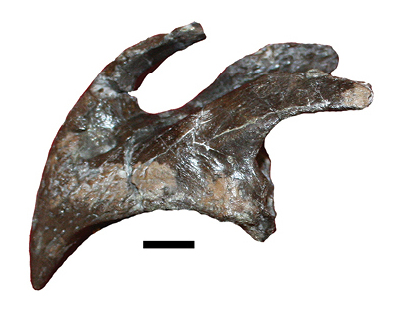

The 2026 study added a partial skull, MTM 2025.1.1. It reaches from the snout tip to the front of the left supratemporal fenestra, an opening on the skull roof. Field crews collected it in 2017, during excavations led by Ősi. The same paper lists a predentary with the front of a dentary (lower jaw bone), plus three more predentaries. It also transfers the bones once called Mochlodon vorosi, including that species’ former holotype—a complete left dentary with four broken teeth. Collected between 2001 and 2011, that material includes jaws, 38 teeth, vertebrae, and limb bones. The new skull, excavated on land owned by the Hungarian Dinosaur Foundation, remains in Hungary.
Ajkaceratops Size and Description
Thanks to the 2026 skull, much of the face of Ajkaceratops is now known. The rest of its body remains far less certain.
Short description of Ajkaceratops
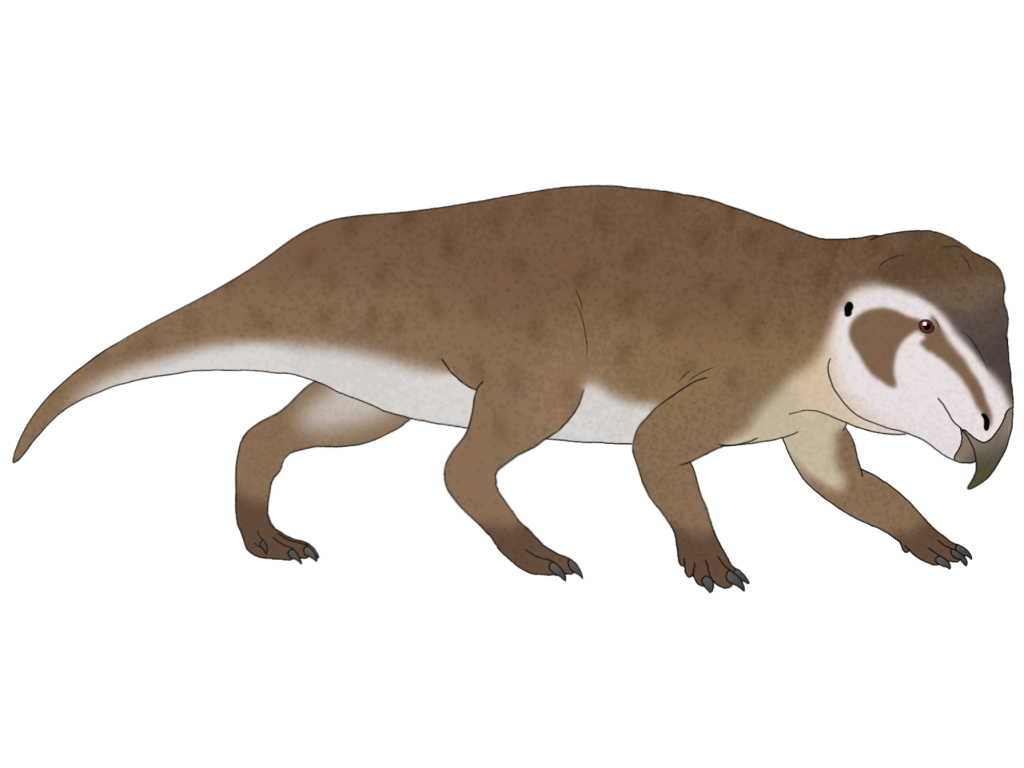
Up front, the premaxillae curved “strongly ventrally into a hook-like rostrum,” as in Archaeoceratops and Bagaceratops. Its hanging tip lacks cutting edges. In 2024, Czepiński and Madzia first noted the tip’s unusual cross-section, which they called “subtriangular.” The 2026 team, describing it as rounded, now treats this trait as unique to the genus. No suture marks a separate rostral bone. It was either absent or fully fused to the premaxillae, perhaps early in growth. The beak surface is heavily pitted, and CT scans reveal “evidence for extensive vasculature”—a rich supply of blood vessels.
Behind the beak, an oval accessory fenestra (an extra skull opening) about 1.6 inches (4 centimeters) long sat between premaxilla and maxilla. The nasals were smooth, and each maxilla held ten tooth sockets. Whether it bore horns or a frill is unknown, because the relevant bones are missing. The 2026 life restoration shows it without the frills and horns of North American ceratopsids. However, the paper offers this only as a “perhaps,” and its authors withdrew an argument against a frill during peer review.
Its posture is equally open—in 2022, Ősi and colleagues called M. vorosi bipedal, but that was before the bones were reassigned.
The teeth are a further puzzle. Upper crowns carry many fine vertical ridges, at least seven on either side of the central one, the authors told reviewers. That central ridge is only slightly stronger, unlike the bold primary ridge of many ceratopsians. A referee called this “very odd for a ceratopsian,” and the authors agreed. Even so, identical teeth and a shared dentary tubercle (a raised bump) convinced them that Mochlodon vorosi was the same animal.
Size and Weight of Type Species
In 2012, Ősi and colleagues estimated an adult length of about 5.2 to 5.9 feet (1.6 to 1.8 meters). They worked from thigh, shin, and upper arm bones then called M. vorosi. For each bone, they scaled the skeleton of the closest relative, which they then took to be a rhabdodontid. The 2012 diagnosis of Mochlodon gave a broader range of about 4.9 to 6.6 feet (1.5 to 2 meters). A 2022 study later repeated that figure.
However, Maidment and colleagues note that those limb bones come from a bone bed. In their words, “some of the material could still prove to be iguanodontian.” No peer-reviewed source gives a height or a weight. The 2010 CORDIS report put the animal at about 55 to 66 pounds (25 to 30 kilograms), but it gave no method.
The new skull’s premaxillae are about 18 percent larger than those of the holotype. Back in 2010, the describers proposed that the largest specimens were plausibly close to fully grown. They cited fused snout bones and “finished” bone surfaces, while cautioning that the animal’s growth stage could not be settled with certainty.
The Dinosaur in Detail
Its 2026 diagnosis lists seven unique traits in the snout and jaws. They include a rounded, hanging snout tip without cutting edges, a deeply concave palate, and sharp predentary margins. Its maxillae would also have met on the midline, keeping the vomer (a palate bone) away from the premaxilla—a common neoceratopsian feature. Meanwhile, its frontals formed just 0.24 inches (6 millimeters) of the eye-socket rim, as in Leptoceratops.

In 2024, Czepiński and Madzia called its ceratopsian likenesses “largely superficial” and its placement “far from certain.” Their analyses tended to place it “within or close to Ceratopsia,” yet some scorings could not narrow it beyond Ornithischia. In 2025, a side analysis by Bertozzo and colleagues moved it into Ornithopoda (duck-billed dinosaurs and kin) when the beak was scored as a premaxilla. Their main analysis kept it a basal ceratopsian.
The 2026 team then grouped it with Ferenceratops, Zuniceratops, and the ceratopsids in several analyses. With Turanoceratops removed, one weighting made it the closest relative of Zuniceratops. Their Bayesian analysis—a probability-based method—joined it with Ferenceratops and Zalmoxes robustus. Forcing the old “rhabdodontids” into Iguanodontia, home of the duck-billed dinosaurs, only produced longer, poorer-fitting trees. The authors told reviewers that their “entire case” rests on these results. In the first round, referee Eric Morschhauser judged the case “a plausible hypothesis” but not yet a “clear” case. After revisions, he found the conclusions “appropriately derived from the results.” Referee Andrew Farke called a ceratopsian identity “most parsimonious.” On current evidence, it stands as a ceratopsian—though after years of dispute, the debate is not yet closed.
Interesting Points about Ajkaceratops
- Its 2010 describers suggested that ceratopsians reached Europe at least twice, with Ajkaceratops perhaps “island-hopping” across the Tethys Ocean.
- The Iharkút species Mochlodon vorosi, named in 2012 as a rhabdodontid, is now treated as Ajkaceratops itself, and the older 2010 name covers both.
- In a 2015 study of the Iharkút bones, Ajkaceratops accounted for just six identified specimens from at least three individuals.
- Maidment’s team digitally restored the crushed skull’s original shape in Blender and deposited the raw CT scans of the 2026 specimen on Zenodo.
- The 2026 authors linked it to a group uniting Zuniceratops, Uzbekistan’s Turanoceratops and the ceratopsids. That group’s common ancestor, they proposed, may have reached North America via Europe before the Turonian stage.
Contemporary Dinosaurs
Sharing the same bone bed was Hungarosaurus, a nodosaurid ankylosaur about 13 to 15 feet (4 to 4.5 meters) long. It is known from several partial skeletons and hundreds of isolated bones. Jaws and teeth of this armored herbivore come from the Szál-6 breccia—the same layer that yielded Ajkaceratops. This flood-laid jumble of clay clasts, pebbles, plant debris, and bones is roughly 12 inches (30 centimeters) thick. In 2022, Ősi and colleagues compared the two through teeth then assigned to M. vorosi. They found that Hungarosaurus ate “softer vegetation,” while the other animal “likely fed on tougher material.” That points to niche partitioning—two plant-eaters drawing on different foods.
Also known from the Csehbánya Formation at Iharkút (exact level relative to Ajkaceratops not known): Pneumatoraptor. This small basal paravian theropod is known only from a single scapulocoracoid (shoulder girdle bone). The Iharkút beds are dated only broadly to the late Santonian, so it may not have lived at the same time.
Ajkaceratops in its Natural Habitat
The world Ajkaceratops roamed was a wet, low-lying alluvial plain, crossed by an anastomosing river system—a web of branching, rejoining channels. Its climate was humid but seasonal—preliminary studies of annual rings in coalified wood point the same way. Forests linked to Normapolles (a group of flowering-plant pollen types) grew over an underwood of herbs and ferns. Trunks related to the Araucariaceae conifers and Pandanites leaves also turn up.
As a herbivore, Ajkaceratops probably browsed low, as its tooth microwear suggests. The 2022 authors put its reach at plants up to about 3.3 feet (1 meter) tall. Compared with Hungarosaurus, it wore away “more than twice as much of its crown volume.” Its dentine was also twice as thick on the working side of each crown. The 2022 authors called this “a novel adaptation for increasing dental durability.” Those measurements come from teeth then called M. vorosi, which the 2026 study treats as Ajkaceratops.
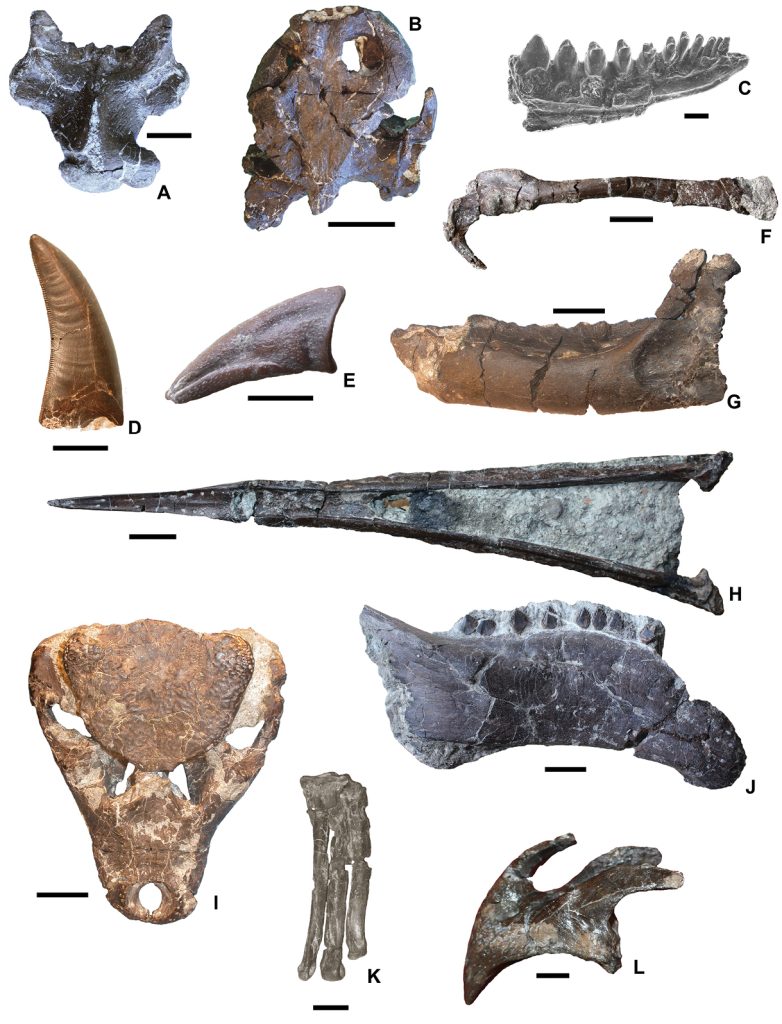

While there is no direct evidence of whether Ajkaceratops moved in groups, it may have kept to different ground than its armored neighbors. Ornithopods and ceratopsians, as the bones were then identified, made up only 6 percent of the dinosaur fauna. Ankylosaurs, by contrast, made up 83 percent. In 2015, Botfalvai and colleagues suggested that the rarer plant-eaters lived in “distal, drier habitats.” Other dinosaurs include a smaller nodosaurid tentatively referred to Struthiosaurus, unnamed abelisaurid and tetanuran theropods, and enantiornithine birds such as Bauxitornis. Beyond the dinosaurs, the fauna included fishes, frogs, the turtle Foxemys, the freshwater mosasauroid Pannoniasaurus, crocodyliforms, and the pterosaur Bakonydraco. Across the European islands, the 2026 authors argue, horned and duck-billed dinosaurs shared “mid-to-large-sized herbivore roles,” as they did elsewhere in the north.
Frequently Asked Questions
According to a 2010 CORDIS report, it honors Ajka, the hometown of describer Attila Ősi, while kozmai honors geologist Károly Kozma.
It lived in the late Santonian stage of the Late Cretaceous, roughly 85 to 84 million years ago.
A 2012 estimate from bones now referred to it puts it at about 5.2 to 5.9 feet long. No published study has estimated its height or weight.
It was a herbivore, and tooth wear suggests it browsed low on tough plant material.
It comes from the Csehbánya Formation at Iharkút, a former bauxite mine in the Bakony Mountains of western Hungary.
It was described as a ceratopsian in 2010, then disputed. A 2026 study again recovered it as a ceratopsian.
Sources
The information in this article is based on various sources, drawing on scientific research, fossil evidence, and expert analysis. The aim is to provide a comprehensive and accurate overview of Ajkaceratops. However, please be aware that our understanding of dinosaurs and their world is constantly evolving as new discoveries are made.
- https://doi.org/10.1038/nature09019
- https://static-content.springer.com/esm/art%3A10.1038%2Fnature09019/MediaObjects/41586_2010_BFnature09019_MOESM292_ESM.pdf
- https://doi.org/10.1038/s41586-025-09897-w
- https://research.birmingham.ac.uk/en/publications/a-hidden-diversity-of-ceratopsian-dinosaurs-in-late-cretaceous-eu/
- https://static-content.springer.com/esm/art%3A10.1038%2Fs41586-025-09897-w/MediaObjects/41586_2025_9897_MOESM1_ESM.pdf
- https://static-content.springer.com/esm/art%3A10.1038%2Fs41586-025-09897-w/MediaObjects/41586_2025_9897_MOESM2_ESM.pdf
- https://static-content.springer.com/esm/art%3A10.1038%2Fs41586-025-09897-w/MediaObjects/41586_2025_9897_MOESM5_ESM.pdf
- https://doi.org/10.1093/zoolinnean/zlae048
- https://doi.org/10.1371/journal.pone.0044318
- https://doi.org/10.1038/s41598-022-24816-z
- https://pure-oai.bham.ac.uk/ws/files/283325488/Maidment_et_al._in_press.pdf
- https://doi.org/10.3897/zookeys.469.8439
- https://doi.org/10.1016/j.palaeo.2014.09.032
- https://doi.org/10.1016/j.palaeo.2015.10.018
- https://doi.org/10.1007/s12549-018-0362-z
- https://doi.org/10.1371/journal.pone.0312519
- https://doi.org/10.1038/s41598-025-98083-z
- https://stratigraphy.org/ICSchart/ChronostratChart2024-12.pdf
- https://www.cordis.europa.eu/article/id/32251-hungarian-scientists-discover-islandhopping-dinosaur
- https://www.birmingham.ac.uk/news/2025/scientists-uncover-first-clear-evidence-of-horned-dinosaurs-in-cretaceous-europe
- https://www.nhm.ac.uk/discover/news/2026/january/europes-missing-ceratopsian-dinosaurs-have-finally-been-found.html
This article was last fact checked: TheDinosaurs Team, 21-11-2026
Featured Image Credit: MakairodonX, CC BY 4.0, via Wikimedia Commons
