
In Jianchang County, in western Liaoning Province, China, the Yixian Formation yielded a remarkable fossil. It is a young therizinosaur that its describers called the most complete articulated skeleton of any member of the group. Named Jianchangosaurus yixianensis in 2013, this gracile theropod lived during the Early Cretaceous, probably in the Barremian stage. Its describers placed it near the base of Therizinosauria, just one step above Falcarius. Meanwhile, its jaws pair a toothless tip with teeth set like those of an ornithischian, or “bird-hipped,” dinosaur.
The Henan Geological Museum bought the skeleton. Paleontologist Hanyong Pu and seven colleagues described it in PLoS ONE in 2013. However, one later study has questioned its standing as a separate genus. In 2024, paleontologist Andrea Cau provisionally treated it as a junior synonym of Beipiaosaurus—in effect, a young Beipiaosaurus whose differences, in his view, largely reflect age and size. Other studies before and after his treat the two as separate, and no published study has yet tested his proposal.
Jianchangosaurus Key Facts
| Keyword | Fact |
|---|---|
| Pronunciation | Not specified |
| Meaning of name | Jianchang Lizard |
| Group | Theropoda (Therizinosauria) |
| Type Species | Jianchangosaurus yixianensis |
| Diet | Herbivore |
| When it Lived | Probably about 125.7 to 124.1 MYA |
| Period | Cretaceous |
| Epoch | Early Cretaceous (probably Barremian stage) |
| Length | About 6.6 feet (2 meters) |
| Height | About 3.3 feet (1 meter) at the hips |
| Weight | Not specified |
| Mobility | Moved on two legs (bipedal) |
| First Discovery | Year not specified |
| Described by | 2013 by H. Pu, Y. Kobayashi, J. Lü, L. Xu, Y. Wu, H. Chang, J. Zhang, and S. Jia |
| Holotype | 41HIII-0308A (Henan Geological Museum) |
| Location of first find | Niujiaogou, Jianchang County, western Liaoning Province, China (Yixian Formation) |
Jianchangosaurus Origins, Taxonomy and Timeline
The name Jianchangosaurus comes from geography. “Jianchang” refers to the county of Liaoning Province where the specimen came to light, while “saurus” means “lizard.” The species name yixianensis refers to the Yixian Formation, the rock unit that yielded the skeleton.
Pu and colleagues placed it within Theropoda, Coelurosauria, and Therizinosauria. Their analysis returned 40 most parsimonious trees—the simplest solutions for the data—whose consensus put it at the base of the group. It sat one step above Falcarius as the sister taxon (closest relative) of Therizinosauroidea, the clade of Beipiaosaurus and later forms. In 2019, Hartman and colleagues recovered Falcarius, Jianchangosaurus, Beipiaosaurus, and Alxasaurus as successively closer to therizinosaurids. Jianchangosaurus yixianensis is the type and only known species.
Cau’s 2024 study reads the fossil differently. In his reading, both animals come from the Yixian Formation and differ mainly in size and body proportions. Several stated differences, he judged, depend on age or size, such as a skull longer than the femur and slender hand claws. Accordingly, he provisionally coded the holotype into Beipiaosaurus as the source of its immature features. Earlier, Yao’s team in 2019 and Liao’s team in 2021 had treated it as separate. In 2026, Liao and colleagues continued to treat it as a distinct species.
Pu’s team gave the holotype’s age only as Early Cretaceous, though they described the Yixian Formation as Barremian. The Niujiaogou beds remain undated, but in the Jin-Yang basin the Yixian Formation formed between about 125.76 and 124.12 million years ago. Those dates fall within, or at the very start of, the Barremian stage, so a Barremian age is likely. Still, Yao and colleagues caution that the Jehol therizinosaur beds lack precise dates. Together, they note, the Yixian and Jiufotang formations span at least eight million years.
Discovery & Fossil Evidence
The skeleton comes from Niujiaogou, a site in Jianchang County within the Yixian Formation of western Liaoning. Pu and colleagues name neither a member nor a bed, nor a collector or discovery date. Instead, the Henan Geological Museum in Zhengzhou bought the specimen. The manuscript reached the journal on March 25, 2012, and the paper went online on May 29, 2013.
Cataloged as 41HIII-0308A, the holotype is a nearly complete juvenile skeleton with its skull and mandibles (lower jaws). It lacks only the distal—far—end of the tail, and every vertebra survives back to the eleventh caudal (tail) vertebra. Pu’s team read its youth from open sutures in the neck and back vertebrae and from unfused neck ribs. Feather impressions, a pair of hyoids (throat bones), and two concretions also survive.
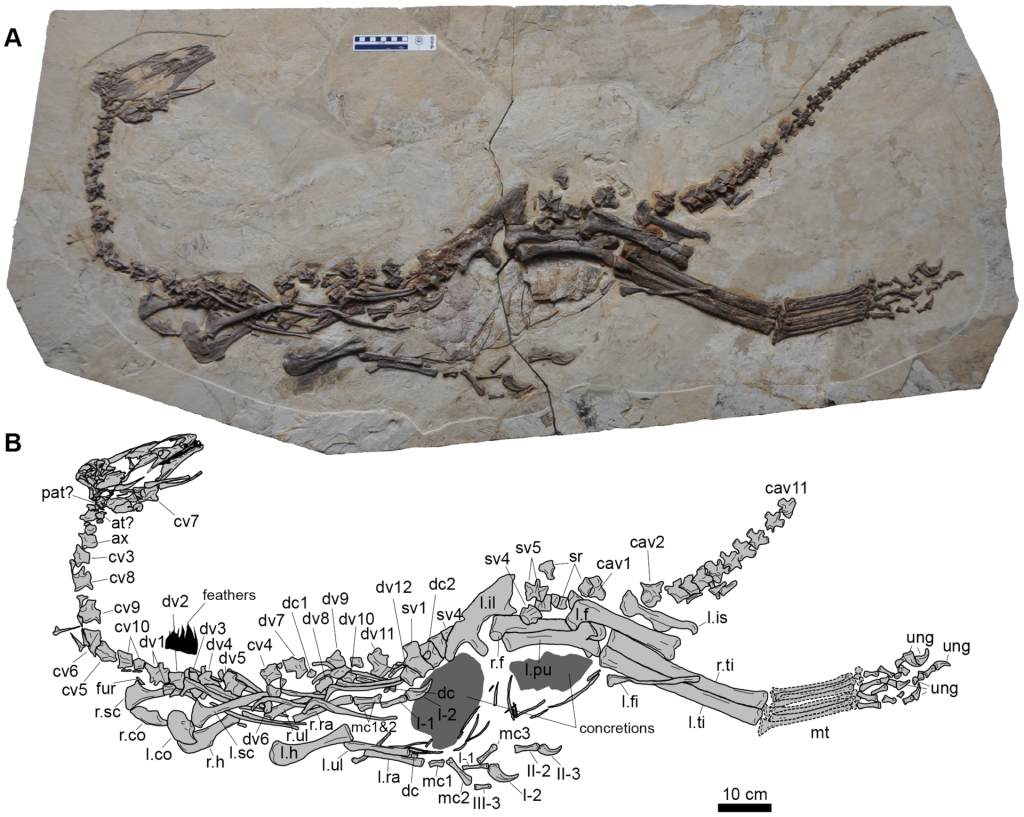

Preparation left its mark on the fossil. Some bones apparently moved during that work, including the middle neck vertebrae and the toe bones. Even so, one neck vertebra had already shifted before burial. In addition, most metatarsals (upper foot bones) appear partly reconstructed. Thick coatings partly cover them, however, so this cannot be confirmed. Despite this, the authors argued for a single individual, because the vertebrae match in size and no bones overlap. No other specimen has been referred to Jianchangosaurus.
Jianchangosaurus Size and Description
Although only a single young animal represents it, Jianchangosaurus preserves nearly its whole body plan.
Short description of Jianchangosaurus
The skull measured about 9.1 inches (230 millimeters) long—longer than the femur, or thigh bone, unlike in Beipiaosaurus. Its premaxilla, the bone at the tip of the upper jaw, carried no teeth. Pu’s team reconstructed a rhamphotheca (horny beak) over that area, since the toothless bone and its small openings may indicate one. Behind it sat 27 maxillary (upper jaw) teeth, while each dentary (lower jaw bone) held an estimated 25 to 28.
Ten cervical (neck) vertebrae formed a neck about 17 inches (440 millimeters) long. The body behind it measured about 20 inches (510 millimeters). Five sacral (hip) vertebrae supported a low ilium (upper hip bone) with a nearly flat top edge—unlike that of any other therizinosaur. Its pubis pointed forward and down rather than backward. On each hand, the claws had a curved, narrow shape, and the first-finger claw outsized that of the second finger.
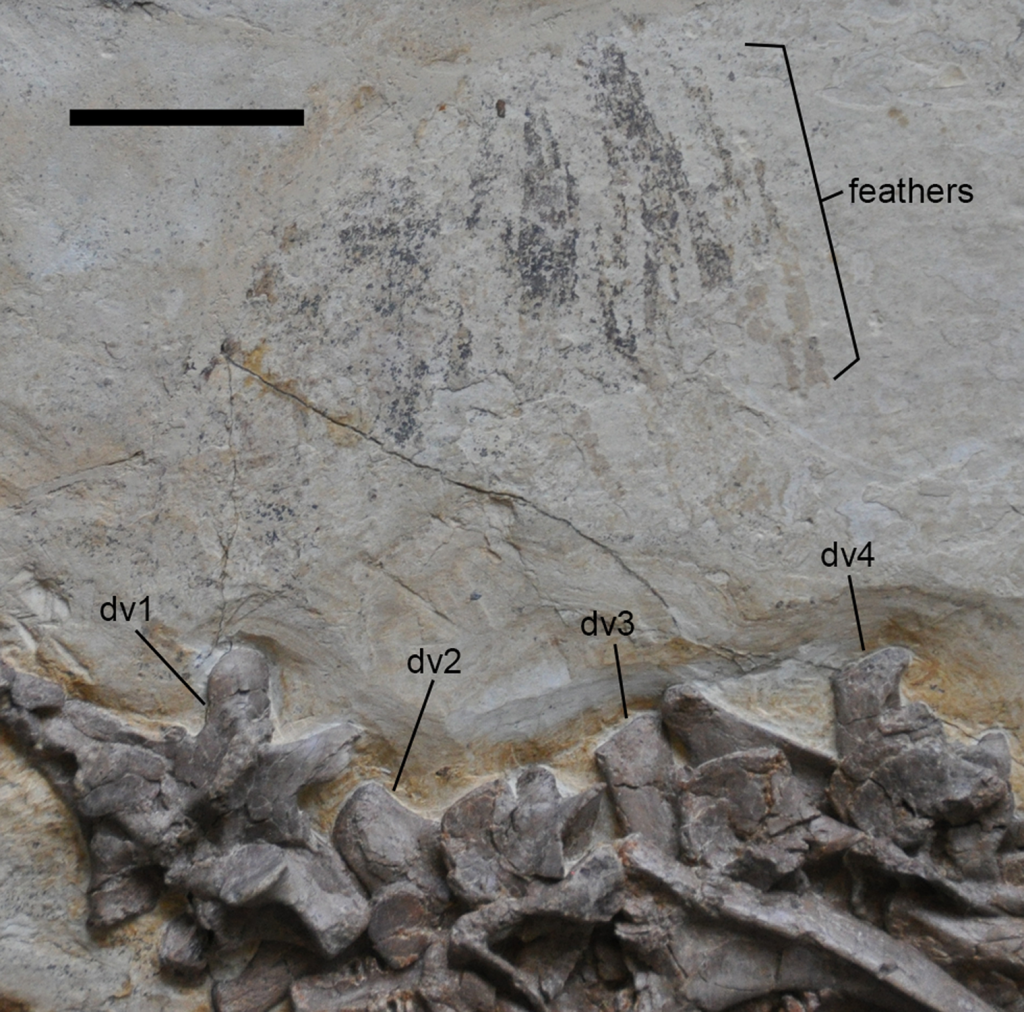
Carbonized feather impressions lie above the first few back vertebrae. Wide and unbranched, they measure 2 to 3 millimeters across and recall the broad filaments of Beipiaosaurus. Their length of about 3.9 inches (10 centimeters) is only an estimate, because preparation destroyed their bases.

Size and Weight of Type Species
Pu and colleagues estimated it at about 6.6 feet (2 meters) long and 3.3 feet (1 meter) tall at the hips. From the skull to the eleventh tail vertebra, the preserved skeleton spans about 6.2 feet (1.88 meters)—the tail tip is missing.
Pu and colleagues gave no weight estimate, though they described it as gracile and shorter than Falcarius utahensis.
All of these figures describe a juvenile, so the size of a fully grown adult remains unknown. For comparison, Liao and colleagues reported in 2026 on Kayrasaurus, another Yixian therizinosaur. It was at least 1.6 times larger than Beipiaosaurus, the second-largest of the Jehol therizinosaurs.
The Dinosaur in Detail
What sets this dinosaur apart is its dentition. From the seventh dentary tooth backward, the crown shape flips—concave on the cheek side and convex on the tongue side. A shelf also insets the tooth row, as in ornithopods and ceratopsians. The teeth themselves were small and lanceolate (lance-shaped), with about three denticles (serrations) per millimeter, as in Beipiaosaurus. Unlike Falcarius, it had no enlarged front teeth.
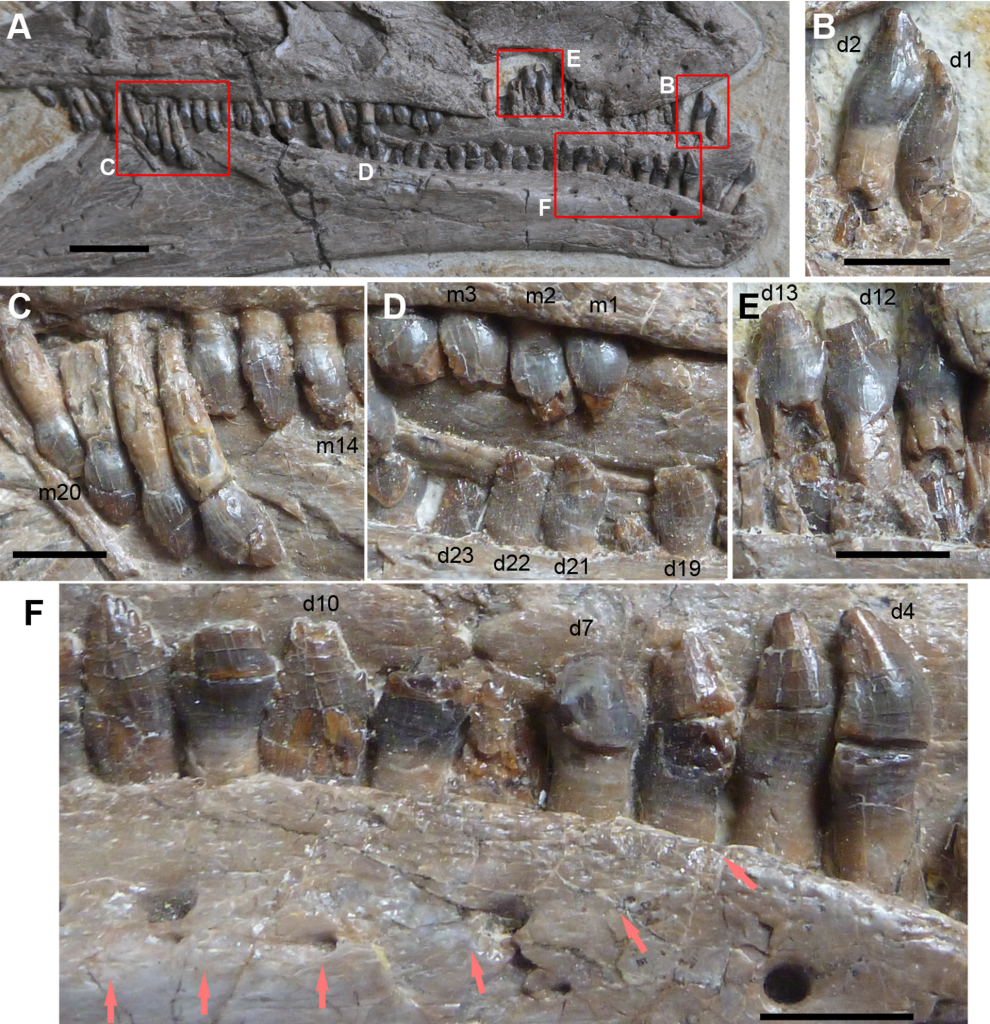

Pu and colleagues proposed that the front of the jaw might have plucked food such as plant material. Farther back, they argued, abutting tooth tips likely maximized biting stress to cut plant fibers. From this, they suggested that Jianchangosaurus may have adapted to herbivory in a different way than other therizinosaurs.
Its legs add another twist. The tibia (shin bone) is about 1.5 times the length of the femur—the highest ratio its describers knew in any therizinosaur. They read this as a sign of possible cursoriality, or adaptation for running, in early therizinosaurs. Their analysis also found five autapomorphies (unique traits), including oval front tail vertebrae and a straight ulna (forearm bone).
Overall, its skull looks more herbivorous than that of Falcarius, but its hips stayed primitive. Pu and colleagues argued that herbivorous adaptations in the therizinosaur skull evolved before changes in the rest of the skeleton. Either way, that mix of primitive and derived traits makes it a useful reference for early therizinosaur evolution.
Interesting Points about Jianchangosaurus
- Its species name, yixianensis, refers to the Yixian Formation, the rock unit in western Liaoning that yielded its only known skeleton.
- It has five of the eleven features that, in Pu’s analysis, support Therizinosauria, such as a rectangular buttress on its first metacarpal.
- Two whitish concretions lie in its body cavity, but the describers offered no interpretation of what they were.
- Its broad, unbranched back feathers resemble those of Beipiaosaurus and, according to its describers, might have served for visual display.
- Its paired hyoids measure about 3.5 inches (88.8 millimeters), roughly two-fifths the length of its skull.
Dinosaurs from the Same Formation
Also known from the Yixian Formation (exact level relative to Jianchangosaurus not known): Beipiaosaurus, Kayrasaurus, Haolong, Sinosauropteryx, and Yutyrannus. Among them, Beipiaosaurus is a therizinosauroid with integumentary (skin-covering) structures, and Pu’s team noted one specimen from the same town, Jianchang. In contrast, Haolong was an iguanodontian with preserved skin and cutaneous spikes. When described in detail in 1998, Sinosauropteryx had the longest tail of any known theropod. Three nearly complete skeletons represent Yutyrannus, a gigantic early tyrannosauroid. In the Jin-Yang basin, where it has precise dates, the formation spans only about 1.6 million years. Still, not every site has dated beds—Niujiaogou among them—so these animals may not all have lived at the same time.
Jianchangosaurus in its Natural Habitat
The world Jianchangosaurus knew took its shape from lakes and volcanoes. Lake and occasionally river sediments buried the Jehol Biota in a volcanic-influenced setting. In finely layered lake beds, Yixian fossils lie flattened with feathers and even color preserved, while more massive deposits hold three-dimensional skeletons. In 2024, MacLennan and colleagues argued against repeated Pompeii-like disasters—the formation instead records a brief snapshot of normal life and death. Across their study area, fossil-rich intervals match periods of high rainfall.
Pu’s team inferred its diet from the jaws, which they judged built for a more herbivorous diet than those of Falcarius. In 2026, Liao and colleagues grouped it with Lingyuanosaurus, another Jehol therizinosaur—both display traits linked to greater cursoriality and forelimb-based foraging. They set this against Beipiaosaurus, and possibly Kayrasaurus, which show signs of enhanced bite force—hypotheses they say need further testing.
Co-occurring therizinosaurs, Pu’s team suggested, may have shared space by feeding differently. Still, no direct evidence shows how these animals divided their food. Yao and colleagues later offered three explanations for three therizinosaurs in one area. The animals may have been separated in time, or kept apart by barriers between the small basins of the Jehol Group. Alternatively, they may have occupied different niches, with Beipiaosaurus less cursorial than Lingyuanosaurus and Jianchangosaurus.
Even the age of Lingyuanosaurus is uncertain. It comes from Sihedang, as does the large, short-armed, winged dromaeosaurid Zhenyuanlong. Yet the Sihedang beds remain disputed—some studies assign them to the Yixian Formation and others to the Jiufotang Formation.
Frequently Asked Questions
It means “Jianchang lizard,” after the county in Liaoning where the skeleton came from, while yixianensis refers to the Yixian Formation.
It lived in the Early Cretaceous, probably about 125.7 to 124.1 million years ago, although its local beds lack direct dates.
Its describers estimated the juvenile holotype at about 6.6 feet long and 3.3 feet tall at the hips. They gave no weight estimate.
It was probably a herbivore. Its describers inferred this from its toothless jaw tip and plant-cutting teeth rather than from preserved food.
It comes from Niujiaogou in Jianchang County, western Liaoning Province, China, in rocks of the Yixian Formation.
Most studies treat it as valid. In 2024, Cau provisionally treated it as a juvenile Beipiaosaurus, but Liao and colleagues still treated it as a separate species in 2026.
Sources
The information in this article is based on various sources, drawing on scientific research, fossil evidence, and expert analysis. The aim is to provide a comprehensive and accurate overview of Jianchangosaurus. However, please be aware that our understanding of dinosaurs and their world is constantly evolving as new discoveries are made.
- https://doi.org/10.1371/journal.pone.0063423
- https://pmc.ncbi.nlm.nih.gov/articles/PMC3667168/
- https://journals.plos.org/plosone/article/file?type=supplementary&id=10.1371/journal.pone.0063423.s001
- https://www.paleoitalia.it/wp-content/uploads/2024/05/01_Cau_2024_BSPI_631.pdf
- https://pmc.ncbi.nlm.nih.gov/articles/PMC6430829/
- https://pmc.ncbi.nlm.nih.gov/articles/PMC8483305/
- https://pmc.ncbi.nlm.nih.gov/articles/PMC6626525/
- https://doi.org/10.1080/14772019.2026.2710287
- https://pmc.ncbi.nlm.nih.gov/articles/PMC8288181/
- https://doi.org/10.1073/pnas.2322875121
- https://www.nature.com/articles/20670
- https://www.nature.com/articles/34356
- https://doi.org/10.1038/nature10906
- https://pmc.ncbi.nlm.nih.gov/articles/PMC4504142/
- https://doi.org/10.1038/s41559-025-02960-9
- https://static-content.springer.com/esm/art%3A10.1038%2Fs41559-025-02960-9/MediaObjects/41559_2025_2960_MOESM1_ESM.pdf
- https://stratigraphy.org/chart
This article was last fact checked: TheDinosaurs Team, 21-11-2026
Featured Image Credit: PaleoNeolitic, CC BY 4.0, via Wikimedia Commons
