
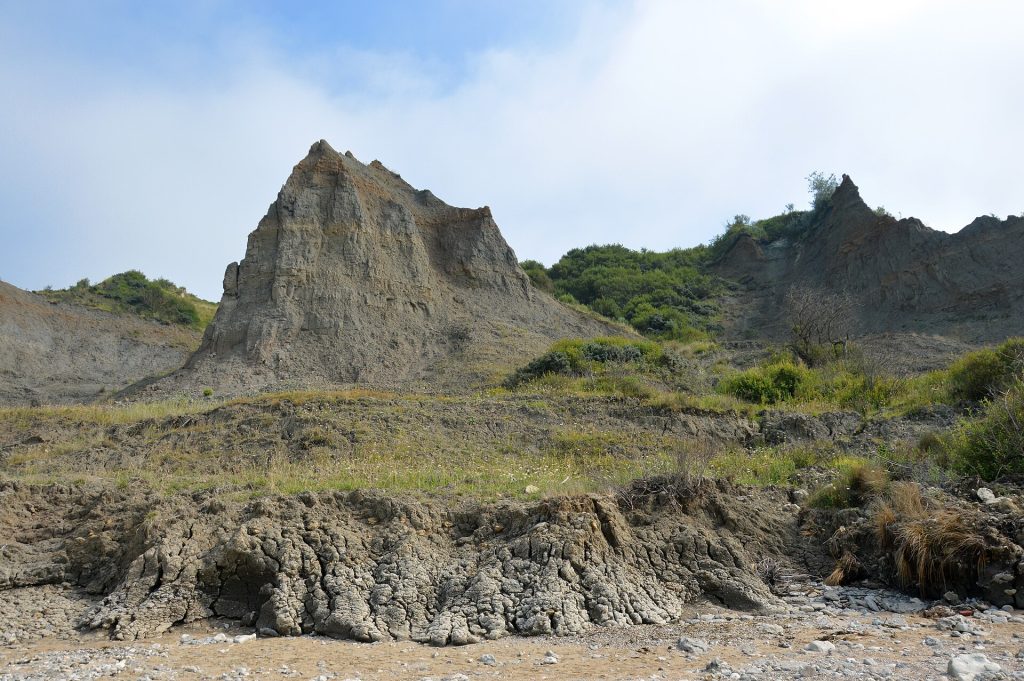
Between Villers-sur-Mer and Houlgate in Normandy, the marls of the Vaches Noires cliffs have yielded fossils since the early 1700s. Among them is Streptospondylus altdorfensis, a meat-eating theropod from the late Callovian or early Oxfordian stage. That places it near the boundary between the Middle and Late Jurassic, around 161.5 million years ago. Its bones rank among the first dinosaur remains ever described, although no one recognized them as dinosaur bones at the time.
The story began in the 1770s, when the Abbé Charles Bacheley gathered fossil bones near Honfleur. He took at least some of them for the remains of “fishes”—cetaceans such as dolphins or sperm whales. In 1808, naturalist Georges Cuvier described the theropod bones as an unknown crocodile. Then, in 1832, Hermann von Meyer gave them a name. Starting with Cope in 1867, later authors recognized the bones as a dinosaur’s. In 2001, paleontologist Ronan Allain confirmed S. altdorfensis as their valid name and made the bones its name-bearing type. Its history doubles as a short course in how paleontology itself grew up.
Streptospondylus Key Facts
| Keyword | Fact |
|---|---|
| Pronunciation | Not specified |
| Meaning of name | Named for Its Peculiar Vertebrae |
| Group | Theropoda (Megalosauroidea) |
| Type Species | Streptospondylus altdorfensis |
| Diet | Carnivore |
| When it Lived | Around 161.5 MYA (late Callovian or early Oxfordian) |
| Period | Jurassic |
| Epoch | Middle–Late Jurassic (late Callovian–early Oxfordian stages) |
| Length | About 19.7 feet (6 meters), indirect estimate |
| Height | Not specified |
| Weight | About 1,100 pounds (500 kilograms), indirect estimate |
| Mobility | Moved on two legs (bipedal) |
| First Discovery | 1770s by the Abbé Charles Bacheley |
| Described by | 1832 by C.E.H. von Meyer, redescribed in 2001 by R. Allain |
| Holotype | None—lectotype MNHN 8605–8609, 8787–8789, 8793, 8794 and 8907, designated by Allain (2001) |
| Location of first find | Vaches Noires cliffs (Marnes de Dives or Marnes de Villers), Calvados, Normandy, France |
Streptospondylus Origins, Taxonomy and Timeline
Von Meyer explained that he named Streptospondylus after the peculiar form of its vertebrae. Its front vertebrae had a convex front joint and a concave rear one—”exactly reversed” from crocodiles. The species name altdorfensis fits less well. It refers to teleosaur skulls from Altdorf in Bavaria that von Meyer wrongly linked to the same animal. As early as 1837, Bronn noted that it does not suit the Normandy bones. Together, the name records a sharp observation and an early mistake.
Von Meyer did not see a dinosaur, judging it a saurian “not even suited to form a subgenus of Crocodilus.” He grouped it with Metriorhynchus among saurians with flipper-like limbs. His species was also a composite, mixing theropod vertebrae with teleosaurs—long-snouted marine crocodile relatives. Allain restricted the name to the theropod bones and placed them in Spinosauroidea, close to Eustreptospondylus from England. Later, Rauhut, Hübner, and Lanser (2016) treated it as a megalosauroid incertae sedis, meaning of uncertain placement. S. altdorfensis is the type and only valid species. In 1842, Owen coined S. cuvieri for half a back vertebra from Chipping Norton in England. However, Owen never figured that bone and it has since vanished, so the name is a nomen dubium—too poorly founded to use.
Allain dated the original bones to the late Callovian or early Oxfordian, around 161.5 million years ago. In 2022, Monvoisin and colleagues noted that heavy pyrite on the type bones hints at a Callovian origin, but this cannot be confirmed. With no single bed known, stages work better than one date. Even the labels differ—Allain’s keywords say Late Jurassic, while a 2003 review of French dinosaurs lists it as Middle Jurassic. At that time, Europe was an archipelago in the Tethys Sea.
Discovery & Fossil Evidence
Most of the bones come from Bacheley’s 1770s collection, which held a teleosaur, a metriorhynchid, and a few theropod bones. After his death, the collection went to the École Centrale de Rouen, and Louis-Benoît Guersent later informed Cuvier about it. Count Beugnot then ordered its transfer to the Muséum national d’Histoire naturelle (MNHN) in Paris. The old labels said only “near Honfleur,” but Brignon (2016) confirmed a Vaches Noires origin.

In 1824, Cuvier figured the vertebrae with the “Gavial d’Honfleur,” a crocodile, but placed the pubis, tibia, and ankle bones with Buckland’s Megalosaurus. Much later, Walker (1964) referred Cuvier’s theropod bones to a new species, Eustreptospondylus divesensis. Its type, a braincase from the same cliffs, is now Piveteausaurus divesensis. Allain rejected Walker’s referral. Because von Meyer named no holotype, Allain chose the theropod bones as the lectotype—a name-bearing specimen picked later. They include MNHN 8787 to 8789, 8793, 8794, 8907, and 8605 to 8609. Monvoisin and colleagues cite them under the museum’s current numbers, MNHN.F.RJN78 to RJN92.
The lectotype includes the last cervical (neck) vertebra and the first two dorsals (back vertebrae). It also preserves the last dorsal with the first two sacrals (hip vertebrae) and the last sacral with the first caudal (tail vertebra). Three linked dorsals and three loose centra (vertebral bodies) complete the spine. The lower ends of the left pubis, right fibula, and right tibia join the right astragalus and calcaneum (ankle bones). A femur end, MNHN 9645, came from a seminary in Beauvais, so only matching rock ties it to the lectotype. Monvoisin and colleagues also tentatively referred more vertebrae and a tibia, which would extend the genus into the early Oxfordian. Collectors rarely find bones here in place—most turn up on the beach after marl flows mix the layers.
Streptospondylus Size and Description
Without a skull, any portrait of Streptospondylus starts from its backbone, hips, and lower legs.
Short description of Streptospondylus
No one has found a skull, and before 2022 the genus rested entirely on bones held in Paris. Its front dorsal vertebrae were strongly opisthocoelous (convex at the front) and flat underneath. Each carried two hypapophyses, small projections on the underside, while the rear dorsals were platycoelous (flat at both ends). The middle and rear dorsal centra were long, and the first dorsal centrum measures 2.3 inches (58 millimeters). Along its side runs a deep pleurocoel (an air-sac pocket) about 1.4 inches (35 millimeters) long.
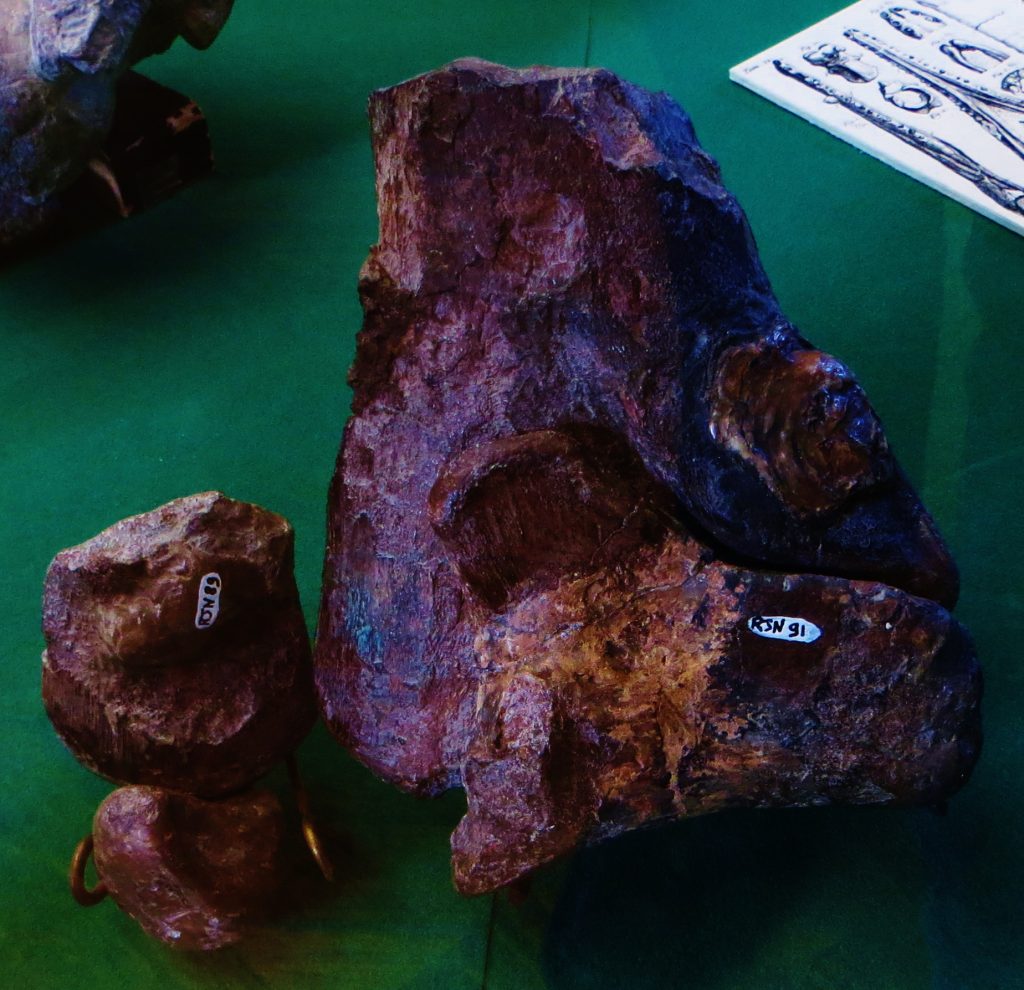

Lower down, the end of the pubis is triangular in section, as in Allosaurus, with only a small rearward expansion. On the lower tibia, a bony rim overhangs the astragalus’s ascending process but does not extend far toward the outer side. The astragalus itself lacks a rear inner process. Like all known theropods, it would have walked on two legs. Because only bones survive, any skin or color in reconstructions is speculative.
Size and Weight of Type Species
Allain described Streptospondylus simply as a “medium-sized theropod,” and neither he nor von Meyer gave a length or a mass. Some neurocentral sutures (seams between vertebral body and arch) remain open, which could mean the type was not fully grown.
The bones themselves are hefty—the largest dorsal centrum measures 3.8 inches (97 millimeters) long, and the lower tibia is 5.5 inches (140 millimeters) wide. In 2026, Boisvert and colleagues listed about 19.7 feet (6 meters) and 1,100 pounds (500 kilograms). That figure is indirect, drawn from earlier estimates and comparisons with related species, and no source gives a height.
Adults may have been much larger, since in 2022 Monvoisin and colleagues suggested that it could reach the size range of Torvosaurus when mature. That idea rests on large, tentatively referred bones such as a 5.5-inch (140-millimeter) dorsal centrum. Consequently, the size of a full-grown Streptospondylus remains open.
The Dinosaur in Detail
One of the most distinctive features of Streptospondylus is the pair of hypapophyses on its front dorsals. While Allosaurus and Sinraptor also have two, Allain found a well-separated pair that does not continue a ventral keel in no other theropod except Eustreptospondylus. The front dorsal centra also lack a ventral keel, and among tetanurans only these two genera share that absence. Remarkably, von Meyer had already noticed in 1832 that these vertebrae carry two ridges underneath instead of a single keel. There is also no hyposphene–hypantrum articulation—an extra interlocking joint between vertebrae—between the first dorsals.
In 2022, Monvoisin and colleagues identified a double pleurocentral depression on the dorsal centra as an autapomorphy, or unique defining trait. Yet they note the same feature in Eustreptospondylus, which points to a close link between the two. In the ankle, Rauhut’s team found the astragalus similar to that of the German Wiehenvenator. Its ascending process, though, is lower and lacks its sharp kink.
Placing Streptospondylus on the family tree has proved stubborn. According to Lacerda and colleagues (2023), a 2012 analysis by Carrano, Benson, and Sampson treated it as a “wildcard” whose shifting position unsettled the results. Likewise, Hendrickx and Mateus (2014) and Chokchaloemwong and colleagues (2019) pruned it from their trees. Rauhut’s team recovered a clean Megalosauridae only after removing it. In a constrained 2025 analysis, Zou and colleagues placed it with Eustreptospondylus in a polytomy—an unresolved branching point—at the base of Megalosauridae.
Monvoisin and colleagues even ask whether the two deserve separate genera, a question a direct comparison could test, especially if the differences reflect growth stages. The evidence ties Streptospondylus tightly to Eustreptospondylus while leaving its wider ancestry unsettled.
Interesting Points about Streptospondylus
- According to Allain, Streptospondylus was the first theropod to receive a binomial name, although Megalosaurus has priority as a genus.
- Cuvier mistook its pubis for a fibula, and later researchers called it an ulna until Walker corrected them in 1964.
- Von Meyer named the genus for its front vertebrae, whose joint surfaces curve the reverse way from those of crocodiles.
- The species name points not to Normandy but to Altdorf in Bavaria, source of teleosaur skulls wrongly linked to it.
- Monvoisin and colleagues counted up to four possible Streptospondylus individuals among the Vaches Noires finds, though only one is a large adult bigger than the type.
Dinosaurs from the Same Formation
Also known from the Vaches Noires cliffs (exact level relative to Streptospondylus not known): Piveteausaurus divesensis, a large theropod known from one braincase. Researchers dispute its affinities, with some studies favoring Megalosauroidea and Allain preferring Allosauroidea. However, Monvoisin and colleagues note that it “might even be a braincase of Streptospondylus,” though from a much bigger animal. It may therefore be a separate predator or simply a larger Streptospondylus. The fossil-bearing marls span the late Callovian to early Oxfordian, so these finds may not all date from the same time.
Streptospondylus in its Natural Habitat
Its world was a coastline of islands, and the Vaches Noires marls are marine sediments full of ammonites, bivalves, and marine reptiles. Like other dinosaurs here, its carcass likely drifted out from the Armorican Massif, at most a few dozen kilometers away. Some bones lay on the seabed until oysters and serpulid worms encrusted them—a vivid example of how dinosaur fossils formed. Meanwhile, studies of Armorican plant fossils indicate that coastal forests grew on that land.
While there is no direct evidence of what Streptospondylus ate, Monvoisin and colleagues call the large theropods here apex predators. They also raised one possibility—that theropods frequented shorelines to feed on beached carcasses. Still, they considered a small-sample effect more likely to explain why so many theropods ended up at sea.
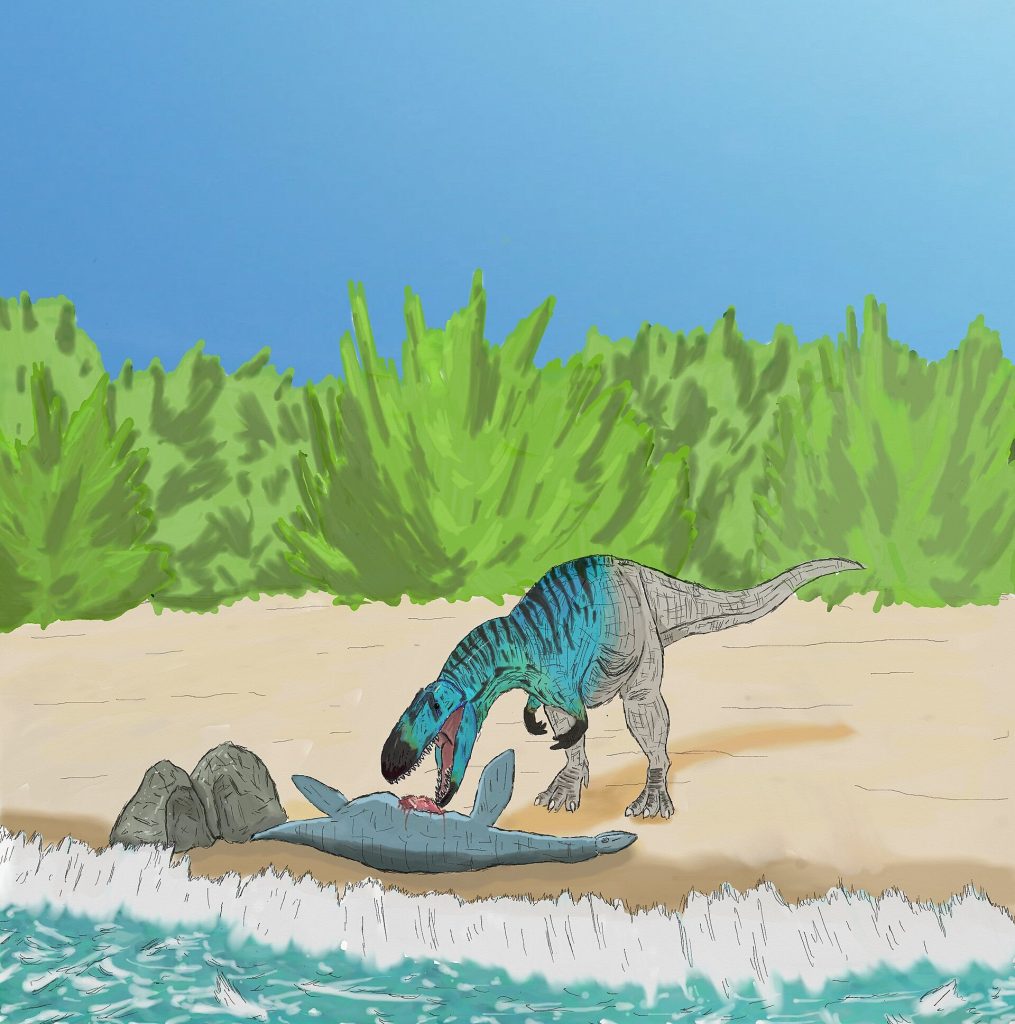

Its social life remains unknown, but as a group, megalosauroids may have preferred nearshore settings, whereas allosauroids tended to live inland. The cliffs record at least three theropod kinds and eight individuals, including an unnamed allosauroid and a megalosaurid close to Torvosaurus. That giant’s femur may have reached 3.3 feet (one meter), probably the largest theropod femur from France. Herbivores are scarce—two late Callovian vertebrae, very probably from a stegosaur, and two sauropod vertebrae, one destroyed in the 1944 bombings. Offshore, teleosaurs and metriorhynchids—sea-going crocodile relatives—shared these waters. Overall, the theropod-heavy record may reflect a small sample rather than the real balance of life on land.
Frequently Asked Questions
Von Meyer named it for its peculiar vertebrae, whose joint surfaces curve the reverse way from a crocodile’s.
It lived in the late Callovian or early Oxfordian, near the Middle–Late Jurassic boundary, around 161.5 million years ago.
Allain called it medium-sized. One 2026 dataset gives an indirect estimate of about 19.7 feet and about 1,100 pounds.
It was a carnivore, and Monvoisin and colleagues regard the large theropods of the Vaches Noires as apex predators.
Its bones come from the Vaches Noires cliffs between Villers-sur-Mer and Houlgate in Calvados, Normandy, France.
It was a megalosauroid theropod, very close to Eustreptospondylus, though its exact position remains uncertain.
Sources
The information in this article is based on various sources, drawing on scientific research, fossil evidence, and expert analysis. The aim is to provide a comprehensive and accurate overview of Streptospondylus. However, please be aware that our understanding of dinosaurs and their world is constantly evolving as new discoveries are made.
- https://www.e-rara.ch/zut/content/pagetext/4587033
- https://www.e-rara.ch/zut/content/pagetext/4587154
- https://sciencepress.mnhn.fr/sites/default/files/articles/pdf/g2001n3a3.pdf
- https://sciencepress.mnhn.fr/sites/default/files/articles/pdf/g2022v44a12.pdf
- https://doi.org/10.1016/j.crpv.2015.10.004
- https://doi.org/10.1016/j.crpv.2019.04.009
- https://doi.org/10.1016/S1631-0683(03)00002-2
- https://palaeo-electronica.org/content/pdfs/654.pdf
- https://pmc.ncbi.nlm.nih.gov/articles/PMC10427828/
- https://pmc.ncbi.nlm.nih.gov/articles/PMC3943790/
- https://pmc.ncbi.nlm.nih.gov/articles/PMC6784982/
- https://pmc.ncbi.nlm.nih.gov/articles/PMC11971988/
- https://pmc.ncbi.nlm.nih.gov/articles/PMC13070321/
- https://stratigraphy.org/ICSchart/ChronostratChart2024-12.pdf
This article was last fact checked: TheDinosaurs Team, 21-11-2026
Featured Image Credit: Atlantis536, CC0, via Wikimedia Commons
