
In the Zuni Basin of west-central New Mexico, the coal-bearing river deposits of the lower Moreno Hill Formation hold the bones of Zuniceratops christopheri. Named in 1998, this horned dinosaur lived in the Turonian stage of the Late Cretaceous—about 92 million years ago by one estimate, or later by newer dating. At the time, its describers called it the oldest recorded ceratopsian with brow horns. To them, its bones also showed that brow horns and vertical shearing tooth wear came before double-rooted teeth and dental batteries.
The story began in November 1996, when Douglas, Hazel, and Christopher Wolfe spotted several partial dinosaur skeletons near an outcrop called Two Rocks Balanced. Two years later, Douglas G. Wolfe and James I. Kirkland described the animal. Taken together, these finds offer a rare glimpse of a lineage assembling its signature features one step at a time.
Zuniceratops Key Facts
| Keyword | Fact |
|---|---|
| Pronunciation | Not specified |
| Meaning of name | Zuni Horned Face |
| Group | Ceratopsia (Ceratopsoidea) |
| Type Species | Zuniceratops christopheri |
| Diet | Herbivore |
| When it Lived | Around 92 MYA (2019 estimate), or after 90.9 MYA (2021 dating) |
| Period | Cretaceous |
| Epoch | Late Cretaceous (Turonian stage) |
| Length | Not specified |
| Height | Not specified |
| Weight | Not specified |
| Mobility | Not specified |
| First Discovery | 1996 by Douglas, Hazel, and Christopher Wolfe |
| Described by | 1998 by D.G. Wolfe and J.I. Kirkland |
| Holotype | MSM P2101 |
| Location of first find | Two Rocks Balanced area, lower Moreno Hill Formation, Zuni Basin, Catron County, New Mexico, USA |
Zuniceratops Origins, Taxonomy and Timeline
The name Zuniceratops means “Zuni horned face.” “Zuni” honors the Zuni people, whose ancestral homelands include the region where the fossils were found. The species name christopheri, in turn, honors Christopher James Wolfe, whom the describers credit as co-discoverer of the holotype.
Wolfe and Kirkland placed Zuniceratops within Ceratopsia, the horned dinosaurs, and its subgroup Neoceratopsia. They also erected a new group, Ceratopsomorpha, for ceratopsians that ancestrally carried paired brow horns—uniting Zuniceratops and Turanoceratops from Uzbekistan with Ceratopsidae, the family of later horned dinosaurs. Lacking double roots and tooth files of more than two teeth, Zuniceratops stayed outside that crown group. Today the name Ceratopsoidea covers Turanoceratops, Zuniceratops, and Ceratopsidae, with no rival name in current use. Some later studies call Zuniceratops the sister taxon—the closest known relative—of Ceratopsidae, one only putatively. Others place Turanoceratops closer, as the 1998 tree did. In 2009, Farke and colleagues called Turanoceratops a “sister taxon, but not a ceratopsid,” and their 2014 tree grouped it with Ceratopsidae. Zuniceratops christopheri is the type and only known species.
Wolfe and Kirkland matched the lower Moreno Hill to a sequence dated as middle to upper Turonian. In 2019, Nesbitt and colleagues gave the assemblage a middle Turonian age of about 92 million years. In 2021, zircon dating by Cilliers and colleagues indicated that the lower Moreno Hill began accumulating after 90.9 million years ago. That makes its animals about a million years younger than the 92-million-year figure. Even so, the team wrote that their result “compares well” with Wolfe and Kirkland’s framework. Their abstract calls that start middle Turonian, while their discussion puts the lower-to-middle Moreno Hill in the late Turonian to very early Coniacian. The samples came from Cox Ranch, not Two Rocks Balanced.
Discovery & Fossil Evidence
After the Wolfes’ find, collecting began in early 1997 under a U.S. Bureau of Land Management permit. The Two Rocks Balanced area covers about half a square mile (1.3 square kilometers) in the southern Zuni Basin.
The holotype, MSM P2101, belongs to the Mesa Southwest Museum in Mesa, Arizona, now the Arizona Museum of Natural History. Collectors recovered it as float (fragments weathered loose onto the slope) below a dark mudstone. It includes the basioccipital (rear base of the skull), a right brow horn core, the right dentary (toothed lower jaw), and two tail vertebrae. The right coracoid (a shoulder bone) and part of the right humerus (upper arm bone) complete the list.
Most of the paratypes—specimens named alongside the holotype—came from the “Haystack Butte” bonebed, slightly lower in the section. In this point-bar deposit of a meandering river, loose bones lay among carbonized logs. Two left maxillae (upper jaw bones) showed that more than one individual was present. Wolfe and Kirkland pictured several carcasses stranded in a log jam along the river margin. By 2000, Wolfe reported at least five individuals, including four left dentaries and more horn cores. Hedrick and colleagues later put the bonebed at 14 by 6 meters (46 by 20 feet).
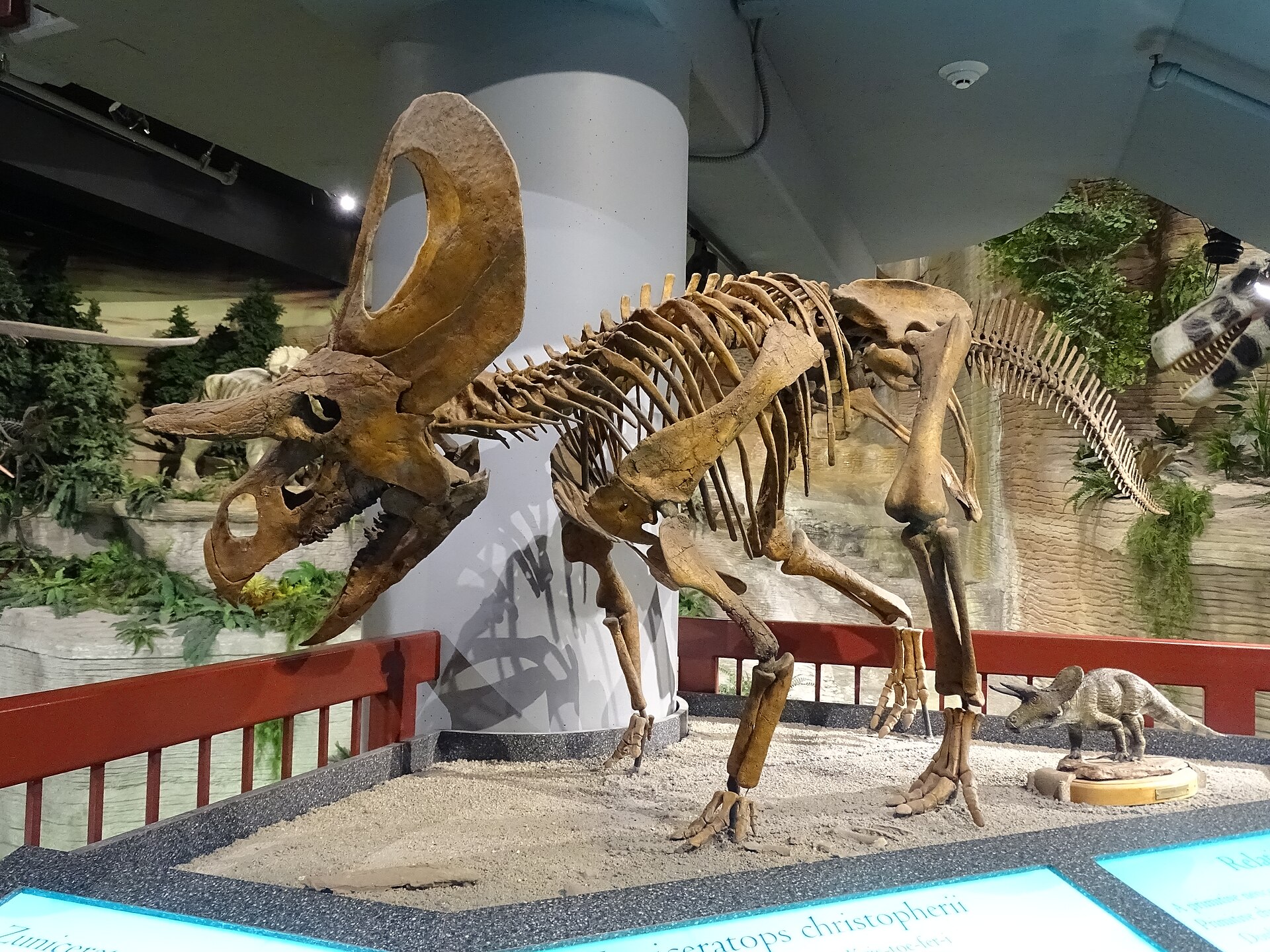

Zuniceratops Size and Description
Short description of Zuniceratops
At the front of the skull, Zuniceratops had relatively large, oval nostril openings. In 2000, Wolfe called them neither chasmosaurine nor centrosaurine—the two main branches of later horned dinosaurs. In 2024, however, Loewen and colleagues likened its elongated, oval narial fossa (nostril recess) to that of chasmosaurines. Its nasals show no sign of a nasal horn, and Loewen’s team also found none. Above each eye rose an elongate brow horn, flattened on its outer side, which Wolfe later described as slightly recurved and lengthening with growth. In 2020, Wilson and colleagues noted that the basalmost (earliest-branching) centrosaurines, such as Diabloceratops, share such long brow horns. Below the horns, a low maxilla framed a large antorbital fenestra—an opening in front of the eye.
The frill was originally described as long and fenestrate—pierced by openings—with a notched squamosal forming much of its main opening. However, that picture rested on a bone that Wolfe later reassigned to a new therizinosauroid theropod from the same bonebed. After the change, he judged the frill thin, probably fenestrate, and “probably without epoccipitals,” the bony knobs that edge some frills. The limbs were gracile (slender), as in Protoceratops and its kin.
Size and Weight of Type Species
Wolfe and Kirkland described Zuniceratops only as an “intermediate-sized ceratopsian.” We found no peer-reviewed estimate of its length, hip height, or weight.
Even so, the bones offer direct measurements. One nearly complete left maxilla is 21.5 centimeters (8.5 inches) long, with 17 tooth files. The holotype’s brow horn, its tip worn or broken, rises about 88 millimeters (3.5 inches) above the orbit. In comparison, a paratype horn reaches 207 millimeters (8.1 inches) from orbit to tip—more than twice as long. The describers judged such differences probably typical of growth and sexual variation.
The bonebed also yielded a left ischium, a lower hip bone, whose outer rear edge is estimated at 478 millimeters (18.8 inches). It curves more strongly than in Centrosaurus but less than in Triceratops. From that curve, Wolfe and Kirkland suggested a skull comparable in size to those of centrosaurines.
The Dinosaur in Detail
Its teeth show a striking blend of old and new traits. The dentary teeth have expanded, ceratopsid-like crowns “but with a single elongate root.” In the original description, each tooth file held one replacement tooth, and every dentary tooth showed vertical shearing wear. Wolfe later estimated 16 to 20 tooth positions, increasing with age, in one or two replacement rows. He also noted partial resorption of worn roots before shedding—an incipient version of the ceratopsid condition.
In contrast, the limb skeleton was considerably less robust than in ceratopsids. The describers argued that its deltopectoral crest—a muscle ridge on the upper arm bone—must have been the smallest among dinosaurs with horns and frills. Yet the bonebed ischium, already described in 1998, is robust and decurved, as in some later ceratopsids.
Its snout echoes the ceratopsids more closely. In 2024, Loewen and colleagues reported a hypertrophied (enlarged) nasal vestibule in Zuniceratops and all ceratopsids. Its antorbital fenestra, by contrast, was larger than in any ceratopsid, whose maxillae are usually tall and triangular. Wolfe and Kirkland compared it instead with Leptoceratops and Montanoceratops. Meanwhile, a 2015 study of lower-jaw shape found Zuniceratops and Avaceratops distinct from the other taxa sampled.
The 1998 family tree set Zuniceratops closer to Ceratopsidae than psittacosaurids, Leptoceratops, and Montanoceratops, with Turanoceratops closer still. The describers considered a wholly North American origin for Ceratopsidae possible, with Turanoceratops a short-lived immigrant into Asia. In 2014, Farke and colleagues read the pair as a sign of an Asia–North America connection before or during the Turonian. Where the lineage first arose remains an open question.
Interesting Points about Zuniceratops
- The genus honors the Zuni people, while the species honors a co-discoverer of the holotype.
- A bone first read as part of the frill belonged to a therizinosauroid theropod buried in the same bonebed.
- Later material showed that Zuniceratops had prominent brow horns but no nasal horn.
- Several holotype bones carry tooth marks, and the describers read a D-shaped hole in the coracoid as trauma suffered before burial.
Contemporary Dinosaurs
Sharing the same bonebed was Nothronychus mckinleyi, a therizinosaurid theropod. In 2015, Hedrick and colleagues reported its skeleton among abundant Zuniceratops material in a paucispecific (few-species) bonebed. With many of its bones lying meters apart among logs and Zuniceratops remains, the team judged it likely that the logs trapped both. That is shared burial, not evidence that the two ever interacted.
Lower in the same local section lay Jeyawati rugoculus, a non-hadrosaurid hadrosauroid—an early relative of the duck-billed dinosaurs. Hedrick’s team placed it in a hadrosaur interval at the base of the section, eight meters (26 feet) below the Zuniceratops bonebed. No source records any interaction.
Closer in the rock column was Suskityrannus hazelae, a small-bodied tyrannosauroid—an early relative of the tyrannosaurs. Its describers called it phylogenetically intermediate between early small tyrannosauroids and the giant tyrannosaurids. The holotype, MSM P4754, comes from Mirror Mesa, near the middle of the lower Moreno Hill. In Wolfe and Kirkland’s section, the Mirror Mesa interval sits about one to two meters below the Zuniceratops bonebed.
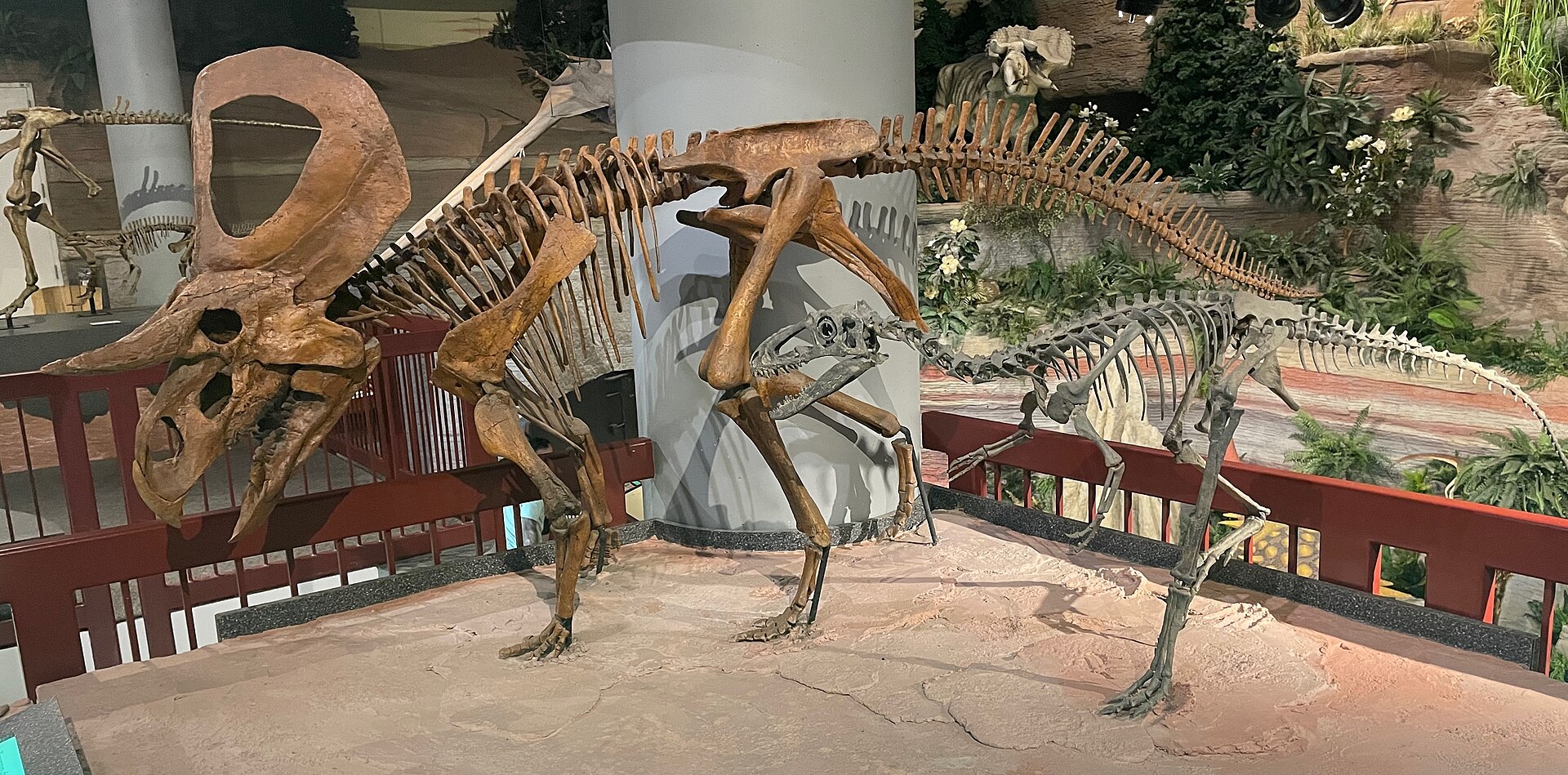

Zuniceratops in its Natural Habitat
The world Zuniceratops roamed lay along the southwestern margin of the Western Interior Seaway, which once stretched from the Gulf of Mexico to the Arctic Ocean. According to Nesbitt and colleagues, the lower Moreno Hill probably formed on a broad, low coastal plain. Kaolin-rich clays there suggest a humid, tropical climate. Petrified wood and leaves are abundant, and some wood appears to come from dicotyledonous angiosperms (flowering plants). Gars, the bowfin-like fish Melvius, turtles, crocodilians, and a squamate—a member of the lizard and snake group—also lived here. Unnamed finds include ankylosaur teeth.
No study we found states its diet directly, but its expanded crowns and shearing wear fit the plant-eating habits generally assigned to horned dinosaurs. While there is no direct evidence of which plants it ate, the wood and leaves at the site show some of the vegetation growing nearby.
Hone and colleagues listed Zuniceratops among ceratopsians known from bone assemblages dominated by, or limited to, a single species. However, Hedrick’s team called the bonebed paucispecific, and the describers pictured a log jam, so group living remains unconfirmed. In 2026, Ames and colleagues used Triceratops horn models to infer that early ceratopsoids such as Zuniceratops may have been able to stab with their horns. Their closely set horns, the team added, may be less suited to wrestling. Grooves on a paratype femur suggest it was scavenged before burial.
Frequently Asked Questions
It means “Zuni horned face,” honoring the Zuni people, and the species name honors co-discoverer Christopher James Wolfe.
It lived in the Late Cretaceous Turonian stage, around 92 million years ago or, by 2021 dating, after 90.9 million.
Its describers called it an intermediate-sized ceratopsian, and we found no peer-reviewed size estimate.
It is treated as a herbivore, like other horned dinosaurs, and its teeth show vertical shearing wear.
Its fossils come from the Two Rocks Balanced area of the lower Moreno Hill Formation in west-central New Mexico.
In 1998, its describers called it the oldest recorded ceratopsian with brow horns, paired here with single-rooted teeth and no nasal horn. Studies differ on whether it or Turanoceratops is the closest known relative of Ceratopsidae.
Sources
The information in this article is based on various sources, drawing on scientific research, fossil evidence, and expert analysis. The aim is to provide a comprehensive and accurate overview of Zuniceratops. However, please be aware that our understanding of dinosaurs and their world is constantly evolving as new discoveries are made.
- https://nmdigital.unm.edu/digital/collection/bulletins/id/958
- https://nmdigital.unm.edu/digital/collection/bulletins/id/1011
- https://doi.org/10.1371/journal.pone.0129449
- https://doi.org/10.1038/s41559-019-0888-0
- https://pubmed.ncbi.nlm.nih.gov/31061476/
- https://static-content.springer.com/esm/art%3A10.1038%2Fs41559-019-0888-0/MediaObjects/41559_2019_888_MOESM1_ESM.pdf
- https://doi.org/10.7717/peerj.10948
- https://pubmed.ncbi.nlm.nih.gov/19277598/
- https://doi.org/10.7717/peerj.12362
- https://doi.org/10.1371/journal.pone.0112055
- https://doi.org/10.7717/peerj.4265
- https://doi.org/10.1098/rsos.200284
- https://doi.org/10.7717/peerj.17224
- https://doi.org/10.7717/peerj.21728
- https://pubmed.ncbi.nlm.nih.gov/26467240/
- https://doi.org/10.1371/journal.pone.0113306
- https://doi.org/10.1007/s00114-009-0543-8
- https://paleobiodb.org/classic/basicTaxonInfo?taxon_no=66590
This article was last fact checked: TheDinosaurs Team, 13-11-2026
Featured Image Credit: Connor Ashbridge, CC BY 4.0, via Wikimedia Commons
