
In Romania’s Hațeg Basin, the Sânpetru Formation crops out in the Sibișel Valley, just south of the village of Sânpetru. Its rocks date from the Maastrichtian—the final stage of the Cretaceous. From this valley came the partial skeleton that now defines Ferenceratops shqiperorum. For more than two decades, scientists filed it under Zalmoxes. That genus belonged to Rhabdodontidae, a family first set beside the iguanodontians, a lineage of ornithopod dinosaurs. Later studies usually placed the family at the base of Iguanodontia instead. In 2026, however, a new study recast the animal as a ceratopsian, part of the wider group that includes Chasmosaurus and Centrosaurus.
The holotype—the name-bearing specimen—was excavated by Franz Nopcsa, the pioneer of Hațeg Basin dinosaur research. He first mentioned it in print in 1925. In 2003, paleontologist David B. Weishampel and colleagues made it the basis of a new species, Zalmoxes shqiperorum. Twenty-three years later, paleontologist Susannah Maidment and six colleagues gave it a genus of its own in the journal Nature. Their study, part of a wider rethink of European fossils, found ceratopsians “not only present but in fact abundant” on the region’s Late Cretaceous islands.
Ferenceratops Key Facts
| Keyword | Fact |
|---|---|
| Pronunciation | Not specified |
| Meaning of name | Named for Ferenc (Franz) Nopcsa |
| Group | Ceratopsia |
| Type Species | Ferenceratops shqiperorum |
| Diet | Herbivore |
| When it Lived | Maastrichtian, probably its early part (from about 72.2 MYA) |
| Period | Cretaceous |
| Epoch | Late Cretaceous (Maastrichtian stage) |
| Length | Not specified |
| Height | Not specified |
| Weight | Not specified |
| Mobility | Not specified |
| First Discovery | Year not specified, by Franz Nopcsa (first mentioned 1925) |
| Described by | 2026 by S.C.R. Maidment, R.J. Butler, S.L. Brusatte, L.E. Meade, F.J. Augustin, Z. Csiki-Sava, and A. Ősi (genus), with the species first named in 2003 by D.B. Weishampel, C.-M. Jianu, Z. Csiki, and D.B. Norman |
| Holotype | NHMUK PV R 4900 |
| Location of first find | Sânpetru Formation, Sibișel Valley south of Sânpetru, Hațeg Basin, Hunedoara County, Romania |
Ferenceratops Origins, Taxonomy and Timeline
The name Ferenceratops is a tribute rather than a description. “Ferenc” is the birth name of Franz Nopcsa, whom the 2026 authors credit with discovering the Hațeg Basin dinosaurs, including this animal’s holotype. The 2026 paper does not explain the “-ceratops” half, although it echoes the group name Ceratopsia. The species name shqiperorum, by contrast, is older—Weishampel and colleagues coined it in 2003. In short, the genus name honors the scientist who first pulled these bones from Transylvanian rock.
Ferenceratops belongs to Ornithischia, the “bird-hipped” dinosaurs, and within it to Marginocephalia (“fringed heads”) and then Ceratopsia. Originally, Weishampel and colleagues placed it in Zalmoxes alongside Z. robustus. Both sat in a new family, Rhabdodontidae, which they called “the sibling clade to Iguanodontia.” The 2026 team kept its placement at the broad level of Ceratopsia. Their dataset lacked two of the three anchor species needed to test a narrower group, Ceratopsoidea. “We err on the side of caution,” the authors wrote in their response to peer review. Ferenceratops shqiperorum is the type and only known species.
The 2026 paper assigns the holotype to the Maastrichtian stage, which spans roughly 72.2 to 66 million years ago. However, the Sânpetru Formation probably covers only the earlier part of it. Paleomagnetic work cited by Godefroit and colleagues in 2009 suggested the formation is entirely lower Maastrichtian. In 2010, Cristian and Cristina Panaiotu placed the section they studied between the start of Chron C32n.1n and the end of Chron C31n. Chrons are spans of steady polarity in Earth’s magnetic field. In the northwest of the basin, volcanic tuffs (ash layers) have been dated to about 69.8 and 71.3 million years ago. This was the closing chapter of the Cretaceous, when Europe was an archipelago of islands.
Discovery & Fossil Evidence
The story begins with Nopcsa, although published accounts do not say when he collected the bones. He called the specimen his “individual I” when he first mentioned it in 1925. In 2003, Weishampel and colleagues gave the locality as Vurpăr, near Vințu de Jos in Alba County, in an unnamed formation. In 2023, however, Felix Augustin and colleagues re-read Nopcsa’s 1925 account and concluded that the holotype “does not come from the southwestern Transylvanian Basin.” The 2026 paper follows that correction and places it in the Sibișel Valley, south of Sânpetru.
Today the holotype, NHMUK PV R 4900, is housed at the Natural History Museum in London. The 2026 paper lists a partial right dentary (the main lower jaw bone) and part of a dorsal (back) vertebra. The shoulder survives as the left scapula (shoulder blade) and part of the left coracoid, a bone at the front of the shoulder girdle. From the hips come a fragment of ilium (upper hip bone), a right ischium (rear lower hip bone), and the far end of a left ischium. A left femur (thigh bone) completes the set. Still, a 2009 inventory by Godefroit and colleagues assigned several bones to the opposite side and listed a sacrum.
The 2003 paper also referred many other bones to Z. shqiperorum. Yet the 2026 authors found that much of that material “does not overlap with either holotype” and needs revision. They accepted only one referred specimen, UBB SPZ-2—an articulated pelvis at Babeș-Bolyai University with “identical ischial morphology.” No other specimens have been referred to Ferenceratops so far, pending a revision of the old collections.

Ferenceratops Size and Description
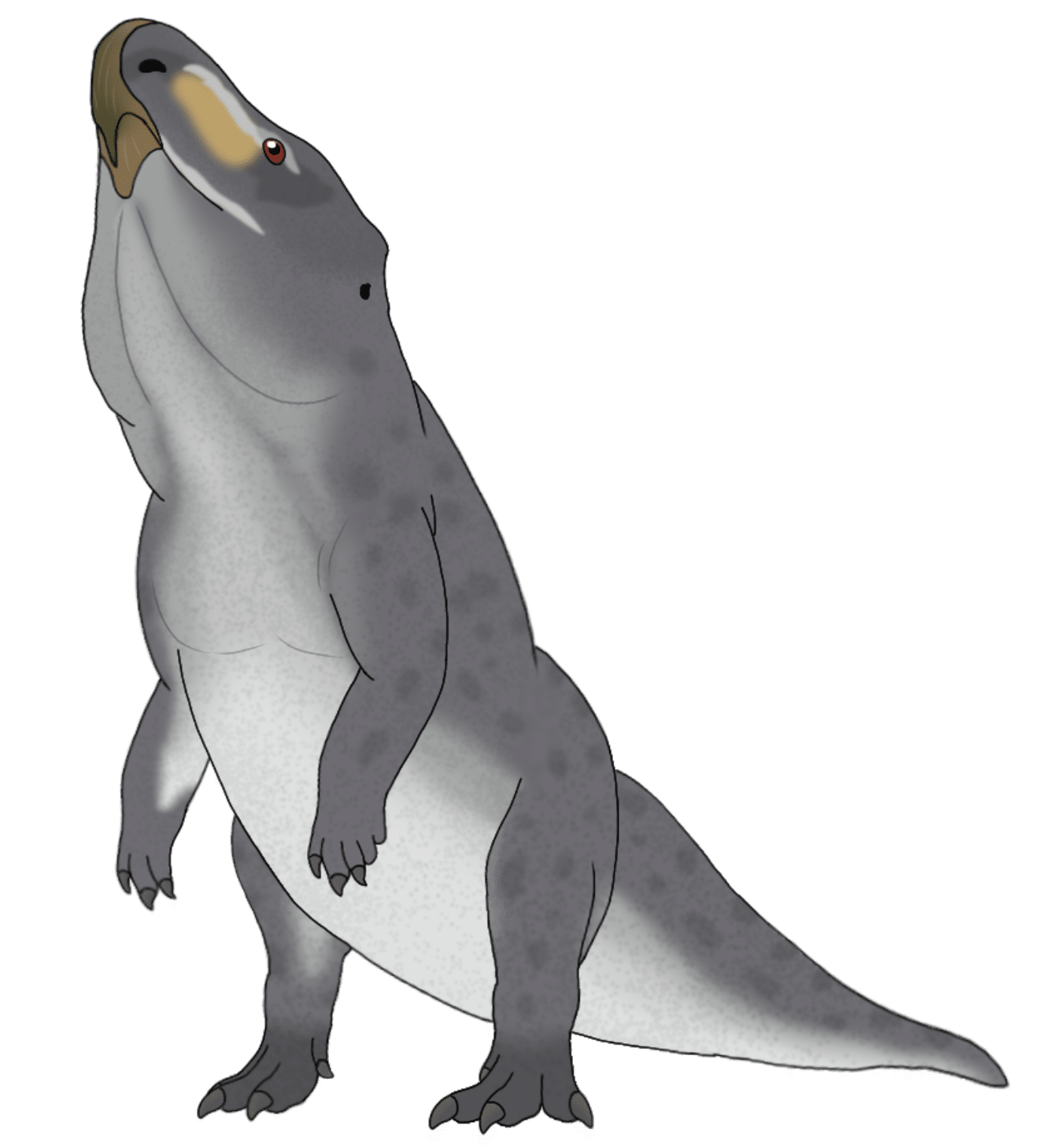
With no skull roof and only a handful of bones, Ferenceratops is best described through its shoulder and hips.
Short description of Ferenceratops
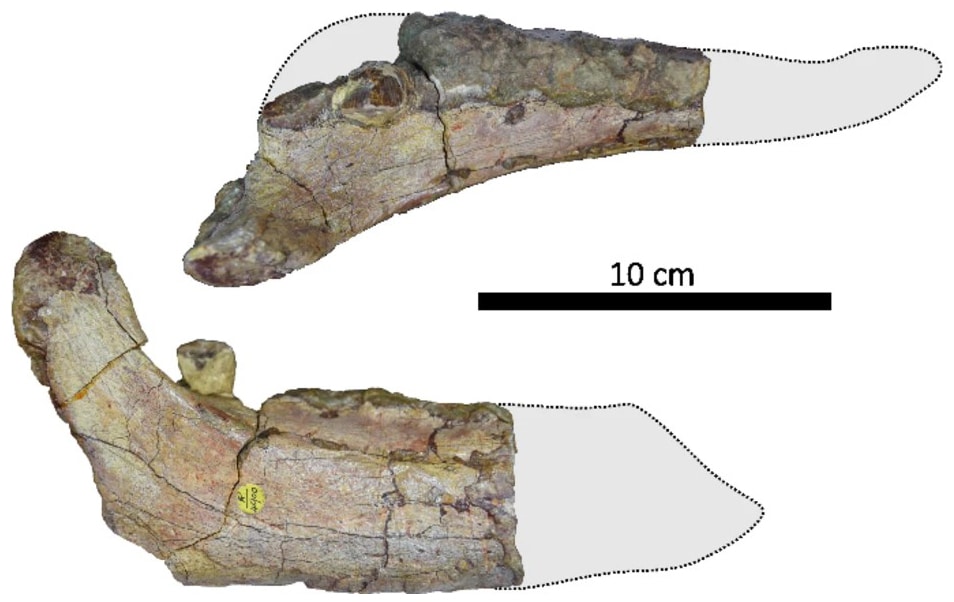
Up front, the only known skull bone is the partial right dentary. It holds a single preserved tooth, the second-to-last in the row. Because no skull roof, frill, or horn material is known, any frill in a reconstruction is guesswork. The 2026 authors raised the possibility that European ceratopsians lacked the elaborate frills of their Asian and North American cousins. However, they framed this as a broad idea, not a trait of this species.
Meanwhile, the shoulder is better preserved. Its scapula had a narrow, strap-like blade that widened toward its tip. It also bore a well-developed, upwardly concave acromial process—a flange at the front of the blade, near the shoulder joint. The coracoid carried an “extremely elongate and slender sternal process,” a prong that projected well below the glenoid (shoulder socket). Farther back, the ischium curved gently and lacked an obturator process, a flange typical of ornithopods.
The referred pelvis adds detail. Its ischia also lack the obturator process and end in a distal boot—a broadened tip. Its ilia are broad and bear a supracetabular flange (a shelf above the hip socket), which the authors called “a feature common in ceratopsids.” The 2026 paper does not say whether Ferenceratops walked on two legs or four. It notes only that ceratopsians and iguanodontians evolved four-legged walking independently.
Size and Weight of Type Species
The 2026 description gives no length, height, or weight for Ferenceratops. Even though the holotype includes a femur, the paper offers no estimate from it. Earlier, the 2003 study noted that adults of Z. robustus were smaller than those of Z. shqiperorum. That comparison, though, likely rested on a broader set of referred bones than the 2026 team accepts.
In 2012, Ősi and colleagues estimated a length of about 8.2 feet (2.5 meters) for a subadult then referred to Z. shqiperorum. They gave about 4 feet (1.2 meters) for a juvenile. Rather than measuring skeletons, they scaled the closest relative’s skeleton to each femur.
Those femora, however, do not belong to the holotype, and the 2026 paper does not refer them to Ferenceratops. The only accepted referred specimen, the UBB SPZ-2 pelvis, has no published size estimate either. For now, the true size of this dinosaur remains open—at least according to the current fossil record.
The Dinosaur in Detail
What sets this dinosaur apart is the shoulder and hip anatomy that undid its old identity. Its revised diagnosis rests on a combination of four traits. The missing obturator process matters because that feature is “ubiquitous in ornithopods.” In the paper’s comparison figure, this ischium sits beside those of early ceratopsians such as Psittacosaurus and Protoceratops. A long sternal process, meanwhile, is common in ceratopsians but shorter in early iguanodontians.
The authors traced the old mix-up to convergence between iguanodontians and ceratopsians—the independent evolution of similar forms—in “dental, jaw and limb morphology.” Maidment told the Natural History Museum, “Had Nopcsa’s material been found today, I don’t think it would have been interpreted as iguanodontian because of what we now know about these dinosaurs.” The new genus was needed because this species came out “definitively” as a ceratopsian. By contrast, the position of Z. robustus, the type species of Zalmoxes, was “less conclusive.”

Their equal-weights parsimony analysis—a method that favors the family tree needing the fewest changes—produced 525 equally short trees. Their strict consensus grouped Ferenceratops with Hungary’s Ajkaceratops, Zuniceratops, Chasmosaurus, Turanoceratops, and Centrosaurus. A second run that down-weights often-changing traits also placed both European animals within Ceratopsia. Both Bayesian analyses, a probability-based approach, agreed.
Still, not every test pointed the same way. When that second run forced all rhabdodontids into Iguanodontia, F. shqiperorum fell beside Hadrosauriformes, the group that includes the duck-billed dinosaurs. Reviewing an earlier draft in the first round, one referee called it “a plausible hypothesis” but added, “I don’t think the case is ‘clear’. Not yet.” After revisions, the same referee judged the conclusions “appropriately derived from the results.” Taken together, every unconstrained analysis placed it among the ceratopsians—but that verdict rests on a handful of bones.
Interesting Points about Ferenceratops
- The genus name honors Franz Nopcsa through “Ferenc,” his birth name, and its holotype is one of the Hațeg Basin fossils he excavated.
- The same 2026 paper described a new Ajkaceratops specimen from Iharkút, Hungary, and folded the species Mochlodon vorosi into Ajkaceratops.
- An apparently close tie between these European ceratopsians and the ceratopsids, Zuniceratops, and Turanoceratops “could suggest” that the latter group’s ancestor reached North America via Europe before the Turonian.
- Using a modified version of a dataset first built by Dieudonné and colleagues in 2021, the 2026 team also recovered Ferenceratops and Ajkaceratops as sister taxa among unresolved ceratopsians.
Ferenceratops in its Natural Habitat
Imagine a subtropical island at about 28 degrees north, resting on a crustal block known as Tisia-Dacia. Across Transylvania, braided rivers wound through broad and relatively dry floodplains under a “seasonally variable and semiarid” climate. Parts of the Hațeg Basin also held meandering rivers “with localized freshwater ponds and wetlands.” At Nălaț-Vad, another Sânpetru Formation site, the rocks record sandy channel fills set among black to reddish-brown floodplain silts and clays.
The 2026 paper says nothing about this animal’s diet. Instead, Maidment and colleagues placed European ceratopsians among the islands’ “mid-to-large-sized herbivore roles.” In their view, ceratopsians living alongside iguanodontians made the island herbivore community “more similar” to mainland ecosystems of the time. Ferenceratops likely filled one of the plant-eating niches on these islands.
While there is no direct evidence of how Ferenceratops lived or whether it moved in groups, its formation preserves a varied fauna. The 2026 paper notes that F. shqiperorum and Z. robustus came from the same locality. In fact, Nopcsa’s “Nest 1” quarry in the Sibișel Valley yielded both the holotype dentary of Z. robustus and the type material of the hadrosaur Telmatosaurus. Other finds at Sânpetru include an osteoderm (bony skin plate) from an indeterminate titanosaur, plus a nodosaurid tooth that may belong to Struthiosaurus. A 2025 revision recognized four titanosaurs from Hațeg Island, among them Magyarosaurus. Non-dinosaurs include the crocodyliform Theriosuchus sympiestodon at Sânpetru and the multituberculate mammal Barbatodon transylvanicus at nearby Pui. No source ties any of these finds to the holotype’s bed, so none can yet be called a proven neighbor.
Frequently Asked Questions
It honors Franz Nopcsa, whose birth name was Ferenc. Its describers credit him with discovering the Hațeg Basin dinosaurs, including its holotype.
It lived in the Maastrichtian stage of the Late Cretaceous, probably early in it, after about 72.2 million years ago.
No reliable size is known. Its 2026 describers gave no estimate, and the only published length comes from bones they did not refer to this species.
It was a herbivore, according to its describers, who placed European ceratopsians in mid-to-large-sized herbivore roles.
It comes from the Sânpetru Formation in the Sibișel Valley, south of Sânpetru in Romania’s Hațeg Basin.
It was first described in 2003 as a species of Zalmoxes, but a 2026 study reclassified it as a ceratopsian.
Sources
The information in this article is based on various sources, drawing on scientific research, fossil evidence, and expert analysis. The aim is to provide a comprehensive and accurate overview of Ferenceratops. However, please be aware that our understanding of dinosaurs and their world is constantly evolving as new discoveries are made.
- https://doi.org/10.1038/s41586-025-09897-w
- https://research.birmingham.ac.uk/en/publications/a-hidden-diversity-of-ceratopsian-dinosaurs-in-late-cretaceous-eu/
- https://static-content.springer.com/esm/art%3A10.1038%2Fs41586-025-09897-w/MediaObjects/41586_2025_9897_MOESM1_ESM.pdf
- https://static-content.springer.com/esm/art%3A10.1038%2Fs41586-025-09897-w/MediaObjects/41586_2025_9897_MOESM2_ESM.pdf
- https://static-content.springer.com/esm/art%3A10.1038%2Fs41586-025-09897-w/MediaObjects/41586_2025_9897_MOESM5_ESM.pdf
- https://doi.org/10.1017/S1477201903001032
- https://doi.org/10.3897/fr.26.108967
- https://sciencepress.mnhn.fr/sites/default/files/articles/pdf/g2009n3a3.pdf
- https://doi.org/10.1371/journal.pone.0044318
- https://doi.org/10.3897/zookeys.469.8439
- https://stratigraphy.org/ICSchart/ChronostratChart2024-12.pdf
- https://www.nhm.ac.uk/discover/news/2026/january/europes-missing-ceratopsian-dinosaurs-have-finally-been-found.html
- https://doi.org/10.1016/j.palaeo.2009.11.017
- https://doi.org/10.1080/14772019.2024.2441516
This article was last fact checked: TheDinosaurs Team, 13-11-2026
Featured Image Credit: Connor Ashbridge, CC BY 4.0, via Wikimedia Commons
