
High in Morocco’s High Atlas Mountains, near the village of Toundoute, lie the river and flood-plain deposits of the Toundoute continental series. Two bone-beds there, laid down by mudflows, hold a rich haul of Early Jurassic dinosaur bones. Among them is Berberosaurus liassicus, a medium-sized theropod named in 2007 that lived roughly 193 to 175 million years ago, in the Pliensbachian to Toarcian stages. Its describers called it the oldest known abelisauroid—a claim that pushed the lineage’s record back by about 50 million years.
The fossils came to light during the DinoAtlas Project, whose expeditions worked in the Toundoute series for six years before the description. Paleontologist Ronan Allain and six colleagues then named the animal from a partial skeleton with no skull or teeth. Later studies have since moved it around the ceratosaur family tree more than once. Even so, it helps fill a striking gap—in 2007, the fossil record held almost no theropods from between the Pliensbachian and Bajocian stages.
Berberosaurus Key Facts
| Keyword | Fact |
|---|---|
| Pronunciation | Not specified |
| Meaning of name | Berber Lizard |
| Group | Theropoda (Ceratosauria, placement debated) |
| Type Species | Berberosaurus liassicus |
| Diet | Carnivore (inferred from its group) |
| When it Lived | 193 to 175 MYA |
| Period | Jurassic |
| Epoch | Early Jurassic (Pliensbachian to Toarcian stages) |
| Length | Not specified |
| Height | Not specified |
| Weight | Not specified |
| Mobility | Not specified |
| First Discovery | Between about 2001 and 2007 (exact year unpublished), by DinoAtlas Project expeditions |
| Described by | 2007 by R. Allain, R. Tykoski, N. Aquesbi, N.-E. Jalil, M. Monbaron, D. Russell, and P. Taquet |
| Holotype | MHNM-Pt9, Pt23, Pt22, Pt19, Pt21, Pt16, and Pt20 (associated postcranial bones, Muséum d’Histoire Naturelle de Marrakech) |
| Location of first find | Upper bone-bed, Toundoute continental series, Douar of Tazouda near Toundoute, Ouarzazate Province, High Atlas, Morocco |
Berberosaurus Origins, Taxonomy and Timeline
The name Berberosaurus honors the Berbers, a people who, in the describers’ words, “live mainly in Morocco.” To this the authors added the Greek sauros, meaning “lizard.” The species name liassicus comes from “Lias,” the stratigraphic epoch of the specimen’s rocks. Together, the name ties the dinosaur to its homeland and to its moment in deep time.
In 2007, Allain and colleagues placed Berberosaurus within Theropoda, the group of mostly meat-eating dinosaurs, and then within Ceratosauria and Neoceratosauria. More precisely, they called it a basal abelisauroid—an early member of a carnivorous lineage. Their analysis also recovered a “traditional” Ceratosauria that included the coelophysoids, with Tetanurae—the other main branch of predatory theropods—as its sister group. Berberosaurus liassicus is the type and only known species.
The original paper dated the bone-bed to the Pliensbachian–Toarcian, or “middle to late Early Jurassic.” On today’s time scale, those two Jurassic stages span roughly 193 to 175 million years ago. However, in 2005, geologist Christian Montenat and colleagues—Allain and Najat Aquesbi among them—had already cautioned that the series is hard to date precisely. Their best estimate was a probable Middle to Late Lias age, about 190 to 175 million years ago. In their view, a Toarcian age alone had not been proven either. In 2008, Allain and Aquesbi linked the radiation of groups such as Neoceratosauria to the Pliensbachian–Toarcian mass extinction.
Discovery & Fossil Evidence
The type locality lies at the Douar of Tazouda, near Toundoute in the Province of Ouarzazate, where the bones came from the upper of two bone-beds. Mudflows formed both beds, and together they have yielded at least five partial skeletons of the sauropod Tazoudasaurus, as well as theropod bones. The exact year of the find has not been published. The DinoAtlas Project behind the excavations had funding from the National Geographic Society and Morocco’s Ministry of Energy and Mines. In fact, the site lies only about 330 feet (100 meters) from the spot that yielded the Tazoudasaurus holotype.
The holotype comprises associated bones from a single patch of about 43 square feet (4 square meters). It includes a cervical (neck) vertebra, MHNM-Pt9, and the front part of the sacrum (the fused hip vertebrae), MHNM-Pt23. Alongside these are a second left metacarpal (hand bone), MHNM-Pt22, and a right femur (thigh bone), MHNM-Pt19. Two pieces of tibia (shinbone) and a left fibula (the slender calf bone) complete the set. Tectonic forces affected most of these bones, and a gypsum-filled fault plane even crosses the neck vertebra—yet it is not deformed.
A second specimen, the upper end of a right femur numbered MHNM-To1-218, came from a smaller individual at the Tazoudasaurus holotype site. Because there are two right femora, Allain and colleagues counted at least two individuals in 2007. In 2008, Allain and Aquesbi repeated that tally and noted only six other bones, all associated with one femur at locality Pt. As of that 2008 report, no Berberosaurus material was known from outside this upper bone-bed.
Berberosaurus Size and Description
With no skull and few bones, any portrait of Berberosaurus rests on its neck, hips, hand, and legs.
Short description of Berberosaurus
Its neck vertebra was short, with a centrum (the spool-shaped body of the vertebra) less than 1.5 times as long as its front face was wide. That bone was also riddled with air spaces—two pairs of deep, oval pleurocoels (air-sac openings) dug into its sides, while internal cavities called camerae hollowed it out. A short neural spine topped the vertebra.
Farther back, three fused vertebrae of the sacrum survive, though the full sacral count is unknown. Its underside arched strongly upward, to the same degree as in Ceratosaurus and Carnotaurus. The surviving hand bone measures about 3.1 inches (78 millimeters). In the leg, both known femora were hollow, and the left fibula is complete. The tibia remained unfused to the astragalus (an ankle bone)—despite the animal’s apparent maturity. At its lower end, the tibia has a roughly triangular outline, while an oblique ridge caps a groove on the fibula.
Because only bones survive, any discussion of its skin, color, or outward shape is speculative. Likewise, its describers did not discuss its posture or gait.
Size and Weight of Type Species
The original description calls Berberosaurus only “a medium-sized theropod with ceratosaurian affinities.” Its describers gave no estimate of its body length, hip height, or weight. Without more of the skeleton, the safest guides are the bones themselves.
Because the bone is incomplete, the holotype femur’s length of about 19.9 inches (505 millimeters) is only an estimate. By contrast, the complete fibula measures about 17.6 inches (447 millimeters). Even so, Allain’s team did not scale these bones up into a body length.
The referred femur hints at variation in size. Its upper end is about 4.5 inches (114 millimeters) wide, compared with about 5.6 inches (141 millimeters) in the holotype. Allain and colleagues also judged the holotype to be a subadult that died before reaching skeletal maturity. However, they cautioned that its growth may not have followed the pattern seen in coelophysoids.
The Dinosaur in Detail
What sets this dinosaur apart is the neck bone, which carries extra pneumatic (air-filled) openings beyond its deep pleurocoels. According to its describers, these are unknown in other ceratosaurs—with the possible exception of Dilophosaurus. That comparison reflects their broad 2007 Ceratosauria, which still included Dilophosaurus—later analyses place it outside the group. A triangular hollow on one of its bony ridges and an opening into the spinal canal also match Spinostropheus.
On the femur, the anterior trochanter (a muscle-attachment crest) reaches the femoral head’s midpoint, and the trochanteric shelf is large. Interestingly, the smaller referred femur bears a pronounced shelf, while the holotype shows more of a mound. The describers took this as a hint of “some degree of femoral dimorphism.” In 2018, Dal Sasso and colleagues noted, citing Carrano and Choiniere, that the hand bone might be a left third metacarpal rather than a second. They also found a “lip-like” projection on it that only Saltriovenator shares.
Its placement is harder still to pin down. The 2007 analysis scored 264 characters across 30 ingroup taxa and found Berberosaurus only “weakly supported” as an abelisauroid. It sat as a more derived abelisauroid than Spinostropheus, but outside a group formed by Xenotarsosaurus and Abelisauria. Dal Sasso’s team later recovered it as the sister of Saltriovenator on the earliest-branching ceratosaur line, though the support was “relatively weak,” resting on a single shared feature.
In a 2018 review, paleontologist Rafael Delcourt summarized the competing results—a basal ceratosaur, a neoceratosaur, a basal abelisauroid, or a close relative of Etrigansauria. As Delcourt noted, its position even affects how old Ceratosauroidea appears to be. Analyses in 2019 and 2023 then flagged it as an unstable taxon, or “wildcard.” These studies show an animal whose few bones carry outsized weight in the early history of ceratosaurs.
Interesting Points about Berberosaurus
- In 2007, its describers hailed it as the oldest known abelisauroid, though later analyses have placed it at the base of Ceratosauria instead.
- The genus name honors the Berber people of Morocco, and the species name refers to the Lias, the time interval of its rocks.
- Its holotype bones came from an area of only about 43 square feet (4 square meters), just 330 feet (100 meters) from the Tazoudasaurus holotype site.
- Its neck vertebra carries extra air-filled openings that its describers knew from no other ceratosaur in their broad 2007 sense of the group, except possibly Dilophosaurus.
- Analyses in 2019 and 2023 both flagged it as an unstable taxon whose shifting position blurs the ceratosaur family tree.
Contemporary Dinosaurs
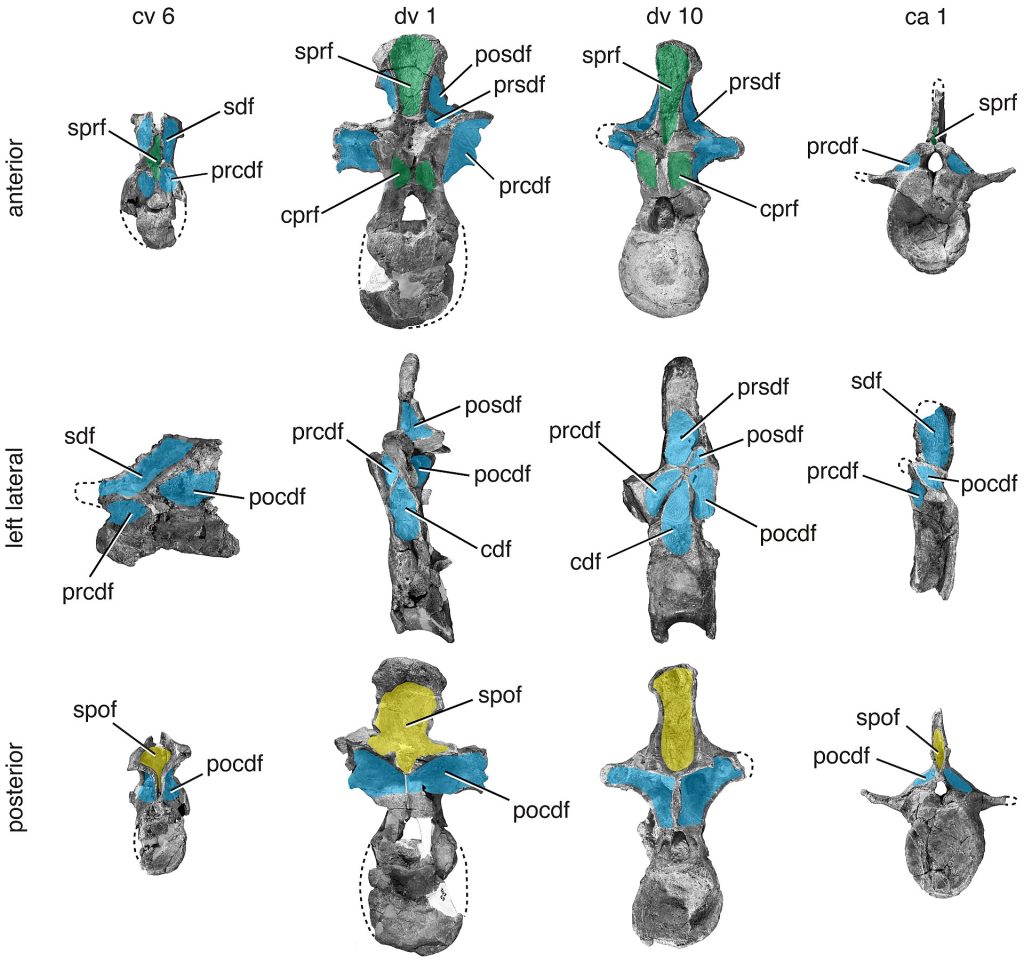
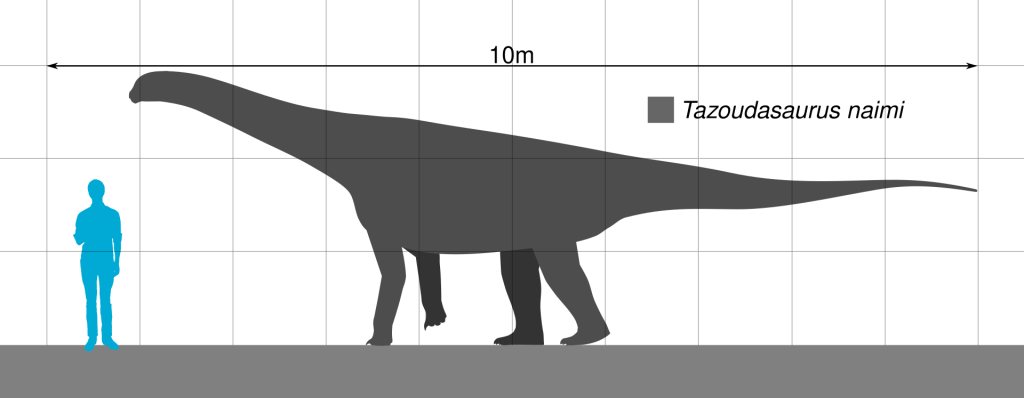
Sharing the very same bone-bed was Tazoudasaurus naimi, a primitive vulcanodontid sauropod. As Allain and colleagues showed in 2004, its skeleton is well preserved, including a complete lower jaw with teeth. At least six individuals, from juveniles to adults, come from the upper bone-bed. Other Tazoudasaurus bones—among them a humerus (upper arm bone) about 3.3 feet (1 meter) long—lay near those of Berberosaurus. In 2008, Allain and Aquesbi suggested that Tazoudasaurus may have been one of the abelisauroid’s prey. They stressed, however, that this idea “needs to be confirmed by future works”—for now, the two are linked only by bones that lie side by side.

Berberosaurus in its Natural Habitat
The world Berberosaurus roamed was a landscape of torrential river channels and flood plains. The climate was hot, with humid episodes broken by strongly marked dry seasons. Small plant fragments were probably mostly fern leaflets, with much rarer cycad-like plants and bits of conifer twig. Meanwhile, calcareous soils with sparse vegetation eroded into the rivers. Travertine fragments suggest springs or pools that kept some ground moist through the dry season. Debris from a nearby, explosive volcanic center also fed into the sediments.

As a ceratosaurian theropod, Berberosaurus was almost certainly a carnivore, though no teeth or skull survive to show what it ate. The upper bone-bed is about 10 to 13 feet (3 to 4 meters) thick and has produced more than 600 bones. Apart from woody debris, it shows no sign of microfossils or small vertebrates. According to Allain and Aquesbi, the mudflow that formed it probably killed the animals inside. Such flows carried bones and parts of carcasses only short distances before rapid burial protected them.
While there is no direct evidence of how Berberosaurus hunted or behaved, its fauna appears to have been sparse. In 2005, Montenat and colleagues reported no continental invertebrates at the site, only dinosaur bones—mostly Tazoudasaurus, plus a few from one or two unidentified theropods. Allain’s team also reported bones of medium-sized and large theropods in 2004, and their 2007 paper lists “a large carnivorous dinosaur of uncertain affinities.” Still, by 2008 the upper bone-bed had produced just two dinosaur taxa, Tazoudasaurus and Berberosaurus. Farther afield, the series is very likely a lateral equivalent of the Toarcian Azilal and Wazzant formations, which have yielded unnamed sauropod and theropod remains.
Frequently Asked Questions
It means “Berber lizard,” honoring the Berber people of Morocco, while liassicus refers to the Lias, an Early Jurassic interval.
It lived in the Pliensbachian to Toarcian stages of the Early Jurassic, roughly 193 to 175 million years ago.
Its describers called it medium-sized but gave no length or weight. Its incomplete femur measures an estimated 19.9 inches (505 millimeters).
It was a ceratosaur, a type of theropod. Its describers first called it a basal abelisauroid, but its exact place within Ceratosauria is still debated.
Its bones come from the Toundoute continental series near Toundoute, in Morocco’s High Atlas Mountains.
Its describers reported extra air-filled neck openings unknown in other ceratosaurs as they defined the group in 2007, except possibly Dilophosaurus. They also called it the oldest known abelisauroid, a view later studies have not consistently supported.
Sources
The information in this article is based on various sources, drawing on scientific research, fossil evidence, and expert analysis. The aim is to provide a comprehensive and accurate overview of Berberosaurus. However, please be aware that our understanding of dinosaurs and their world is constantly evolving as new discoveries are made.
- https://doi.org/10.1671/0272-4634(2007)27[610:AADTFT]2.0.CO;2
- https://folia.unifr.ch/unifr/documents/300228
- https://sciencepress.mnhn.fr/sites/default/files/articles/pdf/g2008n2a5.pdf
- https://folia.unifr.ch/unifr/documents/300052
- https://doi.org/10.1016/j.crpv.2004.03.001
- https://doi.org/10.7717/peerj.5976
- https://doi.org/10.1038/s41598-018-28154-x
- https://doi.org/10.1038/s41598-019-43725-2
- https://doi.org/10.1038/s41598-019-45306-9
- https://doi.org/10.7717/peerj.16236
- https://stratigraphy.org/ICSchart/ChronostratChart2024-12.pdf
This article was last fact checked: TheDinosaurs Team, 21-11-2026
Featured Image Credit: Mario Lanzas, CC BY-SA 4.0, via Wikimedia Commons
