
Along the Red Deer River of southern Alberta, the Dinosaur Park Formation has yielded a theropod known from little more than its lower jaws. Named Richardoestesia gilmorei in 1990, it lived in the Campanian stage of the Late Cretaceous—roughly 76.5 to 74.4 million years ago. Its holotype is a pair of partial dentaries, the tooth-bearing bones of the lower jaw. Yet its name now stretches far beyond those bones, because researchers attach it to isolated teeth across North America.
C. M. Sternberg collected the jaws in 1917, and paleontologist C. W. Gilmore described them in 1924. At first, Gilmore tied them to another theropod, Chirostenotes pergracilis, although he admitted the pairing was arbitrary. Decades later, paleontologists Philip J. Currie, J. Keith Rigby Jr., and Robert E. Sloan gave the jaws their own genus. Fittingly, their chapter dealt with theropod teeth. Its story shows how much one good specimen matters when nearly everything else is a loose tooth.
Richardoestesia Key Facts
| Keyword | Fact |
|---|---|
| Pronunciation | Not specified |
| Meaning of name | Not specified |
| Group | Theropoda (Coelurosauria incertae sedis) |
| Type Species | Richardoestesia gilmorei |
| Diet | Carnivore |
| When it Lived | 76.5 to 74.4 MYA |
| Period | Cretaceous |
| Epoch | Late Cretaceous (Campanian stage) |
| Length | Not specified |
| Height | Not specified |
| Weight | Not specified |
| Mobility | Not specified |
| First Discovery | 1917 by C. M. Sternberg |
| Described by | 1990 by P.J. Currie, J.K. Rigby Jr., and R.E. Sloan |
| Holotype | NMC 343 |
| Location of first find | About 2½ miles south of the mouth of Little Sandhill Creek, Red Deer River, Dinosaur Park Formation, Alberta, Canada |
Richardoestesia Origins, Taxonomy and Timeline
In broad terms, Richardoestesia is a theropod, but its exact place in that group remains unresolved. In 2013, paleontologists Derek W. Larson and Philip J. Currie listed it under Coelurosauria incertae sedis—coelurosaurs of uncertain placement. They also grouped the teeth as “the Richardoestesia complex.” In 2018, D. W. E. Hone and colleagues similarly called the genus “of uncertain affinities,” citing a 2005 assessment by Currie. Besides the type species, R. gilmorei, two more species are assigned to the genus: R. isosceles from Texas and R. asiatica from Uzbekistan.
In 2014, paleontologists Thomas E. Williamson and Stephen L. Brusatte described the holotype as coming from the upper Campanian. Later, uranium–lead dating by J. Ramezani and colleagues in 2022 put the Dinosaur Park Formation at about 76.5 to 74.4 million years ago. That span covers roughly 2 million years. Its main fossil-bearing interval falls between about 76.6 and 75.0 million years ago, a range that includes the dating uncertainties. According to Larson and Currie, R. gilmorei is definitively known only from this formation—a narrow window for a name so widely used.
Discovery & Fossil Evidence
The story begins in 1917, when Sternberg collected the jaws south of Little Sandhill Creek. Gilmore placed the spot about 2½ miles (4 kilometers) south of the creek’s mouth on the Red Deer River. He recorded it about 200 feet (61 meters) above river level, in what he called the Belly River formation. Modern work places the holotype in the Dinosaur Park Formation. In 1924, Gilmore treated the jaws as a referred specimen of Chirostenotes pergracilis. Even so, he called the association “purely arbitrary,” because the jaws turned up three years after that animal’s type and a few miles away.
Gilmore cataloged the holotype as No. 343 of the Geological Survey of Canada, and later papers cite it as NMC 343. He described “considerable portions of both dentaries,” with roots of functional teeth and a few complete germ teeth. Germ teeth are developing teeth that had not yet fully erupted from the jaw. Back in 1987, Currie suggested that NMC 343 might belong to a separate theropod, provided Chirostenotes and Caenagnathus proved to be the same genus.
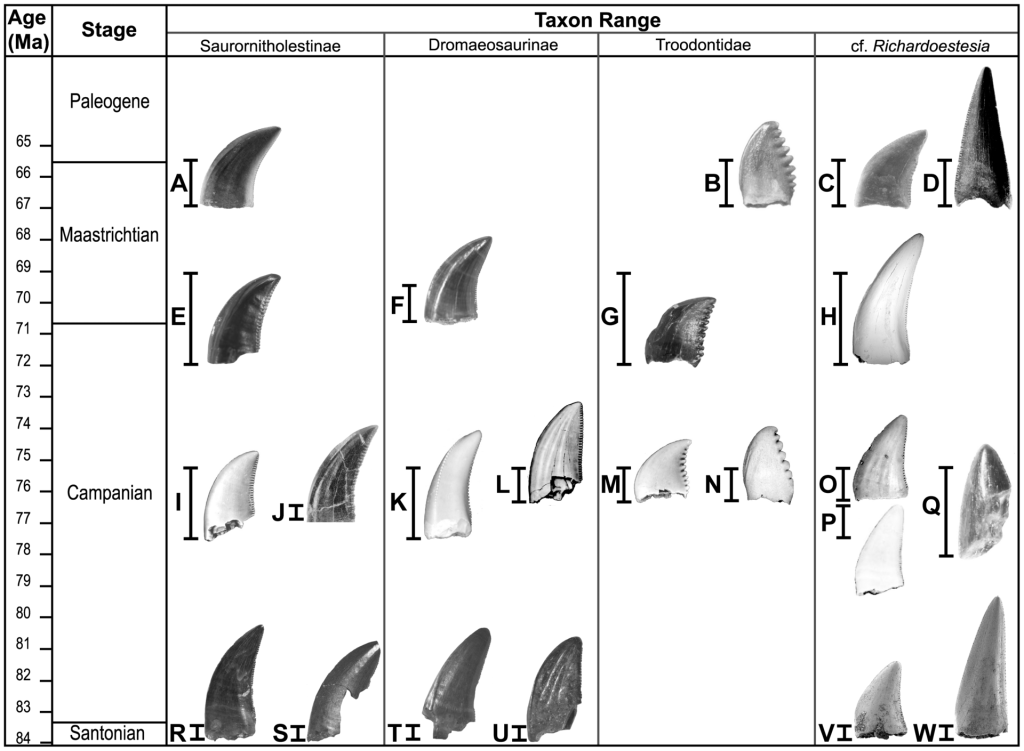

Beyond the holotype, everything assigned to Richardoestesia consists of isolated teeth. In 2019, A. Averianov and H.-D. Sues noted that the 1990 description combined the dentaries with distinctive isolated teeth. In 2002, a study led by paleontologist Julia T. Sankey examined more than 1,700 small theropod teeth from the Judith River Group and reported both R. gilmorei and R. isosceles. Larson and Currie later figured a Dinosaur Park tooth, TMP 2000.019.0004, as R. gilmorei. Still, matching shed teeth to the holotype is tricky. Its germ teeth are incompletely erupted, so researchers cannot measure them directly against shed crowns, although similarities with referred Dinosaur Park teeth have been noted.
Richardoestesia Size and Description
With only jaws and teeth to go on, any portrait of Richardoestesia has to start at the mouth.
Short description of Richardoestesia
The holotype jaws are long and slender. In 1924, Gilmore called the dentary “extremely long and slender,” and Currie stressed the point again in 1987, before the genus had a name. Gilmore could also clearly distinguish sockets for thirteen teeth, and he estimated at least eighteen in the complete row. In his words, the teeth were compressed, sharp pointed, and recurved, with serrations on the rear edge only.
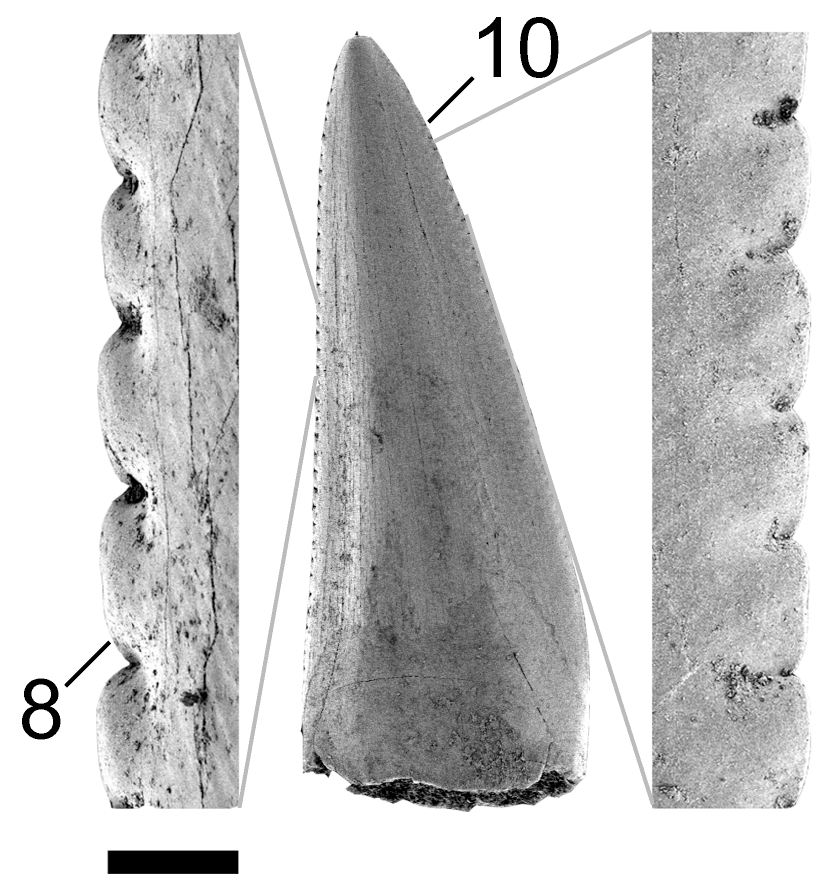
As Larson and Currie reported, the 1990 description gave the teeth small, rounded denticles—tiny serrations along a cutting edge. It also noted backward-curved crowns. Williamson and Brusatte later called the genus’s teeth bladelike, with front serrations like the rear ones or absent. No skull, limbs, or tail are known, so its posture and proportions remain a blank. Likewise, no skin survives, so any discussion of its body covering is speculative.

Size and Weight of Type Species
The only hard numbers come from the jaw, and they describe the bone rather than the animal.
As preserved, the left dentary reaches about 7.6 inches (193 millimeters), although both ends are incomplete. Gilmore estimated that the complete bone would have measured about 9.1 inches (230 millimeters).
Without more of the skeleton, scaling these jaws up to a whole body would be guesswork. For now, Richardoestesia is best measured by its teeth—and those are anything but simple.
The Dinosaur in Detail
What sets this dinosaur apart is what Currie called the extremely fine serrations of its teeth. In 2013, Larson and Currie sorted the teeth into two shapes: curved and often short ones like R. gilmorei, and straight, tall ones like R. isosceles. They also found that teeth given one name in different formations often differ measurably. Williamson and Brusatte went further. In their view, referrals spanning the Santonian to the Maastrichtian, and West Texas to southern Alberta, likely represent more than one taxon.
The R. isosceles Debate
The second species divides opinion most sharply. In 2001, Sankey named R. isosceles from a partial tooth in the upper Aguja Formation of Texas. Its crown was less recurved and more nearly erect than in R. gilmorei. However, Rauhut argued in 2002 that it was poorly diagnosed, and he called it a nomen dubium—a name too poorly founded to use. In 2008, paleontologist N. R. Longrich instead treated it as a junior synonym, or later name, of R. gilmorei. Larson and Currie kept both names, though they cautioned that the two may not differ within the Oldman and Dinosaur Park formations. Company and colleagues even suggested that the tooth may belong to a crocodyliform. Averianov and Sues called it a nomen dubium in 2019.
Some of these shapes may even come from one mouth. Using teeth from New Mexico, Williamson and Brusatte argued that erect and recurved forms likely sat at different positions in one jaw. That would make the animal heterodont—its tooth shape changing along the jaw—and it supported Longrich’s view. Longrich had also suggested that many teeth known as Paronychodon could be the front teeth of Richardoestesia.
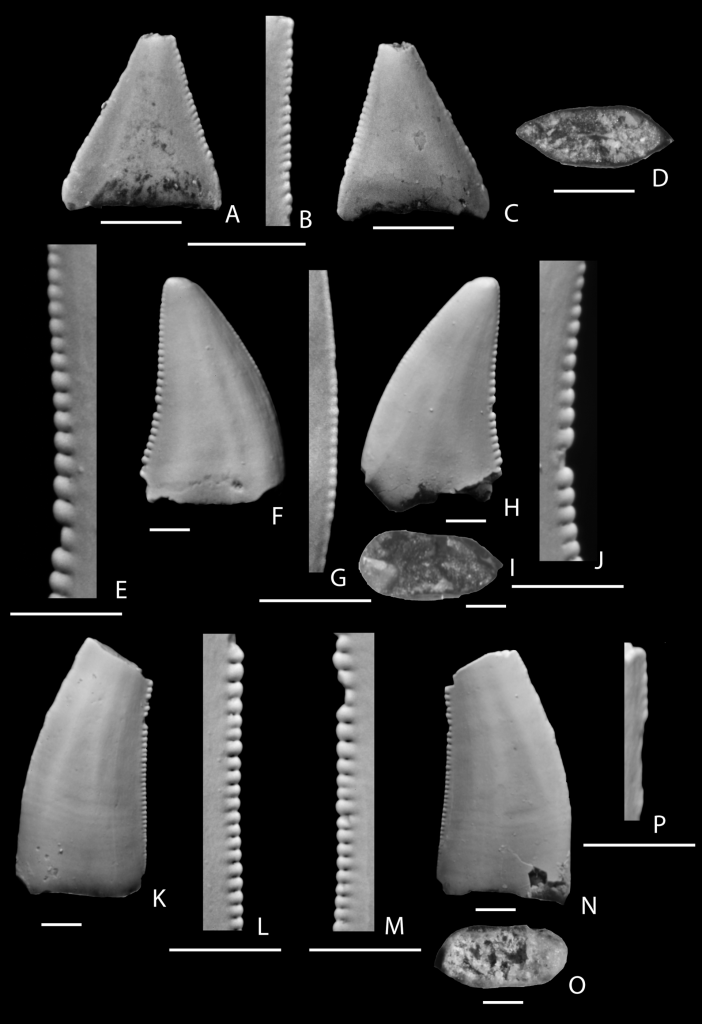

In Asia, R. asiatica, named by Lev Nesov in 1995, rests on many isolated teeth from three formations in Uzbekistan. Unlike R. gilmorei, it includes a large proportion of straight teeth and has fully serrated front edges. Indeed, Averianov and Sues could not tell it apart from R. isosceles. These studies leave a name doing double duty—one genus on paper, perhaps several animals in the rocks. For Larson and Currie, jaws with teeth still in place would ease the problem.
Interesting Points about Richardoestesia
- Before it had a name, the holotype spent decades provisionally linked to the oviraptorosaur Chirostenotes pergracilis, a pairing Gilmore himself called “purely arbitrary.”
- Gilmore could clearly count sockets for thirteen teeth in the holotype jaw, and he estimated at least eighteen in the complete row.
- Several of the holotype’s teeth are germ teeth that were still incompletely erupted, which makes comparison with shed teeth difficult.
- Teeth of R. asiatica from Uzbekistan carry an average of 28.4 front and 34.5 rear denticles in every 5 millimeters (0.2 inches) of cutting edge.
- While studying bite marks on the frill of a young horned dinosaur, Hone and colleagues listed Richardoestesia among the toothed carnivores of the Dinosaur Park beds. However, they did not compare its teeth with the marks, and they favored a dromaeosaurid or young tyrannosaur.
Dinosaurs from the Same Formation
Also known from the Dinosaur Park Formation (exact level relative to Richardoestesia not known): the tyrannosaurid Gorgosaurus, the dromaeosaurids Dromaeosaurus and Saurornitholestes, the small microraptorine Hesperonychus, the caenagnathid Chirostenotes, and the horned dinosaur Centrosaurus. The formation spans about 2 million years, so these animals may not all have lived at the same time. Gilmore recorded the holotype’s position only as about 200 feet above the river, which does not tie it to any of these finds.
Richardoestesia in its Natural Habitat
The world of the Dinosaur Park Formation lay at the edge of the Western Interior Seaway. About 230 feet (70 meters) thick in Dinosaur Provincial Park, the formation records a transgressive phase—a time when the sea advanced onto the land. Ancient river channels, unusually rich in bonebeds, dominate its lower half. Toward the top, it passes into the tidal wetlands and shorelines of the Lethbridge Coal Zone. Above lie the marine shales of the Bearpaw Formation.
In 2018, Hone and colleagues counted Richardoestesia among the toothed, carnivorous forms of the Dinosaur Park beds. However, they tied no bite marks to it, so what it actually hunted remains open. Lizards, crocodiles, champsosaurs, and mammals also counted among the formation’s non-dinosaur carnivores.
Together with the Oldman Formation below, these rocks have produced more than 140 vertebrate species in the park. Across the Belly River Group, microsites—small concentrations of bones and teeth—show that shifts between marine and land settings drove changes in the overall vertebrate fauna. Even so, the dinosaur communities themselves seem to have been little affected. In the Dinosaur Park Formation, a few microsites cluster together partly because of their tyrannosaurid and Richardoestesia teeth. While nothing reveals whether it lived alone or in groups, its teeth remain a familiar find across the Late Cretaceous of North America.
Frequently Asked Questions
It was a theropod of uncertain placement within Coelurosauria, known from a pair of partial lower jaws and many isolated teeth.
It lived during the Campanian stage of the Late Cretaceous, about 76.5 to 74.4 million years ago.
Only the jaw gives hard numbers. The holotype’s left jaw measures about 7.6 inches as preserved, and Gilmore estimated about 9.1 inches when complete.
It is regarded as a carnivore, listed by Hone and colleagues among the toothed, carnivorous forms of the Dinosaur Park Formation.
Its holotype jaws were found in 1917 south of Little Sandhill Creek on the Red Deer River, in the Dinosaur Park Formation of Alberta, Canada.
It is disputed. Some researchers call it a nomen dubium or a synonym of R. gilmorei, while Larson and Currie keep it distinct.
Sources
The information in this article is based on various sources, drawing on scientific research, fossil evidence, and expert analysis. The aim is to provide a comprehensive and accurate overview of Richardoestesia. However, please be aware that our understanding of dinosaurs and their world is constantly evolving as new discoveries are made.
- https://doi.org/10.1017/CBO9780511608377.011
- https://download-telecharger.services.geo.ca/pub/nrcan_rncan/publications/STPublications_PublicationsST/297/297678/mb_038.pdf
- https://doi.org/10.1371/journal.pone.0054329
- https://doi.org/10.1371/journal.pone.0093190
- https://doi.org/10.1080/02724634.2019.1614941
- https://doi.org/10.1666/0022-3360(2001)075%3C0208:LCSDAF%3E2.0.CO;2
- https://doi.org/10.1666/0022-3360(2002)076%3C0751:STABTF%3E2.0.CO;2
- https://doi.org/10.7717/peerj.5748
- https://doi.org/10.1371/journal.pone.0283581
- https://doi.org/10.1186/s12898-016-0106-8
- https://tb.plazi.org/GgServer/xml/03EBA441FF988449C7E3FDE8F2EED3FB
- https://doi.org/10.1038/s41598-022-19896-w
- https://www.app.pan.pl/archive/published/app48/app48-191.pdf
- https://doi.org/10.1073/pnas.0811664106
- https://doi.org/10.18435/vamp29362
- https://stratigraphy.org/ICSchart/ChronostratChart2024-12.pdf
This article was last fact checked: TheDinosaurs Team, 21-11-2026
Featured Image Credit: Derek W. Larson, Philip J. Currie, CC BY 2.5, via Wikimedia Commons
