In the Alpine foothills along the Swiss–Italian border, the marine limestone of the Saltrio Formation once held an unexpected predator. Less than 50 miles (80 kilometers) north of Milan, the Saltrio quarry has produced building stone since the 15th century. Within it lay the scattered bones of Saltriovenator zanellai, a large predatory theropod. It lived during the early Sinemurian stage of the Early Jurassic, roughly 199.3 to 197.5 million years ago. Its describers presented it as the oldest known ceratosaurian—a view later studies share. At an estimated 25 feet (7.5 meters), it is also the largest predatory dinosaur yet known from its epoch.
In the summer of 1996, fossil amateur Angelo Zanella spotted bones emerging from large blocks of rock in the quarry. Quarry explosives had already blown the fossil-bearing layer into hundreds of pieces. In 2018, paleontologists Cristiano Dal Sasso, Simone Maganuco, and Andrea Cau finally named the animal. According to its describers, its few bones—above all one complete finger—shed light on how the hand of birds evolved.
Saltriovenator Key Facts
| Keyword | Fact |
|---|---|
| Pronunciation | Not specified |
| Meaning of name | Saltrio Hunter |
| Group | Theropoda (Ceratosauria) |
| Type Species | Saltriovenator zanellai |
| Diet | Carnivore |
| When it Lived | 199.3 to 197.5 MYA |
| Period | Jurassic |
| Epoch | Early Jurassic (Sinemurian stage) |
| Length | About 25 feet (7.5 meters), estimated from a subadult |
| Height | About 7.2 feet (2.2 meters) at the hips, reconstruction estimate |
| Weight | About 2,560 to 3,580 pounds (1,160 to 1,622 kilograms), estimates |
| Mobility | Not specified |
| First Discovery | 1996 (summer) by Angelo Zanella |
| Described by | 2018 by C. Dal Sasso, S. Maganuco, and A. Cau |
| Holotype | MSNM V3664 |
| Location of first find | Salnova quarry, Saltrio Formation, Saltrio, Varese Province, Lombardy, Italy |
Saltriovenator Origins, Taxonomy and Timeline
The genus name joins a place and a profession. “Saltrio” is the locality where the holotype was found, while venator is Latin for “hunter”—and, the describers added, a type of Roman gladiator. Meanwhile, the species name zanellai honors Angelo Zanella, who discovered the fossil.
In 2018, Dal Sasso and colleagues placed the animal within Neotheropoda and then Ceratosauria, the lineage that also includes the later Ceratosaurus. Their analysis recovered it as the sister taxon of Berberosaurus, a younger Early Jurassic theropod from Morocco, on the basalmost (earliest-branching) ceratosaur lineage. However, the authors called the support for this pairing relatively weak, because the two known skeletons overlap only in the metacarpals (palm bones). It is the only known species, and no later study we found has challenged its validity.
About a hundred marine invertebrate species, including 19 index ammonites—fossils used to date rocks—fix the formation as Sinemurian. An ammonite and a nautiloid found with the bones narrow the bone bed to two layers, from the bucklandi and semicostatum zones. However, only the lower layer contains the green mineral glauconite. That places the skeleton in the bucklandi zone, the earliest part of the early Sinemurian, roughly 199.3 to 197.5 million years ago. In fact, its describers argued that it pre-dates the appearance of theropods approaching 2,200 pounds (1,000 kilograms) by more than 25 million years.
Discovery & Fossil Evidence
Zanella was a collaborator of the Museo di Storia Naturale di Milano. He usually hunted for ammonites and other small invertebrates, Dal Sasso noted in 2003, so the find was accidental. Before its naming, the animal was informally called “saltriosauro,” a nomen nudum—a name without standing, since no diagnosis or catalog number was published.
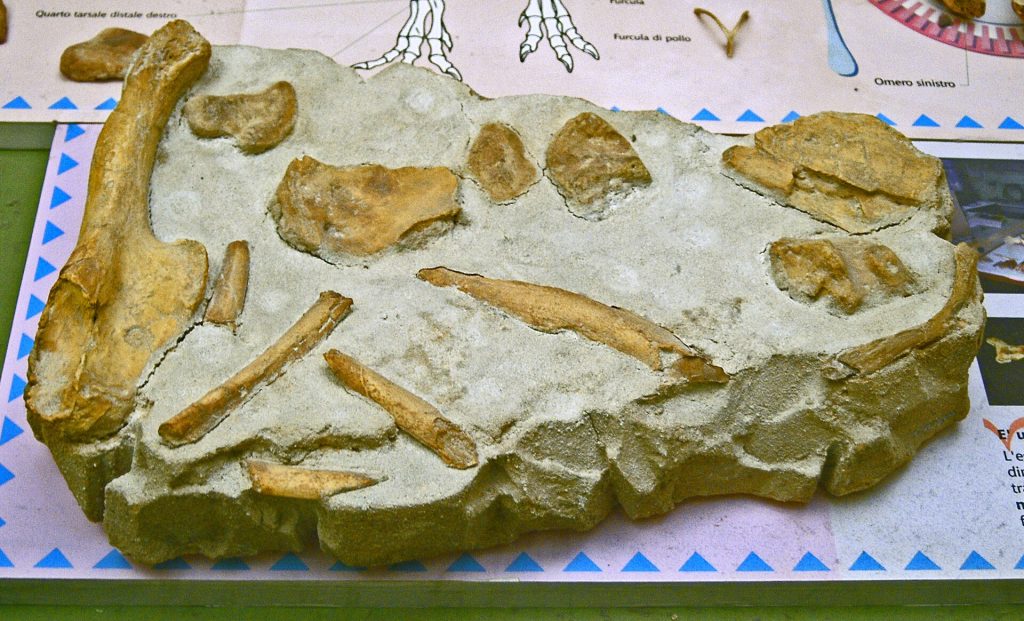

Freeing the bones from about half a ton of limestone took some 1,800 hours with weak formic acid, ending in 1999. Of 132 bone pieces, the describers identified 35 determinable bones, several pieced together from many fragments, as the holotype, MSNM V3664, kept in Milan. The other pieces are only partly identifiable or indeterminate. The holotype includes jaw fragments, ribs, a furcula (wishbone), and parts of the scapula (shoulder blade) and breastbone. Parts of both humeri (upper arm bones), the right hand, the ankle, and four metatarsals (foot bones) complete the list.
No vertebrae turned up in the two blocks holding most limb bones, and the chest block lacks gastralia (belly ribs). Because no bone is duplicated and all match in size, the remains belong to one individual. A single tooth, MSNM V3659, is referred to the species but kept apart from the holotype as a possible shed tooth. In 2003, Dal Sasso estimated that less than 10 percent of the skeleton was recovered, and in 2021 Cau still called the holotype the only known specimen.
Saltriovenator Size and Description
With so little of the skeleton preserved, every picture of Saltriovenator blends measured bones with careful inference.
Short description of Saltriovenator
The skull is almost unknown, apart from pieces of two lower jaw bones—the splenial and the prearticular. The describers’ reconstruction puts its length at about 2.6 feet (80 centimeters). Their drawing also adds a crest along the snout and another on the lacrimal bone in front of the eye. Both are inferred from the group’s likely ancestral condition rather than preserved. The referred tooth is typically ziphodont—blade-like, recurved, and serrated—with a preserved crown about 1.7 inches (43 millimeters) tall.
In the chest, a broad, V-shaped furcula bore a prominent hypocleideum, a spur at the point of the V. Its shoulder blade was strap-like, as in other early-branching ceratosaurs such as Ceratosaurus. The upper arm bone was robust, straight, and about 14.1 inches (358 millimeters) long. A quadrangular deltopectoral crest—a ridge for the chest muscles—ran along half its length. The main palm bone was stout. All four bones of the third finger survive, though the claw has lost its tip. The claw carries a prominent flexor tubercle, a bump for the tendon that curled the finger.
In the foot, the ankle bones remained unfused to the metatarsals. The fourth metatarsal curves outward toward its lower end, which the authors read as a weight-bearing (graviportal) adaptation. Skin and soft tissue are not preserved, so any talk of its coloration is speculative.

Size and Weight of Type Species
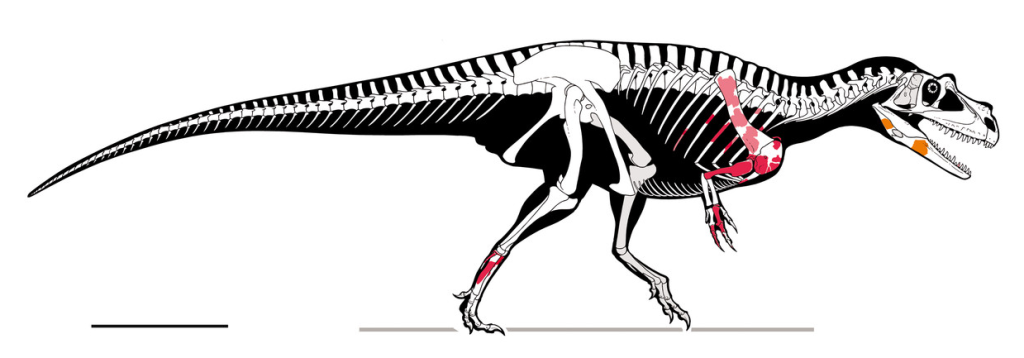
In 2018, Dal Sasso and colleagues estimated Saltriovenator at about 25 feet (7.5 meters) long. First, they compared it with a subadult Allosaurus about 26 feet (8 meters) long. The scapulae were almost equal, but the Italian humerus was 10 percent longer. That suggested a length of at least 23 to 26 feet (7 to 8 meters). Scaling up a Ceratosaurus skeleton, meanwhile, gave about 24 feet (7.3 meters) and a hip height of about 7.2 feet (2.2 meters).
Similarly, the reconstruction gave a weight between 2,560 and 3,360 pounds (1,160 and 1,524 kilograms). In contrast, estimating femur (thigh bone) length from the shoulder blade and upper arm gave 2,800 to 3,580 pounds (1,269 to 1,622 kilograms). Every method put it close to or above 2,200 pounds (1,000 kilograms). By their count, it was at least 25 percent larger than the largest known Ceratosaurus. It also outsized the holotype of Cryolophosaurus. In 2007, Smith and colleagues had estimated that animal at 21 feet (6.5 meters) and 1,025 pounds (465 kilograms). With the mass formula used for Saltriovenator, however, the describers put Cryolophosaurus at about 2,200 pounds (1,000 kilograms)—still lighter.
In 2003, Dal Sasso gave a preliminary 26 feet (8 meters) and 1.5 metric tons (about 3,300 pounds). In 2021, Cau restated the length as about 26 feet (8 meters). Every estimate, however, rests on indirect comparison. Counting five growth lines and back-calculating about 19 more, the team put its age at death at 24 years or older. Even so, the animal was still a subadult that had not quite reached full size.
The Dinosaur in Detail
What sets this dinosaur apart is its hand. On the main palm bone, an enlarged lip overhangs the joint and borders a deep, wide pit. The first bone of the same finger bears a deep, narrow groove and a distinct bump. According to the describers, this pit-and-lip complex let that bone bend backward by 65 degrees. By comparison, Welles credited Dilophosaurus with 90 degrees in 1984.
Dal Sasso and colleagues saw a hand built to grasp struggling prey without dislocating, and its stout bones may reflect heavier loads than slender early theropods faced. Overall, the skeleton shows a mosaic of features seen in four-fingered theropods and early tetanurans, the more evolved lineage. From it, the team inferred that the first ceratosaurs had two, three, four, and one bones in their first four fingers. In their view, this supports the idea that bird fingers are digits one to three, and makes the strange hand of Limusaurus a specialization of late ceratosaurs.
Its placement has shifted over time. In 2003, before its naming, Dal Sasso noted tetanuran traits such as a three-fingered hand and a furcula. He considered it possibly transitional—a basal tetanuran or even the most ancient carnosaur. In the 2018 analysis, forcing it into Tetanurae made the shortest family trees five steps longer. It lacks hallmarks of neoceratosaurs, the later ceratosaurs, such as more symmetrical joints at the end of the main palm bone.
Later work has built on it. In 2021, a review by Cau called it the oldest known averostran and ceratosaur, and a second Cau-led study used it as the ceratosaur example for wishbone shape. In 2026, Rowe and colleagues again treated it as the earliest ceratosaur. Taken together, these traits portray a powerfully armed early hunter—one whose family tree rests on a handful of bones.
Interesting Points about Saltriovenator
- It is the first dinosaur skeleton from the Italian Alps and the first of Jurassic age found in Italy.
- It is the third named non-avian dinosaur species from Italy and the country’s second theropod skeleton after Scipionyx.
- Saltrio Stone from its quarry was used in Milan’s La Scala theater and Turin’s Mole Antonelliana.
- Its describers suggested it could have been among the most common large theropod trackmakers on western Tethys shores.
- Its bones carry at least 30 borings, likely the first record of marine bioerosion on dinosaur remains.
Saltriovenator in its Natural Habitat
The world Saltriovenator knew was a warm coastline beside an open sea. Its bones settled on a slope of that basin, in sunlit, well-oxygenated water a few dozen meters deep and within reach of storm waves. The carcass may have come from the Arbostora swell, a raised block that had stood above water for about 3 million years. By the animal’s time, the swell had sunk back beneath a shallow sea, though land still lay to the south and southwest. Western Lombardy had a warm, humid climate, and ancient red soils suggest forests covered the land. Coeval beds near Lake Maggiore yield conifers and Ptilophyllum, a plant that filled a niche like modern mangroves.
While there is no direct evidence of what it hunted, the describers saw it as an apex macropredator, a view Cau restated in 2021. If the local highlands were connected, the 2018 team argued, they could support predators over 23 feet (7 meters) long. Tracksites in northeastern Italy record theropods of similar size. The team also proposed that such hunters were one factor pushing Early Jurassic sauropods toward giant size. In England, the holotype of the early neotheropod Sarcosaurus comes from the same ammonite zone. However, no study we found links the two regions’ land faunas.
After death, the carcass apparently floated out to sea and sank not far from the shoreline. It lay exposed on the sea floor for months, maybe years. Some semicircular marks were likely made by vertebrate jaws, and one deep bite scars a hand or foot bone. Even so, the describers concluded that bottom-dwelling invertebrates were its main scavengers. The only other vertebrate in the blocks was a bony fish—fitting for a land hunter that found its grave at sea.
Frequently Asked Questions
It means “Saltrio hunter,” after the Italian locality, and the species name zanellai honors discoverer Angelo Zanella.
It lived in the early Sinemurian stage of the Early Jurassic, roughly 199.3 to 197.5 million years ago.
Its describers estimated about 25 feet (7.5 meters) long and 2,560 to 3,580 pounds, based on a subadult known from under 10 percent of its skeleton.
Its one known tooth is blade-like and serrated, typical of a carnivore, though no direct evidence of its prey has been found.
It was found in the Salnova quarry at Saltrio, in Lombardy, northern Italy, within the Saltrio Formation.
Its describers and later studies rank it as the oldest known ceratosaur and the largest predatory dinosaur known from the Early Jurassic.
Sources
The information in this article is based on various sources, drawing on scientific research, fossil evidence, and expert analysis. The aim is to provide a comprehensive and accurate overview of Saltriovenator. However, please be aware that our understanding of dinosaurs and their world is constantly evolving as new discoveries are made.
- https://doi.org/10.7717/peerj.5976
- https://pmc.ncbi.nlm.nih.gov/articles/PMC6304160/
- https://doi.org/10.1016/S1631-0683(03)00007-1
- https://sciencepress.mnhn.fr/sites/default/files/articles/pdf/comptes-rendus-palevol2003v2f1a05.pdf
- https://www.socnatmatmo.unimore.it/download/Atti2021.pdf
- https://doi.org/10.1093/zoolinnean/zlaa054
- https://research.birmingham.ac.uk/files/94667499/ZOJ_02_2020_4023.R1_Proof_hi.pdf
- https://doi.org/10.1038/s41598-021-94285-3
- https://doi.org/10.1038/s41598-025-32686-4
This article was last fact checked: TheDinosaurs Team, 16-11-2026
Featured Image Credit: Danny Cicchetti, CC BY-SA 4.0, via Wikimedia Commons
