
Near the village of Heroldsberg in Bavaria, a conglomerate layer in the red mudstones of the Trossingen Formation yielded one of the first named dinosaurs. Paleontologist Hermann von Meyer called the animal Plateosaurus engelhardti in 1837, five years before the word “Dinosauria” existed. Today, however, the genus is anchored to a different species, Plateosaurus trossingensis, after a 2019 ruling on scientific names. This herbivore lived in the Norian stage of the Late Triassic—around 207 million years ago by one estimate.
In 1834, chemistry professor Johann Friedrich Philipp Engelhart showed the first bones at a naturalists’ meeting in Stuttgart. Meyer studied them, then announced a new genus in a short letter dated April 4, 1837. Later, mass bonebeds at Trossingen, Halberstadt, and Frick turned that scrappy start into a detailed portrait—from skulls and growth marks to a severe bone infection.
Plateosaurus Key Facts
| Keyword | Fact |
|---|---|
| Pronunciation | Not specified |
| Meaning of name | Broadway Lizard, per Moser, as Meyer gave no etymology and the common “Flat Lizard” is disputed |
| Group | Sauropodomorpha, Plateosauridae |
| Type Species | Plateosaurus trossingensis, designated in 2019, originally Plateosaurus engelhardti |
| Diet | Herbivore |
| When it Lived | Around 207 MYA according to Moser, while Regalado Fernández and Werneburg give 211 to 203.6 MYA for the Trossingen type bone bed, using an older (2011) time scale |
| Period | Triassic |
| Epoch | Late Triassic (Norian stage) |
| Length | About 21 feet (6.5 meters) for the type specimen, with adults estimated at about 16 to 33 feet (4.8 to 10 meters), though Moser argues the 10-meter top figure should be reduced |
| Height | Not specified |
| Weight | About 1,530 pounds (693 kilograms) for skeleton GPIT 1, Mallison’s 2010 estimate |
| Mobility | Moved on two legs (bipedal), according to Mallison’s 2010 study |
| First Discovery | 1834 by Johann Friedrich Philipp Engelhart |
| Described by | 1837 by Christian Erich Hermann von Meyer |
| Holotype | SMNS 13200, holotype of the type species P. trossingensis |
| Location of first find | Probably the Buchenbühl clay pit on the Haidberg, near Heroldsberg, Middle Franconia, Bavaria, Germany, Trossingen Formation |
Plateosaurus Origins, Taxonomy and Timeline
Meyer never explained the name he chose. In 2003, paleontologist Markus Moser traced it to the Greek plateia, meaning “broad way,” and rendered Plateosaurus as “broadway lizard.” The more familiar translation, “flat lizard,” stems from Agassiz’s unjustified change of the spelling to Platysaurus. The species name honors Engelhart, whose name Meyer spelled “Engelhardt,” so engelhardti is the correct original form. Together, the name pairs a broad road with the man who first carried its bones to Stuttgart.
Plateosaurus belongs to Dinosauria, Saurischia, and Sauropodomorpha—the wider lineage that also includes the giant sauropods. It also gives its name to the family Plateosauridae and the larger group Plateosauria. In 2024, paleontologist Joep Schaeffer redescribed the holotype and re-examined where P. trossingensis sits in the sauropodomorph family tree.
Researchers once recognized up to 20 species in up to eight genera, many later lumped into P. engelhardti. In 2010, however, paleontologists Peter Galton and D. Kermack judged P. engelhardti a nomen dubium—a name too doubtful to use. Two years later, Galton asked the International Commission on Zoological Nomenclature to make SMNS 13200 a neotype, or replacement name-bearer, for that species. Then, in Opinion 2435 of 2019, the Commission set aside all previous fixations of type species for the genus. It designated P. trossingensis Fraas, 1913 as the type species of Plateosaurus.
On the current international chart, the Norian spans roughly 227.3 to 205.7 million years ago. Moser dated the original Bavarian beds to about 207 million years ago and correlated them with the Upper Norian. In 2022, paleontologists Omar Regalado Fernández and Ingmar Werneburg likewise placed the Trossingen type bone bed in the Sevatian, an informal label for the latest Norian. Using a 2011 timescale, they gave it an age of 211 to 203.6 million years.
Discovery & Fossil Evidence
Meyer’s letter recalled that Engelhart had brought bones “of a giant animal” from a breccia-like sandstone to the Stuttgart meeting. Moser later dated the find to summer 1834, probably at a clay pit on the Buchenbühl, about 1.2 miles (2 kilometers) south of Heroldsberg. Meyer drew the best pieces—nearly complete long limb bones and vertebrae—from “one of the most gigantic saurians.” Because its limb bones were heavy and hollow, he linked it to Iguanodon and Megalosaurus.
Galton later called the 1837 description “vague and non-diagnostic.” The original lot has also shrunk—of about 45 fragments that Blanckenhorn reported in 1898, fewer than half survive at Erlangen. Moser identified one piece as turtle plastron (belly shell). In 2000, Galton had traced another, now lost, to a theropod, or predatory dinosaur. Moser later pinned it down as a metatarsal (foot bone). He judged the worn bones probably reworked, with no two from the same individual. He then chose a partial sacrum (fused hip vertebrae), UEN 552, as the lectotype—a name-bearer picked from the original bones.
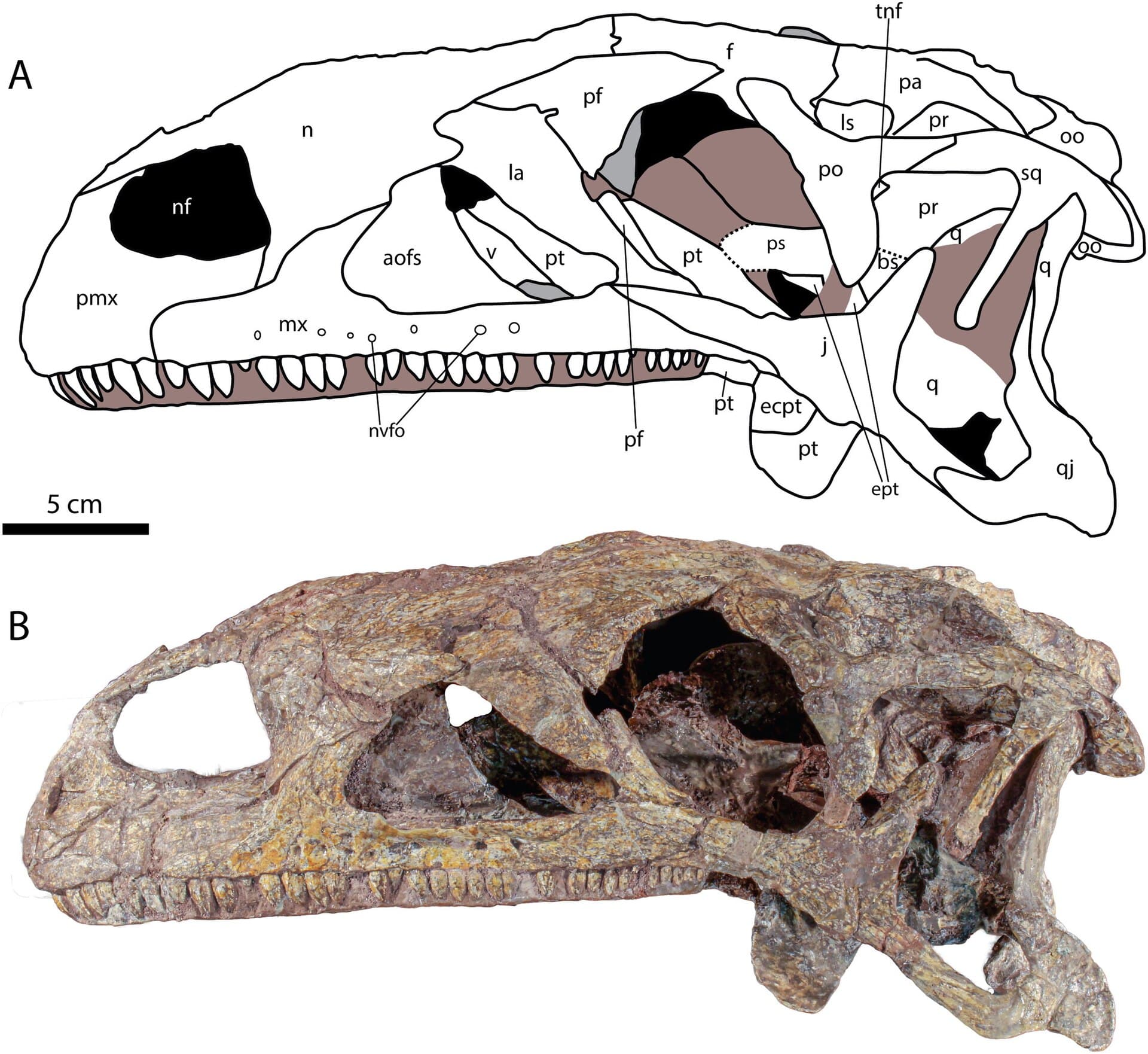

In 1913, paleontologist Eberhard Fraas reported skeleton SMNS 13200 and named it P. trossingensis. This almost complete skeleton with skull came from the lower bone bed at the Obere Mühle (upper mill) in Trossingen. Today it is housed at the Staatliches Museum für Naturkunde Stuttgart. After Huene’s detailed 1926 description, it became the basis for the concept of Plateosaurus.
Moser lists mass finds at Halberstadt in 1909, Trossingen in 1911, and Ellingen in Bavaria in 1962, where about 1,000 bones turned up. Digging at Frick in Switzerland has run since 1976. Meanwhile, the Stuttgart museum has resumed yearly digs at Trossingen. Moser counted over 100 complete and partial skeletons. A 2024 museum release now cites more than 250 plateosaurid individuals from Germany, Switzerland, and France.
Plateosaurus Size and Description
Short description of Plateosaurus
Digital tests by paleontologist Heinrich Mallison show a neck that could bend up, down, and sideways but resisted twisting, while the tail was highly flexible. The hand was adapted for grasping, yet the arm could barely reach in front of the shoulder. Its feet were digitigrade (walking on the toes), with a steeply held metatarsus (the long bones of the foot). No skin is described, so its covering and coloring remain speculative.
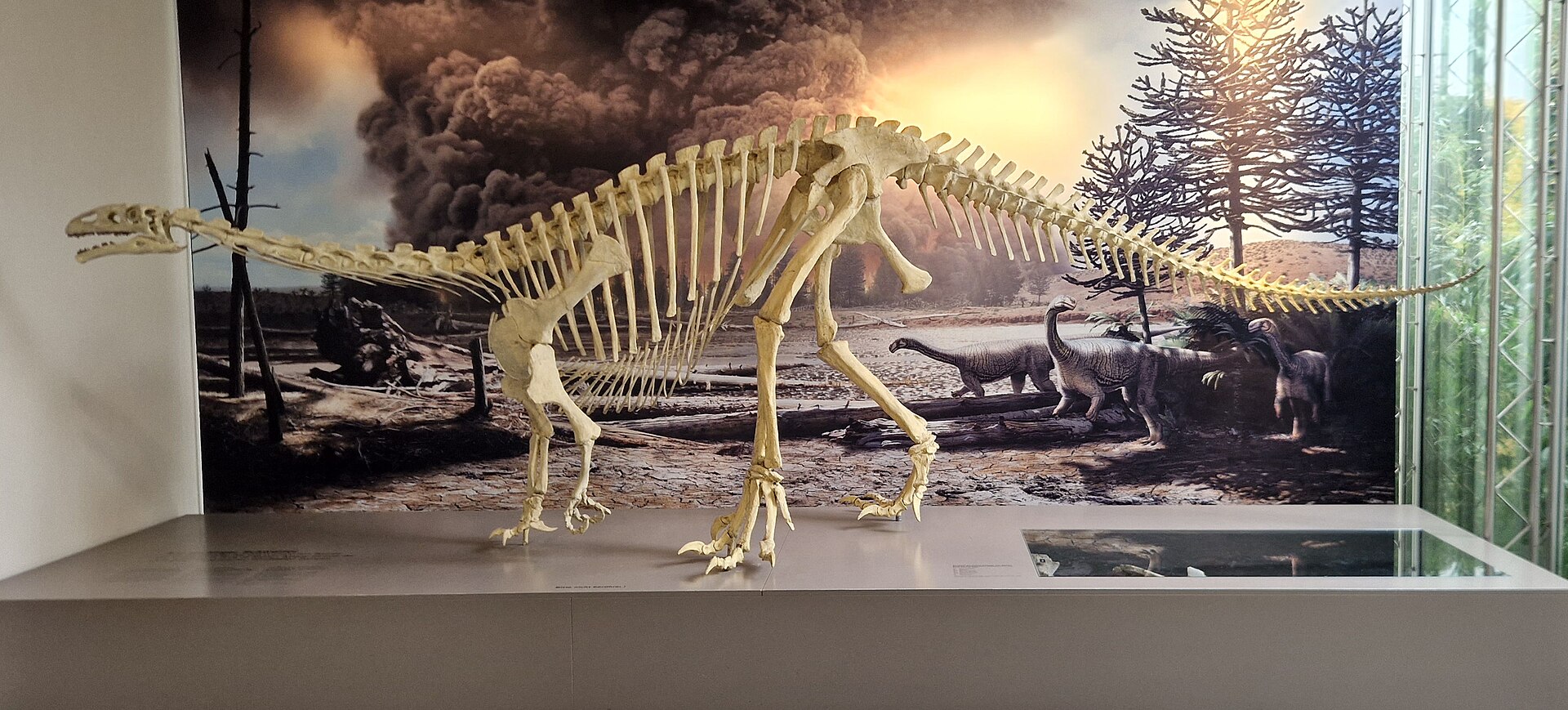
How it stood has long divided researchers. Huene saw a digitigrade biped, Jaekel a kangaroo-like hopper, and Fraas a sprawling quadruped. Wellnhofer’s 26-foot (8-meter) mount from 1994 and Moser’s 2003 proposal both put it on all fours. Even so, Moser did not rule out a two-legged stance—only fast two-legged running. Mallison’s 2010 digital mount of skeleton GPIT 1, however, showed an obligate biped—one that had to walk on two legs—with a nearly horizontal back.

Size and Weight of Type Species
A reconstruction of SMNS 13200 in Galton’s 2012 case shows a body length of about 21 feet (6.5 meters). Studies cited by paleontologist Sina Dupuis and colleagues in 2025 put adults between about 16 and 33 feet (4.8 and 10 meters). Moser, however, traced the 10-meter figure to a thigh bone, or femur, 3.2 feet (98 centimeters) long. Swelling clay had probably enlarged that bone, so he wrote that the estimate “must therefore be reduced.” Nau’s 2022 work, cited by Dupuis’s team, gives an average near 22 feet (6.7 meters). Frick animals ran smaller on average, and most measured 16 to 21 feet (4.8 to 6.5 meters). Still, the largest, SMF 15.6, reached about 25.6 feet (7.8 meters), above the species average. As a result, the team suggests the gap with German sites may be smaller than once thought.
In 2010, Mallison built a computer volume model of GPIT 1. His basic model weighed about 1,530 pounds (693 kilograms). Scaled to the smallest and largest adults, his figures run from about 1,050 pounds (476 kilograms) to roughly 9,480 pounds (4,300 kilograms). That upper figure, however, assumes the doubtful 10-meter length.
The Dinosaur in Detail
One of the first features to draw attention in Plateosaurus was its sacrum of three vertebrae. In 1839, Meyer called a sacrum of at least three fused vertebrae “outrageous for a saurus.” Moser later argued that the third sacral vertebra began as a tail vertebra.
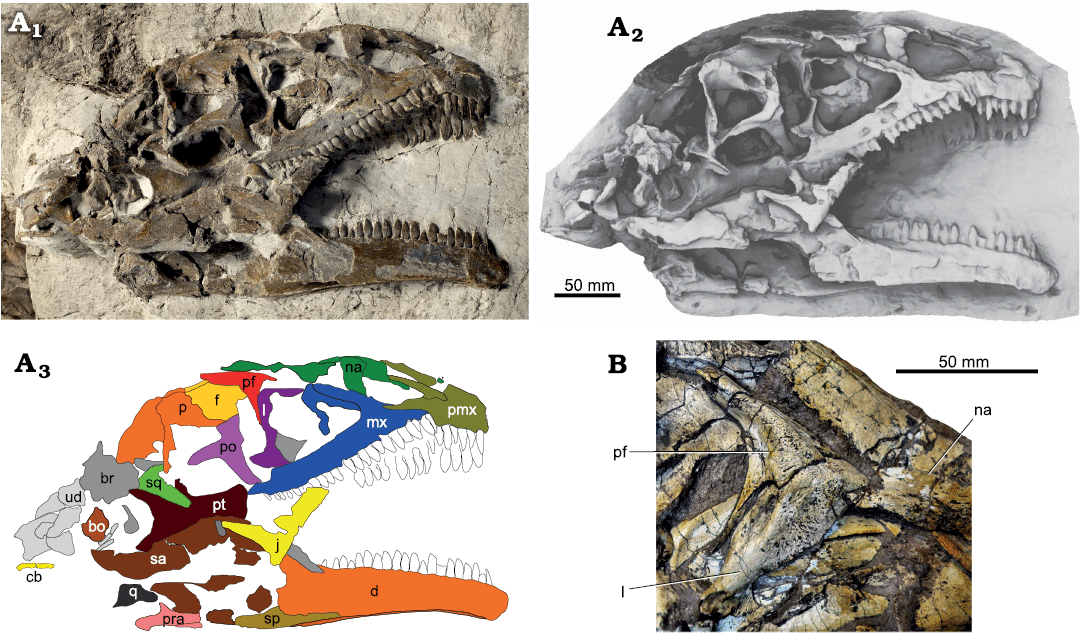
Counting species has proved harder. In 2021, paleontologist Jens Lallensack and colleagues described eight complete and six partial skulls from Frick, which brought P. trossingensis to 14 complete skulls. Although the skulls proved highly variable, they found no sign of more than one species among those from Frick, Trossingen, and Halberstadt. In 2023, however, Regalado Fernández and colleagues argued that the bone beds are not necessarily home to a single species. They narrow the genus to three species—P. trossingensis, P. gracilis, and P. longiceps—which Dupuis and colleagues treat as tentative. P. gracilis is the animal Huene first named Sellosaurus gracilis in 1908, and whether P. longiceps is distinct remains contested.

Growth adds another layer. In 2005, paleontologists Martin Sander and Nicole Klein found fast-growing fibrolamellar bone (a rapidly deposited bone tissue) in its limbs. Its growth marks, however, matched body size poorly, so they read this as life histories shaped by environment, as in modern ectothermic (cold-blooded) reptiles. Lallensack’s team later summarized this as an endothermic (warm-blooded) dinosaur that kept developmental plasticity—growth that varied with conditions.
Taken together, variable skulls and variable growth make Plateosaurus a lasting puzzle for anyone counting its species.
Interesting Points about Plateosaurus
- Meyer later grouped it in his “Pachypodes,” a group equivalent to Owen’s Dinosauria, but Huxley in 1870 was the first to place it in Dinosauria by name.
- Galton calls it the first non-English, non-avian dinosaur to be named, and the second sauropodomorph and Triassic dinosaur.
- Most skeletons from the big bonebeds lie on their bellies with crouched hind legs, informally called the “frog-kick” posture.
- The Frick skeleton “Teoplati” shows chronic osteomyelitis (bone infection) in its right shoulder blade and upper arm, likely one of the most advanced cases known.
Contemporary Dinosaurs
Sharing the Trossingen bone bed was Tuebingosaurus maierfritzorum, named in 2022 from hip, tail, and leg bones long filed as Plateosaurus. It was a massopodan—a member of the advanced sauropodomorph group that includes Mussaurus and, ultimately, the sauropods. That bed probably built up over hundreds of years, so the two need not have met.
In Thuringia lived Liliensternus liliensterni, a theropod that Zahner and Brinkmann list among coelophysoids, relatives of Coelophysis. Moser calls it the only known theropod of the Knollenmergel—the Württemberg equivalent of the Feuerletten, which he places in the Trossingen Formation. On that correlation, the two shared a formation and the late Norian, but no interaction is known.
At Frick, a younger layer above the classic Plateosaurus bone beds holds Notatesseraeraptor frickensis, an early neotheropod allied with Dilophosaurus and later theropods. The immature skeleton even preserves stomach contents. Its layer, in the same Gruhalde Member, sits only about 3.3 feet (1 meter) below the Triassic–Jurassic boundary. Nothing, however, ties it directly to Plateosaurus.
Northeast of Frick, Schleitheim in Canton Schaffhausen yielded Schleitheimia schutzi, the most derived (advanced) sauropodomorph known from the Late Triassic of Europe. Paleontologist Oliver Rauhut and colleagues suggest it may be the closest relative of the sauropods. Its bones most probably came from the uppermost Norian Gruhalde Member, and the same Schaffhausen material includes Plateosaurus, though no interaction is recorded.
Older sauropodomorphs such as Efraasia come from the earlier Löwenstein Formation.
Plateosaurus in its Natural Habitat
The world Plateosaurus roamed at Frick was a playa—a dry inland basin—washed by episodic sheet floods. Its rocks are gray to variegated marls (limy mudstones) cut by channels of silty marl to coarse sandstone. In Bavaria, Moser describes the fauna and flora of the Feuerletten as paucispecific, or poor in species.
Mallison, citing Galton, treats Plateosaurus as a herbivore. Moreover, his model suggests it could grasp small objects with one hand and feed at ground level without leaning on its arms.
While there is no direct evidence of herds, Sander in 1992 explained the crowded bonebeds as animals mired in mud. Teoplati probably died trapped in a mudhole on the Klettgau floodplain. Injuries to tail chevrons (bones beneath the tail vertebrae) may record thrashing to escape such traps, according to Schaeffer and colleagues. In 2025, paleontologist Thomas Filek and colleagues also suggested, from an almost complete Frick tail, that tail-whipping may have helped deter predators.
Frequently Asked Questions
Moser derives it from Greek for “broad way,” giving “broadway lizard” rather than the common “flat lizard.”
It lived in the Norian stage of the Late Triassic, around 207 million years ago by Moser’s estimate.
Adults are estimated at about 16 to 33 feet long, though Moser argues the top figure should be reduced. Mallison’s model of skeleton GPIT 1 weighed about 1,530 pounds.
It was a herbivore, and Mallison’s model suggests it could grasp small objects with one hand and feed at ground level.
The first bones came from near Heroldsberg in Bavaria, Germany, in 1834.
Galton calls it the first non-English, non-avian dinosaur ever named, and Moser counted over 100 complete and partial skeletons.
Sources
The information in this article is based on various sources, drawing on scientific research, fossil evidence, and expert analysis. The aim is to provide a comprehensive and accurate overview of Plateosaurus. However, please be aware that our understanding of dinosaurs and their world is constantly evolving as new discoveries are made.
- https://archive.org/details/neuesjahrbuchfer1837stut
- https://archive.org/download/biostor-284755/biostor-284755.pdf
- https://www.iczn.org/cases/all-cases/case/3560
- https://epub.ub.uni-muenchen.de/12711/1/zitteliana_2003_b24.pdf
- https://palaeo-electronica.org/2010_2/198/index.html
- https://app.pan.pl/archive/published/app55/app20090075.pdf
- https://pubmed.ncbi.nlm.nih.gov/16357257/
- https://www.app.pan.pl/archive/published/app66/app008042020.pdf
- https://vertebrate-zoology.arphahub.com/article/86348/
- https://sjpp.springeropen.com/articles/10.1186/s13358-025-00368-3
- https://doi.org/10.1080/14772019.2024.2335387
- https://pmc.ncbi.nlm.nih.gov/articles/PMC6669044/
- https://sjg.springeropen.com/articles/10.1186/s00015-020-00360-8
- https://stratigraphy.org/ICSchart/ChronostratChart2024-12.pdf
- https://doi.org/10.5852/ejt.2023.913.2375
- https://www.naturkundemuseum-bw.de/en/press/detailansicht/new-insights-into-one-of-europes-oldest-dinosaurs
- https://www.naturkundemuseum-bw.de/en/research/science-blog/plateosaurus-trossingensis-and-the-dino-mania-in-wuerttemberg
- https://doi.org/10.1098/rsos.250325
This article was last fact checked: TheDinosaurs Team, 30-10-2026
