
In the Junggar Basin of Xinjiang, northwestern China, the upper Shishugou Formation at Wucaiwan holds one of the oddest theropods of the Jurassic. Named Limusaurus inextricabilis in 2009, this small ceratosaur lived during the Oxfordian stage of the Late Jurassic, which its describers put at 161 to 156 million years ago. Its adults had no teeth at all—only a horny beak. At the time, its describers called it the only known beaked, herbivorous Jurassic theropod.
A Sino-American expedition team collected its skeletons from bonebeds that researchers later called “death pits.” In 2009, paleontologist Xu Xing and fourteen colleagues described the animal in Nature, and they used its strange hand to reopen an old question about how to number bird fingers. Later, in 2017, a study of 19 specimens showed that Limusaurus lost its teeth as it grew. With 78 growth-related changes on record, it shows how far one dinosaur could change between hatchling and adult.
Limusaurus Key Facts
| Keyword | Fact |
|---|---|
| Pronunciation | Not specified |
| Meaning of name | Mud or Mire Lizard |
| Group | Theropoda (Ceratosauria, Noasauridae) |
| Type Species | Limusaurus inextricabilis |
| Diet | Herbivore (adults), juveniles probably omnivores |
| When it Lived | 161.5 to 154.8 MYA (Oxfordian stage) |
| Period | Jurassic |
| Epoch | Late Jurassic (Oxfordian stage) |
| Length | About 5.6 feet (1.7 meters), holotype estimate |
| Height | Not specified |
| Weight | Not specified |
| Mobility | Not specified |
| First Discovery | Year not specified, by the Sino-American expedition team |
| Described by | 2009 by X. Xu, J.M. Clark, J. Mo, J. Choiniere, C.A. Forster, G.M. Erickson, D.W.E. Hone, C. Sullivan, D.A. Eberth, S. Nesbitt, Q. Zhao, R. Hernandez, C.-K. Jia, F.-L. Han, and Y. Guo |
| Holotype | IVPP V 15923 |
| Location of first find | Upper Shishugou Formation, Wucaiwan area, Junggar Basin, Xinjiang, China |
Limusaurus Origins, Taxonomy and Timeline
Mud lies at the root of the name Limusaurus—”Limus” is Latin for “mud or mire,” while “saurus,” Latinized from Greek, means “lizard.” The species name inextricabilis, Latin for “impossible to extricate,” refers to the specimens’ inferred death in a mire. Together, the name tells how these animals are thought to have died rather than how they lived.
Xu and colleagues placed Limusaurus in a very basal position within Ceratosauria. In all 1,882 most-parsimonious (simplest) trees of their main analysis, Elaphrosaurus came out as its sister taxon. However, only one shared trait—neck ribs fused to the vertebrae—supported that link, and the authors called it “likely to be labile,” or easily overturned. Indeed, in their separate digit analysis Elaphrosaurus wandered, while Limusaurus paired with Masiakasaurus. In 2016, Rauhut and Carrano moved Elaphrosaurus into the Noasauridae, within a Jurassic subclade, Elaphrosaurinae, otherwise known from eastern Asia. Later analyses recovered the two genera as sister taxa again, and researchers now treat it as a noasaurid. Limusaurus inextricabilis is the type and only known species.
Its fossils come from the upper Shishugou Formation, which the original paper assigned to the Oxfordian stage, then put at 156 to 161 million years ago. Today that stage spans roughly 161.5 to 154.8 million years ago, at the start of the Late Jurassic. In 2022, Xu and colleagues placed nearly all of the formation in the Oxfordian and dated the fauna to roughly 159 to 164 million years ago—with the death pits high in that sequence. Published ages for two ash layers at Wucaiwan vary by about a million years because researchers later recalibrated the dating standard, so the stage remains the safer guide. Meanwhile, the original team saw it as evidence of Middle to Late Jurassic faunal links between Asia and other continents, despite the Turgai Sea.
Discovery & Fossil Evidence
The expedition team collected the specimens from pits excavated in the Wucaiwan area, although the exact year of discovery does not appear in the sources we consulted. In 2010, paleontologists David Eberth, Xu, and James Clark reported three bonebeds holding at least 18 small non-avian theropods. These pits were only 1 to 2 meters (3.3 to 6.6 feet) deep. Of the theropods, a minimum of 15 individuals—the fewest animals the bones could represent—belonged to Limusaurus.
The holotype, IVPP V 15923, is an articulated, nearly complete skeleton held at the Institute of Vertebrate Paleontology and Paleoanthropology in Beijing. Only some distal caudal vertebrae (the bones near the tail tip) are missing. This skeleton came from near the base of a pit labeled TBB2005, which produced nine Limusaurus specimens in all, including the holotype, and nine other small vertebrates.
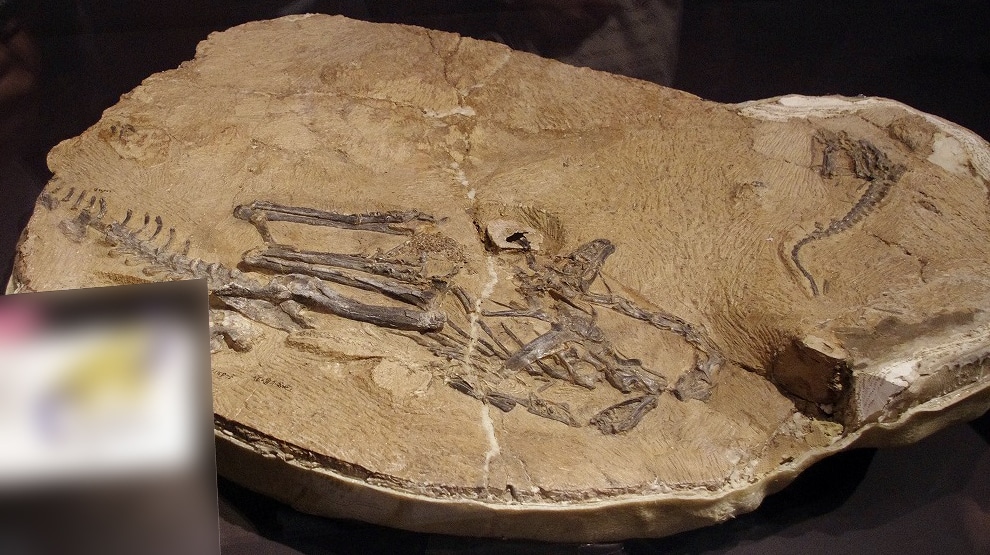

A second skeleton, IVPP V 15924, is semi-articulated and lacks its skull. The published supplementary information adds a third specimen, IVPP V16134—a partial left forelimb with a greatly reduced first metacarpal (palm bone). Since no single specimen preserves the whole hand, its reconstruction draws on all three. Meanwhile, pit TBB2001 held only Limusaurus, including a nearly complete, very small and presumably juvenile skeleton.
Limusaurus Size and Description
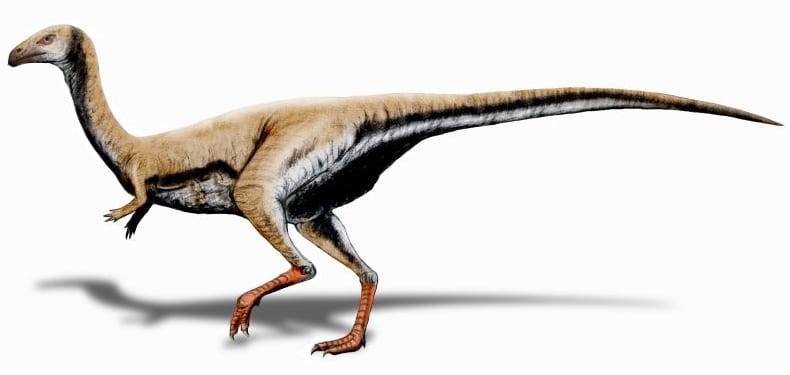
Small and long-legged, Limusaurus had leg proportions like those of derived coelurosaurs (the theropod group that includes tyrannosaurs and birds).
Short description of Limusaurus
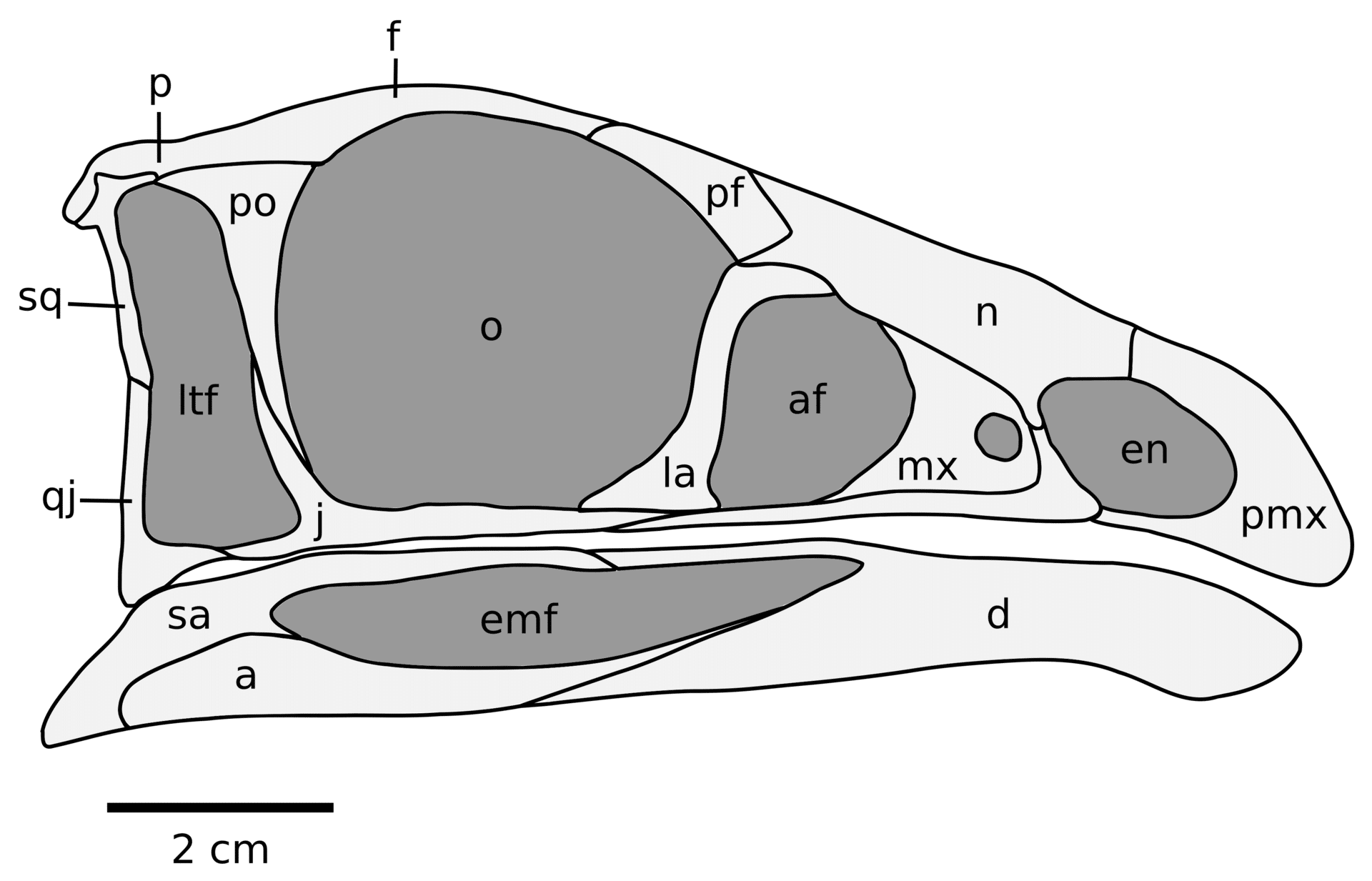
The head was small and short, only half as long as the femur (thigh bone). Adults had toothless jaws covered by a fully developed rhamphotheca, the keratin sheath that forms a beak. An opening in the lower jaw, the external mandibular fenestra, took up about 40 percent of the jaw’s length. Behind the head, the cervical (neck) vertebrae were significantly elongate. The chest carried a single fused sternal plate (breastbone) and a widely arched furcula (wishbone).
The forelimbs were very short—its describers put them at less than one-fifth the length of the hind limbs. In contrast, the tibiotarsus (shin bone) reached about 120 percent of the femur’s length, and the foot about 130 percent. The first toe was small, just 17 percent as long as the third metatarsal, a long foot bone. From these proportions, its describers inferred strong running ability. However, no source we consulted describes its skin or coloration, so any picture of its outer covering is speculative.

Size and Weight of Type Species
The holotype measured an estimated 5.6 feet (170 centimeters) in total length—about as long as many adult humans are tall. That figure combines the near-complete skeleton with an estimate for the missing tail tip, so it is part measurement and part reconstruction. By direct measurement, its femur is 208 millimeters (about 8.2 inches) long.
No height or weight appears in the scientific descriptions. Instead, the leg bones offer the best sense of scale, with a tibiotarsus of 249 millimeters (about 9.8 inches).
The second original skeleton, V 15924, was about 15 percent larger, judging by tibiotarsus length. Its bone held four preserved growth lines, and the marrow cavity may have erased at most one more. That suggests a five-year-old young adult in its sixth year, with growth slowing but not yet complete. Wang and colleagues’ later six-stage growth scheme places the holotype at stage four, according to a 2021 study.
The Dinosaur in Detail
What sets this dinosaur apart is its hand—and the long argument it started. The first metacarpal is extremely reduced and carries no phalanges (finger bones). Digits II and III each have three phalanges, and the ungual (claw) of digit III is rotated 90 degrees. By contrast, the slender fourth metacarpal bears an unknown number of phalanges.
In 2009, Xu and colleagues read this as bilateral digit reduction—fingers lost from both sides. If birds keep digits II, III and IV, they argued, the simplest reading is that all tetanurans (the branch leading to birds) shared them. Their analysis found this at least 10 steps shorter than a shift within the group. However, in 2018, Dal Sasso and colleagues argued that its hand is a derived condition limited to late-diverging ceratosaurs, and favored digits I, II and III in birds. A 2019 study noted that its bearing on the ancestral bird condition “has been contested.” Another 2018 study, whose data did not bear directly on the question, judged four competing hypotheses still plausible.
In 2017, Wang and colleagues found that hatchlings and juveniles were fully toothed, while mature individuals were toothless and beaked. Scans revealed vestiges of tooth sockets, indicating gradual tooth loss. They called this the first fossil record of ontogenetic edentulism—tooth loss during growth—among jawed vertebrates. A later dissertation could not reject that toothed juveniles and large toothless specimens are one species.

Elsewhere, plesiomorphic (ancestral) features shared with coelophysids sit beside derived ones shared with tetanurans. Its small head, toothless jaws, long neck and long legs also converge on ornithomimosaurs (“ostrich mimics”) and the crocodile-line reptile Effigia. Yet the toothless Brazilian noasaurid Berthasaura is not a close relative, suggesting toothlessness arose at least twice in the family. Taken together, Limusaurus is a mosaic of primitive and derived traits.
Interesting Points about Limusaurus
- Its species name means “impossible to extricate,” a reference to the specimens’ inferred death in a mire.
- Its 2009 describers called it the first definitive ceratosaur known from East Asia.
- Limusaurus accounts for at least 15 of the 18 or more small theropods recovered from the Wucaiwan death pits.
- Researchers logged 78 separate changes as it grew, including the complete loss of its teeth.
- At its description, it was considered the earliest and most basal theropod inferred to have been herbivorous.
Contemporary Dinosaurs
Sharing a death pit with Limusaurus was Guanlong, an early tyrannosauroid with a large, fragile and highly pneumatic (air-filled) crest on its skull. In 2006, its describers called it the oldest known tyrannosauroid, from the lower Upper Jurassic of the Junggar Basin. Since then, researchers have placed it in Proceratosauridae, an early-branching tyrannosauroid group that includes older Middle Jurassic relatives such as Kileskus from Russia. In pit TBB2002, its holotype and paratype lie above two Limusaurus specimens, within about 65 centimeters (2.1 feet) of stacked skeletons. Eberth and colleagues found that carcasses in these pits were buried one after another, each coming to rest above earlier ones. Still, no evidence records any direct interaction—the two simply shared the same landscape.
Limusaurus in its Natural Habitat
The world Limusaurus roamed was warm to hot and seasonally wet and dry, with silicified tree trunks—mostly the conifer wood type Agathoxylon—common in the formation. Eberth and colleagues found no sign that the pits were open hollows. Instead, they suggested that large dinosaurs, possibly sauropods, trampled saturated sediment until it liquefied and trapped small animals. Animals under about 3 meters (9.8 feet) long and 1 meter (3.3 feet) tall were especially at risk.
Beside the holotype lay a small crocodyliform (crocodile relative). The same pit yielded tritylodonts (mammal relatives), mammal remains, part of a turtle shell, and a small ornithischian tail. The upper Shishugou Formation at Wucaiwan is also known for the early alvarezsauroid Haplocheirus, the theropod Zuolong and the early ceratopsians Yinlong and Hualianceratops. However, published sections place all of them below the death pits.
Xu and colleagues inferred herbivory from the small toothless head, long neck and, above all, a gastric mill—stomach stones, or gastroliths, that grind food. Both original skeletons preserve gastroliths like those of some ornithomimids, and two pit specimens show gastrolith patches. Later, the 2017 growth study proposed a shift from probable omnivory in juveniles to adult herbivory, backed by gastroliths and stable isotopes (chemical signatures in fossils).
While there is no direct evidence of herd life, the pits hint at numbers. Eberth’s team found nothing to explain the many Limusaurus beyond small size and a large, possibly gregarious local population. In 2018, paleontologist Rafael Delcourt likewise suggested they might have lived together. Because small theropods are scarce elsewhere in the Shishugou fauna, the pits preserve a rare slice of it. As a long-legged, beaked plant-eater, Limusaurus likely filled a niche few Jurassic theropods are known to have occupied.
Frequently Asked Questions
It means “mud or mire lizard,” and the species name inextricabilis means “impossible to extricate.”
It lived in the Oxfordian stage of the Late Jurassic, which spans roughly 161.5 to 154.8 million years ago.
The holotype measured an estimated 5.6 feet (1.7 meters) long, but the scientific descriptions give no height or weight.
Its describers inferred a herbivorous diet, and a 2017 study proposed a switch from probable omnivory in juveniles to herbivory in adults.
Its fossils come from death pits in the upper Shishugou Formation at Wucaiwan, Xinjiang, China.
A 2017 study called it the first fossil record of a jawed vertebrate losing its teeth as it grew up.
Sources
The information in this article is based on various sources, drawing on scientific research, fossil evidence, and expert analysis. The aim is to provide a comprehensive and accurate overview of Limusaurus. However, please be aware that our understanding of dinosaurs and their world is constantly evolving as new discoveries are made.
- https://www.nature.com/articles/nature08124
- https://static-content.springer.com/esm/art%3A10.1038%2Fnature08124/MediaObjects/41586_2009_BFnature08124_MOESM344_ESM.pdf
- https://www2.gwu.edu/~newsctr/newscenter/research/dinosaur/clark.pdf
- https://www.sepm.org/files/eberth.9fv438284ks7g2du.pdf
- https://sepm.org/files/eberth1.u5aqc7onqgn5dtak.pdf
- https://doi.org/10.1016/j.cub.2016.10.043
- https://europepmc.org/article/MED/28017609
- https://www.nature.com/articles/s41598-018-28154-x
- https://www.nature.com/articles/s41598-021-01312-4
- https://peerj.com/articles/5976/
- https://www.nature.com/articles/npre.2011.6375.1.pdf
- https://www.nature.com/articles/s41467-019-11215-8
- https://doi.org/10.1111/joa.12719
- https://epub.ub.uni-muenchen.de/48879/
- https://www.nature.com/articles/s41598-019-45306-9
- https://scholarspace.library.gwu.edu/concern/gw_etds/bn9997676
- https://doi.org/10.1038/nature04511
- https://doi.org/10.1126/science.1182143
- https://www.nature.com/articles/s41598-019-48148-7
- https://doi.org/10.1098/rspb.2006.3566
- https://doi.org/10.1371/journal.pone.0143369
- https://peerj.com/articles/4881/
- https://doi.org/10.7554/eLife.76676
- https://par.nsf.gov/servlets/purl/10382909
- https://stratigraphy.org/ICSchart/ChronostratChart2023-09.pdf
This article was last fact checked: TheDinosaurs Team, 13-11-2026
Featured Image Credit: Levi Martinez-Reza, CC BY-SA 3.0, via Wikimedia Commons
