
Deep in Mongolia’s Nemegt Basin, in the Baruungoyot Formation at Khulsan, paleontologists recovered the poorly preserved skull roof of an armored dinosaur. Named Tarchia kielanae in 1977, it was a herbivorous ankylosaurid—a member of a family known for heavily ornamented skulls and rows of bony armor. It lived during the middle to late Campanian stage of the Late Cretaceous. Later studies added two more species to the genus, although researchers still disagree about which fossils belong to it. In many ways, Tarchia is a case study in how a name can outgrow its first fossil.
The Polish-Mongolian Palaeontological Expeditions collected the type specimen at Khulsan—in 1970, according to the Paleobiology Database. Paleontologist Teresa Maryańska described it in 1977, in the same paper that named its neighbor Saichania. Over the following decades, other researchers moved bones in and out of the genus. Then, in 2021, a skull and partial skeleton from the Nemegt Formation became a third species, T. tumanovae. Together, these finds show how strongly a single fragmentary specimen can shape—and limit—what we know of a whole genus.
Tarchia Key Facts
| Keyword | Fact |
|---|---|
| Pronunciation | TAR-kee-ah (Natural History Museum) |
| Meaning of name | Brainy One |
| Group | Ankylosauridae (Ankylosaurinae) |
| Type Species | Tarchia kielanae |
| Diet | Herbivore |
| When it Lived | About 75 to 70 MYA (Natural History Museum estimate) |
| Period | Cretaceous |
| Epoch | Late Cretaceous (Campanian to Maastrichtian stages) |
| Length | Not specified in peer-reviewed sources, about 18 feet (5.5 meters) per the Natural History Museum |
| Height | Not specified |
| Weight | Not specified |
| Mobility | Moved on all four legs (quadrupedal) |
| First Discovery | 1970 by the Polish-Mongolian Palaeontological Expeditions (year per the Paleobiology Database) |
| Described by | 1977 by T. Maryańska |
| Holotype | ZPAL MgD I/111 |
| Location of first find | Khulsan, Baruungoyot Formation, Nemegt Basin, Ömnögovi (South Gobi), Mongolia |
Tarchia Origins, Taxonomy and Timeline
According to the Natural History Museum’s Dino Directory, the name Tarchia comes from the Mongolian word “tarkhi,” meaning “brain.” The museum adds that Maryańska chose it because the animal had a larger braincase than Saichania. Together, the name points to the braincase—and a tall braincase is still one of the traits that unite the genus today.
Tarchia belongs to Ankylosauridae and, within that family, to the subgroup Ankylosaurinae. Ankylosaurids carried rows of osteoderms (bony plates set in the skin) along the back and flanks. However, how many species Tarchia holds depends on whose work you follow. In her 2014 doctoral thesis, paleontologist Victoria Arbour recognized only T. kielanae. She judged the older name T. gigantea a nomen dubium—a name too poorly founded to use. In contrast, Penkalski and paleontologist Tatiana Tumanova named T. teresae in 2017. In 2021, Jin-Young Park and colleagues added T. tumanovae, recognizing three species in all.
The type species comes from the Baruungoyot Formation, which Park and colleagues place in the middle to upper Campanian. The Natural History Museum puts the genus at roughly 75 to 70 million years ago. However, the museum gives no method, and no radiometric date anchors these rocks. As paleontologist Łukasz Czepiński noted in 2020, Gobi strata lack the marine and volcanic rocks that classic dating needs. Instead, ages rest on comparing faunas. Some studies also stretch the formation into the early Maastrichtian, and the two Nemegt species reach that stage as well.
Discovery & Fossil Evidence
According to later accounts, Maryańska based Tarchia kielanae on ZPAL MgD I/111, a partial skull from Khulsan—the same locality as the holotype of Saichania. Its history soon tangled with Dyoplosaurus giganteus, which Maleev had founded in 1956 on tail vertebrae, foot bones, and osteoderms from the Nemegt Formation. Tumanova later moved it into Tarchia as T. gigantea, arguing that the two holotypes came from coeval (same-age) deposits at nearby localities. In 1990, Coombs and Maryańska went further and treated T. kielanae as a junior synonym of T. gigantea.
The holotype preserves the back of the skull roof, the braincase, and part of the occiput (the rear face of the skull). Arbour described it as poorly preserved—and worse, it could not be located at its Warsaw institute in October 2009. She therefore worked from Maryańska’s 1977 black-and-white photographs. Both Arbour and Park’s team note that no postcranial bones—those behind the skull—can be referred to T. kielanae.
For decades, a referred skull from Hermiin Tsav, PIN 3142/250, stood in for the genus in most comparisons and family trees. Arbour assigned it to Saichania in 2014, whereas Penkalski and Tumanova made it the holotype of T. teresae in 2017. Several Nemegt tails were also once filed under T. gigantea, among them ZPAL MgD I/113 from Altan Uul III. Its tail-handle spines diverge at about 35 degrees, while almost every other ankylosaurid handle averages 20 to 25 degrees. Ankylosaurus, with its U-shaped spines, is the exception. Its 2013 describers therefore suggested that either ZPAL MgD I/113 or the other Polish-collected tails do not belong to Tarchia. In 2014, Arbour leaned toward ZPAL MgD I/113 being the odd one out. Finally, a Korea-Mongolia expedition collected MPC-D 100/1353, the future holotype of T. tumanovae, at Hermiin Tsav in 2008.
Tarchia Size and Description
The type species is so fragmentary that the body plan comes mostly from the Nemegt species T. tumanovae.
Short description of Tarchia
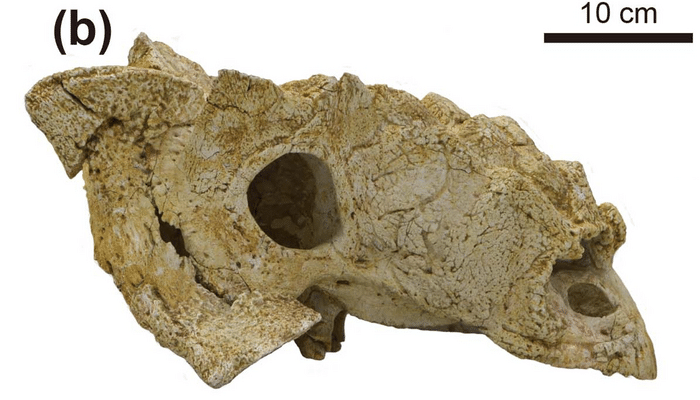
Under Park and colleagues’ definition, every Tarchia species has a tall braincase and a tall foramen magnum (the spinal cord opening). Each also has an occipital condyle—the knob joining skull to neck—that points down and back. That downturned condyle helps them tell Tarchia apart from Pinacosaurus grangeri, Saichania, Zaraapelta, and Minotaurasaurus. In T. tumanovae, the skull is trapezoidal from above and, in Park’s description, broader than long, with pitted caputegulae (armor tiles on the skull). The snout ended in a forward-jutting, shovel-shaped beak with no teeth at its tip. Farther back, each maxilla (upper jaw bone) held 19 tooth sockets.
The squamosal horns at the back corners of the skull were pyramidal and recurved, built of two distinct layers. Behind the head, ribs fused to the vertebrae arched outward into a barrel-like trunk. The tail ended in a club whose handle locked together 14 fused vertebrae, braced along the sides by ossified (bony) tendons. Its knob, made of two large osteoderms and one small one, was somewhat wider than long.
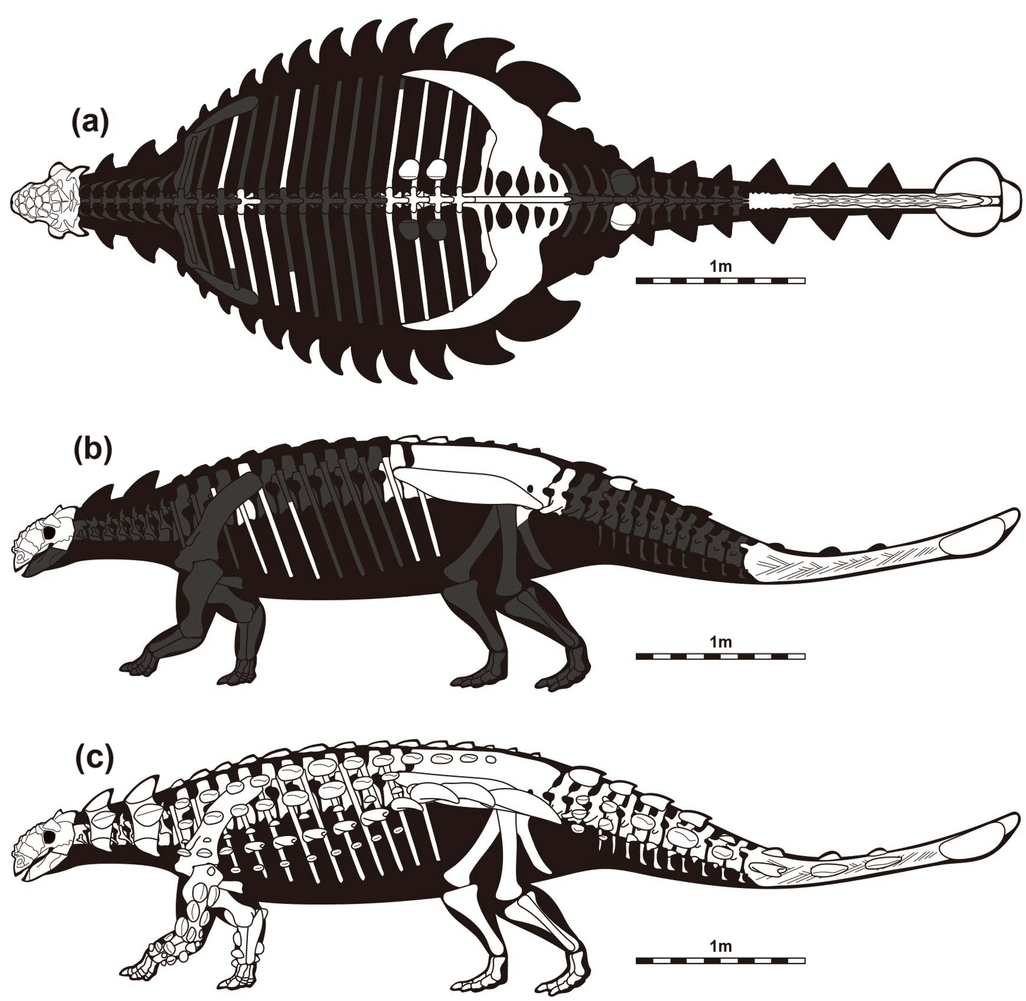

The skin impressions linked to the genus come from ZPAL MgD I/113, a specimen of doubtful referral. There, Arbour and colleagues described large, keeled, roughly rectangular scales over the bony armor. Any picture of the outer covering of Tarchia itself is therefore speculative.
Size and Weight of Type Species
No peer-reviewed study consulted here gives a body length or weight for Tarchia. The Natural History Museum lists a length of about 18 feet (5.5 meters), without naming an author or method. It is best read as a rough museum guide.
Direct measurements of T. tumanovae stand on firmer ground. Park and colleagues measured its skull at 16.7 inches (423.1 millimeters) from snout tip to squamosal horns. Across those horns, it spans 15.1 inches (382.8 millimeters). Yet its widest measured point lies across the quadratojugal horns, at an incomplete 16.5 inches (418.6 millimeters). The tail-club handle runs 5.2 feet (1,571.1 millimeters). Meanwhile, the knob measures 21.6 inches (549.5 millimeters) wide but only 18.5 inches (470.1 millimeters) long. Each ilium—the main hip bone—measures about 3 feet (919.6 to 930.9 millimeters).
Older Nemegt finds include record-setting tails, although their referral to Tarchia is now uncertain. In 2013, Arbour and colleagues called ZPAL MgD I/43, with its 24.4-inch (62-centimeter) knob, the largest known ankylosaurid tail club. ZPAL MgD I/113, meanwhile, preserves a 10.2-foot (3.1-meter) tail, which they described as the longest complete ankylosaurid tail.
The Dinosaur in Detail
What sets this dinosaur apart, under the 2021 definition, are four skull features unique to the genus. Park and colleagues list a sigmoidal, peaked armor tile above each eye. Behind it sits a second tile with a rounded front and a flat, forward-leaning back. They add a poorly defined postorbital fossa (a depression behind the eye socket) and a foramen magnum taller than wide.
The horns may also record growth. In T. tumanovae, the irregular base of the outer horn layer may represent a resorption surface. Park and colleagues read it as support for Penkalski and Tumanova’s 2017 idea that the horns were heavily remodeled during growth. Histology (the study of bone tissue), they stress, is needed to confirm it. Arbour and colleagues had instead proposed that the two layers fuse with age.
Arbour’s 2014 diagnosis looks quite different. She defined T. kielanae by an extra bony piece behind the eye, ringed by a distinct furrow, and described narrow-based, long squamosal horns. Many of those traits, however, come from INBR 21004—a skull bought without provenance data at a Tucson fossil show and first named Minotaurasaurus.
That skull sits at the heart of the debate. Arbour treated Minotaurasaurus as a junior synonym of T. kielanae, whereas Park and colleagues kept it separate. Her analysis of 20 species and 160 characters paired T. kielanae with Zaraapelta, another Baruungoyot ankylosaurid. Saichania joined them in 90 percent of trees, although she coded T. kielanae mainly from that skull. By contrast, Park’s much smaller analysis of seven taxa and 23 characters grouped the three Tarchia species together. It recovered Saichania, Zaraapelta, and Minotaurasaurus as successive outgroups. Taken together, Tarchia remains a genus defined by a handful of skull features—and by which skulls researchers allow inside it.

Interesting Points about Tarchia
- The holotype of the type species could not be found at its Warsaw institute in 2009, so Arbour studied it from 1977 photographs.
- ZPAL MgD I/113, once referred to Tarchia, was the first Mongolian ankylosaurid found with impressions of the horny scales over its bony armor.
- Park and colleagues read healed rib fractures and a lopsided tail-club knob in T. tumanovae as evidence of combat.
- The species T. tumanovae honors Tatiana Tumanova for her contributions to the understanding of Mongolian ankylosaurs.
Tarchia in its Natural Habitat
The world Tarchia kielanae roamed was a dry one. In 2012, paleontologist Federico Fanti and colleagues described the Baruungoyot Formation as semi-arid to arid, with recurring beds of wind-blown sand. At the Nemegt locality, its upper layers hold stacked redbeds with caliches (hardened soil crusts) and feeding traces. Nearby, wind-laid and river deposits interfinger over about 82 feet (25 meters), so dunes and rivers coexisted early in Nemegt times. Some ankylosaurs from the Djadokhta and Baruungoyot formations lie in resting postures, perhaps buried alive in dust storms or rainstorms.
Also known from the Baruungoyot Formation at Khulsan are Saichania, the protoceratopsid ceratopsians Bagaceratops and Breviceratops, and the oviraptorid Conchoraptor. No source, however, places them at the same level as the Tarchia holotype. With Zaraapelta, the formation holds three named ankylosaurids. Arbour added a condition. If a lone Scolosaurus from Alberta proves to come from an older rock unit, the Baruungoyot “preserves the greatest diversity of ankylosaurid ankylosaurs in the world.”
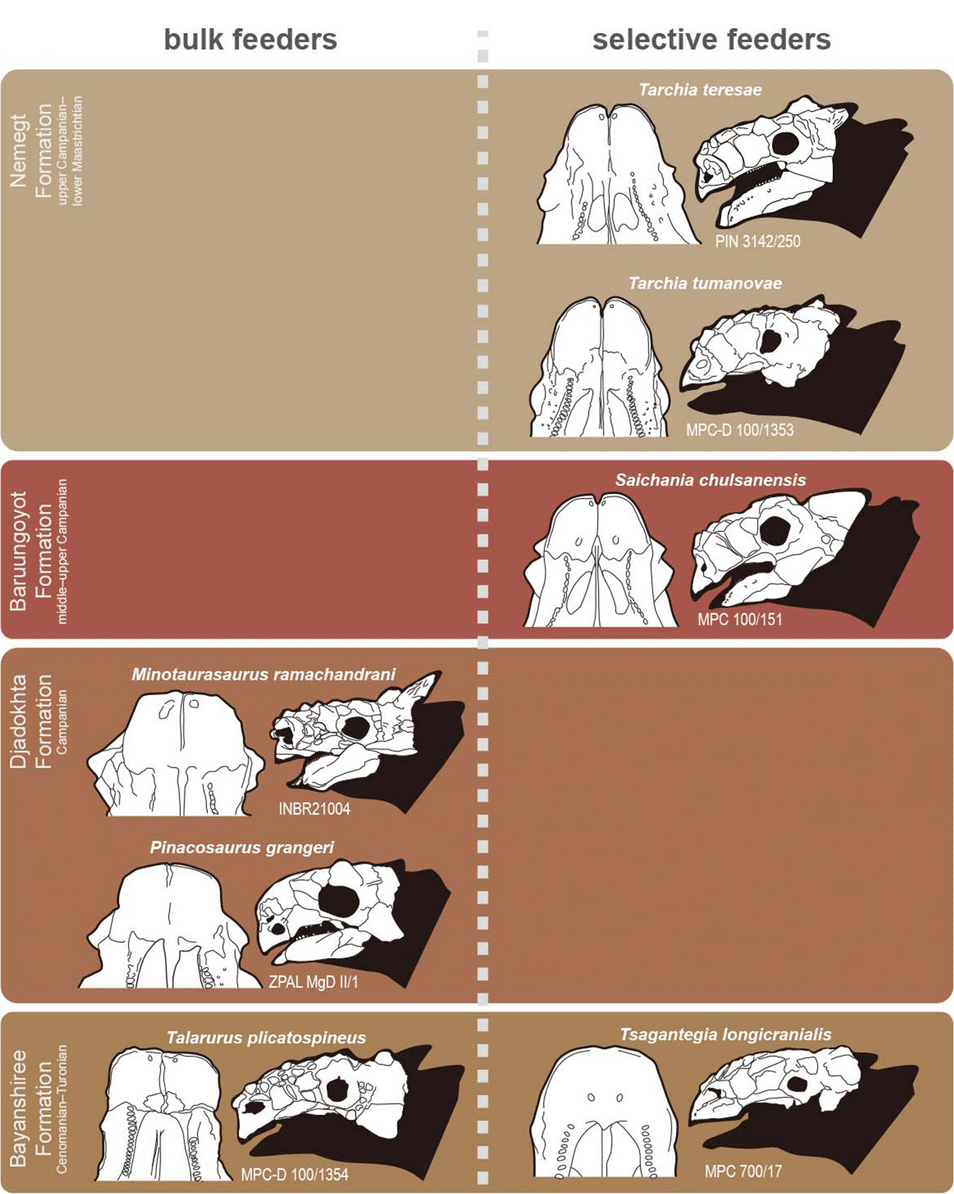

Park and colleagues proposed that the Nemegt Tarchia species were probably selective feeders, judging from their shovel-shaped muzzles, and extended this to all ankylosaurines of both formations. The shift, they suggested, may reflect habitat change and competition with bulk-feeding hadrosaurids from North America. Arbour had earlier compared the beaks of Saichania and INBR 21004, her T. kielanae, and found no substantial difference. Diet alone, she concluded, could not explain why several ankylosaurids shared the formation.
While there is no direct evidence of herds, T. tumanovae carries injuries that Park’s team linked to agonistic behavior—fighting between rivals. They also suggested its uneven tail club may reflect a preferred side in tail use, much like tusk use in African elephants. A poorly healed ossified tendon in the club handle may be another combat injury, they added.
Frequently Asked Questions
According to the Natural History Museum, it means “brainy one,” from the Mongolian word “tarkhi,” meaning “brain.”
The type species lived in the middle to late Campanian stage of the Late Cretaceous. The Natural History Museum gives about 75 to 70 million years ago for the genus, whose Nemegt species may reach the early Maastrichtian.
No peer-reviewed body length was found, but the Natural History Museum gives about 18 feet (5.5 meters). The T. tumanovae skull measures 16.7 inches long.
It was a herbivore, and Park and colleagues proposed that the Nemegt species were probably selective feeders.
The type species comes from the Baruungoyot Formation at Khulsan, in Mongolia’s Nemegt Basin.
Arbour recognized one in 2014, while Park and colleagues recognized three in 2021: T. kielanae, T. teresae, and T. tumanovae.
Sources
The information in this article is based on various sources, drawing on scientific research, fossil evidence, and expert analysis. The aim is to provide a comprehensive and accurate overview of Tarchia. However, please be aware that our understanding of dinosaurs and their world is constantly evolving as new discoveries are made.
- Maryańska, T. 1977. Ankylosauridae (Dinosauria) from Mongolia. Palaeontologia Polonica 37: 85–151.
- https://doi.org/10.4202/app.2011.0081
- https://era.library.ualberta.ca/items/cd5b999b-5995-4aeb-b630-57a36f317abc
- https://doi.org/10.1016/j.cretres.2016.10.004
- https://doi.org/10.1038/s41598-021-02273-4
- https://doi.org/10.1038/s41598-021-83568-4
- https://doi.org/10.1371/journal.pone.0031330
- https://doi.org/10.4202/app.00701.2019
- https://pmc.ncbi.nlm.nih.gov/articles/PMC10651048/
- https://paleobiodb.org/data1.2/colls/single.json?id=181421&show=full
- https://paleobiodb.org/data1.2/occs/list.json?base_name=Tarchia
- https://www.nhm.ac.uk/discover/dino-directory/tarchia.html
This article was last fact checked: TheDinosaurs Team, 13-11-2026
Featured Image Credit: Conty, CC BY-SA 4.0, via Wikimedia Commons
