
In western Liaoning, in northeastern China, a siltstone slab from the Yixian Formation holds a nearly complete feathered dromaeosaurid. Named Zhenyuanlong suni in 2015, it lived in the Early Cretaceous. The formation’s beds in the Jin-Yang basin are dated to roughly 125.8 to 124.1 million years ago. Its family—the dromaeosaurids—is one that the 2015 press release called “feathered carnivores.” It outsized all but one Liaoning dromaeosaurid, and it paired broad wings with remarkably short arms.
Its story began with a local farmer who donated the skeleton but chose not to reveal his name. It was Zhenyuan Sun who secured the specimen for study. In 2015, paleontologists Junchang Lü and Stephen L. Brusatte described it in Scientific Reports. Their verdict was striking—an animal with large wings on its arms that probably could not fly. That pairing makes it a revealing case for feather evolution, the theme its describers placed in the paper’s title.
Zhenyuanlong Key Facts
| Keyword | Fact |
|---|---|
| Pronunciation | Not specified |
| Meaning of name | Zhenyuan’s Dragon |
| Group | Theropoda (Dromaeosauridae) |
| Type Species | Zhenyuanlong suni |
| Diet | Carnivore (inferred from its family) |
| When it Lived | About 125.8 to 124.1 MYA (Yixian Formation dates from the Jin-Yang basin, not the fossil’s own bed) |
| Period | Cretaceous |
| Epoch | Early Cretaceous (Barremian stage) |
| Length | About 5.4 feet (1.65 meters) estimated in life, 4.2 feet (126.6 centimeters) as preserved |
| Height | Not specified |
| Weight | About 26 pounds (12 kilograms), 2016 estimate |
| Mobility | Probably unable to fly (non-volant) |
| First Discovery | Year and finder not specified (donated by a local farmer who wished to stay anonymous) |
| Described by | 2015 by Junchang Lü and Stephen L. Brusatte |
| Holotype | JPM-0008 |
| Location of first find | Sihedang, Jianchang County, Liaoning Province, China (Yixian Formation) |
Zhenyuanlong Origins, Taxonomy and Timeline
The name Zhenyuanlong joins a person to a legend, since “Long” is the Chinese Pinyin word for “dragon.” Both the genus and the species name suni honor Zhenyuan Sun, who secured the specimen for study. Together, the name reads roughly as “Zhenyuan’s dragon”—a tribute to the man who brought the fossil to science.
Lü and Brusatte placed Zhenyuanlong within Theropoda, then within Coelurosauria and Maniraptora (successively narrower theropod groups that include birds), and finally within Dromaeosauridae. In their analysis, it joined the other five Liaoning dromaeosaurids—Changyuraptor, Graciliraptor, Microraptor, Sinornithosaurus, and Tianyuraptor—in a basal polytomy (an unresolved branching point) with the dromaeosaurines and velociraptorines (the branches named after Dromaeosaurus and Velociraptor). Forcing those six into one group cost only a single extra step. For that reason, the authors suggested they “may simply be a grade”—a series of branches rather than one clade. Short arms, they added, may have evolved more than once. Zhenyuanlong suni is the type and only known species.
No source we consulted dates the exact bed, so its age rests on the formation as a whole. In 2021, Zhong and colleagues dated the Jin-Yang basin’s Yixian Formation to about 125.8 to 124.1 million years ago. That is a span of only about 1.63 million years, much shorter than earlier estimates. Those dates fall within the Barremian stage, although other studies place the Yixian or Zhenyuanlong itself in the Aptian. Earlier, the University of Edinburgh’s 2015 announcement had simply given its age as about 125 million years. Either way, it belongs to the Early Cretaceous, within the Jehol Biota—a famously well-preserved, volcanic-influenced ecosystem.
Discovery & Fossil Evidence
Lü and Brusatte gave the type locality as Sihedang in Jianchang County, in the Yixian Formation. They named no member or bed, and no discovery date appears in any source we consulted. The locality is also less tidy than it sounds. Beds at a Sihedang locality in Lingyuan City go to the Yixian Formation in some studies but the Jiufotang Formation in others. Whether that site matches the Jianchang locality has not been confirmed. Announcing the find, Lü called western Liaoning “one of the most famous places in the world for finding dinosaurs.”
The holotype, JPM-0008, is a nearly complete skeleton with skull and lower jaws, held at the Jinzhou Paleontological Museum in Liaoning. It lies on one slab of fissile (easily split) siltstone, with no counterpart. The slab survives in three pieces, the first holding the head, neck, shoulders, arms, and front of the back. The second carries the hips and legs, and the third the base and middle of the tail. Y.Q. Zhang prepared it at the Institute of Geology of the Chinese Academy of Geological Sciences, under Lü’s direction. The close fit and careful preparation, the authors argued, “support the authenticity of the skeleton and plumage.”
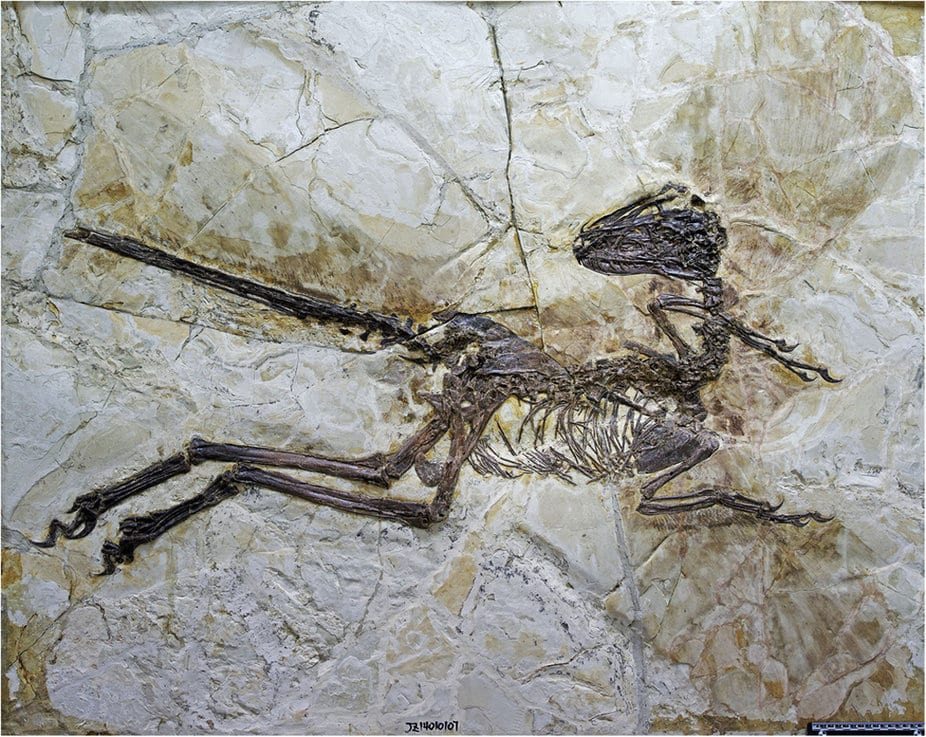

In some vertebrae near the front of the back, the neural arches—the bony arches over the spinal cord—are not yet fused to their centra (vertebral bodies). The animal was therefore likely a sub-adult, though a “fairly mature” one. Judging by comparison with Tianyuraptor, about half the tail is missing. Zhenyuanlong is the second large, short-armed dromaeosaurid known from Liaoning, after the Tianyuraptor holotype, which preserved no feathers. Everything known about the genus so far comes from this one skeleton.
Zhenyuanlong Size and Description
Zhenyuanlong breaks the dromaeosaurid mold—large in body, small in arm, yet richly feathered.
Short description of Zhenyuanlong
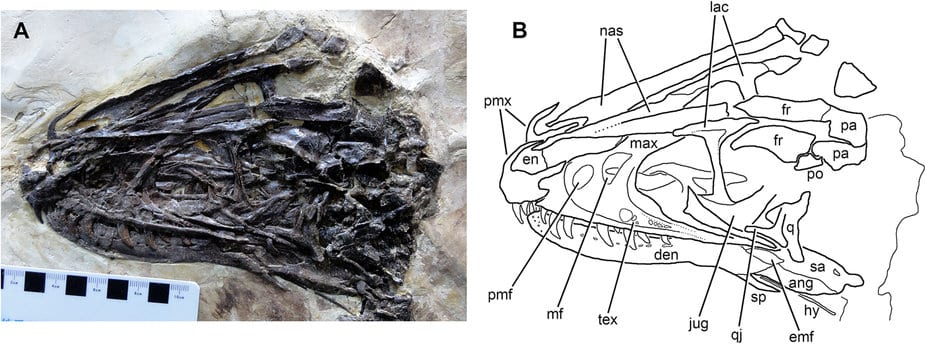
The skull measured about 6.5 inches (166.1 millimeters) long, and its antorbital fossa (a depression in front of the eye) had a sharp lower rim. Within it sat a huge promaxillary fenestra (an extra skull opening), about as large as the maxillary fenestra. Unusually for a dromaeosaurid, the left and right parietals (skull-roof bones) had fused. In the upper jaw, the first premaxillary tooth was considerably smaller than the second and third. A long, thin hyoid—the bone that supports the tongue—lies beneath the back of the lower jaw.
The arms were strikingly short, with a humerus (upper arm bone) of 4.8 inches (121.1 millimeters) and an extremely slender radius. Farther back, the femur (thigh bone) reached 7.6 inches (193.4 millimeters), with a tibia (shin bone) about 1.3 times as long. Its feet bore large, curved claws and a reduced first toe, while bony rods stiffened the tail almost to its base.
Large pennaceous (vaned) feathers formed arm wings, while others angled back at about 45 degrees above the base of the tail. Small filaments up to 1.2 inches (30 millimeters) long survive in patches above the back and in front of the neck. No feathers show on the legs, but the authors cautioned that their presence “cannot be totally ruled out.”

Size and Weight of Type Species
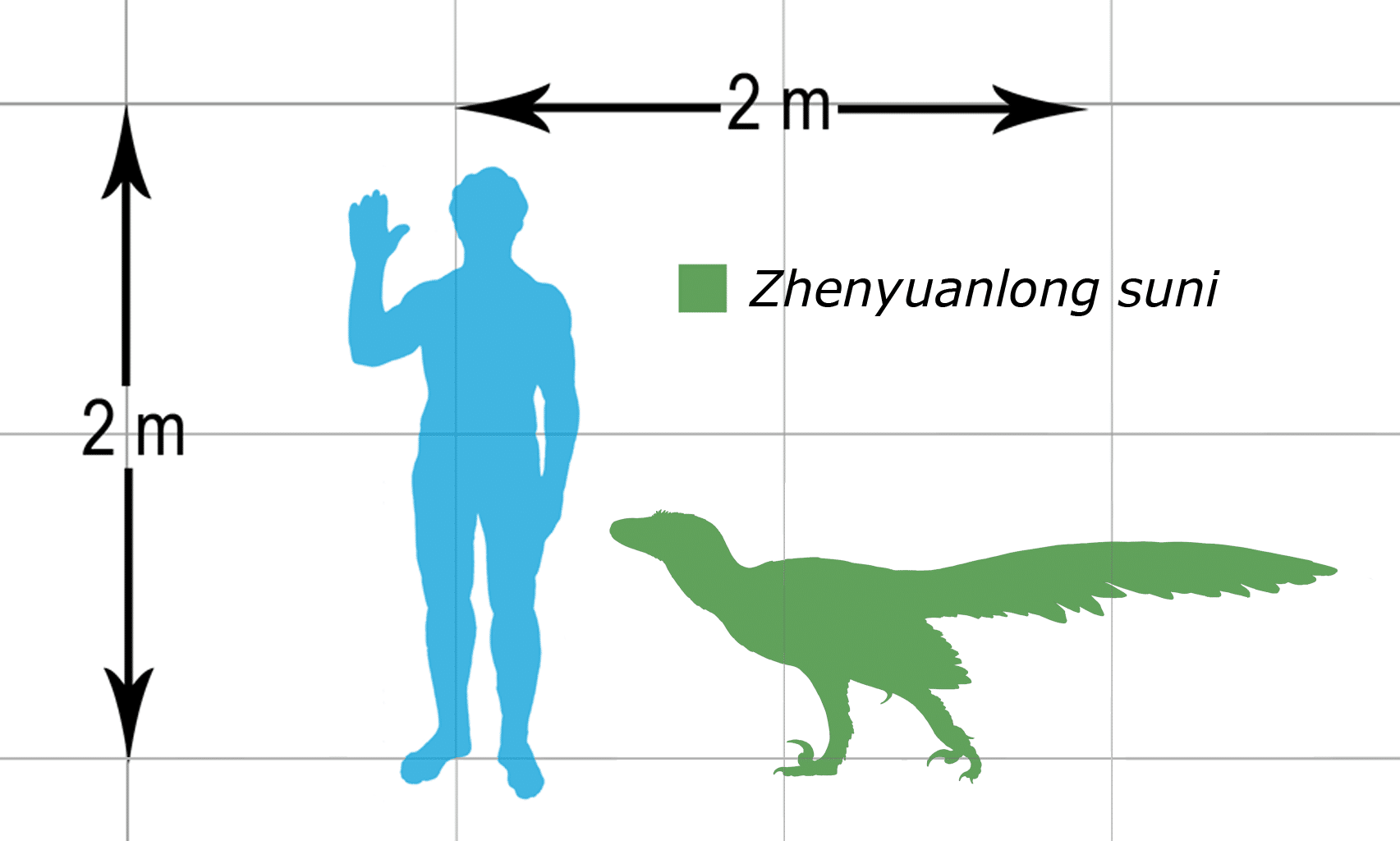
As preserved, the skeleton measures about 4.2 feet (126.6 centimeters). With half the tail missing, Lü and Brusatte estimated a living length closer to 5.4 feet. The 2015 press release put it more simply—the animal “grew to more than five feet in length.”
The 2015 paper gives no body mass, but in 2016 Dececchi, Larsson, and Habib estimated about 26 pounds (12 kilograms) from femur length. Their method used a 2004 equation by Christiansen and Fariña. That figure is an indirect estimate, and no source we consulted gives a hip height. The same team calculated a wingspan of about 4 feet (1.22 meters), and they treated their wing-area values as upper-bound estimates.
Among its Liaoning relatives, only Tianyuraptor had a longer femur, at 212.5 millimeters, whereas Microraptor femora measure just 72 to 97 millimeters. In 2022, Wang and colleagues rated the related Daurlong, about 4.9 feet (150 centimeters) long, at 93 percent of this holotype’s size.

The Dinosaur in Detail
What sets this dinosaur apart is the mismatch between arms and wings. Its forelimb was only 0.48 times the length of its hind limb, the lowest ratio of any Liaoning dromaeosaurid. Tianyuraptor came close at 0.53, while the others exceed 0.80. Even so, that gap is smaller than the variation within Microraptor and Archaeopteryx. The describers judged it “not likely to be a clearly distinguishing feature.” Relative to the femur, its humerus was also shorter than in any dromaeosaurid known in 2015 except Mahakala and Austroraptor.
Short arms, shared with Tianyuraptor and Mahakala, are in the formal diagnosis, but its unique traits are subtler. Its radius (a forearm bone) has a shaft thinner than the first bone of the first finger, which no other dromaeosaurid shows. Among Liaoning dromaeosaurids, it alone is known to have six sacral (hip) vertebrae, though Tianyuraptor may have had unpreserved extras.
The wings preserve about 124 square inches (800 square centimeters) of area on the right and 174 (1,120) on the left. Distortion hides their true shape. The better-preserved right wing shows roughly 10 primaries and 20 secondaries (the main flight feathers), though they proved hard to count. Some appear asymmetric. Lü and Brusatte found the wings “strikingly similar” to those of Microraptor, yet mounted on much smaller arms.
Hartman and colleagues (2019) recovered it as a microraptorian (a relative of Microraptor) in their shortest trees. In contrast, Jasinski and colleagues (2020) found it sister, with Tianyuraptor, to Bambiraptor plus Eudromaeosauria (“true dromaeosaurs”). Wang and colleagues (2022) grouped it with Tianyuraptor and Daurlong in a clade whose wider relationships are weakly supported. A 2018 conference abstract cited by Hartman’s team even suggested it was Tianyuraptor itself. However, later peer-reviewed studies keep it separate. Taken together, its wings are well documented but its ancestry is not.
Interesting Points about Zhenyuanlong
- Lü and Brusatte called Zhenyuanlong “the sixth definitive dromaeosaurid taxon” from the exceptionally preserved Jehol Biota.
- Its name honors Zhenyuan Sun, the man who secured the skeleton for study, while the farmer who donated it chose to stay anonymous.
- It is the second large, short-armed dromaeosaurid known from Liaoning, but the first of that kind found with its feathers preserved.
- Kiat and O’Connor (2024) found that its roughly 10 primaries, like the nine of Caudipteryx, fall in the nine-to-11 range ancestral to Pennaraptora (oviraptorosaurs to birds), which they linked to an early origin of flight.
- Cobb and Sellers (2020) found its toe claw “plots as perching,” yet judged specialist tree-dwelling unlikely for the dromaeosaurids they measured.
Zhenyuanlong in its Natural Habitat
The world Zhenyuanlong roamed belonged to the Jehol Biota, whose remains lie buried in lake and occasional river sediments of the Huajiying, Yixian, and Jiufotang formations. According to Amiot and colleagues (2011), East Asia was cold in this interval. Mean air temperatures were about 50°F (10°C) at roughly 42°N, comparable to cool temperate conditions today. Cobb and Sellers (2020) also placed Zhenyuanlong among the animals “that lived in the forests of Jehol.”
While there is no direct evidence of what Zhenyuanlong ate, its family is generally regarded as carnivorous. No gut contents are known, and no study we consulted links it to particular prey. As for its wings, Lü and Brusatte considered flight unlikely given its size and “incredibly short arms,” though they called for biomechanical tests. In their view, it may have kept its wings from more capable flying ancestors through “the inertia of common descent”—or used them for display. In 2016, Dececchi’s team calculated body-weight support from flapping of only 0.01 to 0.04. That falls below the 0.06 benchmark for the simplest wing-assisted incline running (flapping to help scramble up slopes).
The Yixian Formation has also produced Tianyuraptor, Changyuraptor, Sinornithosaurus, Graciliraptor, and Beipiaosaurus. However, no source ties any of them to the same site or level as JPM-0008. Liaoning’s dromaeosaurids come from multiple formations, and Lü and Brusatte judged it “possible (and indeed probable) that not all of these species lived together.” Even so, they argued that large, short-armed dromaeosaurids likely coexisted with small, long-armed ones in the Jehol Biota. Most of those relatives were housecat- to medium-dog-sized, so Zhenyuanlong stood among the largest dromaeosaurids in the region.
Frequently Asked Questions
It means roughly “Zhenyuan’s dragon,” honoring Zhenyuan Sun, who secured the fossil for scientific study.
It lived in the Early Cretaceous. Yixian Formation beds in the Jin-Yang basin are dated to about 125.8 to 124.1 million years ago.
It reached an estimated 5.4 feet in length, and a 2016 study put its weight at about 26 pounds.
It was a dromaeosaurid, a family of feathered theropods, though its exact position within that family is still debated.
Probably not. Its describers judged flight unlikely because of its size and very short arms, despite its large wings.
Its only known skeleton comes from Sihedang in Jianchang County, Liaoning Province, China, in the Yixian Formation.
Sources
The information in this article is based on various sources, drawing on scientific research, fossil evidence, and expert analysis. The aim is to provide a comprehensive and accurate overview of Zhenyuanlong. However, please be aware that our understanding of dinosaurs and their world is constantly evolving as new discoveries are made.
- https://doi.org/10.1038/srep11775
- https://static-content.springer.com/esm/art%3A10.1038%2Fsrep11775/MediaObjects/41598_2015_BFsrep11775_MOESM1_ESM.pdf
- https://doi.org/10.7717/peerj.2159
- https://doi.org/10.7717/peerj.7247
- https://doi.org/10.1038/s41598-020-61480-7
- https://doi.org/10.1038/s41598-022-24602-x
- https://doi.org/10.1073/pnas.2306639121
- https://doi.org/10.1371/journal.pone.0211173
- https://doi.org/10.1093/nsr/nwab063
- https://doi.org/10.1038/s41598-019-41560-z
- https://doi.org/10.1038/s41598-018-22412-8
- https://doi.org/10.1038/s41598-022-14111-2
- https://doi.org/10.1038/ncomms5382
- https://doi.org/10.1073/pnas.1011369108
- https://doi.org/10.1098/rspb.2009.1178
- https://www.nature.com/articles/45769
- https://www.nature.com/articles/20670
- https://stratigraphy.org/ICSchart/ChronostratChart2024-12.pdf
- https://edwebprofiles.ed.ac.uk/sites/default/files/imports/fileManager/Feathered-cousin-of-Jurassic-Park-star-unearthed-in-China-13-07-2015.pdf
This article was last fact checked: TheDinosaurs Team, 13-11-2026
Featured Image Credit: Emily Willoughby, CC BY-SA 4.0, via Wikimedia Commons
