
At the Khara Khutul locality in southeastern Mongolia, the Bayanshiree Formation yielded a single, puzzling pelvis that paleontologist Rinchen Barsbold first reported in 1979. Its owner, named Enigmosaurus mongoliensis in 1983, lived during the Cenomanian to Turonian stages of the Late Cretaceous—roughly 100 to 90 million years ago. Its name comes from the Greek ainigma (“riddle”), which its describers glossed as “mysterious,” and the label still fits. Only the hips and sacrum survive, yet their describers judged them distinctive enough for a family of their own.
The bones came from the collections of the Soviet-Mongolian Paleontological Expeditions. After Barsbold’s short 1979 note in Nature, he and Altangerel Perle described the pelvis in 1980 without naming it. Barsbold’s 1983 monograph then gave the genus its name, credited to both researchers. In 1980 and again in 1983, its describers asked whether it might belong to Erlikosaurus. That fellow therizinosaur is known from other parts of the skeleton. Its story shows how much a single set of bones can reveal, and how much they still leave open.
Enigmosaurus Key Facts
| Keyword | Fact |
|---|---|
| Pronunciation | Not specified |
| Meaning of name | Riddle, glossed “mysterious” by its describers (from Greek ainigma) |
| Group | Theropoda (Therizinosauria) |
| Type Species | Enigmosaurus mongoliensis |
| Diet | Not specified |
| When it Lived | About 100 to 90 MYA (estimate based on stage ages) |
| Period | Cretaceous |
| Epoch | Late Cretaceous (Cenomanian to Turonian stages) |
| Length | Not specified |
| Height | Not specified |
| Weight | About 1,250 pounds (567 kilograms), figure listed in a 2025 study |
| Mobility | Not specified |
| First Discovery | Year not specified, Soviet-Mongolian Paleontological Expeditions (first mentioned 1979) |
| Described by | 1983 by R. Barsbold and A. Perle (in Barsbold, 1983) |
| Holotype | GIN 100/84 (now MPC-D 100/84) |
| Location of first find | Khara Khutul locality, Bayanshiree Formation, Dornogov Aimag (Eastern Gobi), southeastern Mongolia |
Enigmosaurus Origins, Taxonomy and Timeline
The name Enigmosaurus reflects the uncertainty that surrounded its bones from the start. In the 1983 naming work, the describers derived it from the Greek “ενιγμα,” a riddle, glossed simply as “mysterious.” That account offers no etymology for the species name mongoliensis. Together, the name captures an animal that even its describers struggled to place.
Barsbold and Perle placed it in the infraorder Segnosauria, within Theropoda, and erected a new family for it, Enigmosauridae, beside the Segnosauridae of Segnosaurus. Later work, however, moved these animals into Therizinosauria. In 1994, paleontologist James Clark and colleagues listed Enigmosaurus within Therizinosauridae, the family of Therizinosaurus. They followed Russell and Dong, who had described the early relative Alxasaurus in 1993. The older family name, they noted, has priority over Segnosauridae and Enigmosauridae. In 2022, Yoshitsugu Kobayashi and colleagues recovered Enigmosaurus as the sister taxon—the closest outside branch—of the unresolved clade of derived therizinosaurids. Enigmosaurus mongoliensis is the type and only known species.
The 1983 description dated the holotype to the Cenomanian–Turonian. A 2008 turtle study, following earlier work, assigned the turtle-bearing beds at Khara Khutul to the formation’s lower part, Cenomanian to early Turonian. Still, the exact level of the Enigmosaurus pelvis is unknown. Because no numeric date exists for Khara Khutul itself, its age rests on stage boundaries—roughly 100 to 90 million years ago. Calcite from Khongil Tsav, a different locality, has given dates of 95.9 ± 6.0 and 89.6 ± 4.0 million years. For the formation as a whole, recent studies favor a Cenomanian to Santonian span of the Late Cretaceous.
Discovery & Fossil Evidence
Khara Khutul (also Khara Khutul Ula or Khar Hötöl Uul) lies about 90 kilometers (56 miles) southwest of Sainshand, in Dornogov Aimag of the Eastern Gobi. Although the material came from the Soviet-Mongolian expeditions, the descriptions name neither its finder nor the year it was collected. In his 1979 Nature note, Barsbold reported a backward-pointing pubis in segnosaurids and dromaeosaurids—the family of Velociraptor. He also flagged “a new genus from the Khara Khutul locality,” possibly a new family.
In 1980, Barsbold and Perle described the specimen as “Segnosaurian indet.,” an unnamed segnosaur. Its widely separated ilia and a “cubic projection” on the ilium, they wrote, “prove that this pelvis is of the segnosaurian type.” Still, they ruled that any family decision “must be postponed until more complete material is found.” No such material came to light, yet by 1983 they judged the pelvic differences “entirely sufficient” for a separate family.
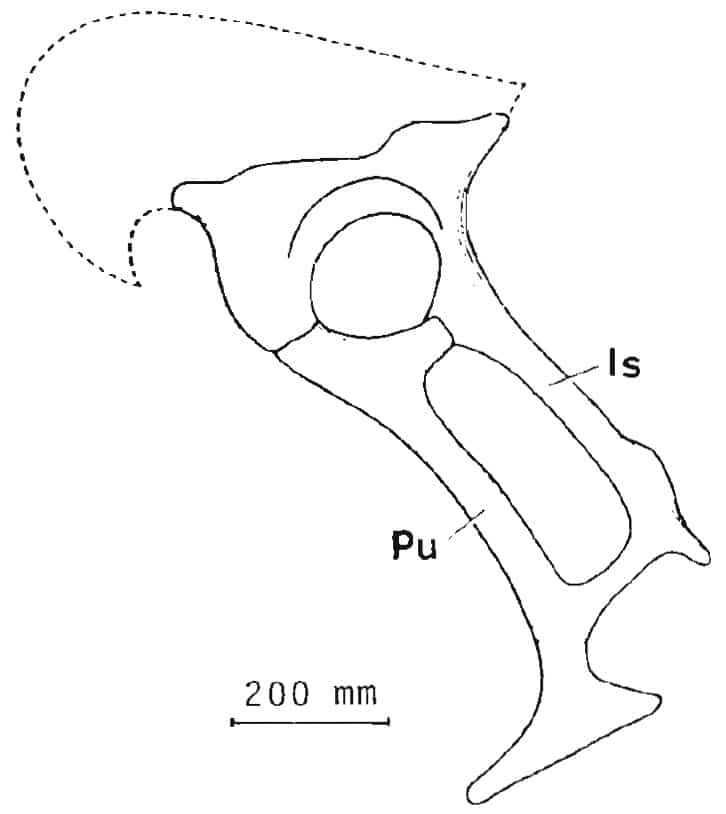

In 1980, the Geological Institute of the Mongolian Academy of Sciences in Ulan Bator held the holotype, GIN 100/84. Today it carries the number MPC-D 100/84, under the acronym of the academy’s Institute of Paleontology. It consists of a pelvic girdle missing the upper ilia (the main hip bones), plus the sacrals—the vertebrae over the hips. No additional specimens have been confirmed, so Enigmosaurus remains known from the holotype alone.
Enigmosaurus Size and Description
With only a pelvis and sacrum to go on, any picture of Enigmosaurus beyond the hips is borrowed from its relatives.
Short description of Enigmosaurus
In 1983, Barsbold and Perle described the pelvis as “moderately large,” with the ilia set widely apart. The front blade of each ilium bent outward, while the reduced rear blade carried a large “cubic process” at its upper edge. Barsbold called this the alti-iliac type. Among saurischians, its outward-bent front blade and reduced rear blade had until then been known only in sauropods.
Below, the pubis pointed backward and down, parallel to the ischium—the opisthopubic arrangement. Its narrow shaft ended in an elongated, shoe-shaped foot, with a wide groove running along its front. The ischium was slightly shorter, and its narrow obturator process, a flange set low on the bone, fused tightly to the pubis. Paleontologist Lindsay Zanno’s 2010 rediagnosis, as summarized by Kobayashi and colleagues in 2025, adds one more trait. In it, the pubic aprons—thin sheets of bone between the pubes—fuse with these processes into a four-rayed, or tetraradiate, process. Kobayashi’s team added that, unlike in Duonychus, the apron stops short of the pubic boot.
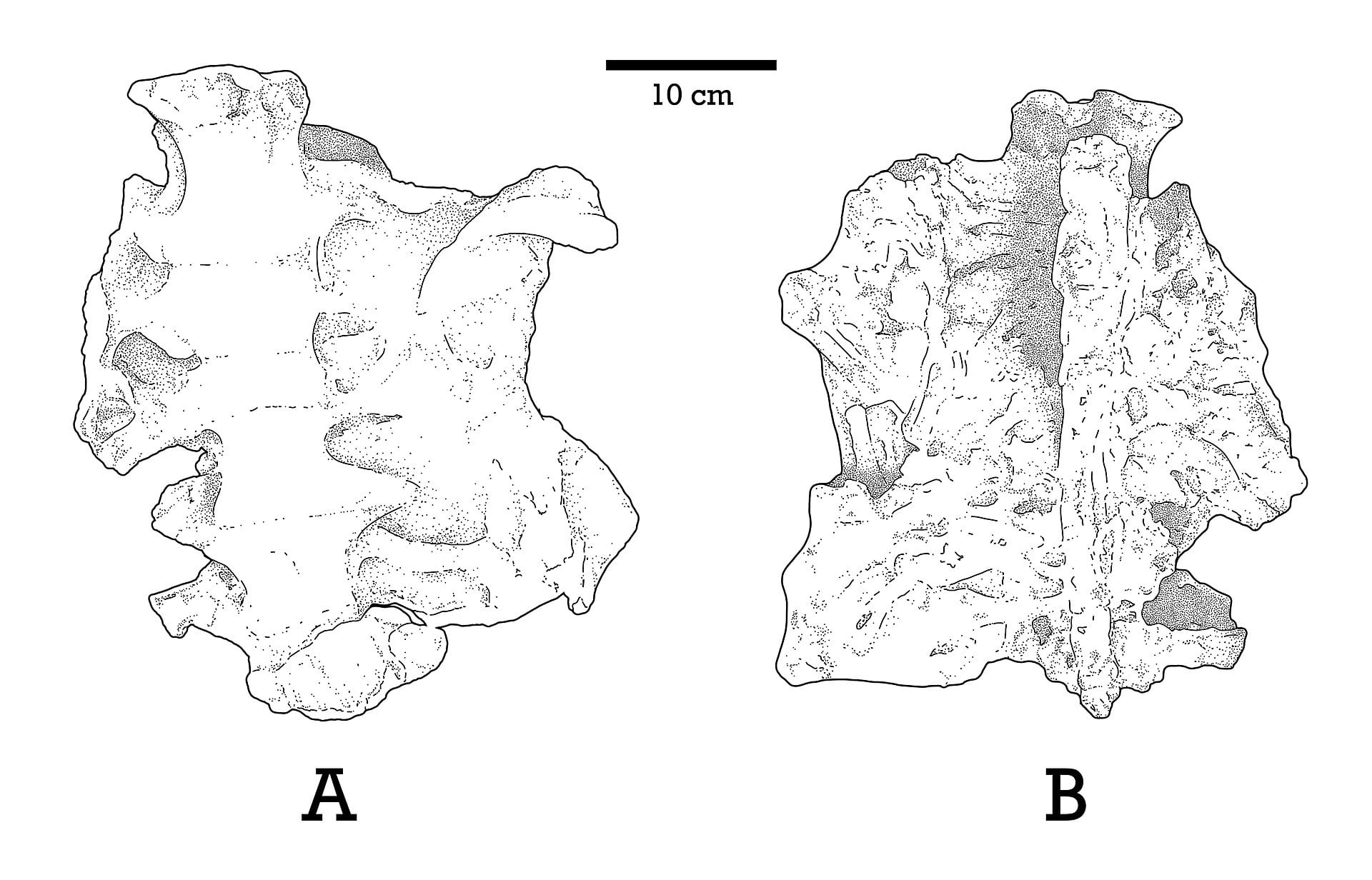
The sacrum held no more than six vertebrae, each with long transverse processes, or side wings. Kobayashi’s team noted that the sacral spines are coalesced and the centra (vertebral bodies) spool-shaped. The first sacral measures 63.8 millimeters (2.5 inches) long, the second only 36.6 millimeters (1.4 inches). Skin, feathers, and the rest of the body are unknown, so any restoration of them is speculative. Even how it moved is uncertain. Barsbold wrote that the function of the segnosaurid pelvis remained unclear. Perfected two-legged walking, he added, was either not a priority for them or was reached another way.

Size and Weight of Type Species
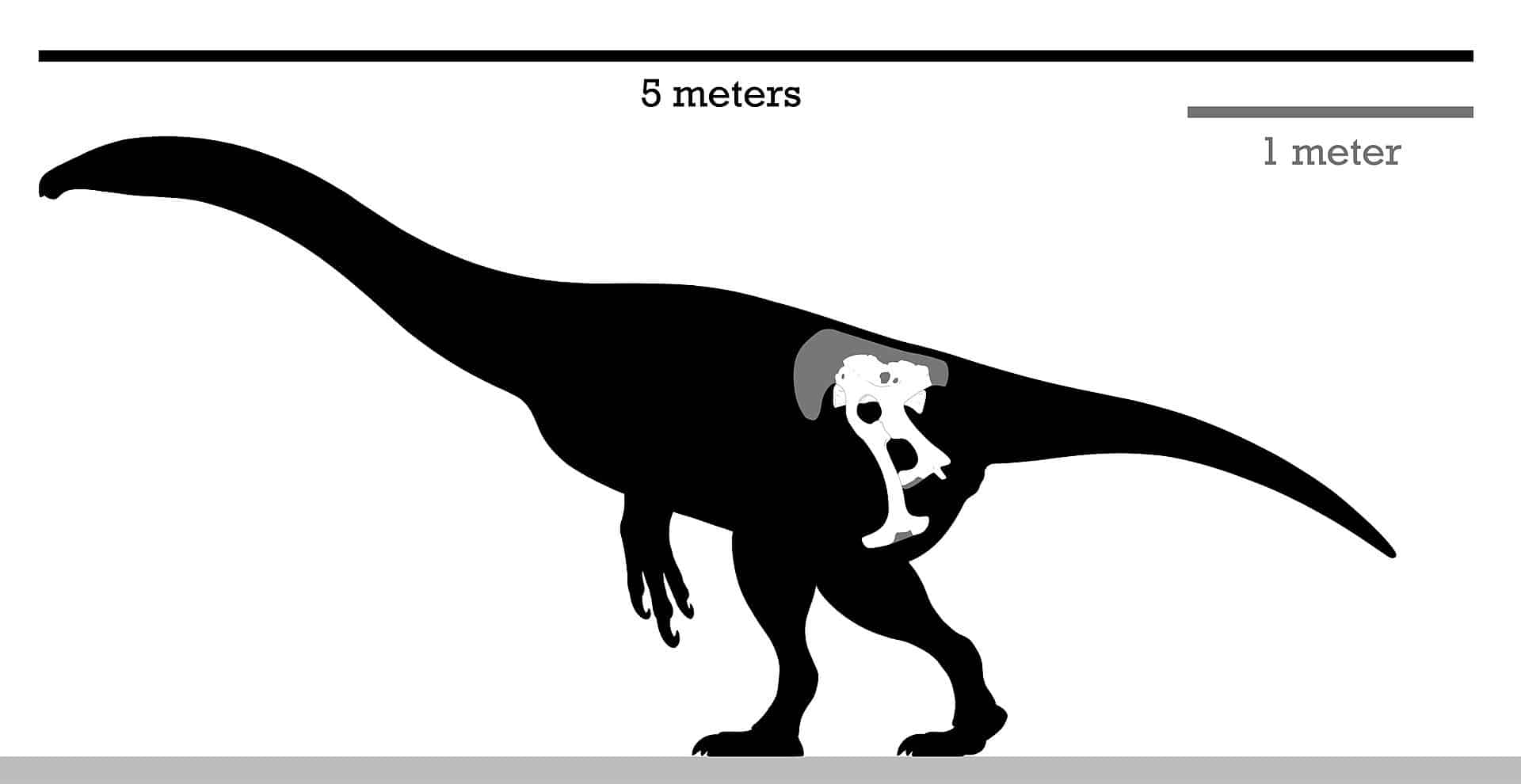
No peer-reviewed study gives a length or hip height for Enigmosaurus, so both remain unknown. Because the holotype is a pelvis, scaling from a complete skeleton of the same animal is impossible. Instead, the original descriptions offer only comparisons—”moderately large” in 1983 and “slightly smaller” than Segnosaurus in 1980.
Kobayashi’s 2025 study lists a body mass of about 1,250 pounds (567 kilograms) for Enigmosaurus—roughly a dairy cow’s weight. It applied the Zanno and Makovicky body-mass method to Duonychus, but it does not say which bone or measurement produced the Enigmosaurus value. Whether the figure first appeared in an earlier study is still unconfirmed.
By that figure, Enigmosaurus weighed roughly twice as much as Erlikosaurus, at 613 pounds (278 kilograms). It also outweighed Duonychus, at about 573 pounds (260 kilograms). Segnosaurus, by contrast, reached an estimated 3,239 pounds (1,469 kilograms). Without more bones, though, these numbers remain indirect estimates rather than measurements.
The Dinosaur in Detail
What sets this dinosaur apart lies almost entirely in the pubis and ischium. The 1983 family diagnosis cites a narrow, shoe-like pubic foot and a narrow obturator process. The genus diagnosis adds a long groove on the front of the lower pubis. Zanno’s 2010 rediagnosis, as reported in 2025, also placed its distinctive traits mainly in the pubic boot, which is fused and shallow, with a V-shaped trough.
Compared with Segnosaurus, the overall plan is strikingly similar. In 1983, the describers found that both pelves shared alti-iliac ilia, long sacral processes, and backward-turned pubes—”a single type of construction.” Yet in 1980 they had noted narrower pubes and ischia and a pubic foot split by a groove. In 2025, Kobayashi’s team also reported a fossa, or hollow, about 117 millimeters (4.6 inches) long on the side of the ilium—a feature that “may be unique” to the genus. Its coalesced sacral spines match those of Segnosaurus and Nothronychus, whereas Duonychus lacks both the fused boot and the coalesced spines.

The deepest puzzle concerns Erlikosaurus. In 1980, Barsbold and Perle listed, as one of three possibilities, that the Khara Khutul pelvis “may belong to Erlikosaurus.” By 1983 they found it “difficult to deny such a possibility.” Still, they rejected it, because Erlikosaurus seemed too close to Segnosaurus to have had a different pelvis. The two holotypes share no bones—the Erlikosaurus type preserves a skull, neck vertebrae, a humerus, and both feet, while Enigmosaurus has only its pelvis and sacrum.
Later studies have kept the two apart. In a 2026 Bayesian analysis, W. J. Freimuth and colleagues found the three Bayanshiree therizinosaurids “somewhat distantly related,” although support for that result was low. Taken together, the hips set Enigmosaurus apart from its relatives, but without overlapping bones, the Erlikosaurus question cannot yet be tested.
Interesting Points about Enigmosaurus
- The genus name comes from the Greek for “riddle,” which its describers glossed as “mysterious,” fitting an animal they put off naming for three years.
- Barsbold mentioned the Khara Khutul pelvis in Nature in 1979, four years before the genus received its formal name.
- Its alti-iliac pelvis pairs an outward-bent front hip blade with a reduced rear blade, a combination previously known among saurischians only in sauropods.
- Although it is known only from the hips and sacrum, it received a family of its own, Enigmosauridae, in 1983.
- A 2025 study lists its weight at about 1,250 pounds, even though no peer-reviewed length or height for it exists.
Enigmosaurus in its Natural Habitat
The world Enigmosaurus roamed was likely semi-arid, with lakes and rivers laying down the mudstones and sandstones of the Bayanshiree Formation. Khara Khutul’s rocks have also produced turtles, including the nanhsiungchelyid Kharakhutulia kalandadzei, with shells about 23 to 25 centimeters (9 to 10 inches) long. With at least two valid nanhsiungchelyids, Khara Khutul is “a unique site,” in the words of the 2008 study.
Diet remains uncertain because no study addresses what Enigmosaurus itself ate. In 1980, Barsbold and Perle suggested that segnosaurs “may have been amphibiotic animals, preying on fish.” More recent work, by contrast, widely regards therizinosaurians as herbivorous. If Enigmosaurus followed its group, it was probably a plant-eater.
In 1983, Barsbold listed Khara Khutul among the localities of a theropod fauna with segnosaurids, dromaeosaurids, ornithomimids, and garudimimids. Segnosaurus also comes from Khara Khutul, although the exact levels of both animals’ bones are unknown. Elsewhere, the wider formation fauna includes Erlikosaurus, Duonychus, Achillobator, Garudimimus, Gobihadros, and Talarurus from other localities or levels. Indeed, the formation stands out for its “exceptional diversity of therizinosaurs,” with at least four taxa. While there is no direct evidence of how Enigmosaurus lived, poor dating means that even niche partitioning among these therizinosaurs cannot yet be judged.
Frequently Asked Questions
Its describers derived it from the Greek ainigma (“riddle”), which they glossed as “mysterious,” and they gave no etymology for the species name mongoliensis.
It lived in the Cenomanian to Turonian stages of the Late Cretaceous, about 100 to 90 million years ago.
No peer-reviewed length or height exists, but a 2025 study lists its weight at about 1,250 pounds (567 kilograms).
It was a therizinosaur, a type of theropod, first placed in its own family, Enigmosauridae, in 1983.
Its only known fossil comes from the Khara Khutul locality of the Bayanshiree Formation in southeastern Mongolia.
Its describers weighed that idea and rejected it. The two holotypes share no bones, and later studies keep them separate.
Sources
The information in this article is based on various sources, drawing on scientific research, fossil evidence, and expert analysis. The aim is to provide a comprehensive and accurate overview of Enigmosaurus. However, please be aware that our understanding of dinosaurs and their world is constantly evolving as new discoveries are made.
- https://www.naturalhistory.si.edu/sites/default/files/media/translated_publications/Barsbold_83_0.pdf
- https://www.app.pan.pl/archive/published/app25/app25-187.pdf
- https://doi.org/10.1038/279792a0
- https://digitallibrary.amnh.org/handle/2246/3712
- https://www.app.pan.pl/archive/published/app53/APP53-601.pdf
- https://doi.org/10.1038/s41598-022-11063-5
- https://doi.org/10.1016/j.isci.2025.112141
- https://doi.org/10.1371/journal.pone.0356471
- https://doi.org/10.7717/peerj.19711
- https://doi.org/10.1371/journal.pone.0052289
- https://paleobiodb.org/data1.2/intervals/list.txt?name=Cenomanian,Turonian
This article was last fact checked: TheDinosaurs Team, 13-11-2026
Featured Image Credit: PaleoNeolitic, CC BY-SA 4.0, via Wikimedia Commons
