
In the South Gobi of southeastern Mongolia, the mudstones and sandstones of the Bayanshiree Formation have yielded one of the most revealing skulls of any therizinosaur. Named Erlikosaurus andrewsi in 1980, this medium-sized theropod lived during the Late Cretaceous. It probably dates to sometime between about 94 and 84 million years ago, though its exact age is debated. A 2014 study described it as the only therizinosaurian known from a nearly complete, three-dimensionally preserved skull. As a result, that skull has let researchers test how these beaked theropods fed and sensed their world.
The fossils came from the Soviet-Mongolian Paleontological Expeditions, although the papers consulted here do not record the year of the find. In 1980, paleontologists Rinchen Barsbold and Altangerel Perle introduced the animal in a paper that also founded a new group, Segnosauria. Then, in 1992 and 1993, researchers restudied the skull at the American Museum of Natural History. Later, another team CT-scanned it and rebuilt it bone by bone in digital form. Each round of study has reshaped the picture—from a possible fish-eater to a beaked plant-cropper.
Erlikosaurus Key Facts
| Keyword | Fact |
|---|---|
| Pronunciation | er-lik-oh-sore-us |
| Meaning of name | Erlik’s Lizard |
| Group | Theropoda (Therizinosauridae) |
| Type Species | Erlikosaurus andrewsi |
| Diet | Herbivore |
| When it Lived | About 94 to 84 MYA (Paleobiology Database range, exact age debated) |
| Period | Cretaceous |
| Epoch | Late Cretaceous (probably Turonian to Santonian stages) |
| Length | Not specified |
| Height | Not specified |
| Weight | 331 to 613 pounds (150 to 278 kilograms) across published estimates |
| Mobility | Not specified |
| First Discovery | Year not specified, by the Soviet-Mongolian Paleontological Expeditions |
| Described by | 1980 by A. Perle, in a paper by R. Barsbold and A. Perle |
| Holotype | GIN 100/111 (later catalogued as PST, IGM, and MPC-D 100/111) |
| Location of first find | Baysheen Tsav (Bayshin Tsav), Bayanshiree Formation, South Gobi Aimag, Mongolia |
Erlikosaurus Origins, Taxonomy and Timeline
The genus name comes from Erlik, a Mongolian name that the original paper glosses as “the lamaist deity, king of the dead.” With -saurus, meaning “lizard,” the full name reads “Erlik’s lizard.” Meanwhile, the species name andrewsi honors Dr. R. Ch. Andrews, leader of the American Asiatic Expeditions between 1922 and 1930.
The 1980 paper credits the name itself to Perle. In it, Barsbold and Perle placed Erlikosaurus in their new infraorder Segnosauria, within the theropods. However, they assigned it only tentatively to the family Segnosauridae, because its pelvis was unknown. They even listed three options, including one in which a pelvis from Khara Khutul would make it the type of a new family. In 1994, paleontologist James Clark and colleagues noted that Therizinosaurus belongs to the same group, so Maleev’s older name Therizinosauridae, from 1954, has priority. Today it sits within Coelurosauria, Therizinosauria, and Therizinosauridae, and E. andrewsi is the type and only known species.
Its age has proved harder to pin down. The 1980 paper gave only “Upper Cretaceous,” while paleontologist Stephan Lautenschlager and colleagues listed the Cenomanian to Turonian stages in 2014. In contrast, a 2025 study by paleontologist Rodrigo Pêgas and colleagues followed Alexander Averianov and Hans-Dieter Sues, who in 2012 placed Bayshin Tsav in the formation’s “upper beds.” Faunal comparisons date those beds to the late Turonian to Santonian. For the Bayshin Tsav collection, the Paleobiology Database gives roughly 94 to 84 million years ago. In all, four therizinosaur species are now known from this one formation.
Discovery & Fossil Evidence
The type locality is Baysheen Tsav in southeastern Mongolia, also spelled Bayshin or Baynshin Tsav. Clark’s team called it a “highly fossiliferous quarry” with a “diverse vertebrate fauna,” set in the upper part of the formation. The manuscript reached its journal in August 1979, yet no paper consulted here records the year of the dig.
In 1980, the holotype, GIN 100/111, belonged to the Geological Institute of the Mongolian Academy of Sciences in Ulan Bator. As first described, it included a skull with its mandible (lower jaw), loose neck vertebrae, a left humerus (upper arm bone), and both feet. In 1994, Clark’s team listed an articulated right pes (foot) missing the upper ends of two of its four metatarsals (foot bones). Since then, the same number has appeared under the acronyms PST, IGM, and MPC-D.
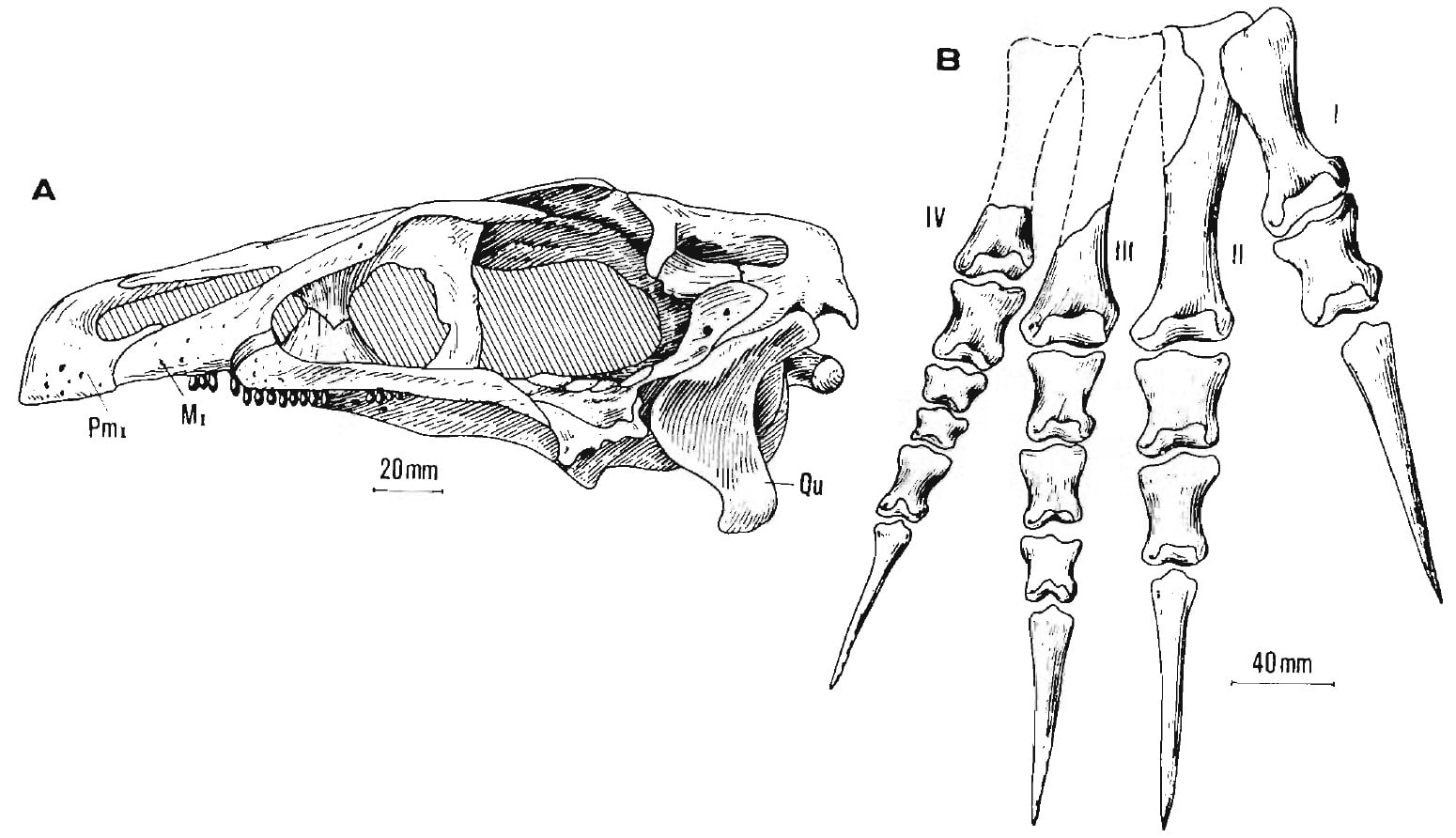

Only the holotype was known in 1980, and two reports from outside Mongolia followed. In 1993, paleontologists Philip Currie and David Eberth reported “Erlikosaurus sp.” from Iren Dabasu in Inner Mongolia, China. Earlier, Currie had linked a frontal (skull roof bone) from Canada’s Judith River Formation to the genus. However, as Clark’s team noted, Barsbold and Teresa Maryańska had pointed out that the Erlikosaurus frontal is not diagnostic. Meanwhile, Perle’s fuller 1981 description and Barsbold’s 1983 work stayed hard to use for scientists who did not read Russian, because no translations existed.
Erlikosaurus Size and Description
Lacking hips and tail, the holotype preserves mainly the head, neck, one arm bone, and the feet.
Short description of Erlikosaurus
The snout was moderately long, with long external nostrils, and its front end was blunt. Its toothless premaxilla (snout-tip bone) and the front of the maxilla (main upper jaw bone) likely carried a horny sheath in life. Clark’s team suggested the beak had an even edge that lacked a sharp tip, and behind it sat small, lance-shaped, coarsely serrated teeth. Below, the slender mandible bent slightly downward at its toothless front—by 20 to 25 degrees, according to the 2014 study.
The neck vertebrae were flat-ended with low arches, and the 1980 authors called them disproportionately large. By contrast, the forelimb was shortened, and its humerus had widened ends with a moderately large deltoid crest for muscle attachment. Each foot was short, with four toes and a loosely built set of metatarsals. Its pedal unguals (toe claws) were relatively large, curved, and strongly flattened from side to side. Since no skin or feathers survive with the holotype, any discussion of its body covering is speculative.

Size and Weight of Type Species
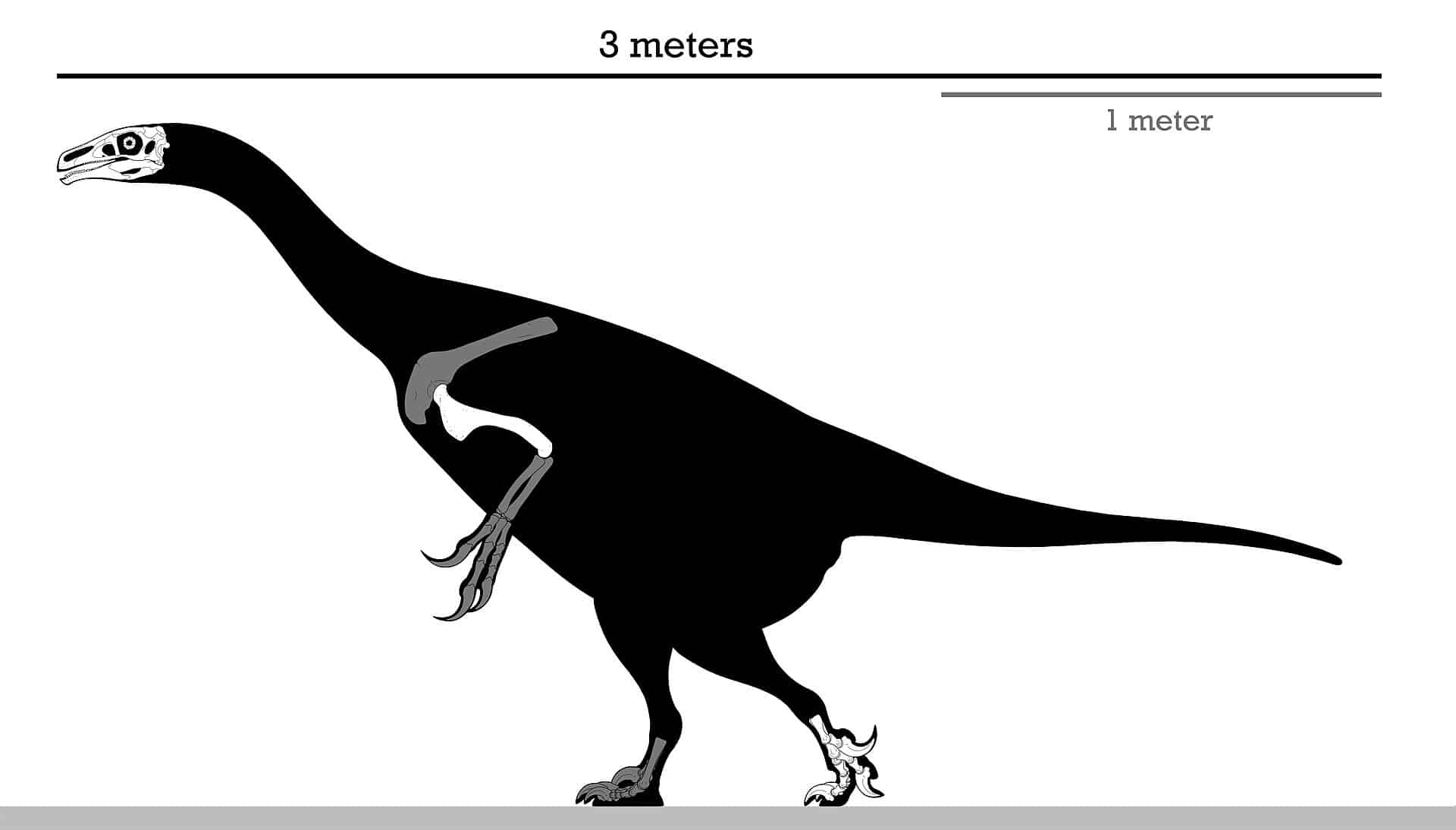
No peer-reviewed study consulted here gives a body length or hip height, although the Natural History Museum’s Dino Directory lists about 3.4 meters (11 feet). Instead, the 1980 authors called it “medium-sized” and “distinctly smaller” than its relative Segnosaurus.
The published mass estimates are all indirect. In 1993, paleontologists Dale Russell and Dong Zhiming estimated 838 pounds (380 kilograms) for Alxasaurus. They then scaled that figure down to about 353 pounds (160 kilograms) for Erlikosaurus, as Lautenschlager’s team later reported. In 2012, that team used the fossil’s 11.8-inch (300-millimeter) humerus to predict a femur length. From there, they settled on a range of 331 to 551 pounds (150 to 250 kilograms).
More recently, paleontologist Yoshitsugu Kobayashi and colleagues listed 613 pounds (278 kilograms) in 2025, without saying where that figure came from. On their figures, Segnosaurus weighed 3,239 pounds (1,469 kilograms)—more than five times as much. Taken together, these estimates place Erlikosaurus between about 331 and 613 pounds.
The Dinosaur in Detail
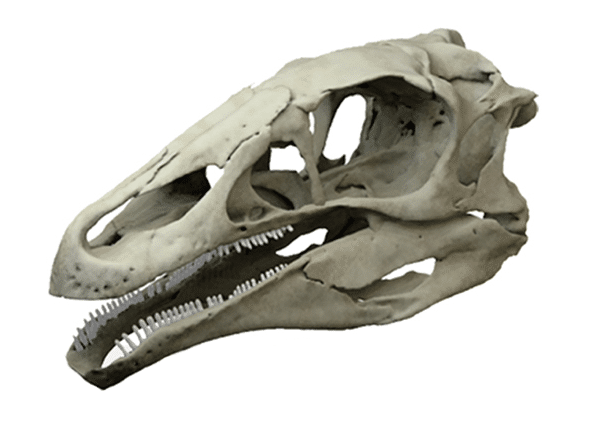
What sets this dinosaur apart is a skull riddled with air spaces. In 2014, Lautenschlager and colleagues listed an antorbital fossa (a hollow in front of the eye) holding three air pockets. Their list also included an inflated, air-filled lacrimal bone at the front of the eye socket and a quadrate—the bone hinging the lower jaw—with an extra third joint surface. Above all, its braincase is more heavily pneumatized—hollowed by air spaces—than in any other known therizinosaurian. Lautenschlager’s team linked that hollowing to smaller jaw muscles and a lower potential bite force in derived therizinosaurians.
The tooth counts are just as telling. The 1980 authors counted 31 closely set teeth in each half of the mandible, and CT scans later confirmed 31 tooth sockets. However, counts for the upper jaw differ slightly—Clark’s team counted 23 maxillary teeth, whereas the 2014 scans revealed 24 sockets. Compared with Segnosaurus, the 1980 authors also noted more lower teeth and a longer toothless jaw tip.

Its family tree once seemed as puzzling as its skull. Before 1994, some researchers linked therizinosaurs with prosauropods or ornithischians, but Clark’s team judged that evidence weak. Instead, they found the skull consistent with a place within Theropoda and Maniraptora. At the time, it was the only described skull among six named therizinosauroids, a list that included Nanshiungosaurus. Later discoveries confirmed it as a derived therizinosaurian. Taken together, Erlikosaurus reads as a theropod that traded front teeth for a beak—a shift the 2014 team placed early in therizinosaur evolution.
Interesting Points about Erlikosaurus
- The 1980 paper that named it describes its namesake, Erlik, as the king of the dead in Mongolian lamaist belief.
- Its skull is the only nearly complete, three-dimensionally preserved therizinosaurian skull known, according to a 2014 study.
- Its endocast (a cast of the brain cavity) measures about 2.1 cubic inches (34.1 cubic centimeters), according to a 2012 CT study.
- Clark and colleagues spelled the name “Erlicosaurus” throughout their 1994 study of the skull.
Contemporary Dinosaurs
Sharing the Bayshin Tsav beds was Segnosaurus galbinensis, a large-bodied therizinosaurid that the 1980 paper already listed from Baysheen Tsav. In 2016, paleontologist Lindsay Zanno and colleagues contrasted its specialized teeth with the simpler teeth of Erlikosaurus. In their view, this supports a hypothesis of dietary partitioning—the two may have split up food sources. Still, no fossil records a direct interaction between them.
Also known from Bayshin Tsav is Garudimimus brevipes, an ornithomimosaur—one of the “bird-mimic” dinosaurs. No direct evidence connects it with Erlikosaurus, so the two simply shared the landscape of the formation’s upper beds.
Adding further diversity was Gobihadros mongoliensis, a non-hadrosaurid hadrosauroid—a close relative of the duck-billed dinosaurs. Its virtually complete holotype skeleton comes from sub-locality I of Bayshin Tsav, though no fossil links it directly to Erlikosaurus.
Bayshin Tsav has also produced Talarurus plicatospineus, an ankylosaurid—one of the armored dinosaurs. Pêgas and colleagues list it among the locality’s dinosaurs, but no fossil links it directly to Erlikosaurus.
Erlikosaurus in its Natural Habitat
Imagine a semi-arid landscape of lakes and rivers laying down mudstones and sandstones. At Bayshin Tsav, the rocks preserve point bars—sandbanks on the inside of river bends—and bonebeds holding isolated bones of dinosaurs and turtles. Across the formation, turtles were especially diverse, with about eight species, alongside Mesozoic mammals and crocodylians. Pterosaurs were rare, but Bayshin Tsav has yielded the small azhdarchid Tsogtopteryx. The wider formation also records ankylosaurids, pachycephalosaurids, ceratopsians, hadrosauroids, sauropods, and other theropods, including Achillobator. That large dromaeosaurid also comes from the upper Bayanshiree beds, but from Burkhant, a separate site.
In 1980, Barsbold and Perle proposed that segnosaurians may have been amphibious fish-eaters. Later work pointed toward plants instead. In 2013, Lautenschlager estimated a bite force of only 43 to 65 newtons (roughly 10 to 15 pounds of force) at the snout tip. He suggested it used its bite mainly for leaf-stripping and plant cropping rather than chewing. A second 2013 model found that a keratinous beak would have helped spread stress and strain. In 2017, he further argued that differing jaw shapes may have let several therizinosaurs coexist.
Its social life left no direct evidence, but its brain offers clues about its senses. In 2012, Lautenschlager and colleagues studied the braincases of Erlikosaurus, Falcarius, and Nothronychus. They reported that smell, hearing, and balance were well developed in these therizinosaurians. For Erlikosaurus, they estimated a best hearing range of about 910 to 1,600 hertz. The team also inferred a nearly horizontal head posture and judged its eyes likely suited to daylight. Its large floccular lobes, part of the cerebellum, may have helped steady its gaze during quick head movements—though the authors also weighed other explanations. Earlier, Clark’s team had found its cerebrum impression similar to those of Troodon and Velociraptor but larger than in Plateosaurus.
Frequently Asked Questions
It means “Erlik’s lizard,” after the Mongolian king of the dead, while andrewsi honors expedition leader R. Ch. Andrews.
It lived in the Late Cretaceous, probably sometime between about 94 and 84 million years ago, though studies disagree on the exact stages.
No peer-reviewed study consulted here gives a length, but weight estimates range from about 331 to 613 pounds (150 to 278 kilograms).
It was most likely a herbivore that stripped and cropped leaves with a beaked, weak-biting jaw.
Its holotype comes from Baysheen Tsav, in the Bayanshiree Formation of southeastern Mongolia.
A 2014 study described its skull as the only nearly complete, three-dimensionally preserved therizinosaurian skull, with an unusually air-filled braincase.
Sources
The information in this article is based on various sources, drawing on scientific research, fossil evidence, and expert analysis. The aim is to provide a comprehensive and accurate overview of Erlikosaurus. However, please be aware that our understanding of dinosaurs and their world is constantly evolving as new discoveries are made.
- https://www.app.pan.pl/archive/published/app25/app25-187.pdf
- https://digitallibrary.amnh.org/handle/2246/3712
- https://doi.org/10.1371/journal.pone.0052289
- https://doi.org/10.1111/joa.12000
- https://doi.org/10.1073/pnas.1310711110
- https://doi.org/10.1080/02724634.2014.874529
- https://doi.org/10.1111/pala.12289
- https://doi.org/10.7717/peerj.1885
- https://doi.org/10.1371/journal.pone.0208480
- https://doi.org/10.1016/j.isci.2025.112141
- https://doi.org/10.7717/peerj.19711
- https://paleobiodb.org/data1.2/occs/list.txt?base_name=Erlikosaurus&show=loc,strat,ref,time
- https://www.nhm.ac.uk/discover/dino-directory/erlikosaurus.html
This article was last fact checked: TheDinosaurs Team, 12-11-2026
Featured Image Credit: PaleoNeolitic, CC BY 4.0, via Wikimedia Commons
