In the eastern Gobi Desert of southern Mongolia, the river-laid rocks of the Bayanshiree Formation have yielded a therizinosaur unlike any described before. Named Duonychus tsogtbaatari in 2025, this theropod carried only two working fingers on each hand. It lived during the Late Cretaceous, somewhere within the Cenomanian to Santonian stages that its formation spans. Its describers call it the first-known didactyl—two-fingered—therizinosaur. Remarkably, one of those fingers still wears a nearly complete claw sheath of keratin, the horny material that forms claws and nails.
The bones surfaced in 2012, when crews were building a water pipeline near Khanbogd Town. Mongolian staff of the Institute of Paleontology dug them out under time pressure from the construction. In 2025, paleontologist Yoshitsugu Kobayashi and three colleagues described the skeleton in the journal iScience. Their study adds a fourth therizinosaur to the formation’s roster—and shows that these long-clawed theropods were more diverse there than previously realized.
Duonychus Key Facts
| Keyword | Fact |
|---|---|
| Pronunciation | Not specified |
| Meaning of name | Two Claws |
| Group | Theropoda (Therizinosauridae) |
| Type Species | Duonychus tsogtbaatari |
| Diet | Herbivore or omnivore |
| When it Lived | 100.5 to 83.6 MYA (span of the formation’s stages, exact level not known) |
| Period | Cretaceous |
| Epoch | Late Cretaceous (Cenomanian to Santonian stages) |
| Length | Not specified in the original description (press reports: about 9.8 feet, 3 meters) |
| Height | Not specified |
| Weight | About 573 pounds (260 kilograms), estimated for a not fully mature individual |
| Mobility | Not specified |
| First Discovery | 2012, during water-pipeline construction near Khanbogd, and excavated by staff of the Institute of Paleontology, Mongolian Academy of Sciences |
| Described by | 2025 by Y. Kobayashi, D.K. Zelenitsky, A.R. Fiorillo, and T. Chinzorig |
| Holotype | MPC-D 100/85 |
| Location of first find | Urlibe Khudak Locality, Bayanshiree Formation, Ömnögovi Province, Mongolia |
Duonychus Origins, Taxonomy and Timeline
The name Duonychus joins the Greek duo, “two,” with onyx, “claw”—a nod to its two-fingered hand. The species name tsogtbaatari honors Khishigjav Tsogtbaatar, a paleontologist and former director of the Institute of Paleontology of the Mongolian Academy of Sciences. Together, the name links the animal’s strangest feature to the institute that now houses its bones.
Within Theropoda, Duonychus belongs to Coelurosauria, Therizinosauria and finally the family Therizinosauridae. Kobayashi and colleagues ran a parsimony analysis, a method that favors the family tree needing the fewest evolutionary changes. It placed Duonychus in a derived clade of therizinosaurids. There it sits in a polytomy—a split with no resolved branching order—beside Nanshiungosaurus and a group that includes Therizinosaurus and Suzhousaurus. Notably, it falls in a different clade from the formation’s other three therizinosaurs, Enigmosaurus, Erlikosaurus and Segnosaurus. Duonychus tsogtbaatari is the type and only known species.
The Bayanshiree Formation spans the Cenomanian to Santonian stages of the Late Cretaceous. The Paleobiology Database dates those stages to roughly 100.5 to 83.6 million years ago. However, no date has been published for this site, so Duonychus could belong anywhere in that range. Uranium–lead dating of caliche at another site, Khongil Tsav, gave ages of about 96 and 90 million years. That site, however, represents only part of the formation. Pêgas and colleagues (2025) note that the formation is informally split into “lower” and “upper” beds. Based on vertebrate fossils, earlier researchers suggested the lower beds are Cenomanian to late Turonian in age. The upper beds, in that view, are late Turonian to Santonian. Its describers do not assign Duonychus to either set.
Discovery & Fossil Evidence
The fossil came to light in 2012 at the Urlibe Khudak Locality in Ömnögovi Province. Workers were laying a water pipeline near Khanbogd Town at the time. Idersaikhan Damdinsuren, Ganzorig Bayasgaa and other Mongolian staff of the Institute of Paleontology excavated it, and Chagnaa Bayardorj prepared the bones. The site lies close to the Amtgai and Baishin Tsav localities. Kobayashi’s team published the description online on March 25, 2025, but the article lacked the required ZooBank registration. As a result, the name became formally available only with a correction notice on August 18, 2025.
The holotype, MPC-D 100/85, is housed at the Institute of Paleontology in Ulaanbaatar. It preserves six articulated dorsal (back) vertebrae, six sacral (hip) vertebrae with their ribs, the first caudal (tail) vertebra and several dorsal ribs. The forelimbs, by comparison, are well represented. They include a partial scapula (shoulder blade) and coracoid, both humeri, ulnae and radii, and wrist and hand bones from each side. The right ilium, both pubes and part of the left ischium—three bones of the hip—round out the skeleton. No skull or hind limb is listed, however.
All of it lay within an area of about 16 by 24 inches (40 by 60 centimeters) at the base of a river sandstone. The researchers read this pebbly layer as channel lag, the coarse debris left on the bed of a fast-flowing river. That high-energy setting, together with the rush of construction, helps explain why the skeleton is incomplete. No additional specimens of Duonychus have been confirmed, so one partial individual is all that is known. Since 2016, joint expeditions of the Institute of Paleontology and Hokkaido University Museum have explored the region. Their finds include hadrosaurs, ankylosaurs, ceratopsians, ornithomimosaurs, oviraptorosaurs and sauropods, as well as other therizinosaurs.
Duonychus Size and Description
Duonychus is known from its back, hips and arms, so its portrait is sharpest exactly where it is strangest.
Short description of Duonychus
Its back vertebrae carried long neural spines, the bony blades along the top of the spine. These vertebrae lack pleurocoels—air-filled hollows on their sides—though the dorsal ribs were pneumatic, or invaded by air spaces. In the hips, the second to fourth sacral vertebrae are flat underneath. A backward-pointing process on the pubis may be unique to the genus. Open neurocentral sutures, unfused seams between the vertebral bodies and their arches, suggest the animal was not fully mature.
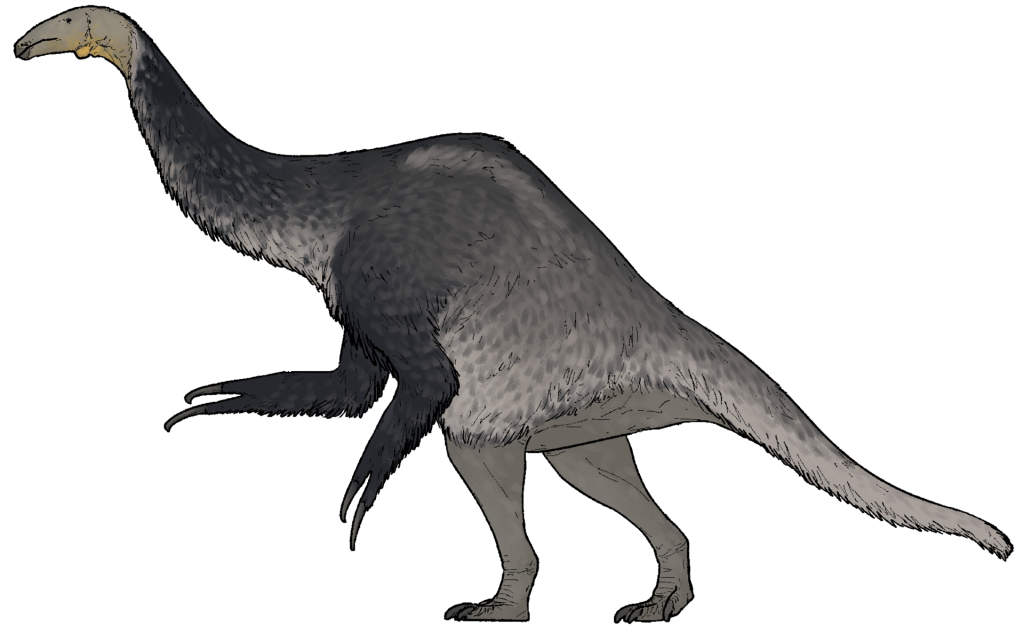
The arms are the star. Each hand had just two working fingers, with the third metacarpal (hand bone) reduced to a thin splint. In addition, the two claws were similar in size and shape. Two of its wrist bones were fused into a single crescent-shaped, or semilunate, carpal. Apart from the claw sheath, no skin or feathers are preserved, so any discussion of its outward appearance is speculative.

Size and Weight of Type Species
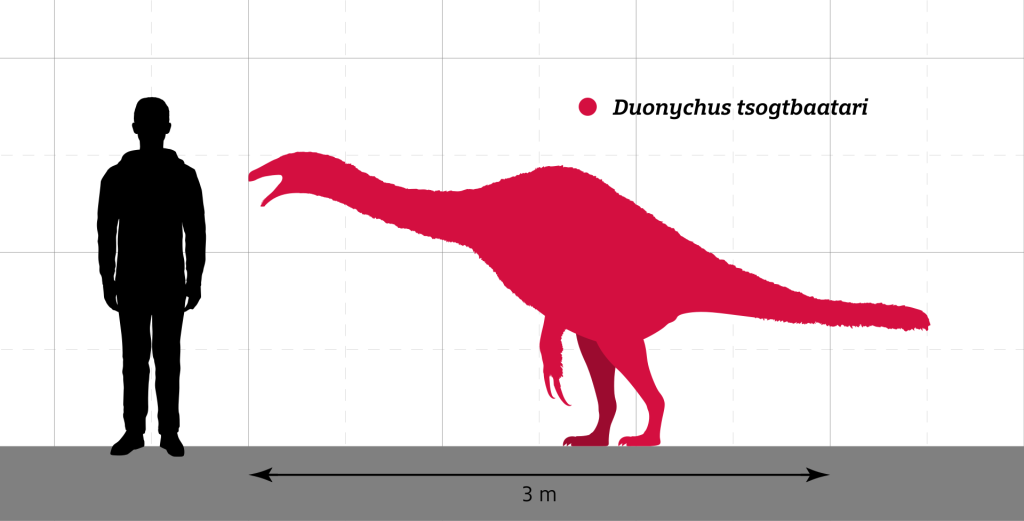
The original description gives no length or height for Duonychus. Reuters, reporting on the study, gave a length of about 9.8 feet (3 meters). That figure, however, comes from a press report rather than a published measurement.
Weight rests on firmer ground, even though no femur (thigh bone) survives. Instead, Kobayashi and colleagues scaled body mass from the ulna and a metacarpal, following a 2013 method by Zanno and Makovicky. The ulna gave about 591 pounds (268 kilograms) and the metacarpal about 571 pounds (259 kilograms). Together, they yield an overall estimate of roughly 573 pounds (260 kilograms). Keep in mind that this is an indirect estimate for an individual that was not yet fully grown.
The authors call it a medium-sized therizinosaur. It compares with Erlikosaurus at about 613 pounds (278 kilograms), whose humerus, at about 1 foot (30 centimeters), matches it in size. By contrast, Enigmosaurus at about 1,250 pounds (567 kilograms) and Segnosaurus at about 3,239 pounds (1,469 kilograms) were far heavier.

The Dinosaur in Detail
What sets this dinosaur apart is its hand. Other therizinosaurs had a digit formula—the count of bones in each finger—of 2-3-4, but Duonychus reads 2-3-0. In the right hand, its third metacarpal measures about 1.6 inches (41 millimeters), less than half the 4.1 inches (103 millimeters) of the second. Even Tyrannosaurus, famous for its two-fingered arms, keeps a longer one, at 57 percent of the second. The authors cite the intact sheath, the preserved small wrist bones and careful preparation as “definitive proof” that the missing finger is genuine.
On the left first claw, the ungual—the bony core—measures about 8.0 inches (203 millimeters) along its upper curve. With the sheath, that curve stretches to about 11.2 inches (284 millimeters)—a keratin claw about 40 percent longer than the bone inside. According to its describers, no other non-paravian theropod—one outside the group of birds and their closest relatives—preserves a sheath this complete and three-dimensional. The sheath curves through about 120 degrees, and its angle of attack, another measure of claw shape, is 59 degrees.
Unlike that of Segnosaurus, its forearm could not bend past a right angle to the upper arm. Its first finger allowed 38 degrees of extension and 14 of flexion, similar to Tyrannosaurus and the oviraptorosaur Oksoko. Its claw, however, could flex to nearly 90 degrees against the preceding finger bone—a range not known in Therizinosaurus, Tyrannosaurus or Oksoko.
Kobayashi and colleagues count at least five losses of the third finger among theropods, in tyrannosaurids, alvarezsaurids, therizinosaurids, oviraptorosaurs and, if Gualicho is one, allosauroids. In contrast to Oksoko, whose unequal claws suggest a specialized first finger, Duonychus has matching claws that point to similar roles for both. Taken together, the authors argue that it was likely an effective grasper despite having only two functional digits.
Interesting Points about Duonychus
- Its describers call Duonychus the first-known didactyl, or two-fingered, therizinosaur, a group whose other members with well-preserved hands carried three fingers.
- The fossil came to light by accident in 2012, when crews were laying a water pipeline near Khanbogd Town in southern Mongolia.
- With its keratin sheath intact, the first claw of the left hand measures about 11.2 inches along its curve. As Darla Zelenitsky told CNN, “It’s close to a foot in size.”
- Although first published in March 2025, the name became formally available only that August, when a correction notice registered it with ZooBank.
- It is the fourth therizinosaur known from the Bayanshiree Formation, which its describers say stands out for its exceptional diversity of therizinosaurs.
Dinosaurs from the Same Formation
Also known from the Bayanshiree Formation (exact level relative to Duonychus not known): the therizinosaurs Segnosaurus, Erlikosaurus and Enigmosaurus, the large dromaeosaurid (raptor) Achillobator, the ornithomimosaur Garudimimus and the hadrosauroid Gobihadros. Gobihadros is known from a virtually complete skull and skeleton. Pêgas and colleagues place two of these localities in the formation’s upper beds. One is Bayshin Tsav, which yielded Erlikosaurus, Segnosaurus, Garudimimus and Gobihadros, and the other is Burkhant, which yielded Achillobator. The formation spans the Cenomanian to Santonian stages, so these animals may not all have lived at the same time.
Duonychus in its Natural Habitat
The world Duonychus roamed was shaped by water. Its formation consists mainly of conglomerates, sandstones and mudstones laid down by alluvial and river systems. Pêgas and colleagues describe lake-to-river settings in a semi-arid paleoenvironment. The formation has also yielded about eight species of turtles, along with crocodylians, mammals and two rare azhdarchid pterosaurs. In 2025, Pêgas and colleagues named them Gobiazhdarcho and Tsogtopteryx. In addition, its dinosaur fauna includes ankylosaurids, pachycephalosaurids, ceratopsians and sauropods.
Its diet remains open, since the describers allow for either a herbivore or an omnivore. Its claw curvature and angle of attack fall within the ranges for climbing, grappling and grasping animals. Given its diet and size, the authors favor grasping branches, perhaps to rake or hook vegetation toward its mouth. They estimate it could grip branches or bundles up to about 3.9 inches (10 centimeters) across, less than Therizinosaurus could. That limit, they suggest, made it a more selective forager.
While there is no direct evidence of how Duonychus lived day to day, the claws may have had other uses. Its describers list territoriality, defense, courtship and play as possibilities. With only a lone individual known, nothing yet speaks to whether it lived alone or in groups. Its clearest ecological signal is diversity—Duonychus shows that Bayanshiree ecosystems held more therizinosaur species than previously realized.
Frequently Asked Questions
It means “two claws,” and the species name tsogtbaatari honors Mongolian paleontologist Khishigjav Tsogtbaatar.
It lived in the Late Cretaceous, somewhere within the Cenomanian to Santonian stages, roughly 100.5 to 83.6 million years ago.
Its describers estimated about 573 pounds for an individual that was not fully mature. Press reports, however, gave a length of about 9.8 feet.
Its describers suggest a herbivorous or omnivorous diet, likely gathered by grasping branches with its two-clawed hands.
Its only skeleton came from the Urlibe Khudak Locality of the Bayanshiree Formation in Mongolia’s eastern Gobi Desert.
Its describers call it the first-known two-fingered therizinosaur, and one of its claws keeps a nearly complete keratin sheath.
Sources
The information in this article is based on various sources, drawing on scientific research, fossil evidence, and expert analysis. The aim is to provide a comprehensive and accurate overview of Duonychus. However, please be aware that our understanding of dinosaurs and their world is constantly evolving as new discoveries are made.
- https://doi.org/10.1016/j.isci.2025.112141
- https://pmc.ncbi.nlm.nih.gov/articles/PMC12131255/
- https://doi.org/10.1016/j.isci.2025.113214
- https://doi.org/10.7717/peerj.19711
- https://doi.org/10.1371/journal.pone.0208480
- https://paleobiodb.org/data1.2/occs/list.txt?base_name=Duonychus&show=loc,strat,time
- https://www.timeslive.co.za/news/sci-tech/2025-03-26-weird-mongolian-dinosaur-wielded-big-sharp-and-nasty-claws/
- https://www.smithsonianmag.com/smart-news/dinosaur-with-two-massive-sloth-like-claws-is-on-another-level-of-weird-even-among-its-unusual-group-of-relatives-180986315/
This article was last fact checked: TheDinosaurs Team, 16-11-2026
Featured Image Credit: PaleoNeolitic, CC BY 4.0, via Wikimedia Commons
