
In the Nanxiong Basin of Guangdong Province, southern China, the red rocks of the Nanxiong Formation hold a dinosaur whose identity changed almost beyond recognition. Paleontologist Dong Zhiming named it Nanshiungosaurus brevispinus in 1979, and it lived during the Late Cretaceous, though its exact age remains disputed. Dong took it for a sauropod—one of the long-necked giant plant-eaters. Today, however, scientists classify it as a therizinosaur—a member of an unusual group of theropods that ate plants or a mixed diet. It is usually placed in the family Therizinosauridae.
Dong’s paper drew on fieldwork by the Institute of Vertebrate Paleontology and Paleoanthropology (IVPP), whose geologists returned to the basin in 1974. The fossil preserves a nearly complete run of neck, back and hip vertebrae plus most of the pelvis. Yet it has no skull, no limbs and only one tail bone—an odd skeleton to build a dinosaur from. Later researchers moved it to a very different branch of the dinosaur family tree. Its story shows how much a single headless skeleton can reveal—and how much it cannot.
Nanshiungosaurus Key Facts
| Keyword | Fact |
|---|---|
| Pronunciation | nahn-shyung-oh-sore-us |
| Meaning of name | Nanxiong Lizard |
| Group | Theropoda (Therizinosauridae) |
| Type Species | Nanshiungosaurus brevispinus |
| Diet | Herbivore or omnivore (inferred from relatives) |
| When it Lived | Disputed, with estimates from about 100 to 66 MYA (most sources favor 84 to 66 MYA) |
| Period | Cretaceous |
| Epoch | Late Cretaceous (Cenomanian to Maastrichtian stages, disputed) |
| Length | 14.4 feet (Natural History Museum figure) |
| Height | Not specified |
| Weight | Not specified |
| Mobility | Not specified |
| First Discovery | Year not specified, by IVPP field geologists |
| Described by | 1979 by Dong Zhiming |
| Holotype | IVPP V4731 |
| Location of first find | Dapingcun village, Shuikou Commune (IVPP Loc. 74015), Nanxiong County, Guangdong Province, China |
Nanshiungosaurus Origins, Taxonomy and Timeline
The Natural History Museum translates Nanshiungosaurus as “Nanxiong lizard”—a nod to the county and basin that yielded the fossil. Curiously, the English translation of Dong’s paper explains neither part of the name. However, its diagnosis does stress low, broad neural spines, the bony blades rising from the top of each vertebra. Together, the name pairs a place with a feature. The genus honors its home basin, while brevispinus (“short spine”) seems to echo those low spines.
Dong placed the genus in Sauropoda, provisionally within the subfamily Titanosaurinae. He judged it closest to the Indian Titanosaurus and also suspected a link with the Mongolian sauropod Nemegtosaurus. That view did not last. In 1992, Dong himself and, separately, Currie moved it into Segnosauridae. Soon after, in their study of Alxasaurus, Russell and Dong placed it in Therizinosauridae. They also called Segnosauridae “probably a junior synonym”—a later name for the same group. Today it sits within Therizinosauria, the theropod lineage that also includes Therizinosaurus.
Pinning down its age is harder. Dong correlated the Nanxiong Formation with the “Senonian or Campanian.” In 2022, Kobayashi and colleagues grouped Nanshiungosaurus with the latest Cretaceous therizinosaurs of the Campanian and Maastrichtian. The Paleobiology Database instead places the type site in the Yuanpu Formation. It dates the site to the Maastrichtian, about 72.2 to 66 million years ago. In contrast, Ke and colleagues in 2023 list it from the Dafeng Formation—a unit spanning the Cenomanian to the middle Campanian. Meanwhile, the Natural History Museum gives roughly 84 to 71 million years ago. Taken together, the estimates run from about 100 to 66 million years ago, and all of them fall within the Late Cretaceous.
Discovery & Fossil Evidence
The Nanxiong Basin had produced dinosaurs before. In 1961, the Guangdong Provincial Office of Geology collected a partial foot there—the first dinosaur record from South China’s “Red Beds.” During the Cultural Revolution, the IVPP’s South China Red Beds Survey then worked across seven provinces. Its geologists returned to Nanxiong in 1974, and Dong based his paper largely on that collection. The type locality, numbered 74015, lies at the village of Dapingcun in Shuikou Commune.
The holotype, IVPP V4731, is an articulated string of cervical (neck), dorsal (back), and sacral (hip) vertebrae. Dong counted 11 cervicals, 10 dorsals, and 5 sacrals, plus one caudal (tail) vertebra still attached to the sacrum. The neck lacks only the atlas, the first neck bone, while the pelvis is basically complete apart from the right ilium and pubis. Oddly, the translated diagnosis gives 12 cervicals, while the description gives 11—the figure later authors use. Liao and colleagues reported in 2021 that Zanno’s later study suggests six sacrals instead.
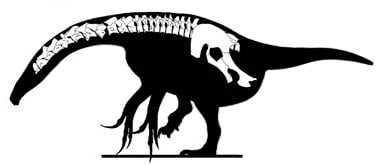

Dong also reported nine articulated tail vertebrae from Chongren in Jiangxi Province. However, he said more material was needed before tying them to N. brevispinus. He likewise called a “massive humerus” and a tooth from the basin sauropod remains, but he did not assign either to the genus. In 1997, Dong and Yu named a second species, “N.” bohlini, from far older Early Cretaceous rocks in Gansu Province. Since then, authors have often written its genus name in quotation marks, which signals doubt about the referral. Zanno and colleagues also noted in 2016 that the vertebrae of both species have been intermittently inaccessible for study. For now, the holotype remains the only specimen confidently assigned to the type species.
Nanshiungosaurus Size and Description
With no skull, limbs or tail, Nanshiungosaurus is known almost entirely from its backbone—so artists must borrow much of its outward appearance from relatives.
Short description of Nanshiungosaurus
The neck is the highlight of the fossil, since few therizinosaurs preserve one so complete. Its axis, the second neck vertebra, has a flat-ended centrum (vertebral body) 5.3 inches (13.5 centimeters) long. Its odontoid process (the peg that meets the atlas) has fused firmly to it. Farther back, the centra lengthen to a peak of 7.1 inches (18 centimeters) at the seventh and eighth cervicals, then shorten again. Overall, Dong found the neck centra 2.5 times as long as those of the back. Later, in 2013, Taylor and Wedel used his figures to suggest that therizinosaur neck bones were not especially stretched.
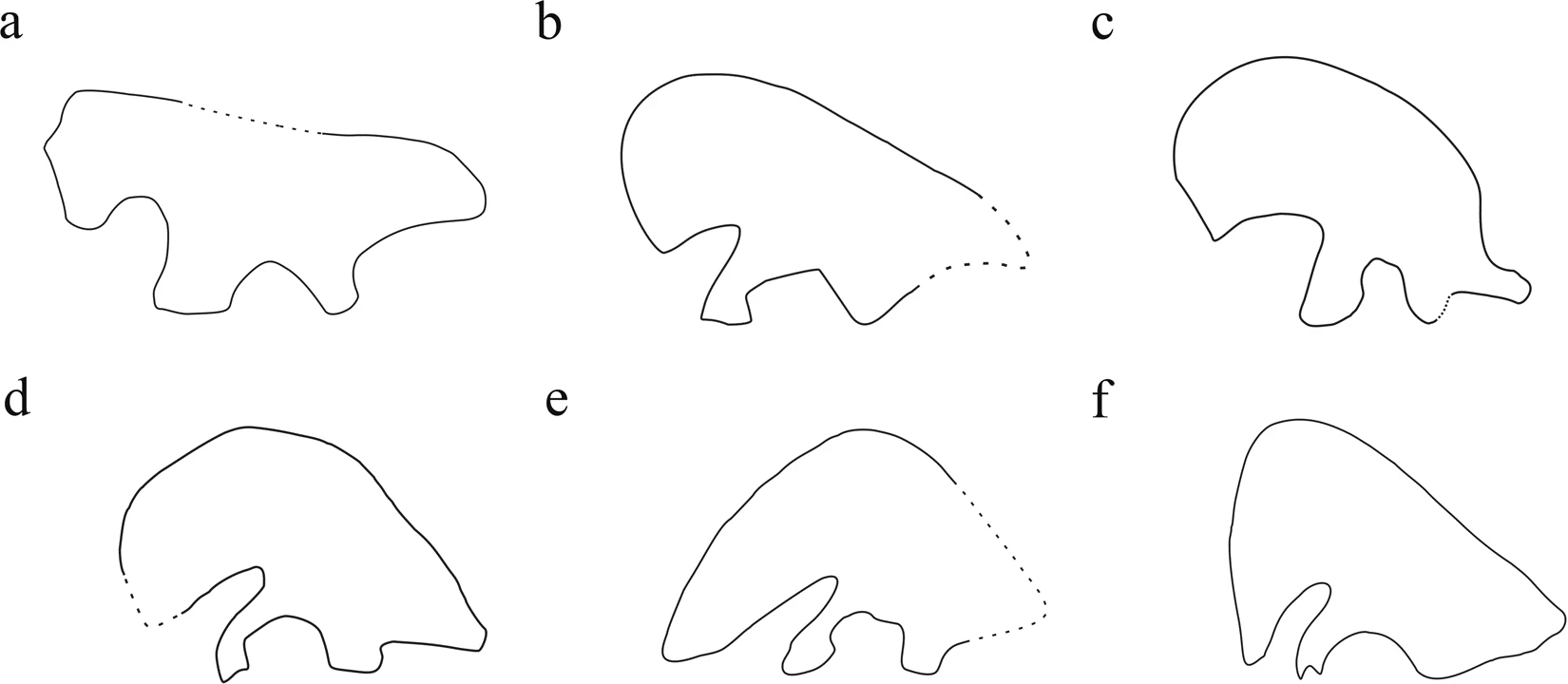
The ten back vertebrae had short centra about 2.8 inches (7 centimeters) long and shallow side hollows. Their thick, broadened spines each ended in a knob. Inside, both centra and neural arches had a honeycomb of air spaces—a feature Dong treated as sauropod-like. Similarly, five solidly fused hip vertebrae merged their spines into a single long plate. The ilium, the upper hip bone, was long and low, with a very well developed forward blade. Below it, a straight pubis and a thin, plate-like ischium had fused together and extended backward, beside a large, circular hip socket. Unlike the early therizinosaur Jianchangosaurus, its back spines do not lengthen toward the hips, as Kobayashi and colleagues noted in 2025. Because no skin, feathers or claws survive, any restoration of its outward appearance is speculative.
Size and Weight of Type Species
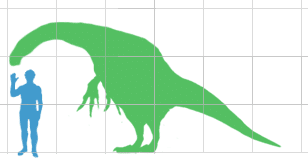
Dong never estimated the animal’s overall size. Instead, he measured individual bones and noted only that the type specimen of Titanosaurus was larger than the Nanxiong fossil. The Natural History Museum lists a length of about 14.4 feet (4.4 meters), but it does not say how it reached that figure. It is therefore best treated as a rough guide.
No peer-reviewed estimate of its height or weight exists. Popular guides offer rough figures, but without limbs any such number depends heavily on proportions borrowed from better-known relatives.
Artists’ reconstructions must fill those gaps. In one by Paul (1997), the neck measures 2.9 times the length of the humerus (upper arm bone). Yet no humerus is known for Nanshiungosaurus, so that ratio reflects the artist’s model rather than a fossil.

The Dinosaur in Detail
What sets this dinosaur apart is how thoroughly its bones fooled their first describer. Dong identified a sauropod from its triradiate (three-pronged) pelvis, honeycombed vertebrae, long neck with fused ribs, and the shape of its neural spines. Yet he also called several traits “extremely autapomorphic”—unique to this animal—including undeveloped pleurocoels (side hollows) and an unusually low ilium. Even the spines cause confusion, since the translated text calls the back spines both “high” and “particularly low.” He even likened the axis to that of Apatosaurus and the forward iliac blade to that of stegosaurs.
Later work read those oddities differently. In 1997, Dong and Yu described the second species as a segnosaur and placed the genus in a family of its own, Nanshiungosauridae. According to Hedrick and colleagues in 2015, study of that species confirmed that Nanshiungosaurus was most closely related to therizinosaurians. Then, in 2021, Liao and colleagues described the downward extension of its forward iliac blade as “extreme,” as in Segnosaurus and Lingyuanosaurus. Earlier, in 2019, Yao and colleagues noted that its pubic peduncle, the ilium’s lower front strut, is slightly constricted at mid-length, as in Suzhousaurus.

Phylogenetic studies agree it is a derived therizinosaur but differ on its neighbors. In 2019, Hartman and colleagues grouped it with Nothronychus, Erlikosaurus and Segnosaurus, leaving Erliansaurus outside. In 2022, Kobayashi’s team supported its clade with one hip trait—a swollen, spherical boss near the hip socket. They also noted that some analyses exclude it from Therizinosauridae, depending on how one defines the family. Taken together, Nanshiungosaurus sits among advanced therizinosaurs, even if its exact branch is still debated.
Interesting Points about Nanshiungosaurus
- Dong originally classified Nanshiungosaurus as a titanosaurine sauropod, but scientists now regard it as a therizinosaur, usually placed in Therizinosauridae.
- It is one of the few therizinosaurs with a nearly complete neck series, alongside Neimongosaurus and Jianchangosaurus.
- Kobayashi and colleagues noted in 2022 that China’s Late Cretaceous therizinosaurs come from the Gobi Desert, except Nanshiungosaurus from southeastern China.
- Dong linked the Nanxiong fauna with Mongolia’s Nemegt Formation and the Subashen Formation of Turpan in Xinjiang.
Nanshiungosaurus in its Natural Habitat
The Nanxiong Basin holds more than 4.3 miles (7 kilometers) of red river and lake sediments spanning the Late Cretaceous and early Paleocene. Its Upper Cretaceous part, the Nanxiong Group, has been divided in several ways. The current Guangdong scheme recognizes the Dafeng, Zhutian and Zhenshui formations, while older schemes also used the name Yuanpu. In 2018, Ma and colleagues described the basin’s climate as hot and semi-arid with some rainfall. They pointed to temporary rivers, shallow lakes and soils full of calcareous nodules. They also note that the “Yuanpu Formation” of some earlier studies corresponds to their Zhutian Formation, which earlier studies read as a floodplain with shallow lakes. Their record shows a relatively hot and wet stage from 72 to 71.5 million years ago. A cool and arid stage followed until 66 million years ago. Which of these settings Nanshiungosaurus knew depends on its disputed age.
While there is no direct evidence of what Nanshiungosaurus ate, its relatives offer clues. According to Kobayashi and colleagues in 2025, therizinosaurs were herbivorous or omnivorous theropods. Earlier, in 2009, Zanno and colleagues called the group the theropod clade with the most substantial anatomical evidence of herbivory. Nanshiungosaurus may therefore have fed mostly on plants, although without a skull or teeth this remains an inference.
Fossil eggs are common in the Nanxiong Basin. Dong listed three egg types in the Nanxiong fauna and noted that fossil eggs are widespread across China’s red beds. Similarly, Ma’s team calls the Zhenshui Formation rich in vertebrate and dinosaur eggs. Whether Nanshiungosaurus lived alone or in groups is unknown, since no publication we found makes a behavioral claim about it. Its place in this ecosystem remains an open question—one that only new fossils are likely to settle.
Frequently Asked Questions
It means “Nanxiong lizard,” after the basin in Guangdong Province, China, that yielded the fossil.
It lived in the Late Cretaceous, but its exact age is disputed. Estimates range from roughly 100 to 66 million years ago, with most sources favoring 84 to 66 million years ago.
The Natural History Museum gives a length of about 14.4 feet (4.4 meters). No peer-reviewed study estimates its height or weight.
Dong first described it as a sauropod, but scientists now classify it as a therizinosaur theropod, usually placed in Therizinosauridae.
No skull or teeth are known, but its therizinosaur relatives were herbivores or omnivores.
Its only confirmed specimen came from near Dapingcun village in Nanxiong County, Guangdong Province, southern China.
Sources
The information in this article is based on various sources, drawing on scientific research, fossil evidence, and expert analysis. The aim is to provide a comprehensive and accurate overview of Nanshiungosaurus. However, please be aware that our understanding of dinosaurs and their world is constantly evolving as new discoveries are made.
- https://naturalhistory.si.edu/sites/default/files/media/translated_publications/Dong_79.pdf
- https://doi.org/10.5281/zenodo.162178
- https://paleobiodb.org/classic/basicTaxonInfo?taxon_no=54831
- https://paleobiodb.org/classic/displayCollResults?collection_no=58448
- https://paleobiodb.org/classic/basicTaxonInfo?taxon_no=58885
- https://paleobiodb.org/classic/basicTaxonInfo?taxon_no=54834
- https://doi.org/10.1139/e93-183
- https://doi.org/10.1371/journal.pone.0129449
- https://doi.org/10.1371/journal.pone.0257913
- https://doi.org/10.1038/s41598-019-41560-z
- https://doi.org/10.1038/s41598-022-11063-5
- https://doi.org/10.1016/j.isci.2025.112141
- https://doi.org/10.7717/peerj.7247
- https://doi.org/10.7717/peerj.1885
- https://doi.org/10.1371/journal.pone.0117281
- https://doi.org/10.7717/peerj.36
- https://doi.org/10.1098/rspb.2009.1029
- https://doi.org/10.7717/peerj.15439
- https://doi.org/10.5194/cp-14-287-2018
- https://www.nhm.ac.uk/discover/dino-directory/nanshiungosaurus.html
This article was last fact checked: TheDinosaurs Team, 01-11-2026
Featured Image Credit: PaleoNeolitic, CC BY 4.0, via Wikimedia Commons
