
In Mongolia’s southeastern Gobi Desert, the river-laid sandstones and mudstones of the Bayan Shireh Formation hold a dinosaur that long puzzled experts on theropods. Described in 1979 as Segnosaurus galbinensis, this large, two-legged dinosaur lived during the Late Cretaceous, between the Cenomanian and Santonian stages. Its describer placed it among the theropods but called the placement only “conditional.” Today, researchers recognize it as a therizinosaurid—a member of Therizinosauria, an unusual theropod branch long linked to plant-eating.
Fieldwork began in 1973, when the Joint Soviet-Mongolian Paleontological Expedition explored the Amtgay locality. Six years later, Mongolian paleontologist Altangerel Perle named the animal on his own. In 1980, he and Rinchen Barsbold built a new infraorder around it and suggested it may have caught fish. Its jaws then remained largely understudied until a 2016 restudy revealed teeth unlike any other theropod’s. Segnosaurus shows how one odd skeleton can unsettle an entire family tree.
Segnosaurus Key Facts
| Keyword | Fact |
|---|---|
| Pronunciation | SEG-no-SORE-us |
| Meaning of name | Slow Lizard |
| Group | Theropoda (Therizinosauria) |
| Type Species | Segnosaurus galbinensis |
| Diet | Herbivore (probably, inferred from its teeth and jaws) |
| When it Lived | About 100 to 84 MYA (age range of the formation) |
| Period | Cretaceous |
| Epoch | Late Cretaceous (Cenomanian to Santonian stages) |
| Length | Not specified in the scientific literature (popular references give about 13 to 23 feet, or 4 to 7 meters) |
| Height | Not specified |
| Weight | More than 2,650 pounds (1,200 kilograms) in a 2013 femur-based estimate, and about 3,240 pounds (1,469 kilograms) as listed in a 2025 study |
| Mobility | Moved on two legs (bipedal) |
| First Discovery | 1973 by the Joint Soviet-Mongolian Paleontological Expedition |
| Described by | 1979 by A. Perle |
| Holotype | MPC-D 100/80 (originally GIN 100/80) |
| Location of first find | Amtgay locality, Bayan Shireh Formation, Ömnögovi (South Gobi) province, Mongolia |
Segnosaurus Origins, Taxonomy and Timeline
Perle took the genus name from the Latin segnis, meaning “slow.” His paper’s English translation leaves the second half unexplained, but London’s Natural History Museum renders the full name as “slow lizard.” The species name galbinensis refers to the Galbin region of the Gobi.
Perle placed Segnosaurus in Saurischia and Theropoda, inside a new family he called Segnosauridae. Even so, the bones sent mixed signals—part theropod, part something else. He noted that the downturned front of the jaw was not typical of theropods, while the teeth still recalled them. The metatarsus (the long bones of the foot) looked like a prosauropod’s, though much larger. He also set it apart from Therizinosaurus and its family, noting a weaker deltopectoral crest—a muscle ridge on the upper arm bone.
The debate soon widened in 1980, when Barsbold and Perle erected the infraorder Segnosauria within Theropoda to hold the new family. By contrast, paleontologist Gregory S. Paul argued in 1984 that segnosaurs were not theropods at all, but relics of the prosauropod–ornithischian transition. In 1993, paleontologists Dale Russell and Dong Zhiming argued that Segnosauridae was probably a junior synonym (a later name for the same group) of Therizinosauridae. Today, it is a therizinosaurid, and Segnosaurus galbinensis is its type and only known species.
The Bayan Shireh Formation spans the Cenomanian to Santonian stages, and the Paleobiology Database dates the genus to roughly 100 to 84 million years ago. In 2020, Kurumada and colleagues used uranium-lead dating on calcite from ancient soil crusts to get about 95.9 ± 6.0 and 89.6 ± 4.0 million years. However, Yoshitsugu Kobayashi and colleagues noted that those samples come from Khongil Tsav, only a portion of the formation. Faunal comparisons and magnetic and pollen studies agree on an age no later than the Santonian.
Discovery & Fossil Evidence
According to Perle’s account, the expedition explored Amtgay in 1973, about 43 miles (70 kilometers) northeast of Khan-Bogdsomona. His paper implies that the first remains turned up that season, but it names no individual finder. More remains of the same dinosaur followed in 1974 and 1975 at Amtgay and Khara-Khutul. By 1980, Barsbold and Perle had added a third site, Baysheen Tsav, to its known range.
The holotype is the specimen that anchors the name. Perle cataloged it as No. 100/80 in the collection of the Geological Institute (GIN) of the Mongolian Academy of Sciences. Barsbold and Perle later cited it as GIN 100/80. Today it is MPC-D 100/80 at the Institute of Paleontology, Mongolian Academy of Sciences, in Ulaanbaatar. It includes the lower jaws, part of the humerus (upper arm bone), and a complete radius and ulna (forearm bones). It also has loose digit bones, a hand claw, an almost complete pelvis, and part of the right femur (thigh bone). Six sacral (hip) vertebrae, 25 tail vertebrae, and pieces of rib complete the list.
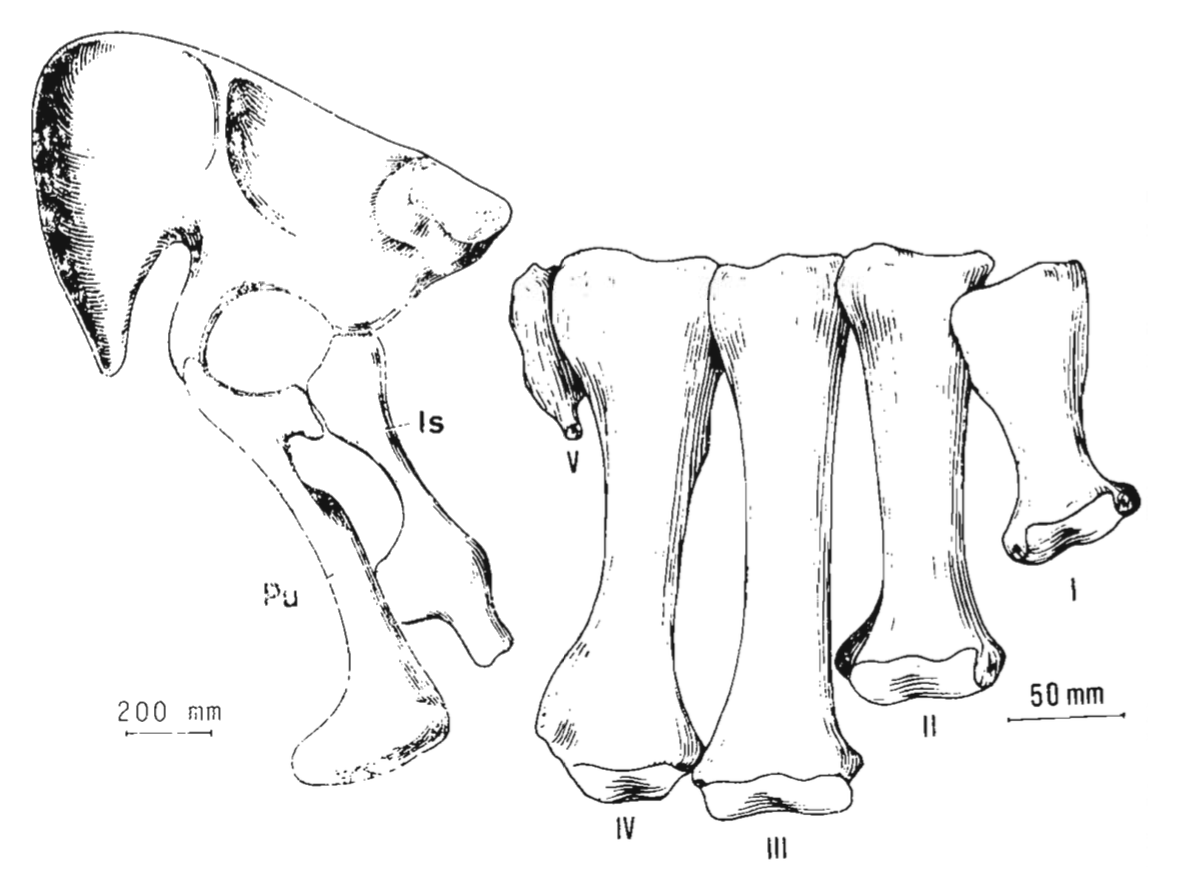

Perle also designated two paratypes, or supporting specimens. One preserves the femur, tibia (shin bone), fibula, and ankle, and the other a scapulocoracoid (shoulder blade) and forearm bones. Barsbold and Perle later listed a separate tibia and fibula from Amtgay. The Paleobiology Database also lists a Segnosaurus occurrence at Urlibe Khuduk, credited to Barsbold in 1983. In 2025, researchers Burigo and Mateus reidentified a Cenomanian record from Japan as Segnosaurus—a recent and still unconfirmed proposal. Meanwhile, most holotype tooth crowns have been damaged since collection—and most have lost their tips.
Segnosaurus Size and Description
Short description of Segnosaurus
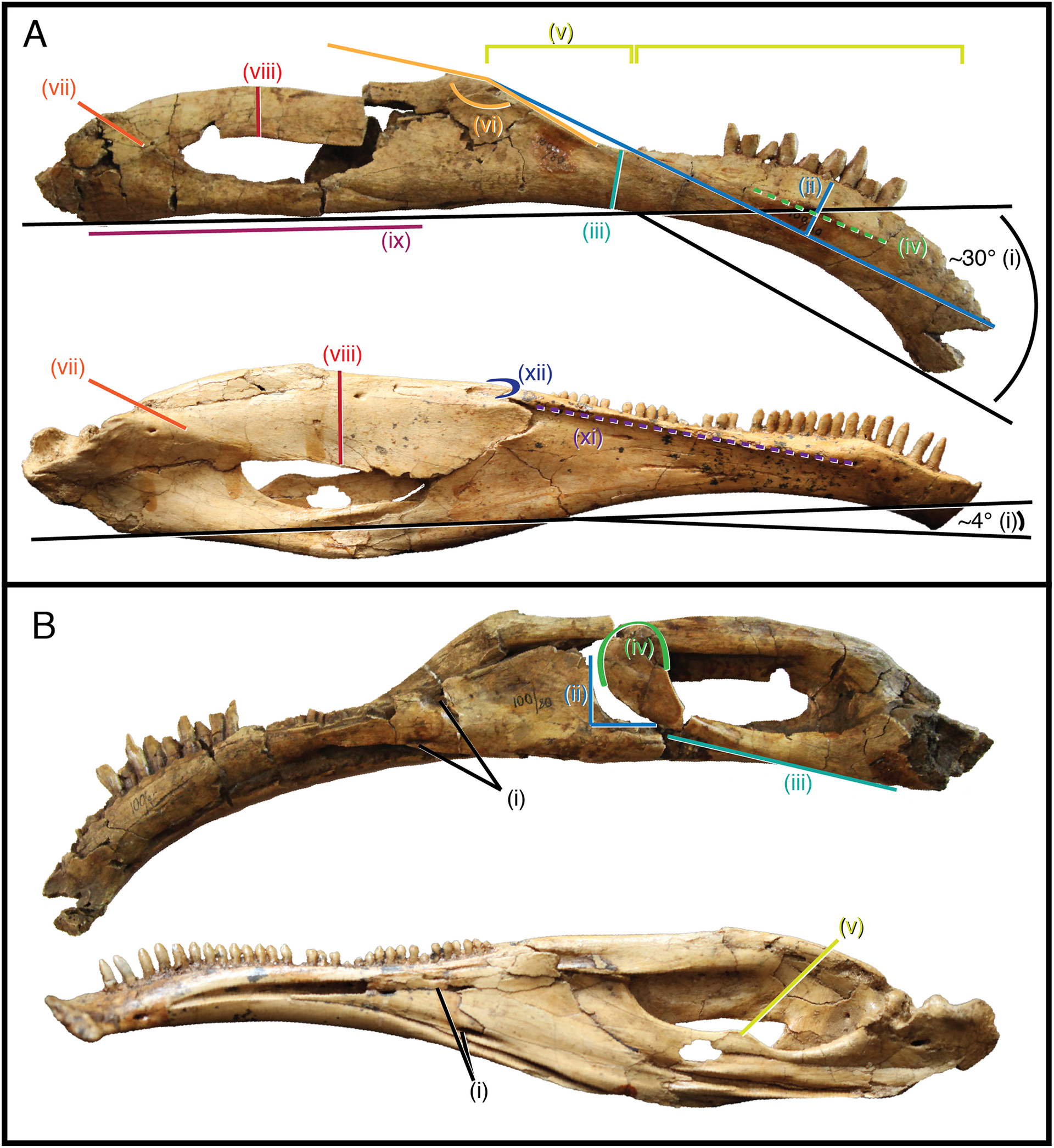
Perle described the lower jaw as long and thin, with closely set teeth. Its front end lacked teeth, and Barsbold and Perle proposed that a horny beak covered it in life. In 2016, paleontologist Lindsay Zanno and colleagues measured a downward bend of about 30 degrees there. Each side held about 24 teeth, all crowded into the front two-thirds of the dentary (the tooth-bearing lower jaw bone).
Farther back, the pubic bones pointed backward—an arrangement Barsbold and Perle called opisthopubic. Six firmly fused vertebrae formed the sacrum, and the front blade of the ilium (upper hip bone) flared strongly outward. The hand had three fingers, and the first bore a sharply curved, pointed claw. Each foot had four toes tipped with massive, recurved claws.
Perle’s diagnosis calls the forelimbs “unreduced,” yet his own description, like the 1980 paper, calls them short. Either way, the animal walked on its hind legs. The published descriptions cover bones alone, so any restoration of its skin or feathers is speculative.

Size and Weight of Type Species
Perle’s diagnosis calls Segnosaurus simply a “large bipedal saurischian,” and the key scientific papers give no body length. The most solid size clue is a paratype femur 2 feet 9 inches (840 millimeters) long. Popular references disagree—paleontologist Thomas Holtz’s genus list gives about 23 feet (7 meters), and the Natural History Museum about 13 feet (4 meters).
In 2013, Zanno and paleontologist Peter Makovicky used an equation linking body mass to femur length to place Segnosaurus above 2,650 pounds (1,200 kilograms). In 2025, Kobayashi and colleagues listed about 3,240 pounds (1,469 kilograms) for Segnosaurus when comparing masses estimated with the Zanno–Makovicky method. Either way, it likely weighed about as much as a small car.
Both figures make it the heavyweight among the formation’s known therizinosaurs. Kobayashi’s team listed about 1,250 pounds (567 kilograms) for Enigmosaurus and 613 pounds (278 kilograms) for Erlikosaurus. Zanno’s 2016 team noted mass differences of up to 500 percent among them.
The Dinosaur in Detail
What sets this dinosaur apart is its teeth. Zanno and colleagues found folded front edges, a serrated triangular facet near the crown bases, and extra denticles (small serrations) beyond the cutting edges. The last teeth even carry three cutting edges, otherwise unknown in Theropoda—though the authors note this may be an abnormality. Its 24 tooth sockets give the lowest count and some of the largest teeth yet known among therizinosaurians.
These details, they argued, create a roughened, shredding surface and point to more oral processing than in its relatives. In contrast, Erlikosaurus had 31 tooth sockets, simpler teeth, and a more gracile jaw. Still, the team found too little comparative material to add these traits to the formal diagnosis. Even the jaw length is unsettled. Perle’s table gives 16.5 inches (420 millimeters), while the restudy measured 14.9 inches (379 millimeters) on a jaw missing its rear end.
The arm also hints at flexibility—at least at the elbow. In 2025, Kobayashi’s team found that their new therizinosaur Duonychus could not flex its forearm past a right angle, unlike Segnosaurus. That implies a wider range of elbow motion, though their method modeled bare bones without soft tissue.
On the family tree, paleontologist Scott Hartman and colleagues recovered Segnosaurus in 2019 in a clade with Nanshiungosaurus, Nothronychus, and Erlikosaurus. Later, a 2022 analysis by Kobayashi’s group paired Segnosaurus with Erlikosaurus in its majority-rule tree, linked by a crest on the upper arm bone. In 2026, however, William Freimuth and colleagues found them somewhat distantly related, though with weak support, so the pairing remains unsettled. It has also served as an anchor species when defining Therizinosauridae itself. Taken together, it looks like a big, derived therizinosaurid with a feeding apparatus all its own.
Interesting Points about Segnosaurus
- When Perle named Segnosaurus in 1979, he admitted that its place among the theropods was only conditional.
- Its metatarsus is so short that Perle wrote no theropod had shown anything like it before.
- Its last teeth carry three cutting edges, which Zanno’s team found nowhere else in Theropoda, though they noted it may be an abnormality.
- Barsbold and Perle once proposed that segnosaurs may have lived partly in water and preyed on fish.
- Its estimated body mass is roughly five times that of Erlikosaurus, a smaller therizinosaurid from the same rock formation.
Contemporary Dinosaurs
Sharing the Bayan Shireh landscape was Erlikosaurus andrewsi, a medium-sized therizinosaurid with a beaked, toothed skull. Its type locality, Baysheen Tsav, also lies within the known range of Segnosaurus. Zanno and colleagues called it coeval—living at the same time. Its simpler teeth, they argued, offer strong support for niche partitioning—the two may have differed in how they gathered, processed, or chose food. In 2026, however, Zanno and co-authors cautioned that poor age control within the formation makes any such coeval partitioning hard to confirm.
Adding further variety was Garudimimus brevipes, a toothless but primitive ornithomimosaur—part of the “ostrich mimic” group. Its type specimen comes from Baishin Tsav, another spelling of Baysheen Tsav, in the same Cenomanian to Santonian formation.
Lumbering across the same formation was Talarurus plicatospineus, an armored ankylosaurid. Skulls described in 2020 come from the Bayan Shiree cliffs, in Cenomanian to Santonian rocks of the same formation. Because the match is only at the formation level, the two may never have met.
Finally, Gobihadros mongoliensis, known from a virtually complete skull and skeleton, was a hadrosauroid—an early relative of the duck-billed dinosaurs. Its holotype comes from Bayshin Tsav, in the same Cenomanian to Santonian formation.
No fossil records direct contact between any of these animals and Segnosaurus.
Segnosaurus in its Natural Habitat
The world Segnosaurus roamed was one of rivers and floodplains in the eastern Gobi basins. Its formation, up to about 980 feet (300 meters) thick, holds conglomerates, sandstones, and mudstones laid down by rivers. A 2021 study described the setting as semi-arid. Freshwater ostracods (tiny shelled crustaceans), mollusks, fishes, abundant turtles, and crocodyliforms (crocodile relatives) shared the scene. Nearby, Duonychus came to rest at the bottom of a river-channel sandstone.
Ideas about its diet have changed over time—in 1980, Barsbold and Perle suggested that segnosaurs may have been amphibious fish-eaters. Zanno’s 2016 team argued instead that its specialized teeth support existing hypotheses of plant-eating in therizinosaurs. Even so, they cautioned that these traits are not quantitatively tied to diet. They also suggested that Segnosaurus may have relied on unique foods or novel feeding strategies.
While there is no direct evidence that Segnosaurus lived in groups, it may have held its own feeding niche among many therizinosaurs. Kobayashi’s team noted the formation’s exceptional diversity of these animals, including Erlikosaurus, Enigmosaurus, and Duonychus. That makes the formation a rare window into how these strange theropods lived.
Frequently Asked Questions
It means “slow lizard,” from the Latin segnis, and the species name galbinensis refers to the Galbin region of the Gobi.
It lived in the Late Cretaceous, between the Cenomanian and Santonian stages, about 100 to 84 million years ago.
Its weight has been estimated at more than 2,650 pounds (2013), and a 2025 study listed about 3,240 pounds. The key scientific papers give no body length.
It was probably a herbivore, although Barsbold and Perle suggested in 1980 that it may have eaten fish.
Its fossils come from the Bayan Shireh Formation at Amtgay and nearby localities in Mongolia’s southeastern Gobi.
Its downturned, partly toothless jaw held some teeth with three cutting edges, a trait otherwise unknown in theropods.
Sources
The information in this article is based on various sources, drawing on scientific research, fossil evidence, and expert analysis. The aim is to provide a comprehensive and accurate overview of Segnosaurus. However, please be aware that our understanding of dinosaurs and their world is constantly evolving as new discoveries are made.
- https://naturalhistory.si.edu/sites/default/files/media/translated_publications/Perle%252079.pdf
- https://www.app.pan.pl/archive/published/app25/app25-187.pdf
- https://doi.org/10.7717/peerj.1885
- https://doi.org/10.1016/j.isci.2025.112141
- https://doi.org/10.1098/rspb.2012.2526
- https://doi.org/10.1111/ter.12456
- https://doi.org/10.1139/e93-183
- https://doi.org/10.1080/02724634.1984.10012026
- https://doi.org/10.7717/peerj.7247
- https://doi.org/10.1038/s41598-022-11063-5
- https://doi.org/10.1139/e05-044
- https://doi.org/10.1016/j.cretres.2019.104340
- https://doi.org/10.1371/journal.pone.0208480
- https://doi.org/10.1038/s41598-021-02273-4
- https://doi.org/10.3390/d17010029
- https://doi.org/10.1371/journal.pone.0356471
- https://paleobiodb.org/classic/basicTaxonInfo?taxon_no=38711
- https://www.nhm.ac.uk/discover/dino-directory/segnosaurus.html
- http://www.geol.umd.edu/~tholtz/dinoappendix/HoltzappendixWinter2011.pdf
This article was last fact checked: TheDinosaurs Team, 03-11-2026
Featured Image Credit: PaleoNeolitic, CC BY-SA 4.0, via Wikimedia Commons
