
On the southwest coast of the Isle of Wight, the cliffs of Chilton Chine expose the river-laid rocks of the Wessex Formation. From these beds came Ceratosuchops inferodios, a spinosaurid—a member of the long-snouted, crocodile-faced family of theropods—named in 2021. It lived during the Barremian stage of the Early Cretaceous, roughly 126 to 121 million years ago. Its describers found it distinct from the broadly contemporaneous Baryonyx and from a second new spinosaurid on the same coast.
Collectors gathered the bones at beach level between 2013 and 2017, all of them from loose sandstone blocks on the foreshore. In 2021, paleontologist Chris Barker and eight colleagues named the animal in Scientific Reports. Only parts of the skull survive—the snout tip, the braincase, and a bone from behind the eye. Even so, those few pieces have prompted debate over how many spinosaurid species shared one river system.
Ceratosuchops Key Facts
| Keyword | Fact |
|---|---|
| Pronunciation | Not specified |
| Meaning of name | Horned Crocodile Face |
| Group | Theropoda (Spinosauridae, Baryonychinae) |
| Type Species | Ceratosuchops inferodios |
| Diet | Carnivore |
| When it Lived | 126 to 121 MYA |
| Period | Cretaceous |
| Epoch | Early Cretaceous (Barremian stage) |
| Length | About 29.5 feet (9 meters), researchers’ estimate in a 2021 University of Southampton news release (no peer-reviewed figure) |
| Height | Not specified |
| Weight | Not specified |
| Mobility | Not specified |
| First Discovery | 2013 to 2017 at Chilton Chine, by fossil collectors. The 2021 paper credits Kai Bailey with finding some Ceratosuchops remains. The first find is undated |
| Described by | 2021 by C.T. Barker, D.W.E. Hone, D. Naish, A. Cau, J.A.F. Lockwood, B. Foster, C.E. Clarkin, P. Schneider, and N.J. Gostling |
| Holotype | IWCMS 2014.95.5, IWCMS 2021.30, and IWCMS 2014.95.1–3 |
| Location of first find | Chilton Chine, near Brighstone, Wessex Formation (Wealden Group), Isle of Wight, England, UK |
Ceratosuchops Origins, Taxonomy and Timeline
The genus name joins three Greek roots—kératos (“horn”), soûkhos (“crocodile”), and óps (“face”). The “horn” refers to the animal’s prominent postorbital boss and rugose (roughened) brow. Its species name, inferodios, pairs the Latin īnfernus (“underworld” or “hell”) with the Greek erodiós (“heron”), a nod to the animal’s presumed heron-like ecology. Together, the name reads as “horned crocodile-faced hell heron,” the translation the University of Southampton offered when it announced the find.
Ceratosuchops is a theropod within Tetanurae and, more narrowly, the family Spinosauridae and its subfamily Baryonychinae. Barker’s team also coined a new clade, Ceratosuchopsini, defined as the most inclusive group containing Ceratosuchops but not Baryonyx or Spinosaurus. They placed three species in it: Ceratosuchops, its Isle of Wight relative Riparovenator milnerae, and the African Suchomimus. Ceratosuchops inferodios is the type and only known species.
The original paper places the Wessex Formation in the Barremian but gives no figure in years. The Paleobiology Database dates this stage—and this species—to roughly 126 to 121 million years ago. However, Lewis and colleagues listed 130 to 125 million years in 2026, largely before that window. Morrison and colleagues, meanwhile, wrote that the formation spans some 15 million years, longer than a Barremian-only age would allow. As a result, any fossil’s age depends heavily on its bed.
Discovery & Fossil Evidence
The fossils came from Chilton Chine, about 0.6 miles (1 kilometer) from Brighstone. Every Ceratosuchops bone turned up in isolated blocks on the foreshore, so its original position in the rock sequence remains uncertain. In 2026, Morrison and colleagues plotted Ceratosuchops near the Chilton Chine Sandstone—but marked the position as approximate. The 2021 paper thanks Kai Bailey for finding and preparing Ceratosuchops remains. Still, no source names the finder of the first piece or its date.
Dinosaur Isle Museum in Sandown holds the holotype, a composite of associated skull parts. It includes the premaxillary bodies (IWCMS 2014.95.5), a rear premaxillary fragment (IWCMS 2021.30), and a near complete but disarticulated braincase (IWCMS 2014.95.1–3). The premaxillae—the paired bones at the snout tip—lay in two separate blocks, yet they fit back together along the crack that split them. Because the braincase pieces lay close together inside one large, cracked block, the describers regarded them as a single individual.
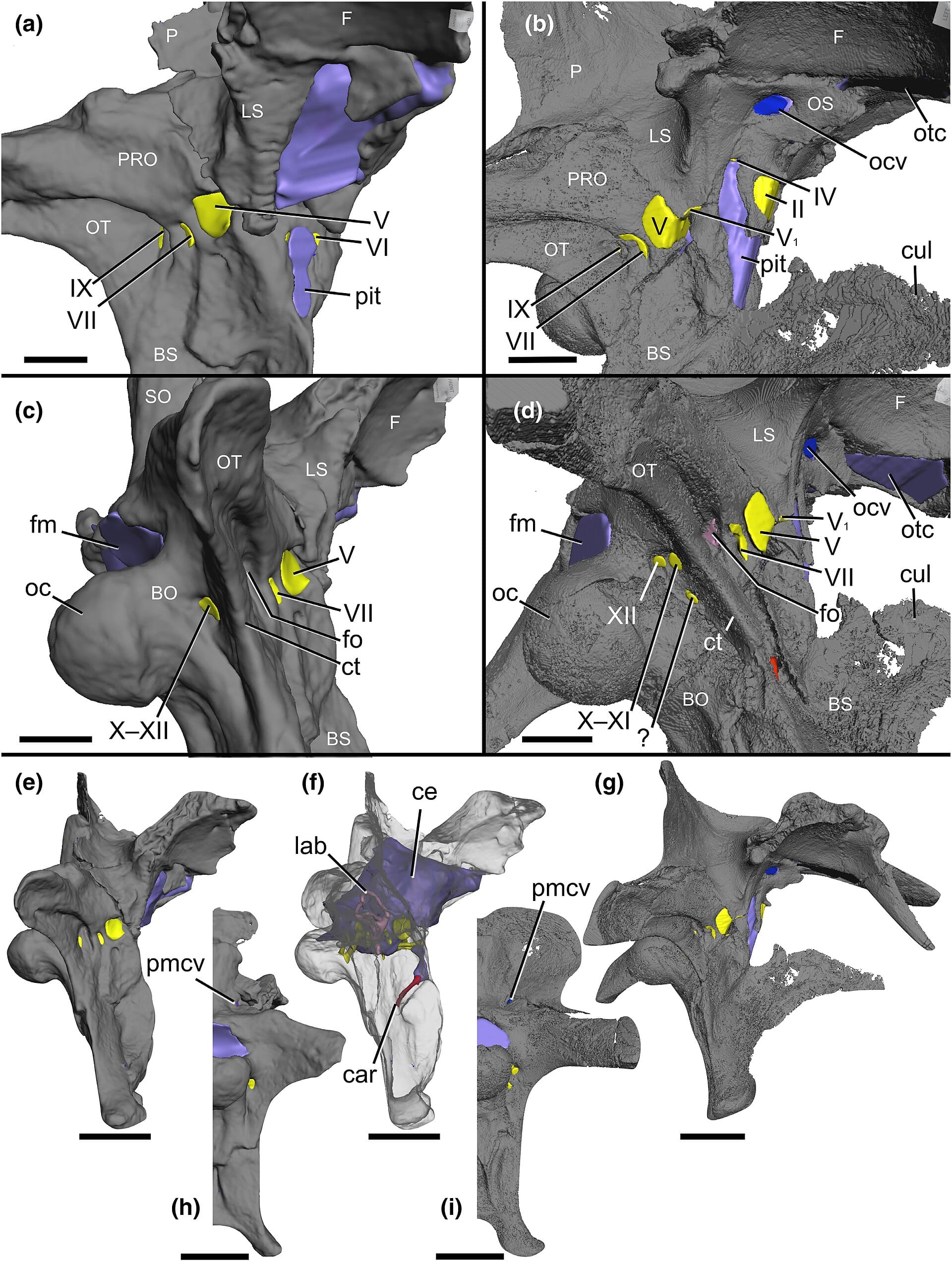

The team also referred a right postorbital (IWCMS 2014.95.4), the bone behind the eye socket. Its joint surfaces match the neighboring frontal and laterosphenoid bones of the braincase. Overall, the Ceratosuchops material survived in better condition than that of Riparovenator, though few of its teeth remain in place. So far, no study has referred any bone from behind the skull to Ceratosuchops.
Ceratosuchops Size and Description
With only parts of the skull in hand, any picture of the whole animal draws heavily on better-known relatives.
Short description of Ceratosuchops
The snout ended in a terminal rosette—an expanded tip in which each premaxilla held seven tooth sockets. Its tooth row hooked at the front, and the largest crowns sat in the first three positions. The teeth were largely conidont (cone-shaped), with fluted, faceted enamel on both their inner and outer faces. Later, in 2023, Barker and colleagues reported denticles, the tiny serrations of theropod teeth, on at least some rear cutting edges.
Above the eye, the rugose brow ended at the back in an enlarged boss on the postorbital. The paper’s supplement describes it as a large, oval knob projecting outward from the orbit’s upper rear corner. Farther forward, the prefrontal bone bore a boss-like process of its own. On the rearticulated skull, the orbits appear more forward-facing than in some theropods, although the 2023 authors labeled this reading preliminary.
Nothing of the neck, body, limbs, or tail belongs to this species as yet. Skin and other soft tissues do not survive either, so any reconstruction of its outward appearance is speculative.

Size and Weight of Type Species
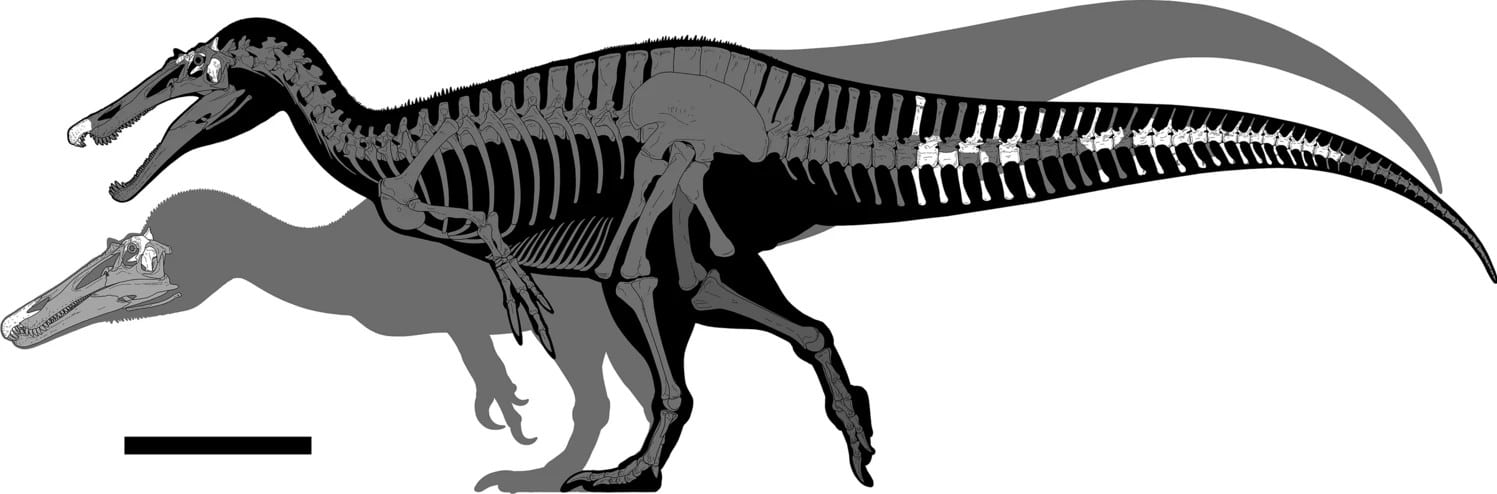
No peer-reviewed study gives a length for Ceratosuchops. The 2021 paper notes only “relatively comparable body sizes” among the Wealden specimens. Its skeletal drawing carries a 3.3-foot (1-meter) scale bar but states no length. Meanwhile, a 2021 University of Southampton news release gave the researchers’ estimate of around 29.5 feet (9 meters) for each new species. It also mentioned skulls about 3.3 feet (1 meter) long but gave no method for either figure.
In 2023, Barker and colleagues noted that no body-mass estimate exists for Ceratosuchops, although it matches Baryonyx in proportions wherever their known bones overlap. No study has published a height at the hips either.
The skull pieces offer firmer, directly measured numbers. Its occipital condyle (the knob that joins skull to neck) is 1.80 inches (45.8 millimeters) wide, against 1.76 inches (44.8 millimeters) in Baryonyx. According to the 2023 study, the Baryonyx holotype represents a slightly smaller individual. In contrast, the Ceratosuchops premaxillae are smaller than the snout material of Riparovenator.
The Dinosaur in Detail
What sets it apart lies mostly in its skull. Barker and colleagues listed five unique traits, among them a pair of bumps on the premaxillae called antenarial tuberosities. Others lie in the braincase, such as deeply grooved oval scars on the basisphenoid and an unusually thick interbasipterygoid web on the braincase floor. Unlike Baryonyx, it had narial fossae—shallow hollows around the nostril—as Suchomimus appears to. Like Baryonyx, though, it had a short subnarial process and no crest along the top of the premaxillae.
The describers were candid about their evidence. Some differences, they noted, resemble individual or growth-related variation in other theropods, and the specimens’ maturity relative to Baryonyx is unknown. Their notes even flagged several “unique” traits as possible individual variation. Still, they named the species for its unique characters and character combinations. Later, a 2023 CT-scan study found the 2021 paper had misapplied one diagnostic term—the basioccipital indentation was not a true “subcondylar recess.”

In the original Bayesian analysis, Ceratosuchops and Riparovenator emerged as distinct sister species, together forming a moderately supported clade with Suchomimus. Their parsimony analysis, built on 1,810 characters and 40 taxa, gave this grouping only limited support. Forcing the pair outside a Baryonyx–Suchomimus grouping cost only two extra steps, a difference the authors’ tests judged insignificant. In 2022, however, Paul Sereno and colleagues suggested the differences between the two Wessex genera could reflect individual variation. They tentatively scored all the Wessex baryonychine material as one taxon, under the name C. inferodios.
Afterward, in 2023, Santos-Cubedo and colleagues counted Ceratosuchops among four valid baryonychine genera—following Sereno’s lumping, so without Riparovenator. In 2026, both Morrison’s team and Lewis’s team kept Ceratosuchops and Riparovenator as separate genera. None of these studies challenges the genus itself—the open question is whether Riparovenator was a separate animal.
Interesting Points about Ceratosuchops
- The full translation “horned crocodile-faced hell heron” comes from the University of Southampton’s 2021 announcement, not from the scientific paper itself.
- Its describers saw support for a European origin of spinosaurids, followed by at least two Early Cretaceous migrations to Africa.
- If its describers are right, the presence of Baryonyx in the Wessex Formation becomes ambiguous, and they treat one vertebra once referred to it as indeterminate.
- The back of its skull shows a smaller third opening below the exits for two cranial nerves, whereas Baryonyx has a single hypoglossal nerve trunk.
- The CT data behind its brain reconstruction sit on MorphoSource, an online archive of 3D specimen data, under project 000491949.
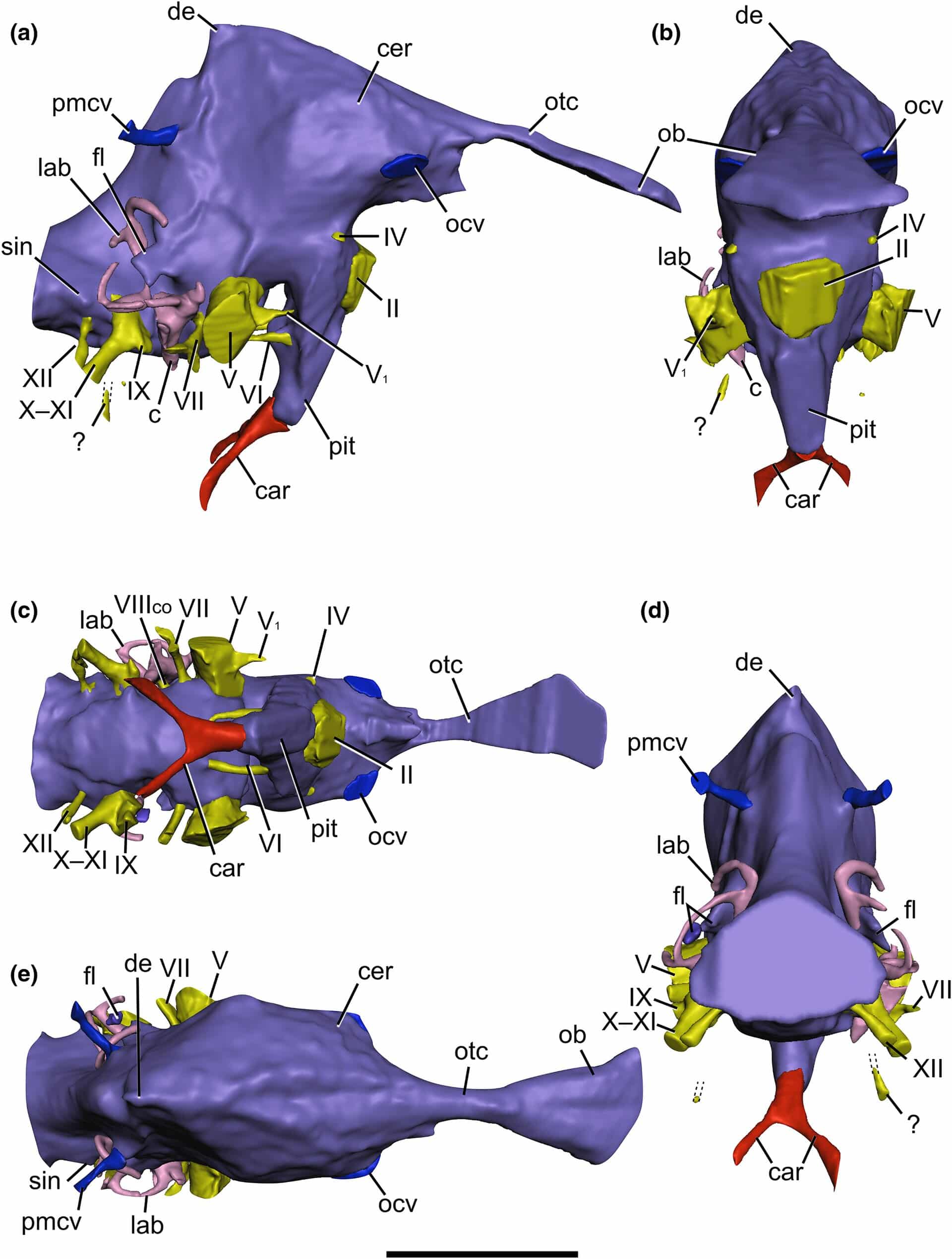
- Its brain shows no tangible sign of semi-aquatic adaptation, and its sense of smell appears unexceptional. CT work put its best hearing at about 2,210 hertz—low-pitched like other large theropods, and lower than in Irritator.
Ceratosuchops in its Natural Habitat
The world Ceratosuchops knew took its shape from water. A perennial, highly sinuous river flowed west to east, laying down sandstones, varicolored mudstones, and plant debris beds. The Isle of Wight then lay between 35 and 40 degrees north, with a warm to hot climate, dry spells, and intense storms. Seasonal lakes and ponds dotted the meander plains. Conifers, ginkgophytes, ferns, cycadophytes, and angiosperms (flowering plants) grew on higher ground to the north. Forest fires occasionally swept the land, and floods washed plant debris into the basin.
Ceratosuchops was a large carnivore, though no study reports gut contents or tooth wear. The 2021 release likened its likely hunting style to a heron’s—a bird that takes prey at the water’s edge but also on land. While there is no direct evidence of its social life, its describers linked the ornate brow to socio-sexual signaling. The overbuilt brows, they added, may also have played a role in fights between rivals.
The Wessex Formation also yielded its closest relative, Riparovenator milnerae, named in the same 2021 paper. Its braincase and tail came from Chilton Chine, likely between the Brighstone and Chilton Chine Sandstones. Morrison’s chart plots Ceratosuchops in roughly that interval, but only approximately, because its loose blocks cannot be tied to a bed. In fact, Barker and colleagues allowed that the two were possibly “separated by geological time.”
Other named dinosaurs are also known from the formation, at different or uncertain levels. Morrison’s chart places the ankylosaurian Vectipelta barretti at bed L5, just below the Chilton Chine Sandstone, while the megaraptoran Invictibellatrix most likely comes from the lower plant debris beds, L1 to L5. Higher up, the allosauroid Neovenator comes from L9 and the tyrannosauroid Eotyrannus from L11. Finally, the ankylosaur Polacanthus appears in the upper part of the section.
Frequently Asked Questions
It means “horned crocodile face,” and the University of Southampton translated the full name as “horned crocodile-faced hell heron.”
It lived in the Barremian stage of the Early Cretaceous, roughly 126 to 121 million years ago.
No peer-reviewed length or weight exists. A 2021 university news release gave the researchers’ estimate of about 29.5 feet (9 meters).
It was a carnivore named for a presumed heron-like ecology, though no one has found its gut contents.
Its fossils come from loose sandstone blocks at Chilton Chine, in the Wessex Formation of the Isle of Wight, England.
A pair of bumps on its snout tip, called antenarial tuberosities, is one of five skull traits its describers listed as unique. The other four lie in the braincase, whereas close relatives likely shared its knobbly brow.
Sources
The information in this article is based on various sources, drawing on scientific research, fossil evidence, and expert analysis. The aim is to provide a comprehensive and accurate overview of Ceratosuchops. However, please be aware that our understanding of dinosaurs and their world is constantly evolving as new discoveries are made.
- https://doi.org/10.1038/s41598-021-97870-8
- https://static-content.springer.com/esm/art%3A10.1038%2Fs41598-021-97870-8/MediaObjects/41598_2021_97870_MOESM1_ESM.pdf
- https://static-content.springer.com/esm/art%3A10.1038%2Fs41598-021-97870-8/MediaObjects/41598_2021_97870_MOESM2_ESM.pdf
- https://doi.org/10.7554/eLife.80092
- https://doi.org/10.1111/joa.13837
- https://doi.org/10.7717/peerj.15453
- https://doi.org/10.1038/s41598-023-33418-2
- https://doi.org/10.1098/rsos.260937
- https://doi.org/10.1098/rsos.260994
- https://doi.org/10.1080/14772019.2021.1978005
- https://doi.org/10.7717/peerj.12727
- https://doi.org/10.1144/jgs2024-046
- https://doi.org/10.1080/14772019.2023.2210577
- https://paleobiodb.org/data1.2/taxa/single.txt?name=Ceratosuchops&show=app
- https://www.southampton.ac.uk/news/2021/09/new-spinosaurid-dinosaurs.page
This article was last fact checked: TheDinosaurs Team, 12-11-2026
Featured Image Credit: Connor Ashbridge, CC BY-SA 4.0, via Wikimedia Commons
