
On the Naze Peninsula of northern James Ross Island, Antarctica, the Cape Lamb Member of the Snow Hill Island Formation holds a puzzling predator known mostly from its legs. Named Imperobator antarcticus in 2019, it lived during the Late Cretaceous—early in the Maastrichtian stage, according to its describers. They called it gigantic and placed it among the paravians, the group that includes birds and their nearest theropod relatives. Exactly where it sits within that group, however, remains disputed.
The bones came to light in 2003. Four years later, paleontologist Judd A. Case and two colleagues reported them as a dromaeosaur—a member of the “raptor” family. In 2019, Ricardo C. Ely and Case finally named it in the journal Cretaceous Research. Each new look at these few bones has since reshaped ideas about Antarctica’s links with other southern lands.
Imperobator Key Facts
| Keyword | Fact |
|---|---|
| Pronunciation | Not specified |
| Meaning of name | Not specified |
| Group | Theropoda (Paraves) |
| Type Species | Imperobator antarcticus |
| Diet | Carnivore |
| When it Lived | Around 72 MYA |
| Period | Cretaceous |
| Epoch | Late Cretaceous (late Campanian to early Maastrichtian stages) |
| Length | Not specified |
| Height | Not specified |
| Weight | Not specified |
| Mobility | Not specified |
| First Discovery | 2003 by a team including Judd A. Case |
| Described by | 2019 by R.C. Ely and J.A. Case |
| Holotype | UCMP 276000 |
| Location of first find | Comb Ridge, Naze (El Morro) Peninsula, Cape Lamb Member of the Snow Hill Island Formation, James Ross Island, Antarctica |
Imperobator Origins, Taxonomy and Timeline
The sources available do not explain the name Imperobator, but the fossil carried humbler labels before 2019. Case and colleagues called it the “Naze dromaeosaur” in 2007, and the 2019 abstract calls it the “Naze Theropod”—both nods to its peninsula. Together, these nicknames tied the fossil to its place for years.
In 2019, Ely and Case classified Imperobator within Theropoda, Coelurosauria, and Maniraptora, and more narrowly as a basal paravian. However, their analyses could not tie it to any of the three paravian subclades—Dromaeosauridae, Troodontidae, and Avialae (birds). In 2024, paleontologist Juan D. Porfiri and colleagues listed it as a possible unenlagiine, one of the dromaeosaur-like paravians known mainly from South America. A year later, Matías J. Motta and colleagues recovered it within Unenlagiidae. Imperobator antarcticus is the type and only known species.
Ely and Case dated the fossil to the early Maastrichtian, the last stage of the Cretaceous. In 2013, palynologist Mercedes di Pasquo and James E. Martin had reached that age from microfossils in the same section—chiefly the cysts of marine plankton called dinoflagellates, backed by an ammonite. Later, paleontologist Matthew C. Lamanna and colleagues placed the Cape Lamb Member dinosaurs in the late Campanian or early Maastrichtian, clustered near the boundary at 72.1 million years ago. The nearest numerical date, 71.0 million years, comes from strontium isotopes on nearby Vega Island. Without a date from the bone itself, “around 72 million years ago” remains an estimate.
Discovery & Fossil Evidence
The fossil weathered out on the western flank of Comb Ridge, on the Naze Peninsula—also called El Morro. Most sources date the find to 2003, but a 2016 university abstract and a 2018 newspaper report say 2004. Case’s 2007 report placed the bones low in the Cape Lamb Member. Later studies, beginning with di Pasquo and Martin, put them near the middle of the 90-meter (295-foot) Comb Ridge section instead. That level sits 41 to 48 meters (135 to 157 feet) above its base.
The University of California Museum of Paleontology in Berkeley holds the holotype, UCMP 276000. As described in 2007, it includes two teeth in a fragment of concretion (a hard nodule of cemented sediment). It also holds the lower end of the left tibia (shin bone), the fibula, and the astragalus and calcaneum (ankle bones). Both ends of left metatarsals II–IV (long foot bones) survive as well. The 2007 report also covers the first bone and partial claw of the second toe and parts of the right shin and foot. A 2012 review later listed pieces of several more toe bones. Freezing and thawing in the Antarctic climate had badly fragmented the metatarsal shafts.
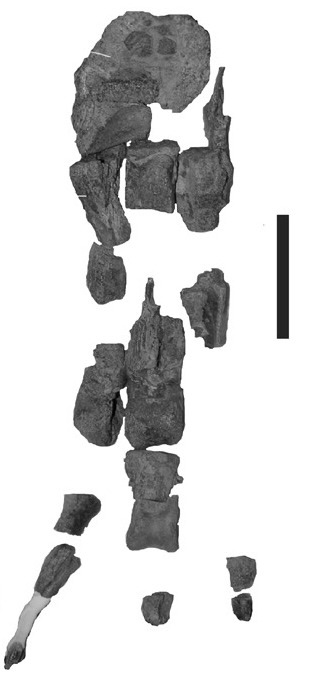

In 2019, Lamanna and colleagues reported relocated skull fragments, a tail vertebra, more teeth, and foot bones from the same specimen. Expeditions in 2011 and 2016 added a tooth, a partial claw, and other fragments, almost certainly from the same individual, but none had a published description by 2019. No study has formally referred a second specimen to Imperobator. In 2022, however, paleontologist Marcelo A. Reguero and colleagues suggested that a theropod toe bone from the same member on nearby Vega Island is probably related to it.
Imperobator Size and Description
With only parts of the legs, a few teeth, and undescribed scraps, any portrait of Imperobator rests on very little bone.
Short description of Imperobator
The skull fragments remained undescribed in 2019, but the 2007 report noted long, narrow teeth, convex on both faces. No serrations were visible on the cutting edges, but poor preservation left the question open. Their shape suggested they came from the front of the jaws.
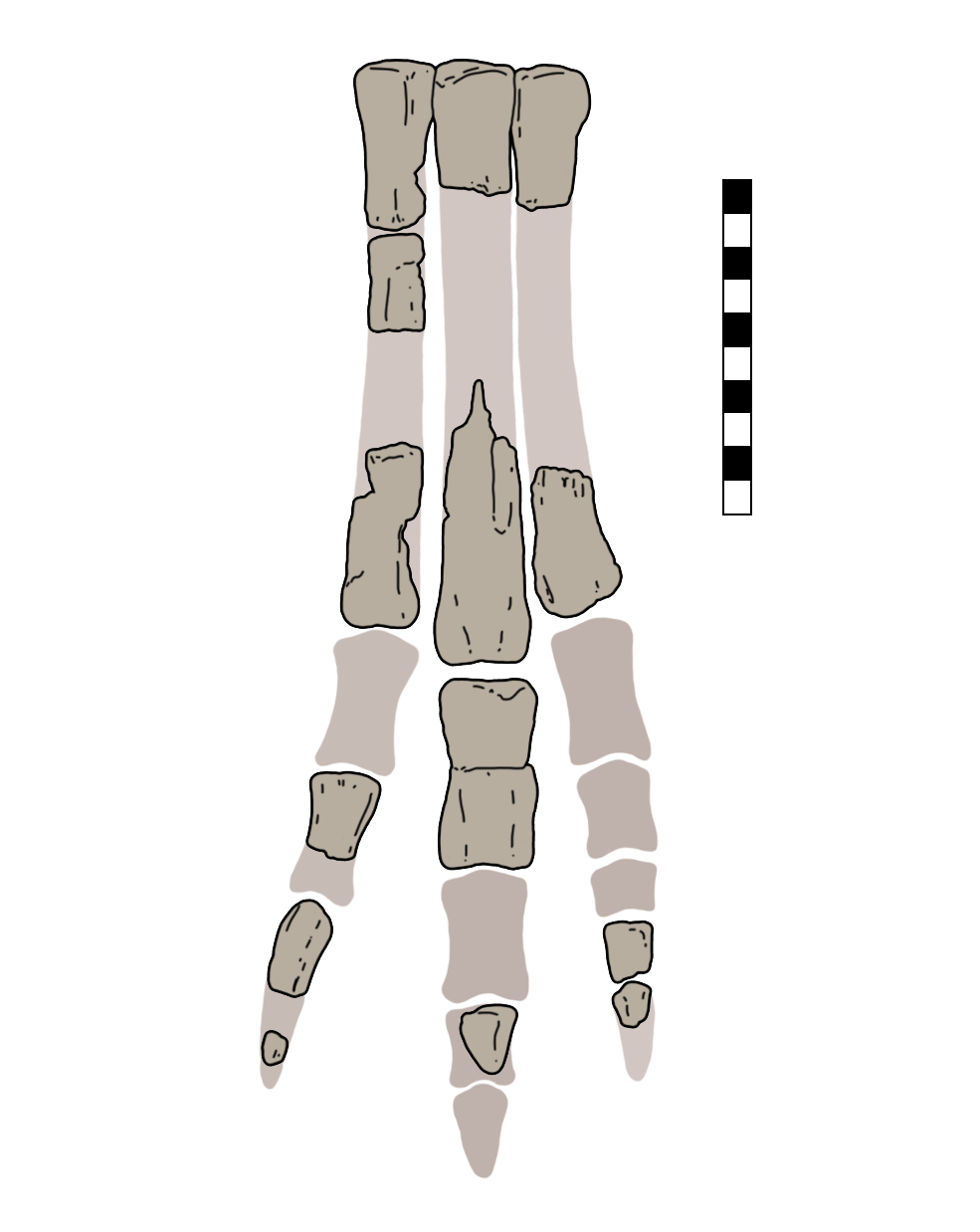
At the ankle, the disc-shaped calcaneum stayed separate from the astragalus but had fused to the fibula. The tight joint between the tibia and the ascending process (a plate of the astragalus that rises against the shin)—normal in theropods—was missing. The third metatarsal narrowed into a pinched ridge at the back, where flanges on its neighbors hid much of it. Unlike those of Late Cretaceous dromaeosaurs and troodontids from Laurasia (the northern continents), the metatarsals were not long and slender. In this, the 2007 authors found it closer to Early Cretaceous dromaeosaurs such as Deinonychus and Utahraptor. They weighed size as a cause but noted that the similarly sized Achillobator has long metatarsals.
Neither skin impressions nor feathers survive, so any discussion of its outer covering is speculative.

Size and Weight of Type Species
The available sources give no length, height, or weight for Imperobator, so only comparisons convey its size.
In 2007, Case and colleagues called it a small theropod. Ely and Case went much further in 2019, calling it a case of paravian gigantism. Their abstract names the dromaeosaurids Utahraptor, Achillobator, Austroraptor, and Dakotaraptor as the best examples.
Lamanna’s team later used “medium-sized” instead. A 2018 newspaper report put it at about twice the size of Velociraptor, but no scientific paper cited here makes that comparison.
The Dinosaur in Detail
What sets this dinosaur apart is the claw on its second toe—or rather, how modest it is. Ely and Case found that Imperobator lacks a hypertrophied (greatly enlarged) second-toe claw. Next to similarly sized dromaeosaurids such as Utahraptor, its claw looks surprisingly small. The 2007 report had read the bone differently, calling it enlarged and trenchant (bladelike), and a 2012 review agreed it was large.
The second metatarsal tells a similar story. Case and colleagues first described the back of its lower end as ginglymoid—a grooved, hinge-like joint—typical of dromaeosaurids. In 2012, however, paleontologist Alan H. Turner and two colleagues saw no such joint and called its absence inconsistent with a dromaeosaurid. Instead, they treated the fossil as a deinonychosaur (the sickle-clawed dromaeosaurid–troodontid group) of uncertain placement. Ely and Case later confirmed that the surface is smooth and excluded the animal from Dromaeosauridae.
Both a heuristic search and a Bayesian analysis by Ely and Case placed Imperobator within Paraves. In 2025, Motta’s team added it to a dataset of 175 taxa and 850 characters, which nested it within Unenlagiidae. They cite its subarctometatarsalian foot—one whose middle metatarsal narrows between its neighbors—as a defining trait of that family.
The placement matters for geography. In 2007, Case’s team saw the Naze animal as perhaps a late remnant of a once worldwide, basal dromaeosaur stock. Lamanna and colleagues later called Imperobator the only possible exception to the South American affinities of other James Ross Basin dinosaurs. Motta’s team, in contrast, counts it among the Late Cretaceous dinosaurs shared by South America and Antarctica. For now, the debate turns on a handful of foot bones—and on extra material still undescribed in 2019.
Interesting Points about Imperobator
- For over a decade, the fossil went by the “Naze dromaeosaur” or “Naze Theropod” before Ely and Case named it in 2019.
- Antarctic freeze–thaw cycles had broken up the shafts of its metatarsals, leaving mainly the ends of these foot bones.
- Since 2007, researchers have called it a dromaeosaurid, an unplaced deinonychosaur, a basal paravian, and most recently an unenlagiid.
- Its bones lay in shallow marine rocks, so Case and colleagues reasoned that they floated out from shore.
Contemporary Dinosaurs
Sharing the same member was Morrosaurus antarcticus, an ornithopod known from a fragmentary right hind limb. In 2016, paleontologist Sebastián Rozadilla and colleagues named it from about 30 meters (98 feet) below the Imperobator level. Lamanna’s team suggested a length of perhaps 4 meters (13 feet). Both lived in the late Campanian or early Maastrichtian, but no fossil records any contact between them.
From slightly older beds of the same formation comes Trinisaura santamartaensis, a small-bodied basal ornithopod. Its Gamma Member beds at Santa Marta Cove, 12 kilometers (7.5 miles) west of the Naze, are probably late Campanian. Even so, Lamanna’s team places it, like Imperobator, within a few million years of the Campanian–Maastrichtian boundary.
Lower still, about 10 meters (33 feet) below the Trinisaura level, lay Antarctopelta, an armored ankylosaur of the late Campanian. Its validity is contested—Victoria Arbour and Philip Currie called it a nomen dubium (doubtful name) in 2016, but Rozadilla and colleagues defended it.
From a neighboring region, the Dorotea Formation of Magallanes in southern Chile, comes Stegouros elengassen, an ankylosaur with bizarre tail weaponry. Its lower Dorotea beds date to between about 74.9 and 71.7 million years ago, overlapping the age range of Imperobator. In 2021, paleontologist Sergio Soto-Acuña and colleagues described Magallanes as biogeographically related to West Antarctica. They also grouped Stegouros with Antarctopelta in a new early-branching ankylosaur clade, Parankylosauria. Lamanna’s team likewise links most James Ross Basin dinosaurs with Patagonian forms. Still, Stegouros lived far from James Ross Island, and nothing ties the two directly.
Imperobator in its Natural Habitat
The world Imperobator knew was temperate, wet, and forested. Di Pasquo and Martin reconstructed highly humid lowland rainforests of podocarps (southern conifers) and Nothofagus (southern beech), with flowering plants and ferns in the understory. Growth rings in fossil wood from the Naze and Lachman Crags, studied by Francis, show a markedly seasonal climate. Reguero and colleagues describe a wider riverine coastal landscape. Citing Bowman’s team, they put yearly averages around 10 to 15 °C (50 to 59 °F).
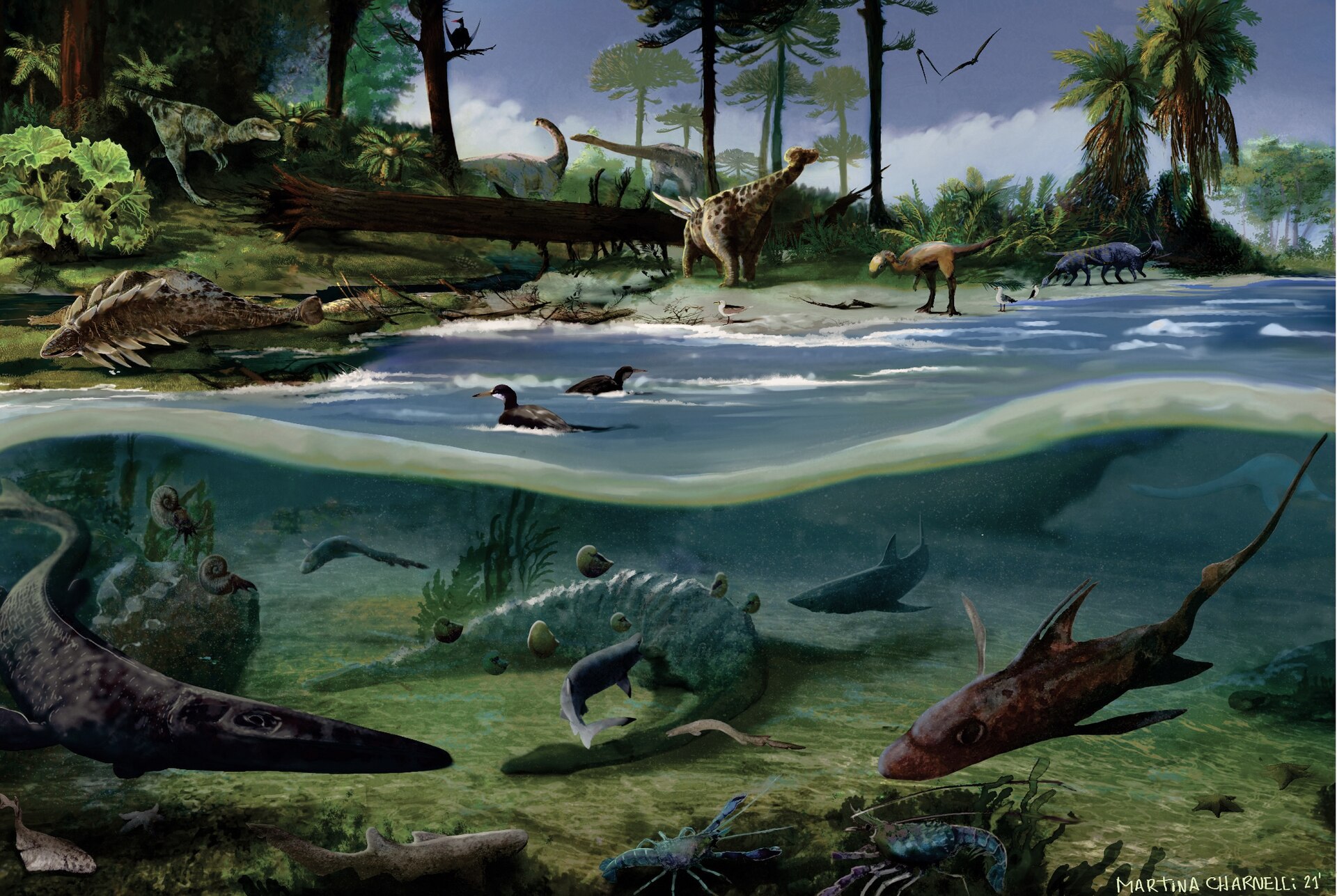

Its rocks are fine sandstones and mudstones laid down on a marine shelf. Ammonites, sharks, and plesiosaurs occur in the same section, and the Cape Lamb Member has also yielded a pterosaur. Di Pasquo and Martin suggested that long transport or exposure on land may explain the dinosaur’s poor preservation. Its presence, they added, points to a nearby coastline. As for diet, Case and colleagues described it as a carnivorous dinosaur, but the available sources name no prey.
While there is no direct evidence of how Imperobator lived, its fused calcaneum and fibula intrigued Case. In 2018, he told a newspaper it was “a different way of solving a problem” that gave the leg similar stability. Reguero and colleagues count four non-avian dinosaur taxa from the Cape Lamb Member. Besides Imperobator and Morrosaurus, they include two unnamed ornithopods from Cape Lamb on Vega Island. The member there has also yielded the theropod toe bone and early birds—among them Antarcticavis capelambensis, the oldest known bird from Antarctica. That short list shows how much of this ecosystem remains unknown.
Frequently Asked Questions
The available sources do not explain the name.
It lived around 72 million years ago, in the late Campanian to early Maastrichtian stages of the Late Cretaceous.
No length or weight is available. The 2007 report called it small, its describers called it gigantic, and a later study called it medium-sized.
Case and colleagues called it a carnivore in 2007, but its prey is unknown.
Its describers called it a paravian theropod of uncertain position, and a 2025 study placed it in Unenlagiidae.
It comes from the Cape Lamb Member of the Snow Hill Island Formation on James Ross Island, Antarctica.
Sources
The information in this article is based on various sources, drawing on scientific research, fossil evidence, and expert analysis. The aim is to provide a comprehensive and accurate overview of Imperobator. However, please be aware that our understanding of dinosaurs and their world is constantly evolving as new discoveries are made.
- https://doi.org/10.1016/j.cretres.2019.04.003
- https://doi.org/10.3133/of2007-1047.srp083
- https://doi.org/10.13679/j.advps.2019.0007
- https://doi.org/10.1016/j.cretres.2013.07.008
- https://zenodo.org/record/5399588
- https://doi.org/10.5710/AMGH.13.11.2024.3604
- https://doi.org/10.1590/0001-3765202220211142
- https://doi.org/10.4202/app.01315.2025
- https://pmc.ncbi.nlm.nih.gov/articles/PMC11177497/
- https://doi.org/10.1016/j.cretres.2015.09.009
- https://doi.org/10.1038/s41586-021-04147-1
- https://doi.org/10.21203/rs.3.rs-821192/v1
- https://inside.ewu.edu/mcnair/ricardo-ely-mcnair-scholar-and-judd-a-case-publish-new-findings/
- https://inside.ewu.edu/mcnair/cohorts/2015-2016-cohort/ricardo-ely/
- http://www.spokesman.com/stories/2018/feb/15/ewu-researchers-antarctic-fossils-help-place-taxon/
This article was last fact checked: TheDinosaurs Team, 05-11-2026
Featured Image Credit: TotalDino, CC BY-SA 4.0, via Wikimedia Commons
