
In the Río de las Chinas Valley of southern Chile, near Torres del Paine National Park, the lower Dorotea Formation has yielded an armored dinosaur with bizarre tail weaponry. Named Stegouros elengassen in 2021, this small herbivore lived about 75 to 72 million years ago, near the end of the Cretaceous. Its describers placed it among the ankylosaurs, the armored dinosaurs. Yet its tail ended in a flat, bladed weapon that, in their words, was “unlike any dinosaur.”
A University of Texas at Austin group spotted the first bones in 2017. In February 2018, a University of Chile team led by Sergio Soto-Acuña and Jonatan Kaluza dug the skeleton out of a steep hillside. Soto-Acuña and 18 colleagues then named the animal in Nature. Their analyses grouped it with other southern armored dinosaurs in a lineage that split earliest from all other ankylosaurs.
Stegouros Key Facts
| Keyword | Fact |
|---|---|
| Pronunciation | Not specified |
| Meaning of name | Roofed Tail |
| Group | Ankylosauria (Parankylosauria) |
| Type Species | Stegouros elengassen |
| Diet | Herbivore (inferred for ankylosaurs as a group) |
| When it Lived | 75 to 72 MYA |
| Period | Cretaceous |
| Epoch | Late Cretaceous (late Campanian to early Maastrichtian stages) |
| Length | About 5.9 to 6.6 feet (1.8 to 2.0 meters) in the 2021 paper, revised to about 4.9 to 5.4 feet (1.5 to 1.65 meters) by co-author Alexander Vargas |
| Height | Not specified |
| Weight | Not specified |
| Mobility | Moved on all four legs (quadrupedal), inferred for ankylosaurs as a group |
| First Discovery | 2017 by a University of Texas at Austin group, excavated in February 2018 by a University of Chile team led by Sergio Soto-Acuña and Jonatan Kaluza |
| Described by | 2021 by S. Soto-Acuña, A.O. Vargas, J. Kaluza, M.A. Leppe, J.F. Botelho, J. Palma-Liberona, C. Simon-Gutstein, R.A. Fernández, H. Ortiz, V. Milla, B. Aravena, L.M.E. Manríquez, J. Alarcón-Muñoz, J.P. Pino, C. Trevisan, H. Mansilla, L.F. Hinojosa, V. Muñoz-Walther, and D. Rubilar-Rogers |
| Holotype | CPAP-3165 |
| Location of first find | Lower Dorotea Formation, Río de las Chinas Valley, Estancia Cerro Guido, Última Esperanza Province, Magallanes Region, Chile |
Stegouros Origins, Taxonomy and Timeline
The name Stegouros joins the Greek stego, “roof,” and uros, “tail,” which its describers chose for the animal’s covered tail. The species name elengassen comes from an armored beast in the mythology of the local Aónik’enk people.
Soto-Acuña and colleagues placed Stegouros within Thyreophora—the armored ornithischians—and then within Ankylosauria. They grouped it with Kunbarrasaurus from Australia and Antarctopelta from Antarctica. For this Gondwanan cluster, they coined Parankylosauria (“at the side of Ankylosauria”), covering every ankylosaur closer to Stegouros than to Ankylosaurus. In contrast, Euankylosauria (“true Ankylosauria”) covers those closer to Ankylosaurus. Stegouros elengassen is the type and only known species.
Parankylosauria has not gone unchallenged, however. Even at review, one referee accepted Antarctopelta as a close relative but rejected the link to Kunbarrasaurus. In 2023, Raven and colleagues, whose analysis did not include Stegouros, recovered Kunbarrasaurus as an early ankylosaurid and found Antarctopelta not closely related to it. Even so, they called Stegouros “a definitive ankylosaur.” Other teams have kept the clade, although a 2026 review listed Antarctopelta only as a possible member. Still, no published study has questioned Stegouros itself—the debate centers on its relatives.
The fossil beds lie between two uranium-lead ages from detrital zircons—about 74.9 million years below and 71.7 million years above. These maximum depositional ages, each uncertain by one to two million years, place Stegouros in the late Campanian to early Maastrichtian stages, roughly 75 to 72 million years ago. Its lineage was far older, though. The describers argued that parankylosaurs split off before the oldest known true ankylosaurs, which date to about 165 to 167 million years ago in the Middle Jurassic. In 2024, Soto-Acuña, Vargas, and Kaluza restated this as a split no later than the Oxfordian, the first stage of the Late Jurassic.
Discovery & Fossil Evidence
The site lies on Estancia Cerro Guido in Chile’s Magallanes Region. At first, only slender limb bones showed, so the team thought it might be an ornithopod. Despite near-freezing temperatures, a fracture, and sprained ankles, the crew removed the skeleton in rock blocks and took them to a University of Chile laboratory in Santiago.
The holotype, CPAP-3165, is a mostly complete, semi-articulated skeleton now held at the Chilean Antarctic Institute in Punta Arenas. The back half—tail, hips, and hind limbs—lay largely articulated, whereas the neck and back vertebrae, forelimbs, armor, and several skull bones were scattered. National Geographic reported the skeleton as about 80 percent complete. No bone is duplicated, and fused neural arches and skull bones rule out a juvenile.
The skeleton lay right side up, with the base of its tail bent into a zig-zag below the hips. The authors proposed that the carcass came to rest on a river sandbar and was quickly buried, although a quicksand trap also remains plausible. Unfortunately, the tail breaks off at its 18th vertebra, and the authors estimate that no more than eight vertebrae are missing. The 2021 description rests on this single individual.
Stegouros Size and Description
Stegouros was small for an ankylosaur, yet its skeleton mixes ankylosaur, stegosaur-like, and more ancestral features.
Short description of Stegouros
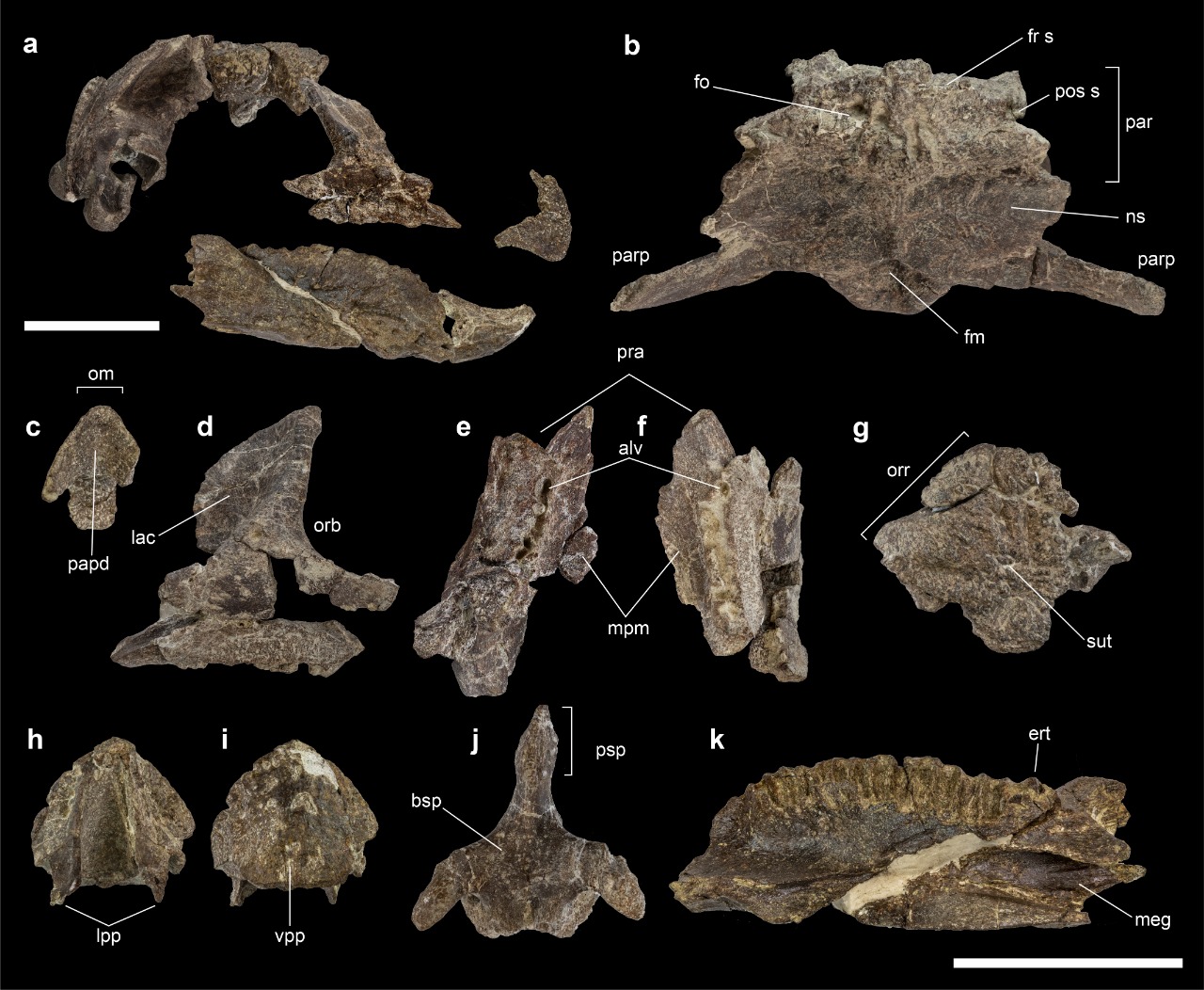
The head was proportionally large, with toothless premaxillae (front upper jaw bones) fused at the midline. Its leaf-shaped, high-crowned teeth sat in a sinuous, inward-bowed row of 14 sockets in the lower jaw. A short, deep predentary—the bone tipping the lower jaw—formed the front of the mouth. The University of Chile described that mouth as narrow, recurved, and much like a bird’s beak.
Behind the head, the neck vertebrae were short and the back vertebrae carried tall spines. The limbs were slender, and the fingers and toes ended in hoof-like unguals (claw bones). Body armor appears to have been sparse. Besides many tiny ossicles and a thin bony sheet over the front of the hips, the team found a few small osteoderms. Only eight keeled oval plates, about 1.6 to 2 inches (40 to 50 millimeters) long, resembled flank scutes. In the authors’ view, this may reflect light trunk armor, as in Kunbarrasaurus. No armor was found on the skull, yet keeled osteoderms turned up on a forelimb and on both feet. Large plates ringing the neck are also unknown, though this could reflect preservation. No skin impressions have been reported, so any discussion of its soft tissue is speculative.

Size and Weight of Type Species
The 2021 paper gave Stegouros a total length of about 5.9 to 6.6 feet (1.8 to 2.0 meters). Two days after publication, however, co-author Alexander Vargas posted a comment on the Nature website. He called that figure an error and gave a snout-to-tail length of about 4.9 to 5.4 feet (1.5 to 1.65 meters), based on a digital assembly of the skeleton. As far as we know, that revision has not appeared in a peer-reviewed paper.
No peer-reviewed height or body mass has been published, although National Geographic said it stood less than two feet (0.6 meters) tall. Meanwhile, one reviewer judged it “relatively small-sized (for an ankylosaur…)” yet apparently skeletally mature.
By the paper’s own figures, its relative Kunbarrasaurus reached about 8.2 feet (2.5 meters). In comparison, Antarctopelta, known from about 15 percent of its skeleton, may have reached about 13 feet (4 meters).
The Dinosaur in Detail
Its tail sets this dinosaur apart. Seven pairs of armor plates, or osteoderms, encased the back half and formed a flat, frond-like blade. The authors named this structure the “macuahuitl,” after the Aztec war club. When a reviewer asked for a plainer term, the authors kept theirs as “a tip of the hat to our Latin American culture.”
The first pair carried sharp keels, and the second covered two vertebrae. The last five pairs fused front to back into a single flattened unit, each plate roughly pentagonal from above. Near the tip, the armor also wrapped beneath the tail. By the describers’ estimate, the tail held at most 26 vertebrae. That is fewer than documented in any other armored dinosaur—the lowest count they cite is 35, in Scelidosaurus.
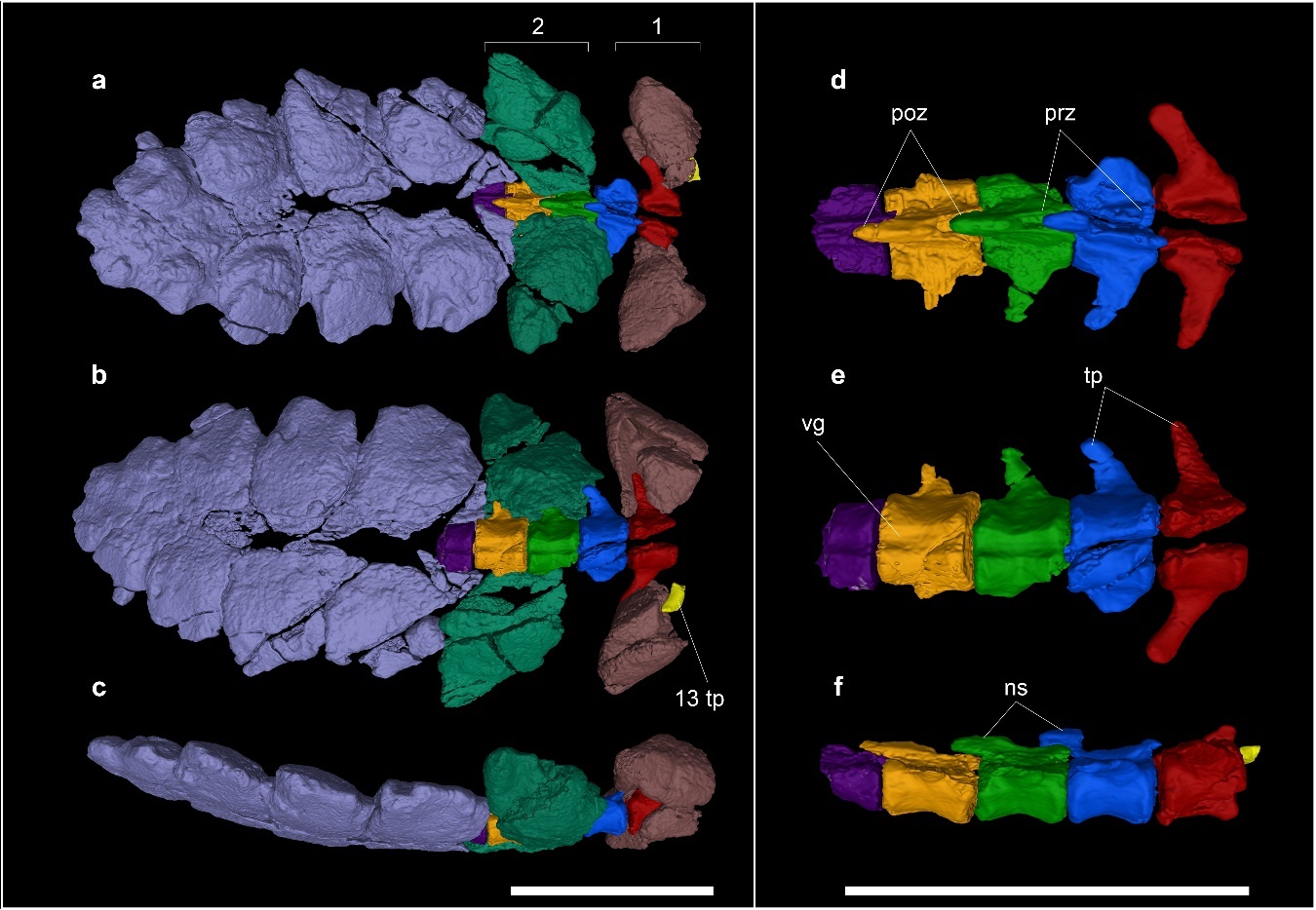

Its route to a weapon was unusual too. Because nodosaurids and early ankylosaurids lacked tail weapons, the describers concluded that the ankylosaurine club evolved independently of the Stegouros weapon. Ankylosaurid clubs rely on long prezygapophyses—forward-reaching joint processes—to stiffen the tail. In contrast, Stegouros has short ones and stiffened its shorter tail through fused armor. Armored dinosaurs, they noted, are the only amniotes with three distinct tail weapons—stegosaur spikes, as in Stegosaurus, the Stegouros frond, and the ankylosaurine club.
The rest of the skeleton is a mosaic of ancestral and derived traits. Its skull and jaws are ankylosaur-like, while parts of the hip bones look “very similar to Stegosauria.” Likewise, the second finger has only two bones, as in stegosaurs. Its teeth resemble those of Edmontonia, but the authors judged this probably convergent. In all five of their analyses, Stegouros fell closer to ankylosaurs than to stegosaurs. Taken together, these traits describe an early-branching ankylosaur that kept much of an older body plan—and added a weapon all its own.
Interesting Points about Stegouros
- Its describers estimated that the tail held no more than 26 vertebrae, fewer than documented in any other armored dinosaur.
- Paleontologist Susannah Maidment, who was not involved, said of its pelvis: “I’d tell you 100 percent that it’s stegosaur.”
- The describers argued that some Antarctopelta vertebrae, once suspected of belonging to marine reptiles, are actually tail bones.
- Before peer review, the diagnosis listed an absence of ossified tendons, but the authors removed it “out of caution.”
Contemporary Dinosaurs
No other named dinosaur is yet known from the Stegouros beds. The three listed here therefore come from the Antarctic Peninsula, which the describers and later workers link to Magallanes through shared plants, animals, and intermittent land bridges at the time. They appear here as same-age neighbors, not as animals that met Stegouros.
From the Gamma Member of the Snow Hill Island Formation on James Ross Island, Antarctica, comes Antarctopelta oliveroi, a larger armored dinosaur about 13 feet (4 meters) long from late Campanian beds. The Stegouros team treated it as a close relative that probably carried a similar tail weapon.
The same member also yielded Trinisaura santamartaensis, an ornithopod possibly belonging to Elasmaria. It shares that late Campanian age, and no interaction with Stegouros is known.
From the Cape Lamb Member of the same formation, on James Ross Island, Antarctica, comes Imperobator antarcticus. This paravian theropod, a member of the bird-and-raptor lineage, dates to the late Campanian to early Maastrichtian.
Stegouros in its Natural Habitat
The world Stegouros roamed was a coastal lowland in the Magallanes foreland basin, shaped as the Andes rose and Gondwana broke apart. Over time, the Dorotea shoreline shifted from shallow sea to tidal deltas and rivers. Stegouros itself lay in a channel-bar sandstone left by a meandering river. Floodplain mudstones a few meters above the skeleton preserve ferns and large-leaved flowering plants, along with horsetails and cattail-like plants buried almost where they grew. Pollen shows that conifers and palms also grew in the region. Because the bones show no sign of extensive drying, the authors suggested a somewhat humid setting.
Like other ankylosaurs, Stegouros was likely a herbivore. According to the University of Chile, this local vegetation was probably its food. In 2023, Ballell and colleagues found relatively low bite leverage at the front of its jaws.
While there is no direct evidence of whether Stegouros lived alone or in groups, its weapon may have served in fights with rivals of its own kind, in defense, or both. Armored herbivores with stiff trunks, its describers note, more often evolve tail weapons. In 2023, Davis and colleagues reported fragmentary remains of a megaraptorid, unenlagiines, and an enantiornithine bird from the same locality. Still, no fossil ties the two predatory groups to attacks on Stegouros. Younger, early Maastrichtian beds higher in the formation hold Gonkoken nanoi, a small duck-billed hadrosauroid. Remarkably, the mammals Magallanodon and Orretherium turned up only about 820 feet (250 meters) from the Stegouros site. The wider formation also yields sharks, frogs, turtles, plesiosaurs, mosasaurs, and marine shells—a mix that reflects its shifting coastline.
Frequently Asked Questions
It means “roofed tail,” for its armored tail, and elengassen is an armored beast in Aónik’enk mythology.
It lived in the late Campanian to early Maastrichtian stages of the Late Cretaceous, about 75 to 72 million years ago.
The 2021 paper gave about 5.9 to 6.6 feet (1.8 to 2.0 meters). Co-author Alexander Vargas later revised this to about 4.9 to 5.4 feet (1.5 to 1.65 meters).
Like other ankylosaurs, it was likely a herbivore, and ferns and flowering plants grew close to where it was buried.
It was found in the Dorotea Formation of the Río de las Chinas Valley, in Chile’s Magallanes Region.
Its short tail ended in a flat, frond-like weapon of seven pairs of armor plates, unlike the spikes of stegosaurs or the clubs of ankylosaurines.
Sources
The information in this article is based on various sources, drawing on scientific research, fossil evidence, and expert analysis. The aim is to provide a comprehensive and accurate overview of Stegouros. However, please be aware that our understanding of dinosaurs and their world is constantly evolving as new discoveries are made.
- https://doi.org/10.1038/s41586-021-04147-1
- https://doi.org/10.21203/rs.3.rs-821192/v1 (the authors’ open preprint of the original description, used to read the full text)
- https://static-content.springer.com/esm/art%3A10.1038%2Fs41586-021-04147-1/MediaObjects/41586_2021_4147_MOESM1_ESM.pdf
- https://static-content.springer.com/esm/art%3A10.1038%2Fs41586-021-04147-1/MediaObjects/41586_2021_4147_MOESM3_ESM.pdf
- https://doi.org/10.12429/j.advps.2023.0036
- https://doi.org/10.1080/14772019.2023.2205433
- https://pmc.ncbi.nlm.nih.gov/articles/PMC10600113/
- https://pmc.ncbi.nlm.nih.gov/articles/PMC10275600/
- https://app.pan.pl/archive/published/app71/app013152025.pdf
- https://doi.org/10.1016/j.jsames.2022.104163
- https://paleobiodb.org/data1.2/occs/list.txt?formation=Dorotea&base_name=Dinosauria&show=strat,loc,ref
- https://uchile.cl/u182278
- https://www.nationalgeographic.com/science/article/this-bizarre-armored-dinosaur-had-a-uniquely-bladed-tail-weapon
This article was last fact checked: TheDinosaurs Team, 03-11-2026
Featured Image Credit: Luis Enrique Pérez López, CC BY-SA 4.0, via Wikimedia Commons
