
In the badlands of Harding County, South Dakota, the upper Hell Creek Formation has yielded one of the largest dromaeosaurids, or “raptors,” ever described. Named Dakotaraptor steini in 2015, this predator lived in the late Maastrichtian, the closing part of the Cretaceous’s final stage. The bones lay no more than 20 meters (66 feet) below the Cretaceous–Paleogene boundary—the layer tied to the end-Cretaceous impact. Its describers called it the first giant dromaeosaurid from the Hell Creek—and the most recent anywhere.
Paleontologist Robert DePalma found the skeleton in 2005, in river deposits of the formation. A decade later, he and four colleagues named it in the journal Paleontological Contributions. Its forearm bore quill knobs—the team’s “first clear evidence” for feather quills on a large dromaeosaurid forearm. Since then, however, a misidentified bone and a dispute over whether the skeleton is one animal have made it a lesson in testing claims.
Dakotaraptor Key Facts
| Keyword | Fact |
|---|---|
| Pronunciation | Not specified |
| Meaning of name | Dakota Plunderer |
| Group | Theropoda (originally Dromaeosauridae, placement debated) |
| Type Species | Dakotaraptor steini |
| Diet | Carnivore |
| When it Lived | Around 66 MYA |
| Period | Cretaceous |
| Epoch | Late Cretaceous (Maastrichtian stage) |
| Length | About 18 feet (5.5 meters) |
| Height | Not specified |
| Weight | Not specified |
| Mobility | Moved on two legs (bipedal) |
| First Discovery | 2005 by Robert A. DePalma |
| Described by | 2015 by R.A. DePalma, D.A. Burnham, L.D. Martin, P.L. Larson, and R.T. Bakker |
| Holotype | PBMNH.P.10.113.T |
| Location of first find | Upper Hell Creek Formation, Harding County, South Dakota, USA |
Dakotaraptor Origins, Taxonomy and Timeline
The name Dakotaraptor points to both a place and a people. “Dakota” refers to the region of the find and, in the describers’ words, to the “Dakota First Nations Tribe,” meaning the Dakota people. “Raptor” is Latin for “plunderer.” The species name steini honors paleontologist Walter Stein. Together, the name joins a landscape, its people, and a fellow paleontologist in a single label.
In 2015, DePalma and colleagues placed the new animal in Dromaeosauridae, within the larger theropod group Maniraptora. Their computer analysis, which produced 1,237 equally short family trees, made it the sister taxon (closest known relative) of Dromaeosaurus. Dakotaraptor steini is the type and only known species.
The 2015 paper gives no age in years, only a position high in the formation, within the late Maastrichtian stage. However, a 2026 study by Eric Roberts and colleagues placed the top of the formation at about 66.05 million years ago, citing earlier radiometric dates. On that basis, Dakotaraptor lived roughly 66 million years ago—just before the end of the Cretaceous.
Discovery & Fossil Evidence
The type locality lies in the southeast corner of Harding County, at a site the Paleobiology Database calls Dakotaraptor Quarry, near Bone Butte. There, the bones lay in medium- to fine-grained sandstone from a slow-moving stream channel. The quarry is a multispecific bonebed—a deposit holding dinosaurs, reptiles, birds, mammals, amphibians, pterosaurs, and fish. Still, the describers recovered no other theropod bones from the skeleton’s layer.
The holotype, PBMNH.P.10.113.T, was cataloged at the Palm Beach Museum of Natural History in Florida as one adult individual. It includes the right femur (thigh bone), both tibiae (shinbones), and the left astragalus and calcaneum (ankle bones). Several metatarsals (long foot bones) and two pedal unguals (toe claws) complete the hind limb. Both humeri, radii, and ulnae (upper and lower arm bones) are present, along with two metacarpals (hand bones) and three finger fragments. A partial back vertebra and 10 tail vertebrae round out the list. In 2024, however, paleontologist Andrea Cau wrote that the type material sits in a private collection, so it is unclear whether it can be re-examined.
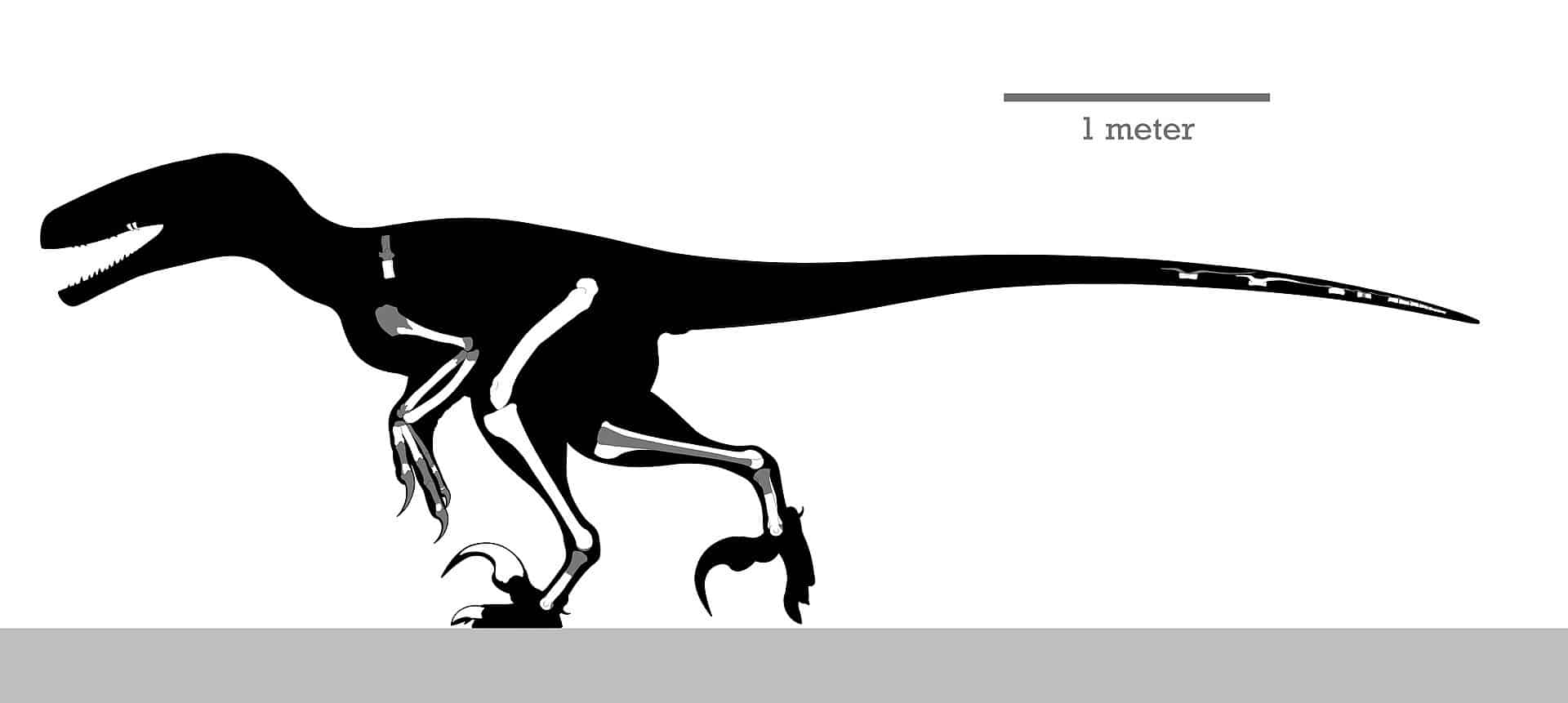

The 2015 list also included a furcula, or wishbone. In 2016, however, paleontologist Victoria Arbour’s team identified it, and a matching bone found about 16 miles (26 kilometers) away, as entoplastra (lower-shell plates) of a soft-shelled turtle, cf. Axestemys splendida. They had not examined a third, unfigured “furcula,” but DePalma’s team accepted the correction that year and removed all three. Arbour’s team did not call Dakotaraptor invalid, though. Beyond the holotype, the describers formally referred a gracile (slender) tibia, a gracile ankle, and five isolated teeth—all from this one quarry.
Dakotaraptor Size and Description
Short description of Dakotaraptor
No skull has been found, but the teeth are telling—flattened side to side and recurved. Each carries 15 to 20 serrations per 5 millimeters on the rear edge and 20 to 27 on the front. Larger than those of any other dromaeosaurid the authors examined, they also differ in serration density from Tyrannosaurus teeth.
The forearm was long, with a robust, slightly bowed ulna measuring 36 centimeters (14.2 inches). Along it ran 10 oblong bumps, each 8 to 10 millimeters long, which the authors read as quill knobs (anchor points for wing feathers). Because the spacing leaves room for about five more, they estimated some 15 secondary flight feathers in all. They also put the wingspan at about 120 centimeters (3.9 feet), not counting the long primary feathers.
The femur measured 55.8 centimeters (22 inches), and the tibia 67.3 centimeters (26.5 inches). That shin was longer than any dromaeosaurid tibia described as of 2015. The authors also read its length relative to the femur as a mark of a fast runner. No skin or feathers are preserved, so the feathered look in reconstructions is inferred from the quill knobs.
Size and Weight of Type Species
DePalma and colleagues estimated an adult length of about 18 feet (5.5 meters). This figure is indirect—they scaled the limb bones against those of Dromaeosaurus, Deinonychus, and Utahraptor. By contrast, a University of Kansas press release gave “about 17 feet” (5.2 meters).
No peer-reviewed study we consulted, including the original, gives a hip height or body weight. Its arm and leg proportions are exceptionally close to those of Deinonychus and Dromaeosaurus, but on a much larger frame. As of 2015, the authors judged only Utahraptor comparable in size—every other known dromaeosaurid was smaller.
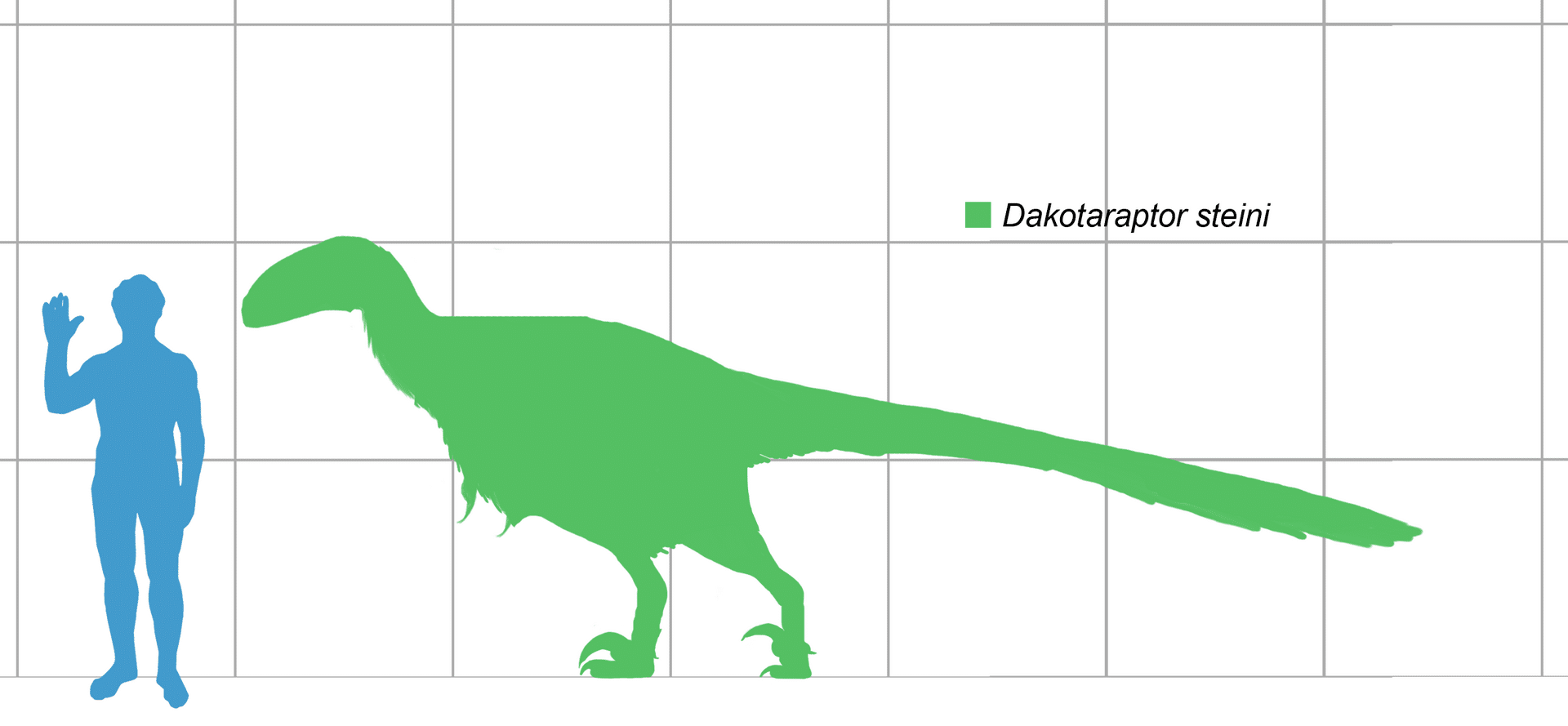

Size also varied within the quarry. A gracile tibia found about 10 meters (33 feet) from the holotype measures 48.5 centimeters, yet growth lines suggest both animals were adults of similar age. An even smaller ankle implies a tibia of about 38.4 centimeters. If the skeleton is a mix of animals, though, the length estimate would rest on more than one individual.
The Dinosaur in Detail
One of the most distinctive features of Dakotaraptor is its enlarged second toe claw—the “killing claw” of dromaeosaurids. It measures 16 centimeters (6.3 inches) straight and 24 centimeters (9.4 inches) along the curve. That equals about 29 percent of femur length, against about 23 percent in Deinonychus. To the authors, a large bump for the flexor tendon suggested claw-flexing power rivaling or exceeding that of Utahraptor.
The shinbone also carries a hooked fibular crest, a ridge the authors called undocumented in any other theropod. They also judged its size and proportions almost certainly incompatible with flight. Keeping quill knobs while growing so large was, in their view, “highly suggestive” of a secondarily flightless animal—one whose ancestors flew or came close.
Its place on the family tree is debated. In 2019, a team led by Scott Hartman recovered it among the unenlagiines, a branch outside Dromaeosauridae in their tree. In 2020, Steven Jasinski and colleagues—in the paper that named Dineobellator—placed it near the base of Dromaeosaurinae. However, they also called it likely a chimera (a mix of bones from different animals) and noted that its “furcula” had proved to be turtle.
In 2024, Cau wrote that a mixed origin “cannot be dismissed.” He pointed to the multitaxon bonebed and to forelimb bones missing most of their joint ends. He also noted a tail vertebra recalling ornithomimids (ostrich-like dinosaurs), plus quill knobs and a hooked fibular crest like those of some caenagnathids (beaked oviraptorosaurs). Cau even disputed the asymmetric grooves on the killing claw, a trait the original authors call diagnostic of dromaeosaurids. Still, DePalma’s team described the holotype as a single individual in its 2016 correction. Taken together, no peer-reviewed paper we consulted declares it invalid—but what exactly it was is still an open question.
Interesting Points about Dakotaraptor
- Its name honors both the region of its discovery and the Dakota people, paired with the Latin word for “plunderer.”
- The holotype shows signs of old injuries—a rough patch of reactive bone on the ulna and healed trauma on a tail vertebra.
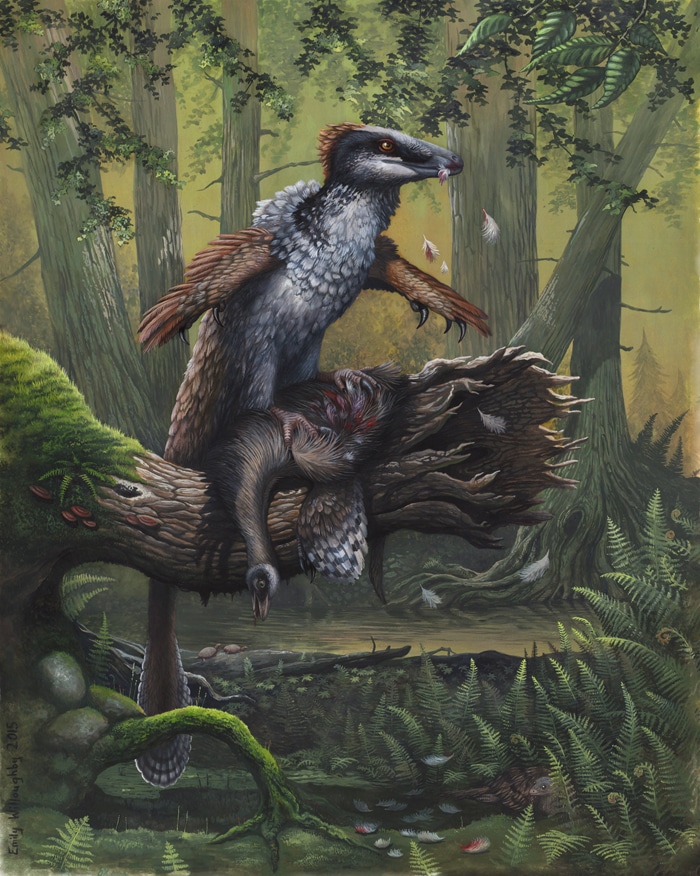
- The cover of the 2015 paper featured a life restoration by Emily Willoughby, showing Dakotaraptor with small birds and the mammal Purgatorius.
- Co-author Larry Martin died before the description was published, and the paper marks him as deceased.
Contemporary Dinosaurs
Towering over the floodplain was Tyrannosaurus, which the 2015 authors called the Hell Creek’s only other large toothed theropod. Since then, however, studies in 2024 and 2025 have argued that the smaller tyrannosaur Nanotyrannus was a separate animal living alongside it. A 2011 census of the upper Hell Creek in Montana counted five Tyrannosaurus skeletons, though it treated Nanotyrannus as young T. rex. The Paleobiology Database also lists Tyrannosaurus from Harding County. For their part, DePalma’s team called competition with “immature Tyrannosaurus rex or Nanotyrannus lancensis” conceivable.
Far more common was Triceratops, a horned ceratopsid and the most abundant dinosaur in that census. Its 22 skeletons made up 69 percent of those from the upper unit, and it appears in the database’s Harding County records too. As an adult megaherbivore (a very large plant-eater), though, it probably exceeded the prey size the describers proposed for Dakotaraptor.
Sharing the same lowlands was Edmontosaurus, a duck-billed hadrosaurid herbivore. The 2011 census recorded five of its skeletons in the upper Hell Creek, and the database lists it from Harding County too.
Rarer still was Pachycephalosaurus, a dome-headed dinosaur whose adult skull dome is dense bone. The 2011 census found it in the upper Hell Creek only as isolated bones. The database records it from South Dakota’s Hell Creek, though not from Harding County itself. No described fossil shows Dakotaraptor interacting with any of these four.
Dakotaraptor in its Natural Habitat
Imagine an extensive floodplain crossed by meandering rivers and backwater channels. In addition, pollen from Montana’s Hell Creek adds swamps and lakes to the scene. At the quarry itself, the bones lay beside plant matter that shows almost no decay or wear.
Before Dakotaraptor, the Hell Creek seemed to hold large tyrannosaurids and small maniraptorans, with few predators in between. Its describers argued that it filled this gap, although later work treating Nanotyrannus as distinct has since narrowed it. In their view, it fed on animals larger than the prey of small maniraptorans, but probably not on adult megaherbivores such as ceratopsians and hadrosaurs. They also judged it plausible that it pinned prey with the killing claw while flapping for balance, as hawks and eagles do when restraining prey.
While there is no direct evidence of its social life, DePalma’s team raised the possibility that it hunted in packs or family groups. They also favored differences between the sexes to explain the robust and gracile forms, though which is which remains unresolved. In addition, they proposed that the wing feathers could have served in display, territorial behavior, or shielding young. Either way, Dakotaraptor may have been one of the Hell Creek’s mid-sized hunters—if its bones belong to one animal.

Frequently Asked Questions
It means “Dakota plunderer,” honoring the region and the Dakota people, while the species name honors paleontologist Walter Stein.
It lived in the late Maastrichtian stage of the Late Cretaceous, around 66 million years ago.
Its describers estimated a length of about 18 feet (5.5 meters) from its limb bones. No peer-reviewed weight estimate that we found has been published.
It was a carnivore, and its describers suggested it took prey larger than small maniraptorans did, but probably not adult megaherbivores.
It was found in 2005 in the upper Hell Creek Formation of Harding County, South Dakota.
It was among the largest dromaeosaurids and bore quill knobs on its forearm, though some researchers suspect its skeleton mixes more than one animal.
Sources
The information in this article is based on various sources, drawing on scientific research, fossil evidence, and expert analysis. The aim is to provide a comprehensive and accurate overview of Dakotaraptor. However, please be aware that our understanding of dinosaurs and their world is constantly evolving as new discoveries are made.
- https://journals.ku.edu/paleocontributions/article/view/20303
- https://journals.ku.edu/paleocontributions/article/view/20301
- https://peerj.com/articles/1691
- https://www.nature.com/articles/s41598-020-61480-7
- https://peerj.com/articles/7247
- https://www.paleoitalia.it/wp-content/uploads/2024/05/01_Cau_2024_BSPI_631.pdf
- https://pmc.ncbi.nlm.nih.gov/articles/PMC3036655/
- https://pmc.ncbi.nlm.nih.gov/articles/PMC2762616/
- https://pmc.ncbi.nlm.nih.gov/articles/PMC13189327/
- https://paleobiodb.org/classic/basicTaxonInfo?taxon_no=331109
- https://news.ku.edu/news/article/2015/11/02/new-giant-raptor-discovered-ku-researchers-south-dakota
- https://www.nature.com/articles/s41586-025-09801-6
- https://doi.org/10.3390/fossils2010001
- https://journals.plos.org/plosone/article?id=10.1371/journal.pone.0028964
This article was last fact checked: TheDinosaurs Team, 31-10-2026
Featured Image Credit: Emily Willoughby, CC BY-SA 4.0, via Wikimedia Commons
