
North of Jilantai Salt Lake in Inner Mongolia, the Tashuikou site exposes rocks later assigned to the Ulansuhai Formation. There, in 1960, a joint team of Chinese and Soviet paleontologists collected the bones of a giant meat-eating theropod. Several later studies place Chilantaisaurus tashuikouensis, named in 1964, in the Turonian stage of the Late Cretaceous, about 92 million years ago. However, some authors put the same beds in the Early Cretaceous—a dispute that is still open.
Paleontologist Hu Show-yung described the animal as sole author, working from one individual’s arm, claw, partial hip, and legs. Its upper arm bone measures 580 millimeters (22.8 inches), which Hu wrote was longer than in any carnosaur then known. Since then, the genus has lost its second species and gained a string of rival family trees. Its story shows how much a few bones can reveal—and how much they leave open.
Chilantaisaurus Key Facts
| Keyword | Fact |
|---|---|
| Pronunciation | Not specified |
| Meaning of name | Named for the locality Chilantai (Jilantai), Inner Mongolia |
| Group | Theropoda (Tetanurae, exact clade debated) |
| Type Species | Chilantaisaurus tashuikouensis |
| Diet | Carnivore |
| When it Lived | Around 92 MYA or slightly younger (Turonian view), with an Early Cretaceous age also proposed |
| Period | Cretaceous |
| Epoch | Late Cretaceous (Turonian stage) or Early Cretaceous (Barremian to Albian stages) |
| Length | Not specified |
| Height | Not specified |
| Weight | 2.5 to 4.2 metric tons (about 2.8 to 4.6 short tons) in three estimates from two 2010 studies |
| Mobility | Not specified |
| First Discovery | 1960 by a joint Chinese and Soviet expedition |
| Described by | 1964 by Hu Show-yung |
| Holotype | Lectotype IVPP V.2884.1 (right humerus), designated by Benson & Xu 2008 (as reported) |
| Location of first find | Tashuikou, about 60 km north of Chilantai, Alashan, Inner Mongolia, China, in beds later assigned to the Ulansuhai Formation, an assignment still contested |
Chilantaisaurus Origins, Taxonomy and Timeline
Hu built the genus name on Chilantai, the locality now spelled Jilantai. His English summary gives no meaning for the species name, but the Chinese name, 大水沟吉兰泰龙, reads as “Tashuikou Chilantai dragon.” Since Tashuikou is the type locality, the epithet very likely points to that site—an editorial reading rather than Hu’s own words. Together, the name ties the animal to its Alashan home.
Hu placed Chilantaisaurus in Carnosauria—the old grouping of big meat-eaters—and in the family Megalosauridae. He kept it out of Tyrannosauridae because of its massive humerus (upper arm bone), relatively short tibia (shinbone), and short, unreduced metatarsals (upper foot bones). Later work recast it within Tetanurae, a large branch of theropods, though its exact family is unresolved. Hu’s second species, C. maortuensis, now has its own genus, so the type species, C. tashuikouensis, is the only one firmly placed here. A third name, C. zheziangensis, rests on much younger (Santonian) bones from Zhejiang. It is not generally accepted in the genus, though the Paleobiology Database still files it there.
From its features, Hu’s Chinese text judged the animal “most probably early Late Cretaceous” in age. In 2010, Brusatte and colleagues favored a Turonian age of about 92 million years, because it rests on radiometric data. Kobayashi and Lü had reported basalts beneath the formation dated 146 to 92 million years, making it younger than 92 million years. In 2001, however, Van Itterbeeck and colleagues used charophytes (fossil freshwater algae) to date the Dashuiguo strata to the Barremian to Albian stages. Their site matches Tashuikou’s location, and they assigned its beds to a separate unit, the Dashuiguo Formation. Their study never discussed Chilantaisaurus itself. Benson and Xu likewise noted that the formation has been called Aptian to possibly Albian, or Late Cretaceous. Either way, the question remains open.
Discovery & Fossil Evidence
According to Hu, the 1960 Chinese–Soviet group collected carnosaur fossils at two sites, Maortu and Tashuikou. He called the bones well preserved and listed ornithopods, sauropods, ankylosaurs, turtles, plants, and invertebrates from the same area. Hu himself named no formation for Tashuikou, though he judged the Maortu beds to be lower. Brusatte and colleagues later assigned both of Hu’s specimens to the Ulansuhai Formation. Since then, Hao and colleagues have placed Maortu in the Lower Cretaceous Miaogou Formation.
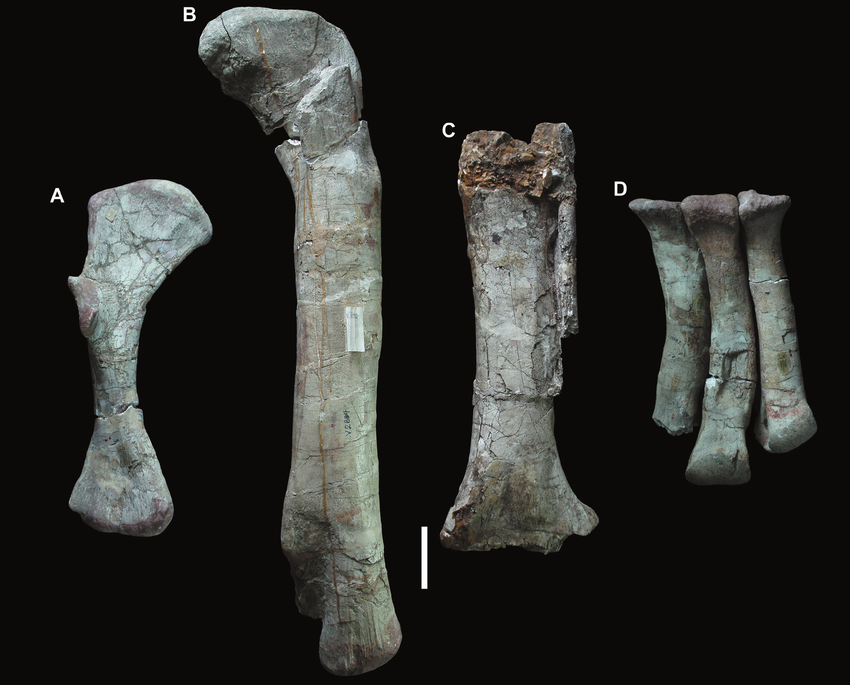
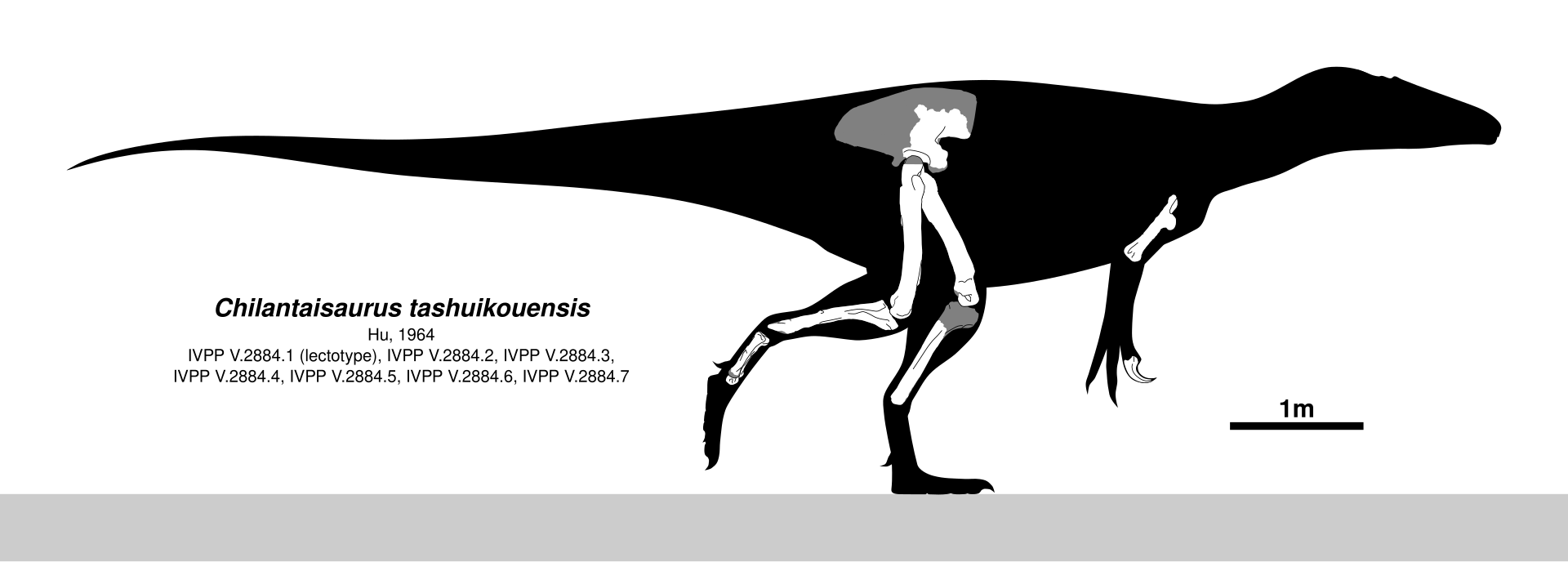
Hu listed all the Tashuikou bones under one catalog number, IVPP V.2884, at the Institute of Vertebrate Paleontology and Paleoanthropology in Beijing. Hu never used the word “holotype,” although Brusatte, Benson, and Xu called V.2884 that in a 2010 review. Earlier, Benson and Xu (2008) had reportedly restricted the name-bearing type to the humerus, V.2884.1, as a lectotype. The material includes a right humerus, the ungual (claw bone) of the first finger, and the front of the left ilium (upper hip bone). It also includes both femora (thigh bones), both tibiae, a fibula (calf bone), and five metatarsals. Hu’s text calls the fibula the right one, but one of his figure captions labels it left. Hu stated that all of it came from a single individual.

Hu also referred an isolated tooth, 45 millimeters (1.8 inches) long as preserved, and two tail vertebrae. These, he wrote, “most probably belong to the same species.” Later work splits them up. Citing Benson and Xu (2008), the Paleobiology Database now lists three indeterminate finds from Tashuikou—one sauropod, one theropod, and one dinosaur. Summaries of that study report that it reidentified the tooth as theropod, one vertebra as sauropod, and the other as dinosaur only. No additional specimens of C. tashuikouensis have been confirmed in the sources consulted here.
Chilantaisaurus Size and Description
Known only from its arm, hip, and legs, Chilantaisaurus must be pictured largely through comparison.
Short description of Chilantaisaurus
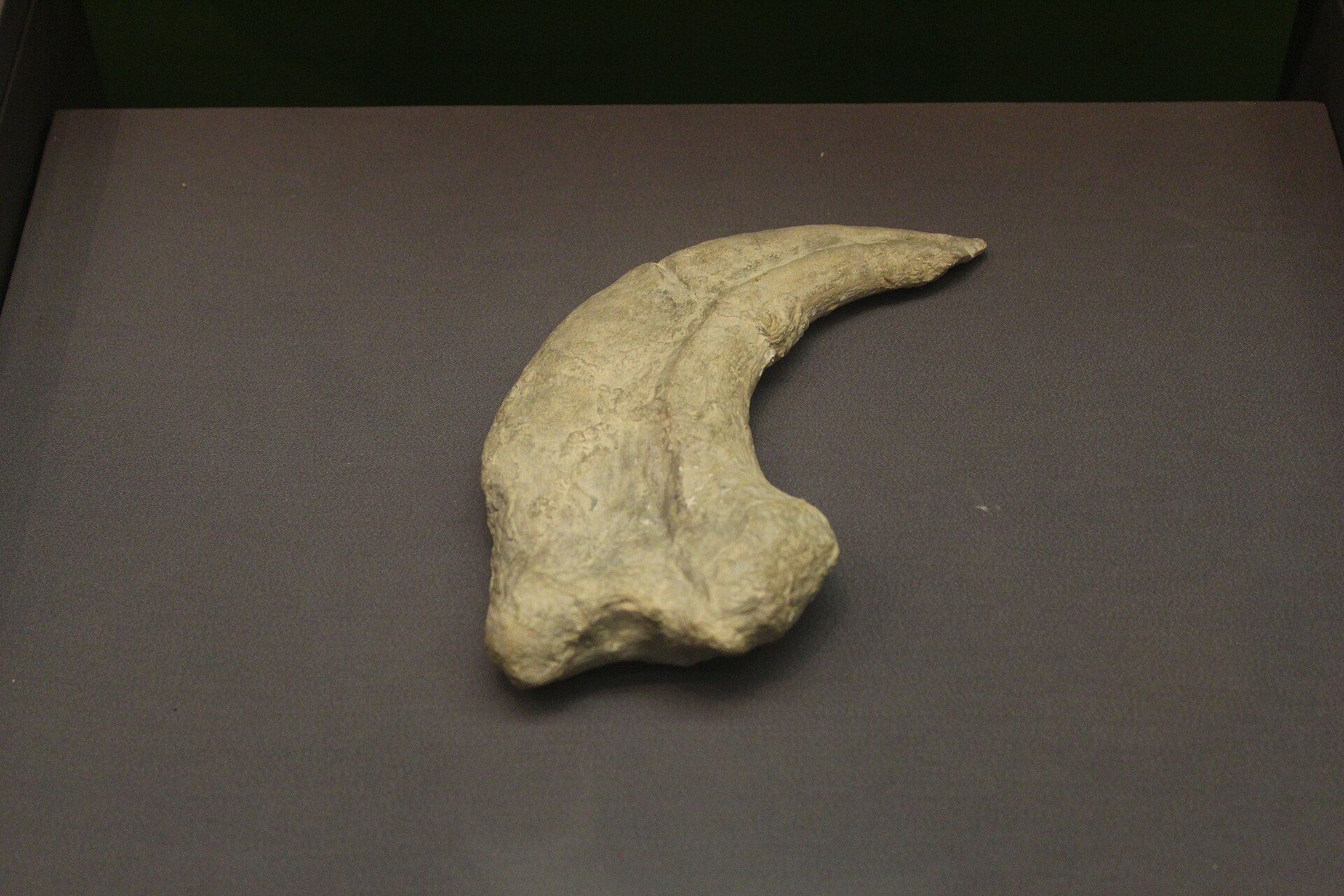
No skull, neck, or back vertebrae are known from the type specimen, so the head and body remain blank. Its humerus is long, stout, and somewhat S-shaped. About 150 millimeters (5.9 inches) below the upper end sits a strong deltoid crest—a short, high, curved plate of bone. The first-finger claw measures 260 millimeters (10.2 inches) along its upper curve. Strongly curved and sharply pointed, it carries grooves along both sides.

The leg bones are equally large. The left femur reaches 1,190 millimeters (46.9 inches), and the right tibia 954 millimeters (37.6 inches). That gives a tibia-to-femur ratio of 0.80, which Hu matched with Antrodemus, the name he used for Allosaurus. He also judged the metatarsals similar in size to those of Acrocanthosaurus. His diagnosis adds that three metatarsals were short and not compactly united. In 2013, White and colleagues called the metatarsus robustly built next to that of Australovenator. Skin and other soft tissues are not preserved, so any restoration of its body covering is speculative.
Size and Weight of Type Species
Hu gave no body length or mass in 1964, instead comparing parts and noting that the humerus is almost twice as long as that of Antrodemus. No peer-reviewed length or hip height could be verified for this article.
Later mass estimates are indirect. In 2010, Benson, Carrano, and Brusatte estimated about 5,500 pounds (2,500 kilograms). That same year, Brusatte, Benson, and Xu derived about 5,525 pounds (2,506 kilograms) from femur circumference and about 9,220 pounds (4,182 kilograms) from femur length. Combined, these estimates run from roughly 2.5 to 4.2 metric tons (2.8 to 4.6 short tons).
Brusatte’s team also called the specimen “a colossal individual.” Citing Benson and Xu, they wrote that it may have rivaled Acrocanthosaurus and Mapusaurus, “and perhaps even Tyrannosaurus.” Similarly, Zanno and Makovicky noted in 2013 that an estimated Siats femur of 1,166 millimeters approximates its 1,190.

The Dinosaur in Detail
One of the most distinctive features of Chilantaisaurus is the length of its arm compared with its leg. Hu calculated a humerus-to-femur ratio of 0.487, against 0.364 in Antrodemus, 0.297 in Albertosaurus, and only 0.25 in Tarbosaurus. Hu also observed that the ilium lacks the recurved front point of Antrodemus, Albertosaurus, and Tyrannosaurus. Decades later, Benson and Xu stressed that it lacks the allosauroid condition—a humerus under 0.4 times femur length.
Their 2008 reassessment began from a puzzle, since earlier numerical analyses had recovered it both as a derived allosauroid and as a derived spinosauroid. Benson and Xu found neotetanuran features: a preacetabular fossa (a hollow in front of the hip socket) and a wedge-shaped third metatarsal shaft. Its enlarged first hand claw recalls spinosauroids, but they judged that trait not unique to them. Hu had already found its fourth trochanter, a muscle scar on the femur, weaker than in Antrodemus. Benson and Xu suggested this may be an autapomorphy (a trait unique to one taxon) or a link to Coelurosauria. They concluded it was likely a neotetanuran but unlikely an allosauroid.
Later studies pulled it in new directions. In 2010, Benson, Carrano, and Brusatte grouped it with Neovenator, Fukuiraptor, Megaraptor, and others in a new clade, Neovenatoridae. In their semi-strict consensus, Zanno and Makovicky later recovered it as the sister taxon to all other megaraptorans, including Siats. Naish and Cau then reported in 2022 that their analysis confirmed a megaraptoran affinity, reading it as part of a “second wave” of tyrannosauroid gigantism.
In 2025, Kellermann and colleagues noted that about 90 percent of its data are missing. Their analyses placed it as the sister of Neovenator, a basal allosauroid, or a tyrannosauroid. Overall, these results paint a picture of a giant whose few bones send mixed signals.
Interesting Points about Chilantaisaurus
- Hu wrote in 1964 that its humerus was longer than that of any carnosaur known at the time.
- The second species Hu named, C. maortuensis, now forms the genus Shaochilong, a small-bodied and short-snouted carcharodontosaurid.
- Before Shaochilong received its name, Chure used the informal name “Alshansaurus” for that same Maortu material in an unpublished 2000 thesis.
- In 2010, Benson and colleagues placed it at the top of Neovenatoridae’s size range, from about 175 kilograms in Fukuiraptor to about 2,500 kilograms.
- A claw labeled as Chilantaisaurus is on display at the Tianjin Natural History Museum, though its photo record does not say whether it is a cast.
Chilantaisaurus in its Natural Habitat
The world Chilantaisaurus roamed depends on which age is right. Under the Turonian view, red mudstone and siltstone dominate its formation, along with evaporites (salt deposits left by drying water) and calcretes (hardened lime-rich soils). If its beds are Ulansuhai, the ornithomimid Sinornithomimus dongi—a lightly built “bird mimic” theropod—is a possible neighbor. In 2003, Kobayashi and Lü described it from a bonebed of at least 14 skeletons—later digs raised the total past 20. However, that site lies roughly 200 kilometers (125 miles) northwest of Tashuikou, and no source places the two at the same level. Around that site, caliche horizons, evaporites, and gilgai soil structures suggest an arid to semi-arid climate.
In the Early Cretaceous view, the picture changes. Van Itterbeeck and colleagues reconstructed the Dashuiguo area as an alluvial plain crossed by rivers from the Hanwulan Shan mountains, under a subhumid climate with seasonal dry periods. There, the team excavated a large bone bed of the iguanodontian Probactrosaurus—a plant-eater they pictured grazing the floodplain. Still, no study ties that bone bed to the same layer as Chilantaisaurus.
Benson and colleagues placed Chilantaisaurus in a clade of “large-bodied predatory dinosaurs.” Its big hand claw fits that role, though no study has tested how it was used. While there is no direct evidence of its prey, Hu’s collecting area did produce ornithopods, sauropods, and ankylosaurs—though his list covers Maortu and Tashuikou together. In 2010, Brusatte’s team read its size gap with Shaochilong as a sign that carcharodontosaurians filled a variety of body sizes and niches. That idea assumes the two lived at the same time, which the reassignment of Maortu now calls into question. With only one individual known, its social life remains a blank.
Frequently Asked Questions
Hu named it after Chilantai, now spelled Jilantai, in Inner Mongolia, and its Chinese name reads “Tashuikou Chilantai dragon.”
Several later studies place it in the Turonian stage of the Late Cretaceous, around 92 million years ago or slightly later. Other authors favor an Early Cretaceous age instead.
Two 2010 studies estimated its weight at about 2.5 to 4.2 metric tons (2,500 to 4,182 kilograms), but no verified length exists.
It was a carnivore, and researchers place it among large-bodied predatory theropods.
It was found in 1960 at Tashuikou, about 60 kilometers north of Jilantai in the Alashan region of Inner Mongolia, China.
Its humerus is nearly half the length of its femur, a higher ratio than Hu found in Antrodemus (Allosaurus), Albertosaurus, or Tarbosaurus.
Sources
The information in this article is based on various sources, drawing on scientific research, fossil evidence, and expert analysis. The aim is to provide a comprehensive and accurate overview of Chilantaisaurus. However, please be aware that our understanding of dinosaurs and their world is constantly evolving as new discoveries are made.
- https://ivpp.cas.cn/cbw/gjzdwxb/xbwzxz/200912/P020091230393410738156.pdf
- https://doi.org/10.1017/S0016756808005475
- https://core.ac.uk/download/28970861.pdf
- https://revistas.ucm.es/index.php/JIGE/article/view/JIGE1010220275A
- https://doi.org/10.1007/s00114-009-0614-x
- https://doi.org/10.1007/s00114-009-0565-2
- https://www.nature.com/articles/ncomms3827
- https://doi.org/10.1371/journal.pone.0068649
- https://pmc.ncbi.nlm.nih.gov/articles/PMC9271276/
- https://doi.org/10.1371/journal.pone.0311096
- https://www.app.pan.pl/archive/published/app48/app48-235.pdf
- https://www.app.pan.pl/archive/published/app53/APP53-567.pdf
- https://biblio.naturalsciences.be/rbins-publications/bulletin-of-the-royal-belgian-institute-of-natural-sciences-earth-sciences/71-sup-2001/irscnb_p4087_01ec08x_71-sup_bulletin-3.pdf
- https://doi.org/10.1016/j.cretres.2024.106023
- https://paleobiodb.org/classic/basicCollectionSearch?collection_no=66925
- https://paleobiodb.org/classic/basicCollectionSearch?collection_no=58445
This article was last fact checked: TheDinosaurs Team, 05-11-2026
Featured Image Credit: TKWTH, CC BY-SA 4.0, via Wikimedia Commons
