
At Bajo de Santa Rosa in Argentina’s Río Negro Province, the Late Cretaceous Allen Formation preserves a predator its describers called bizarre. Named Austroraptor cabazai, it lived roughly 70 million years ago, near the very end of the age of dinosaurs. At about 16.4 feet (5 meters) long, it was the largest dromaeosaurid—a member of the predatory theropod family Dromaeosauridae—then known from the Southern Hemisphere. Its skull was long and low, its teeth small and conical, and its arms surprisingly short.
According to Argentina’s research council CONICET, paleontologist Fernando Novas found the skeleton in 2002 during a joint campaign with the Lamarque municipal museum. Six years later, in 2008, his team presented it at the Museo Argentino de Ciencias Naturales. The formal description by Novas and four colleagues appeared online in December 2008, followed by the printed issue in 2009. During the 2008 field season, a second, slightly smaller skeleton turned up in the same area. In time, its study would revise parts of the original portrait.
Austroraptor Key Facts
| Keyword | Fact |
|---|---|
| Pronunciation | Not specified |
| Meaning of name | Southern Thief |
| Group | Theropoda |
| Type Species | Austroraptor cabazai |
| Diet | Carnivore |
| When it Lived | About 72 to 66 MYA (Paleobiology Database range) |
| Period | Cretaceous |
| Epoch | Late Cretaceous (Campanian to Maastrichtian stages) |
| Length | 16.4 feet |
| Height | Not specified |
| Weight | 811 to 1,144 pounds |
| Mobility | Moved on two legs (bipedal) |
| First Discovery | 2002 by Fernando E. Novas |
| Described by | 2008 (online, printed 2009) by F.E. Novas, D. Pol, J.I. Canale, J.D. Porfiri, and J.O. Calvo |
| Holotype | MML-195 |
| Location of first find | Bajo de Santa Rosa, Allen Formation, Río Negro Province, Argentina |
Austroraptor Origins, Taxonomy and Timeline
The name Austroraptor joins two parts—”austral” refers to southern South America, while “raptor” means “thief.” The species name cabazai honors the late Héctor Cabaza, founder of the Museo Municipal de Lamarque. Together, the name ties a southern thief to the small-town museum that helped bring it to light.
In their original description, Novas and colleagues placed Austroraptor within the theropods—the bipedal predators among dinosaurs. From there they narrowed it to Coelurosauria, Deinonychosauria, and Dromaeosauridae, and finally to the subfamily Unenlagiinae. In their analysis, it sat “deeply internested” within the dromaeosaurids. Adding it also recovered Unenlagiinae as a natural group uniting Unenlagia, Neuquenraptor, Buitreraptor, and the Malagasy Rahonavis—though Rahonavis‘s place in the group has since been questioned. Its unenlagiine hallmarks include shortened side processes on the back vertebrae and a third metatarsal (foot bone) pinched at its upper end. Austroraptor cabazai is the type and only known species.
Novas and colleagues assigned the Allen Formation to the Campanian and Maastrichtian stages of the Late Cretaceous. Later, in 2012, paleontologists Philip Currie and Ariana Paulina Carabajal gave its age as Maastrichtian. The Paleobiology Database lists the fossils as early Maastrichtian, with a default range of about 72.2 to 66 million years ago. Already in 2008, the describers counted it as the youngest dromaeosaurid record from Gondwana, the southern supercontinent. In 2024, Porfiri and colleagues likewise described it as stratigraphically younger and larger-bodied than Unenlagia.
Discovery & Fossil Evidence
The holotype comes from Bajo de Santa Rosa, approximately 56 miles (90 kilometers) southwest of the town of Lamarque. The Paleobiology Database assigns the site to the lower member of the Allen Formation. CONICET dates the find to 2002, and the newspaper Página/12 reported that Novas announced it to his team that December. The National Geographic Society and CONICET were among the sponsors of the study.
Cataloged as MML-195, the holotype belongs to the Museo Municipal de Lamarque. Its skull material includes a frontal and a postorbital (bones of the skull roof and eye socket), both lacrimals, and the maxillae (upper tooth-bearing bones). It also preserves the dentaries (lower jaw bones) with teeth, plus two bones from the back of the lower jaw. Behind the head came five neck vertebrae, two back vertebrae, ribs, gastralia (belly ribs), a right humerus (upper arm bone), and a single hand claw. From the hips comes part of the left pubis. The legs include the left femur (thigh bone), right tibia (shin bone), ankle bones, third metatarsal, and four toe bones.
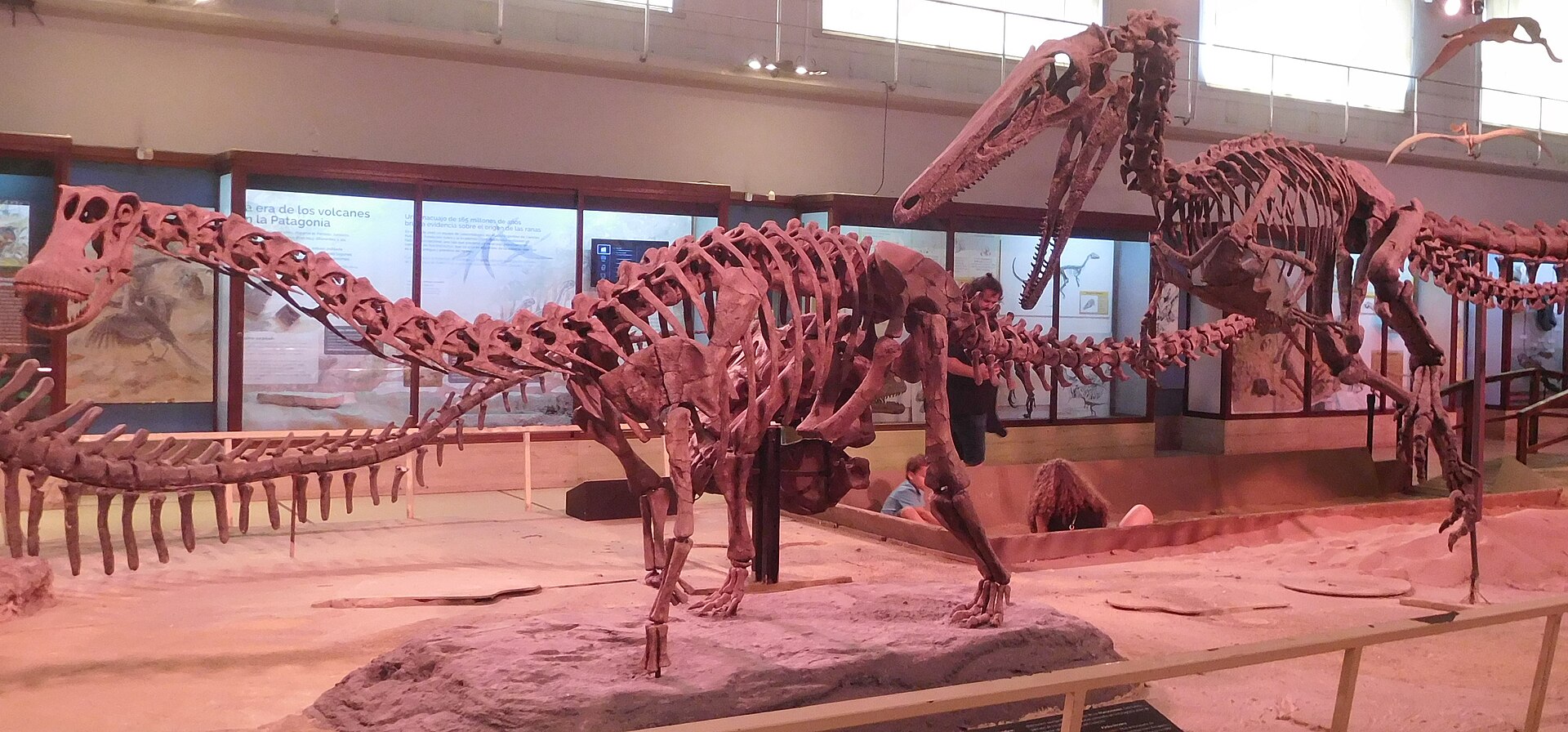

During the 2008 field season, A. Rasmuson of Calgary found a second skeleton on a joint expedition of Argentine and Canadian institutions. Cataloged as MML 220, it was identified by its humerus, third metatarsal, and a fourth-toe bone. The new specimen added forearm bones, hand bones, a back vertebra, and 12 tail centra (vertebral bodies). Both skeletons came from the same ground—the same geographic area and the same stratigraphic levels.
Austroraptor Size and Description
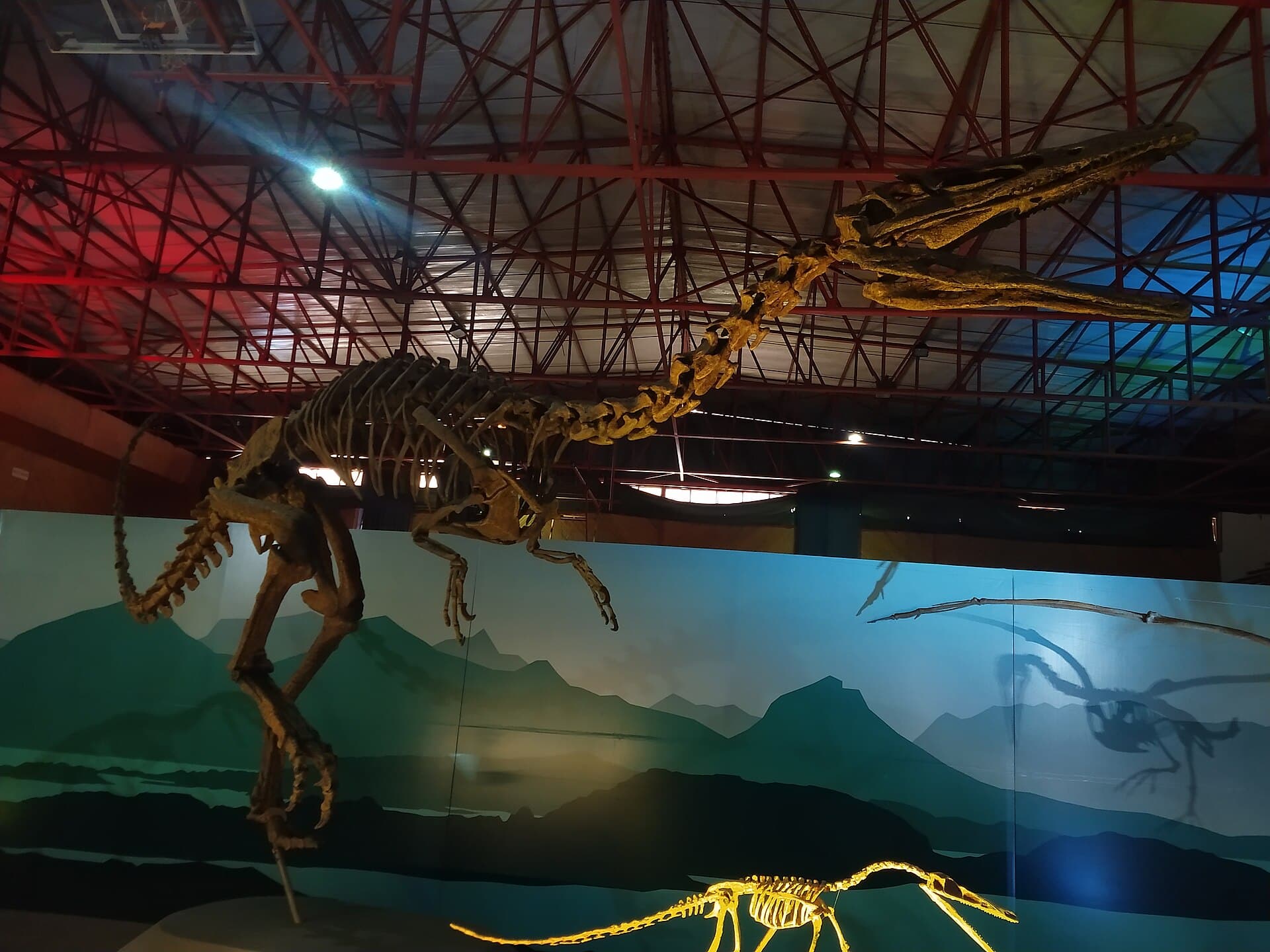
Austroraptor paired a long, low head with short arms and long feet—an unusual build for its family.
Short description of Austroraptor
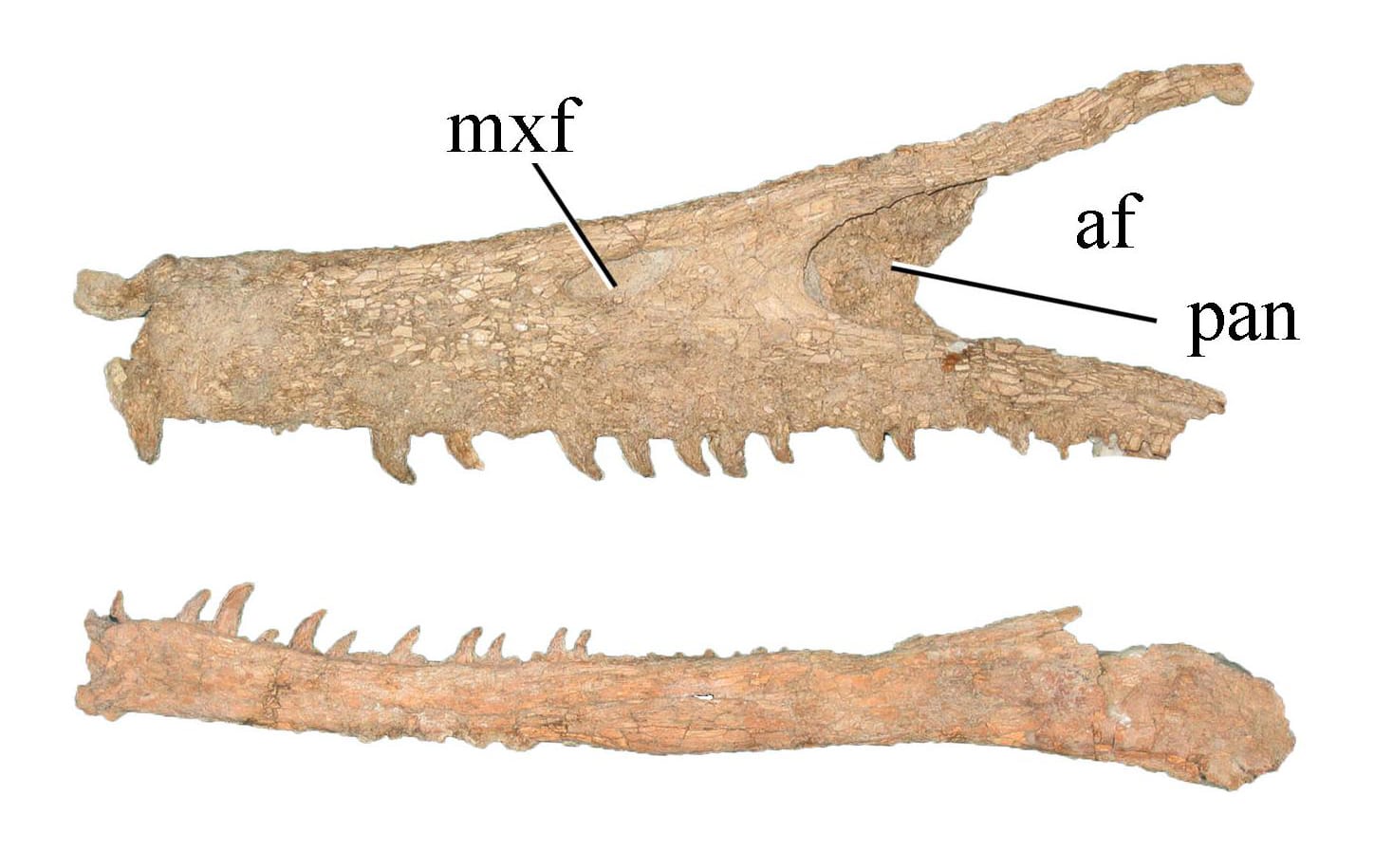
The skull was extremely long and low—roughly 31.5 inches (80 centimeters) as reconstructed. Its maxilla was shallow, with a depth only 21 percent of its length, against at least 30 percent in most Laurasian (northern) dromaeosaurids. Along a straight edge, the upper jaw held 24 teeth, while the lower jaw had 25 tooth positions. Each tooth was small, conical, and hooked, lacking both cutting edges and serrations.
Farther back, the rear neck vertebrae were short and lacked a neural spine (the bony blade on top). The humerus was short and robust, at slightly less than half the length of the femur. The third hand claw was small but strongly curved, more so than in other dromaeosaurids. Although the metatarsals are incomplete, a 2020 study estimated them as very elongated relative to the tibia and femur. As in other deinonychosaurs, its describers noted, the second toe was modified for hyperextension—bending sharply upward.

Size and Weight of Type Species
Novas and colleagues estimated that Austroraptor reached approximately 16.4 feet (5 meters) in length. That figure is indirect—their table gives 494.3 centimeters, calculated from a body-length equation for paravians (birds and their closest dinosaur relatives). None of the sources consulted gives a height at the hips.
Body mass also comes from equations rather than any direct measure. In 2008, the describers used the method of Christiansen and Fariña to reach 368 kilograms (about 811 pounds). Six years later, Benson and colleagues calculated about 519 kilograms (about 1,144 pounds), though they noted that thigh-bone circumference was estimated. In short, the two peer-reviewed estimates are about 811 and 1,144 pounds.
The describers judged it more than 1.5 times the size of Unenlagia. Moreover, they compared it with Achillobator and Utahraptor, concluding that it reached a similar size independently. The second specimen was an adult only slightly smaller than the holotype.
The Dinosaur in Detail
What sets this dinosaur apart is its lacrimal, a bone at the front of the eye socket. Its rear process flared into a fan that helped roof the orbit—”a bizarre condition yet unrecorded in other theropod dinosaurs,” in the describers’ words. The lacrimal was also highly pneumatized (hollowed by air spaces), while the postorbital lacked a process seen in Laurasian dromaeosaurids. Both traits belong to the species’ diagnosis.
The jaws tell a similar story. Like those of Buitreraptor, its teeth lacked cutting edges and serrations, yet their fluted enamel resembled that of spinosaurid theropods. Moreover, its upper jaw had one large, elliptical maxillary fenestra (an opening), whereas most Laurasian forms have two. When described, Austroraptor and Buitreraptor were the only unenlagiines preserving skull material.

The foot has a revision history of its own. Novas and colleagues originally described a robust toe bone, labeled IV-2, as twice the width of II-2—”a marked asymmetry in foot construction.” However, Currie and Paulina Carabajal (2012) suggested it is more likely IV-1, with a shape unique to both specimens. They also found the forearm proportions similar to those of other dromaeosaurids, so it was the humerus that was short. In addition, the second specimen’s foot seems to be arctometatarsalian, with the middle metatarsal pinched near the ankle.
Its wider family ties remain debated. In 2011, Agnolín and Novas placed unenlagiids outside Deinonychosauria, uniting them with birds in the group Avialae. In 2019, Agnolín and colleagues again rejected a dromaeosaurid placement, putting unenlagiids just outside Avialae (the bird lineage). By contrast, Gianechini and Apesteguía treated unenlagiines as South American dromaeosaurids in 2011, a position Gianechini’s team kept in 2020. In 2021, Brum and colleagues proposed Ypupiara as its sister taxon (closest relative), based on tooth proportions. Taken together, its place among birds’ closest relatives remains open.
Interesting Points about Austroraptor
- Its name means “southern thief,” and the species honors Héctor Cabaza, founder of the Museo Municipal de Lamarque.
- When described, it was the largest dromaeosaurid yet discovered in the Southern Hemisphere and the youngest dromaeosaurid record from Gondwana.
- Its describers noted that its fan-shaped lacrimal, which helped roof the eye socket, had not been recorded in any other theropod.
- Its humerus measured about 10.3 inches (26.2 centimeters), less than half the estimated 22-inch (56-centimeter) length of its femur.
- A second specimen found in 2008 helped researchers suggest that a toe bone first labeled IV-2 is more likely IV-1.
Contemporary Dinosaurs
Sharing the very same locality was Bonatitan reigi, a small saltasaurine titanosaurid—part of a group of long-necked plant-eaters. Its describers placed the Bajo de Santa Rosa beds in the Campanian–Maastrichtian Allen Formation. In fact, the Paleobiology Database lists it in the same fossil collection as the Austroraptor holotype. No interaction between the two is documented, so they are best pictured as neighbors.
Also from the Allen Formation came Bonapartesaurus rionegrensis, a hadrosaurid (duck-billed dinosaur) of the tribe Saurolophini from the Salitral Moreno site. It dates to the late Campanian to early Maastrichtian. Its describers tentatively correlate its beds with the formation’s lower member—the same member that yielded Austroraptor. Even so, no interaction between the two is documented.
Austroraptor in its Natural Habitat
The world Austroraptor roamed was varied—the Allen Formation records lakes, dunes, and rivers as well as coasts with estuaries and tidal flats. Its rock types are associated with semiarid conditions. Notably, the formation also records the first Atlantic ingression (incursion of the sea) into the Neuquén Basin. At Bajo de Santa Rosa, the fauna was mainly terrestrial and freshwater, yet elasmosaurid plesiosaurs (long-necked marine reptiles) reveal a marine influence. Alongside theropods, the formation’s dinosaurs included hadrosaurids, nodosaurids, and titanosaurs.
Austroraptor was a carnivore. In 2020, Gianechini and colleagues suggested that it preyed on larger animals, making use of well-developed running ability. Its conical teeth, they added, were probably more resistant and suited to seizing and dismembering large prey. However, it probably did not use its short arms to manipulate prey, at least not in the way Buitreraptor did, according to the same study.
While there is no direct evidence of how Austroraptor lived day to day, it may have been a ground-dwelling hunter. Gianechini’s team found tree-climbing difficult to envision for large unenlagiines such as Austroraptor. Its describers, in turn, saw unenlagiines as morphologically and ecologically more diverse than previously thought. In their view, it shared the large-predator role with abelisaurids.
Frequently Asked Questions
It means “southern thief,” and the species name cabazai honors museum founder Héctor Cabaza.
It lived in the Late Cretaceous, placed by the Paleobiology Database between 72.2 and 66 million years ago.
It was about 16.4 feet long, and two equation-based estimates put its weight at about 811 and 1,144 pounds.
It was a theropod originally classified as an unenlagiine dromaeosaurid, though some researchers place unenlagiids closer to birds.
Its fossils come from the Allen Formation at Bajo de Santa Rosa, in Río Negro Province, Argentina.
It had a long, low skull, a fan-shaped lacrimal that helped roof the eye socket, and an unusually short humerus.
Sources
The information in this article is based on various sources, drawing on scientific research, fossil evidence, and expert analysis. The aim is to provide a comprehensive and accurate overview of Austroraptor. However, please be aware that our understanding of dinosaurs and their world is constantly evolving as new discoveries are made.
- https://doi.org/10.1098/rspb.2008.1554
- https://pmc.ncbi.nlm.nih.gov/articles/PMC2679073/
- https://ameghiniana.org.ar/index.php/ameghiniana/article/view/574
- https://pubmed.ncbi.nlm.nih.gov/21437379/
- https://pubmed.ncbi.nlm.nih.gov/21437380/
- https://doi.org/10.3389/feart.2018.00252
- https://pmc.ncbi.nlm.nih.gov/articles/PMC7163733/
- https://doi.org/10.1371/journal.pbio.1001853.s011
- https://bv.fapesp.br/en/publicacao/197646/a-new-unenlagiine-theropoda-dromaeosauridae-from-the-uppe
- https://pubmed.ncbi.nlm.nih.gov/38872101/
- https://revista.macn.gob.ar/index.php/RevMus/article/view/88
- https://doi.org/10.1080/02724634.2017.1289381
- https://andeangeology.cl/index.php/revista1/article/view/V42n1-a06/html
- https://paleobiodb.org/data1.2/occs/list.json?base_name=Austroraptor&show=loc,strat,ref,coll&vocab=pbdb
- https://www.conicet.gov.ar/?p=3790
- https://www.pagina12.com.ar/diario/sociedad/3-116947-2008-12-18.html
This article was last fact checked: TheDinosaurs Team, 31-10-2026
Featured Image Credit: Fred Wierum, CC BY-SA 4.0, via Wikimedia Commons
