On the northwestern margin of Romania’s Hațeg Basin lies the Densuș-Ciula Formation, a unit built partly from volcanic debris. Its rocks preserve a giant that does not fit the local pattern. Named Uriash kadici in 2025, it was a titanosaur from the early Maastrichtian stage of the Late Cretaceous. Hațeg is better known for the small titanosaurs of an ancient island. In contrast, Uriash is the largest titanosaur known from the basin, with an estimated weight of 5 to 8 metric tons.
Its bones are not new. Ottokár Kadić, a geologist of the Royal Geological Survey of Hungary, collected them near the village of Vălioara in the 1910s. For decades afterward, researchers filed the pieces under other names, chiefly Magyarosaurus. Then, in 2025, paleontologist Verónica Díez Díaz and three colleagues showed that they belong to a distinct animal unlike the other Hațeg titanosaurs. Its size now challenges a simple story of island dwarfing among Hațeg’s sauropods.
Uriash Key Facts
| Keyword | Fact |
|---|---|
| Pronunciation | “uriash” (as given by the describers for the Romanian uriaș) |
| Meaning of name | Giant (from the Romanian uriaș) |
| Group | Sauropoda (Titanosauria, Lithostrotia) |
| Type Species | Uriash kadici |
| Diet | Herbivore |
| When it Lived | Early Maastrichtian (the Maastrichtian spans about 72.2 to 66.0 MYA) |
| Period | Cretaceous |
| Epoch | Late Cretaceous (Maastrichtian stage) |
| Length | About 29.0 to 38.9 feet (8.83 to 11.87 meters), estimated |
| Height | Not specified |
| Weight | About 11,000 to 17,600 pounds (5 to 8 metric tons), estimated |
| Mobility | Not specified |
| First Discovery | 1910s by Ottokár Kadić (registered 1914) |
| Described by | 2025 by V. Díez Díaz, P.D. Mannion, Z. Csiki-Sava, and P. Upchurch |
| Holotype | “Individual C”: SZTFH Ob.3090B, D, G, H, Ob.3104, Ob.3103, and Ob.3095 |
| Location of first find | Kadić’s Locality VI, Budurone ravine, near Vălioara, Densuș-Ciula Formation, Hațeg Basin, Hunedoara County, Romania |
Uriash Origins, Taxonomy and Timeline
The genus name comes from the Romanian word uriaș (“giant”), pronounced “uriash.” In Romanian folklore, the word refers to gigantic humanoid fairy-tale characters, and more broadly to something or someone colossal. The choice alludes to the animal’s large size. Meanwhile, the species name kadici honors Ottokár Kadić (1876–1957), the geologist and paleontologist who discovered the type locality. Together, the name pairs a giant of legend with the man who first dug up its bones.
Uriash is a sauropod within Titanosauria and, more narrowly, Lithostrotia—a subgroup of titanosaurs. Uriash kadici is the type and only known species. Its describers left it out of their phylogenetic analysis—a computer-based family-tree study of 152 taxa and 570 characters. The bones could fill in only about 1 percent of those characters. Even so, the authors note evidence that it was not closely related to the other Hațeg titanosaurs.
The type stratum lies in the lower part of the middle member of the Densuș-Ciula Formation. Once thought late Maastrichtian, these beds now fall in the early Maastrichtian. The description gives no numeric age, but the Maastrichtian as a whole ran from roughly 72.2 to 66.0 million years ago—the final stretch of the Cretaceous. At that time, Hațeg formed an island in the Late Cretaceous European Archipelago, and no titanosaur remains are known there from before the Maastrichtian. The describers therefore suggest that four titanosaur lineages arrived in separate dispersals after the stage began—Uriash probably among them.
Discovery & Fossil Evidence
Kadić found several fossil sites in the northwestern Hațeg Basin between 1909 and 1915, among them Locality VI near Vălioara. In his 1916 report, he described the site as a “nest” in “fine-grained bluish loose sandstones.” It yielded black bones, including thick limb fragments and “exquisitely preserved large vertebrae.” Registry notes from 1914 already linked the bones, calling the humerus part of “the same (gigantic) individual” as the femora. However, the paleontologist Huene did not know they came from one skeleton when he described two of the tail vertebrae in 1932. He identified them as Magyarosaurus and, because of their size, tentatively linked at least one to ?Magyarosaurus hungaricus.
The holotype, “Individual C,” is a partial skeleton in the SZTFH collection in Budapest. It includes four rear caudal vertebrae (tail bones), SZTFH Ob.3090B, D, G, and H. Alongside them are an incomplete right humerus (upper arm bone), an incomplete right femur (thigh bone), and a scrap of the left femur. Finally, the left metatarsal I (the foot bone of the innermost toe) completes the set. Kadić collected eight tail vertebrae, but researchers could locate only four in 2003.
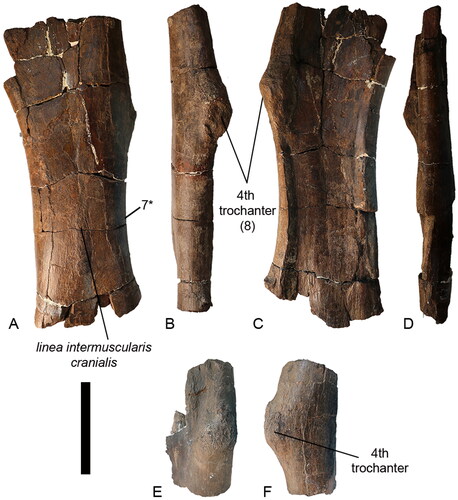

The humerus had its own odyssey. In 1938, the registry listed it as lost, and a large part of it later resurfaced under a new number. In 2003, Zoltán Csiki-Sava matched and rejoined the pieces, and a last fragment followed in 2004. Later, in 2006, Csiki and Grigorescu first recognized Individual C as one associated skeleton. Then, in 2021, Botfalvai and colleagues relocated the approximate position of Locality VI. Their rare-earth analysis of two tail bones and the right femur found a “remarkable similarity”—support for a single site of origin. No additional specimens of Uriash have been confirmed outside this locality.
Uriash Size and Description
Only a handful of bones survive, yet they set Uriash apart from the other named Hațeg titanosaurs.
Short description of Uriash
No skull, neck, or back vertebrae are known, so much of the animal remains a blank. By contrast, the tail is better represented, and its rear vertebrae changed shape substantially along their length. The two foremost survivors are strongly procoelous—concave in front and convex behind—with an hourglass outline from below. According to the describers, that combination appears in no other titanosaur. Farther back, the vertebrae become spool-like.
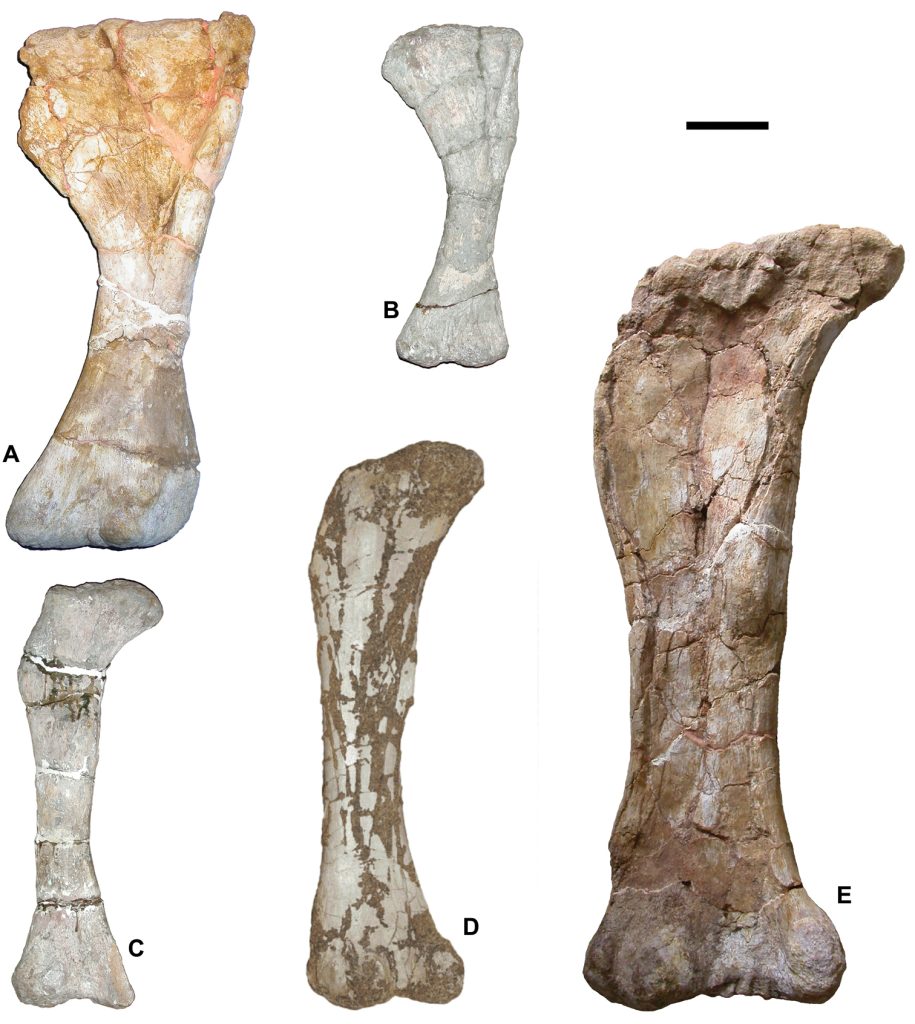
Compared with most other Transylvanian titanosaur remains, the humerus is very large, with a robust shaft. A bulge for the latissimus dorsi, a back muscle anchored on the upper arm, is visible from both the inner and outer sides. On the femur, the fourth trochanter—a crest for the big tail-to-thigh muscles—is extremely well developed. Finally, the metatarsal is nearly complete, with a D-shaped upper end.
The description does not discuss its stance or gait, and no soft tissue survives.
Size and Weight of Type Species
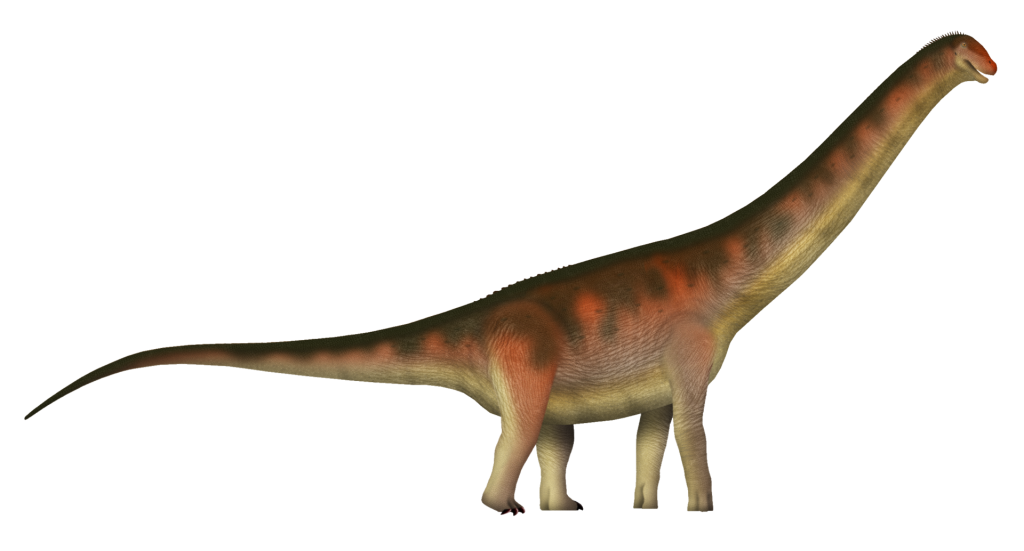
Díez Díaz and colleagues estimated a length of about 29.0 to 38.9 feet (8.83 to 11.87 meters). They also put its weight at about 11,000 to 17,600 pounds (5 to 8 metric tons). Elsewhere in the paper, they describe it as close to 12 meters long. These indirect estimates rest on limb-bone measurements, chiefly the combined circumferences of the humerus and femur.
The description gives no hip height. Even so, the femur conveys the scale—its preserved part suggests an original length of more than 1 meter (about 3.3 feet). That is about twice the size of the next largest Transylvanian femur, which belongs to Magyarosaurus. Since the bone is incomplete and crushed, that figure is an estimate too.
By the same methods, Magyarosaurus dacus weighed only 660 to 972 kilograms (about 1,455 to 2,143 pounds), so Uriash was an order of magnitude heavier. The authors suggest it may have matched the size of Epachthosaurus, which Benson and colleagues estimated at 10.5 metric tons. According to the describers, only Abditosaurus was larger among Late Cretaceous European titanosaurs. In 2022, Vila and colleagues estimated it at 14 metric tons and 17.5 meters.

The Dinosaur in Detail
What sets this dinosaur apart is a set of eight autapomorphies—distinguishing traits that define a species—spread across its few bones. Four are strict autapomorphies, including front-to-back lengthened bases of the neural arches (the bony arches over the spinal cord) in the rear tail vertebrae. Another is a femoral shaft that starts to widen close to midlength. The authors call the remaining four “local” autapomorphies, among them the hourglass tail vertebrae and the bulging muscle scar on the humerus. Although the material is scarce and poorly preserved, it all comes from one individual, so the describers judged a new name justified.
One trait hints at distant kin—the upper half of the humerus carries an “anteromedial arm.” This crest is otherwise known only in lithostrotians from Gondwana, the southern supercontinent, such as Paralititan, Argyrosaurus, and Rukwatitan. The describers treat this as “tentative support” that Uriash belongs to a distinct lineage. More broadly, they argue that Europe’s latest Cretaceous titanosaurs belonged to Gondwanan lineages that invaded during the Barremian to Albian stages.

The bones were not always read this way—in 2005, Le Loeuff referred the big humerus to Magyarosaurus dacus. He took it as evidence that the species was no dwarf and that its small specimens were juveniles. However, Díez Díaz and colleagues disagree, since Individual C shares none of the unique traits of Magyarosaurus, Petrustitan, or Paludititan. Nor, they add, can its size reflect a more mature individual of those taxa. Bone histology adds a twist—the humerus, sampled by Stein and colleagues in 2010, shows an earlier growth stage than sampled Magyarosaurus bones.
Taken together, these clues sketch a large titanosaur that probably reached Hațeg Island by its own route. As of 2026, no later study has revised the genus.
Interesting Points about Uriash
- The name Uriash comes from the Romanian uriaș, a word for the gigantic humanoid characters of Romanian fairy tales.
- With an estimated weight of 5 to 8 metric tons, Uriash is the largest titanosaur known from the Hațeg Basin.
- Its bones were collected over a century ago, but they sat under other names until the 2025 description.
- Two of its tail vertebrae went to Huene in Tübingen in 1927, and he later described them without knowing they came from one skeleton.
Contemporary Dinosaurs
Sharing the same early Maastrichtian member was the dwarf titanosaur Magyarosaurus. Its specimens come from the lowermost part of that member, while Uriash comes from marginally younger beds. Even so, the describers call the two “approximately sympatric”—living in the same area—and near-contemporary members of the same early Maastrichtian faunas. Elsewhere, though, they note that the named Hațeg titanosaurs had largely nonoverlapping ranges in space or time. No direct interaction is recorded, though the authors suggest in general that competition from small titanosaurs may have kept larger ones from shrinking.
Also known from the Densuș-Ciula Formation (exact level relative to Uriash not known): the hadrosauroid Telmatosaurus, the plant-eater Zalmoxes, and Kryptohadros, a hadrosauroid named in 2026. The formation’s fossil beds range from the early into the late Maastrichtian, so these animals may not all have lived at the same time.
Uriash in its Natural Habitat
The world Uriash roamed was the floodplain of an island. Around Vălioara, rivers laid down the middle member on a distal alluvial fan (the outer edge of a fan of river-borne sediment). Poorly to moderately drained floodplains, ponds, and abandoned channels spread across it. Meanwhile, Hațeg Island itself probably grew in land area through the Maastrichtian. The Vălioara fauna also included the turtle Kallokibotion, crocodyliforms such as Allodaposuchus and Acynodon, theropods, ankylosaur teeth, and mammals.
With no skull or teeth preserved, its exact diet is unknown, although titanosaurs as a group were megaherbivores—very large plant-eaters.
Its place in the island ecosystem is debated. Of the earlier scenarios, the describers judge a growing island that made room for large latecomers the soundest, and they dismiss the idea of stray animals or washed-up carcasses. Because small and large titanosaurs coexisted, however, they doubt that added land area was the main driver. Instead, they conclude that one or both of two new explanations of their own are more likely. One is that competition from smaller plant-eaters kept large titanosaurs from shrinking. The other is that the small Hațeg species descend from ancestors already dwarfed before reaching the island. In 2022, Vila and colleagues proposed that larger titanosaurs replaced dwarfs in a turnover. In contrast, Díez Díaz’s team sees no such size-related turnover in Transylvania. Later, in younger beds of late early to early late Maastrichtian age, Paludititan appears to replace both Uriash and Magyarosaurus.
Frequently Asked Questions
It comes from the Romanian uriaș, meaning “giant,” and the species name honors geologist Ottokár Kadić.
It lived in the early part of the Maastrichtian stage (about 72.2 to 66.0 million years ago) of the Late Cretaceous.
Indirect estimates give a length of about 29.0 to 38.9 feet and a weight of about 11,000 to 17,600 pounds.
It was a lithostrotian titanosaur, a herbivorous sauropod, and the largest titanosaur known from Romania’s Hațeg Basin.
Its bones come from Kadić’s Locality VI in the Densuș-Ciula Formation, near Vălioara in Romania’s Hațeg Basin.
Its few bones carry eight diagnostic traits, including strongly procoelous, hourglass-shaped tail vertebrae—a combination unknown in any other titanosaur.
Sources
The information in this article is based on various sources, drawing on scientific research, fossil evidence, and expert analysis. The aim is to provide a comprehensive and accurate overview of Uriash. However, please be aware that our understanding of dinosaurs and their world is constantly evolving as new discoveries are made.
- https://doi.org/10.1080/14772019.2024.2441516
- https://discovery.ucl.ac.uk/id/eprint/10200130/3/Mannion_MS%20Transylvanian%20titanos_accepted.pdf
- https://doi.org/10.1016/j.cretres.2021.104781
- https://link.springer.com/content/pdf/10.1007/s12549-025-00661-6.pdf
- https://doi.org/10.1080/14772019.2025.2607800
- https://paleobiodb.org/data1.2/taxa/list.txt?name=Uriash&show=attr,app
- https://stratigraphy.org/chart
This article was last fact checked: TheDinosaurs Team, 17-11-2026
Featured Image Credit: Ddinodan, CC BY 4.0, via Wikimedia Commons
