
Deep in the Brushy Basin Member of the Morrison Formation, the Cleveland-Lloyd Dinosaur Quarry of east central Utah holds the scattered remains of an elusive predator. Named Marshosaurus bicentesimus in 1976, this carnivorous theropod lived during the Late Jurassic. Its bones lay jumbled among thousands of others in a quarry dominated by the far more common Allosaurus. Many researchers now place it in Piatnitzkysauridae, a small family of medium-sized meat-eaters—although that placement is still debated.
The fossils come from the University of Utah’s Cleveland-Lloyd collection, which a cooperative dig project assembled mainly in the summers of 1960 to 1965. While sorting that collection, paleontologist James H. Madsen, Jr. noticed hip and jaw bones that matched none of the quarry’s known meat-eaters. The animal’s story shows how paleontologists can build a species from loose parts—and how many questions can outlast the assembly.
Marshosaurus Key Facts
| Keyword | Fact |
|---|---|
| Pronunciation | Not specified |
| Meaning of name | Named after Othniel Charles Marsh |
| Group | Theropoda |
| Type Species | Marshosaurus bicentesimus |
| Diet | Carnivore |
| When it Lived | Late Kimmeridgian (Salt Wash Member) to around 147 MYA (Cleveland-Lloyd, a minimum age) |
| Period | Jurassic |
| Epoch | Late Jurassic (Kimmeridgian–Tithonian stages) |
| Length | About 14.8 to 19.7 feet (4.5 to 6 meters), estimated |
| Height | Not specified |
| Weight | About 441 to 551 pounds (200 to 250 kilograms), estimated |
| Mobility | Not specified |
| First Discovery | Year not specified, from the University of Utah’s Cleveland-Lloyd Dinosaur Collection |
| Described by | 1976 by James H. Madsen, Jr. |
| Holotype | UUVP 2826 (now UMNH VP 6373), a left ilium |
| Location of first find | Cleveland-Lloyd Dinosaur Quarry, Brushy Basin Member, Morrison Formation, Emery County, Utah, USA |
Marshosaurus Origins, Taxonomy and Timeline
The genus name honors Othniel Charles Marsh, whom Madsen called “a great student of dinosaurs.” He chose the species name bicentesimus “in honor of the bicentennial of the United States of America.” Madsen published both names in 1976 in the journal Utah Geology. Together, the name links the animal to a famous paleontologist and to the moment of its own naming.
At first, Madsen placed Marshosaurus in Theropoda as family incertae sedis—a Latin label meaning its family was uncertain. He noted skull features shared with Velociraptor and a maxilla (main upper jaw bone) resembling that of Deinonychus. However, he concluded that the gap in size and age meant Marshosaurus and Velociraptor were “probably not closely related.” In 1991, paleontologist Brooks B. Britt’s faunal list placed it, with a question mark, in Dromaeosauridae. Two years later, Chure, Britt, and Madsen reported that a preliminary analysis made it “a carnosaurian tetanuran.” Through it all, M. bicentesimus has remained the type and only known species.
Madsen gave its age simply as “Late Jurassic.” Later, Chure’s team (1993) and Hendrickx and colleagues (2015) placed it in the Kimmeridgian–Tithonian, while Lacerda and colleagues wrote “Kimmeridgian” alone in 2024. An ash bed about 3 feet (1 meter) above the quarry has an older potassium-argon date of about 147 million years, reported by Bilbey in 1998. The bones are therefore at least that old. Finds from the lower Salt Wash Member, which Chure’s team dated to the late Kimmeridgian, are older still. More broadly, the whole Morrison Formation accumulated roughly 156 to 147 million years ago, by one 2019 estimate. That places Marshosaurus in the later part of the Jurassic, although its exact span is still unsettled.
Discovery & Fossil Evidence
The Cleveland-Lloyd quarry lies about twenty miles south of Price and eight miles east of Cleveland, in Emery County. Since its discovery in 1927, at least seven institutions have collected nearly 10,000 bones there, usually completely disarticulated, or separated from one another. The Marshosaurus material came from about 150 feet (45.75 meters) below the top of the Brushy Basin Member.
The holotype, UUVP 2826 (now UMNH VP 6373 at the Natural History Museum of Utah), is a left ilium—the upper blade of the hip. Part of its front blade is missing, so its full length of about 14.8 inches (375 millimeters) is an estimate. Around it, Madsen built a hypodigm, or reference set of specimens. That set includes a premaxilla (front upper jaw bone), maxillae, dentaries (lower jaw bones), more ilia, and the lower hip bones—pubes and ischia. The ilia point to at least two individuals of about the same size.
Madsen admitted that grouping loose bones this way “might appear an unsatisfactory taxonomic procedure.” Still, he argued that the unassigned, same-sized ilia and maxillae “must represent a fourth genus.” Lack of funds also left several hundred “generically suspect” elements unprepared, and some, he thought, may belong to Marshosaurus.
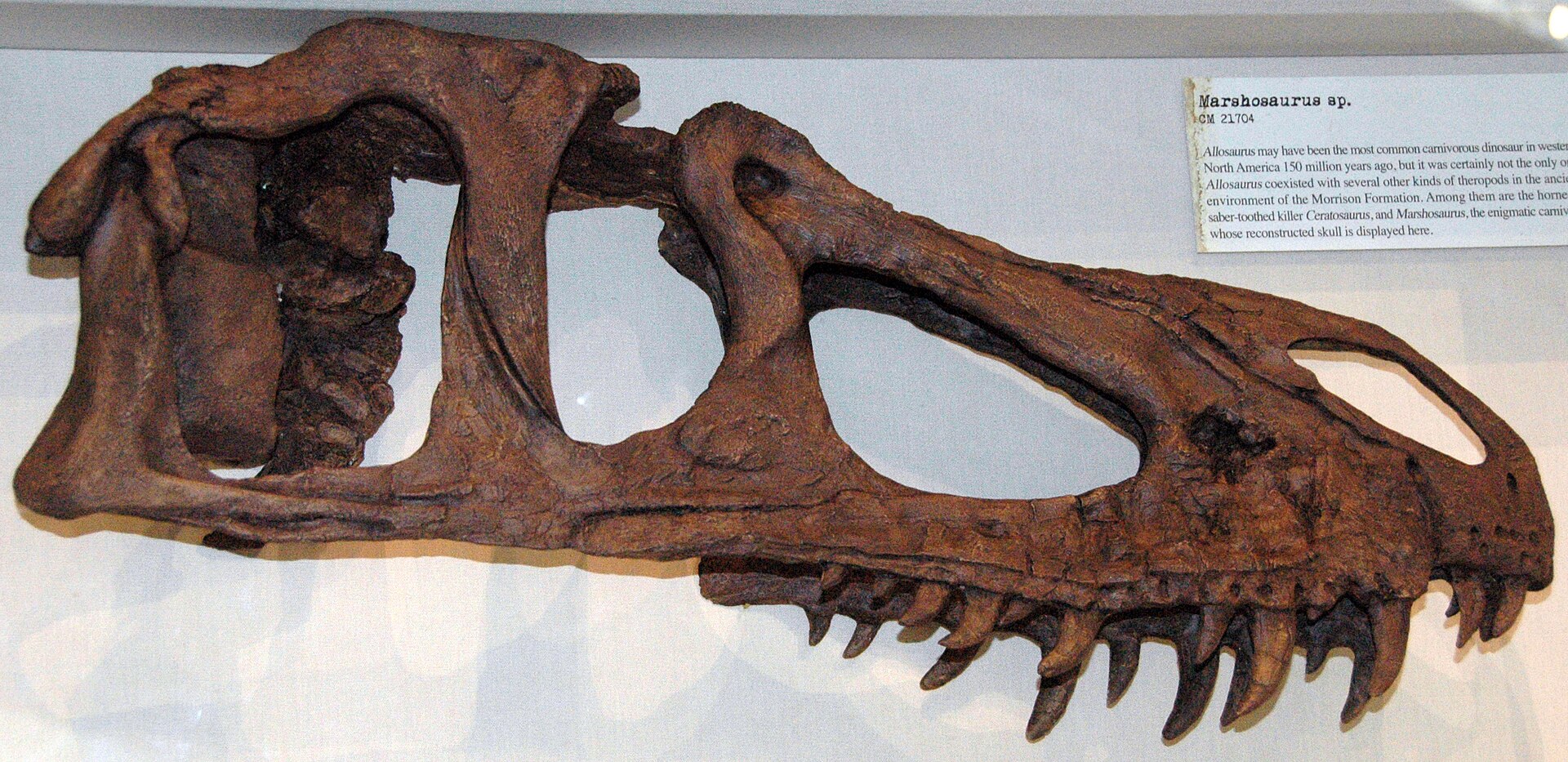

In 1991, Britt tentatively referred a tail vertebra from Dry Mesa Quarry in Colorado “by a process of elimination”—the first report outside Cleveland-Lloyd. Two years later, an abstract by Chure, Britt, and Madsen announced two new specimens from in and near Dinosaur National Monument. These included the first braincase and temporal skull material. They also extended its range into northeastern Utah and northwestern Colorado—and down into the older Salt Wash Member. Later studies use a Carnegie Museum specimen, CM 21704, for comparison, but further material is “as yet undescribed.”
Marshosaurus Size and Description
Marshosaurus is known mostly from its jaws and hips, so its portrait has a sharp face and blurry legs.
Short description of Marshosaurus
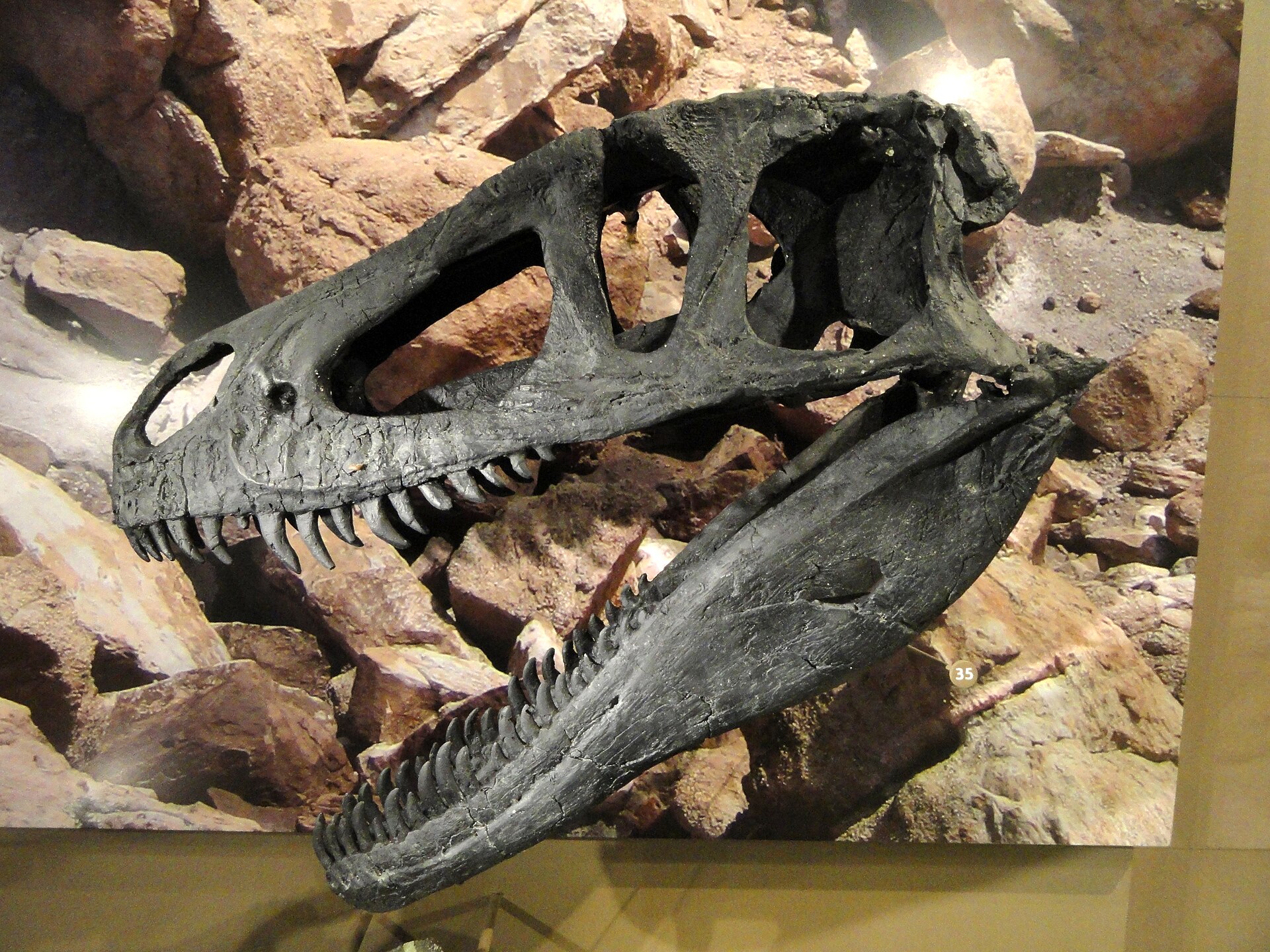
The head was probably narrow, since the paired dentaries form a narrow lower jaw in articulation. At the front, the premaxilla was longer than high—about 1.9 by 1.3 inches (47 by 34 millimeters)—and only loosely joined to the maxilla. Madsen counted four premaxillary teeth, 16 maxillary teeth, and 22 dentary teeth. These teeth were flattened side to side and curved backward, with coarser serrations on the rear edge than on the front. Skull material from Dinosaur National Monument also shows a primitive, unconstricted lateral temporal fenestra (an opening behind the eye).
Farther back, rib scars suggest at least four, and probably five, sacral (hip) vertebrae. The ilium was heavy, with a long, low rear blade. Below it, the pubis was long, slender, and bowed forward, ending in a teardrop-shaped foot. The ischium, by comparison, reached only about two-thirds of the pubis’s length. No femur, tibia, or fibula has been formally described, so the legs remain unknown.
Size and Weight of Type Species
Without a thigh bone or shin bone, every body-size estimate for Marshosaurus is indirect. Madsen judged the adult “probably five meters or less in length”—about 16.4 feet or less—without stating his method. Citing estimates by Gregory S. Paul, Lacerda and colleagues give all three piatnitzkysaurids a typical length of about 14.8 feet (4.5 meters). In contrast, Hendrickx and colleagues in 2015 gave piatnitzkysaurids a length of 16.4 to 19.7 feet (5 to 6 meters).
For weight, the same team reports Paul’s figure of about 441 pounds (200 kilograms) for Marshosaurus. In 2020, Foster proposed a slightly heavier 551 pounds (250 kilograms). Combined, these figures suggest a medium-sized predator. None of the sources consulted here gives a height at the hips.
The bones themselves are firmer ground. One pubis measures about 16.5 inches (420 millimeters) long, while the dentary tooth row runs about 7.8 to 8.1 inches (199 to 205 millimeters).
The Dinosaur in Detail
One of the most distinctive features lies inside the snout. Its maxillary sinus, an air space in the upper jaw, was divided and had two side openings. Madsen proposed that the sinuses “may have housed a specialized gland(s)” or extra sensory tissue. Its interdental plates—bony plates between the tooth sockets—were separated to their bases, unlike the fused plates of Allosaurus. In 2023, Lei and colleagues also measured unusually thin front and side teeth, plus a snout longer and narrower than in Allosaurus.

The hips are just as telling. Madsen singled out the faceted ischiadic peduncle—the joint for the ischium—and hollows on the joint for the pubis as the ilium’s key features. In 2023, Lacerda and colleagues found that its concave-bottomed pubis evolved separately from those of Coelophysis and Masiakasaurus. Unlike its closest relatives, it also had an expanded, apron-like ischial symphysis, where the two ischia meet.
Madsen labeled a rough patch on the pubis the probable origin of the ambiens muscle, and Lacerda’s team still reads it that way. They inferred only 12 pelvic and hindlimb muscles for Marshosaurus, against 29 for Piatnitzkysaurus and 21 for Condorraptor. That low count reflects missing bones—Marshosaurus has the fewest preserved pelvic elements of the three.
Benson in 2010 and Carrano and colleagues in 2012 ran the first cladistic studies to place piatnitzkysaurids within Megalosauroidea. Carrano’s analysis found Marshosaurus to be the family’s earliest-diverging member. However, Lacerda’s 2023 analysis left the three species unresolved. In 2019, Rauhut and Pol instead placed Piatnitzkysauridae just outside Allosauroidea, within a broader Carnosauria. Pradelli, Pol, and Ezcurra went further in 2025, recovering the family, Marshosaurus included, as the earliest-branching group of Allosauroidea. Even a 2026 study calls it only “potentially” a piatnitzkysaurid. Taken together, its exact branch on the family tree is still open.
Interesting Points about Marshosaurus
- Its species name, bicentesimus, was chosen to honor the 200th anniversary of the United States of America.
- One right ilium, UUVP 2742, carries a deformity on its blade that Madsen thought was probably traumatic in origin.
- In 2023, Lei and colleagues counted it among the four apex predators of the Morrison Formation.
- One left dentary, UUVP 40-555, has a gap in its tooth row whose significance Madsen called unknown.
Contemporary Dinosaurs
Dominating the Cleveland-Lloyd bone bed was Allosaurus fragilis, the most common member of the quarry’s fauna. Madsen’s census counted at least 44 individuals from 83 thigh bones. Its bones come from the same deposit that yielded Marshosaurus, so the two shared the landscape, although no fossil records how they interacted.
Also present was Ceratosaurus, a ceratosaur theropod represented at the quarry by one large adult. That specimen came from the same bone bed, which lies about 150 feet below the top of the Brushy Basin Member. Even so, nothing links the two predators directly.
The quarry also yielded Stokesosaurus clevelandi, a small theropod that Madsen named from the same site in 1974. Researchers now regard it as a tyrannosauroid, an early member of the lineage that later produced Tyrannosaurus. Madsen noted that the larger of its two individuals was about the same size as Marshosaurus—though no interaction between them is recorded.
Among the plant-eaters was Stegosaurus, a plated ornithischian represented by at least two individuals of Stegosaurus cf. stenops (a tentative species identification). Its bones come from the same bone bed, but nothing ties it directly to Marshosaurus.
Marshosaurus in its Natural Habitat
The world Marshosaurus roamed was one of rivers, floodplains, and lakes. Late Jurassic Utah was strongly seasonal, swinging between arid and monsoonal conditions. The quarry itself formed on a poorly drained floodplain, where floods carried carcasses into a short-lived pond. At times, its waters may have been choked with nutrients, judging from barite and sulfide minerals. Rare snails and charophytes (stoneworts) point to shallow, quiet or slow-moving fresh or brackish water.
As a carnivore, Marshosaurus probably met bone while feeding—a habit Lei and colleagues see in all the large Morrison theropods. A worn front tooth on one Colorado specimen suggests that its foremost teeth often struck bone. However, Lei’s team also argued that its thin front crowns were more likely to break on bone than the stouter teeth of Torvosaurus, Ceratosaurus, and Allosaurus.
While there is no direct evidence of group living, the quarry’s two same-sized individuals cannot settle the question on their own. In 1976, Madsen counted about three kinds of carnivore there for every kind of herbivore, a ratio he called “out of balance” with typical populations. Lacerda’s team suggested that its wide brevis fossa, a muscle attachment area on the ilium, may signal a larger hip-to-thigh muscle with greater pulling power.
Frequently Asked Questions
It honors paleontologist Othniel Charles Marsh, and the species name bicentesimus celebrates the United States bicentennial.
It lived in the Late Jurassic, from the late Kimmeridgian to around 147 million years ago, a minimum age for its type quarry.
Estimates range from about 14.8 to 19.7 feet (4.5 to 6 meters) long and 441 to 551 pounds, all indirect.
It was a carnivore, and a worn front tooth suggests it often bit into bone while feeding.
Its holotype comes from the Cleveland-Lloyd Dinosaur Quarry in Emery County, Utah, within the Morrison Formation.
A divided maxillary sinus, unfused interdental plates, and a distinctive ilium set it apart from Allosaurus and the other theropods Madsen compared.
Sources
The information in this article is based on various sources, drawing on scientific research, fossil evidence, and expert analysis. The aim is to provide a comprehensive and accurate overview of Marshosaurus. However, please be aware that our understanding of dinosaurs and their world is constantly evolving as new discoveries are made.
- https://doi.org/10.34191/ug-3-1_51
- https://ugspub.nr.utah.gov/publications/utah_geology/UtGeol3-1.pdf
- https://ugspub.nr.utah.gov/publications/bulletins/B-109.pdf
- https://doi.org/10.1111/joa.13983
- https://doi.org/10.1098/rsos.230481
- https://docentes.fct.unl.pt/omateus/files/hendrickx_etal_2015_non_avian_theropods_pjvp12_11.pdf
- https://doi.org/10.7717/peerj.16327
- https://doi.org/10.1038/s41598-019-56959-x
- http://npshistory.com/publications/NRTR-93-11.pdf
- https://geology.byu.edu/0000017c-f2a9-dd9b-a7ff-f2af65580000/geol-stud-vol-37-britt-pdf
- https://vjs.pgi.gov.pl/article/view/26618
- https://doi.org/10.7717/peerj.3368
- https://spiral.imperial.ac.uk/handle/10044/1/73346
- https://ugspub.nr.utah.gov/publications/misc_pubs/MP-00-2.pdf
- https://doi.org/10.4202/app.2011.0141
- https://doi.org/10.1098/rsos.260994
- https://doi.org/10.1038/s41598-019-53672-7
- https://doi.org/10.1093/zoolinnean/zlae176
- https://giw.utahgeology.org/giw/index.php/GIW/article/view/35
This article was last fact checked: TheDinosaurs Team, 12-11-2026
Featured Image Credit: TotalDino, CC BY 4.0, via Wikimedia Commons
