
On the Uncompahgre Plateau of western Colorado, the river-laid sandstones of Dry Mesa Quarry lie near the bottom of the Morrison Formation’s Brushy Basin Member. In 1979, paleontologists Peter Galton and James Jensen named a large and heavily built theropod from these beds Torvosaurus tanneri. They placed it in the upper Kimmeridgian at the base of the Tithonian—the closing chapters of the Late Jurassic. A second species, T. gurneyi, followed from Portugal in 2014.
Eddie and Vivian Jones of Delta, Colorado, found the quarry in the summer of 1971. Digging began the following April, and nearly all of the big theropod’s bones came out in that first field season. Since the 1979 description, skull bones, a Portuguese jaw, and even embryos have filled in much of the picture—though old questions remain.
Torvosaurus Key Facts
| Keyword | Fact |
|---|---|
| Pronunciation | Not specified |
| Meaning of name | Savage Lizard |
| Group | Theropoda (Megalosauridae) |
| Type Species | Torvosaurus tanneri |
| Diet | Carnivore |
| When it Lived | About 152 to 145 MYA for both named species, and the Middle Jurassic (Callovian stage) for a German jaw fragment that Rauhut and colleagues (2020) call the oldest Torvosaurus record |
| Period | Jurassic |
| Epoch | Late Jurassic (Kimmeridgian to Tithonian stages), and possibly Middle Jurassic (Callovian stage) for the genus |
| Length | About 30 to 33 feet (9 to 10 meters) |
| Height | Not specified |
| Weight | About 2.3 metric tons (5,060 to 5,190 pounds) for one Wyoming T. tanneri (GPM 0012), from Campione and colleagues’ femur equation, and about 4 to 5 metric tons for T. gurneyi, scaled from skull length. The methods differ, and the two species were probably similar in size |
| Mobility | Not specified |
| First Discovery | 1971 by Eddie and Vivian Jones, who found Dry Mesa Quarry and its “discovery bone” (excavated from 1972 by J.A. Jensen) |
| Described by | 1979 by P.M. Galton and J.A. Jensen |
| Holotype | BYU 2002 (both humeri, both ulnae and the right radius), restricted by Britt in 1991 to the left humerus, BYUVP 2002 |
| Location of first find | Dry Mesa Quarry, Brushy Basin Member, Morrison Formation, western Colorado, USA |
Torvosaurus Origins, Taxonomy and Timeline
The name Torvosaurus joins the Latin torvus, meaning “savage, cruel, wild,” with the Greek sauros, or “lizard.” The species name tanneri honors N. Eldon Tanner, first counselor in the First Presidency of The Church of Jesus Christ of Latter-day Saints. Its Portuguese sibling, T. gurneyi, is a nod to paleoartist James Gurney, creator of Dinotopia.
Galton and Jensen placed the animal in the Carnosauria and the family Megalosauridae. They likened its forelimb and pelvis to Europe’s Megalosaurus and Poikilopleuron rather than to other Morrison genera. Jensen later erected a family of its own—Torvosauridae—while paleontologist Gregory Paul tentatively sank the species into Megalosaurus. In 2014, paleontologists Christophe Hendrickx and Octávio Mateus placed both species within Megalosauridae as the sister clade of Megalosaurus.
Radiometric dates for the quarry of about 150 to 151 million years, listed by the Paleobiology Database, fall near the Kimmeridgian–Tithonian boundary. Hendrickx and Mateus recorded T. tanneri from late Kimmeridgian to late Tithonian deposits, and T. gurneyi from the late Kimmeridgian. Because Megalosaurus is Bathonian, they suggested the lineage likely arose during or around that earlier stage. In 2020, however, paleontologist Oliver Rauhut and colleagues described a maxilla fragment from middle Callovian (Middle Jurassic) rocks of north-western Germany. They called it the oldest Torvosaurus record, some 10 million years older than the other fossils, and proposed a north-central European origin for the genus.
Discovery & Fossil Evidence
Galton and Jensen placed Dry Mesa Quarry in Montrose County, but paleontologist Brooks Britt’s 1991 monograph puts it in Mesa County. Its “discovery bone” was an extremely large theropod phalanx (finger or toe bone), now cataloged as BYUVP 5026.
Galton and Jensen designated BYU 2002, the long bones of both arms, as the holotype. Because the scattered bones matched in size and fit together at the elbow, the authors judged them one animal. However, Britt found that no left radius (forearm bone) exists—the 1979 figures of one were reversed drawings of the right radius. The series is therefore five bones: both humeri (upper arm bones), both ulnae, and the right radius. Britt also restricted the holotype to the better-preserved left humerus. He argued the arm bones could not be proven to come from one individual—and probably did not. The rest of the 1979 material included a dentary (lower jaw bone), vertebrae, and hand, hip, leg, and ankle bones.
Britt added skull material, including a premaxilla and maxilla (upper jaw bones). He counted two large and one relatively smaller Torvosaurus at Dry Mesa. He also reported the genus from Dinosaur National Monument in Utah and two Wyoming sites. Earlier, Galton and Jensen had tentatively referred a large claw from Calico Gulch Quarry, 121 miles (195 kilometers) away.

Torvosaurus Size and Description
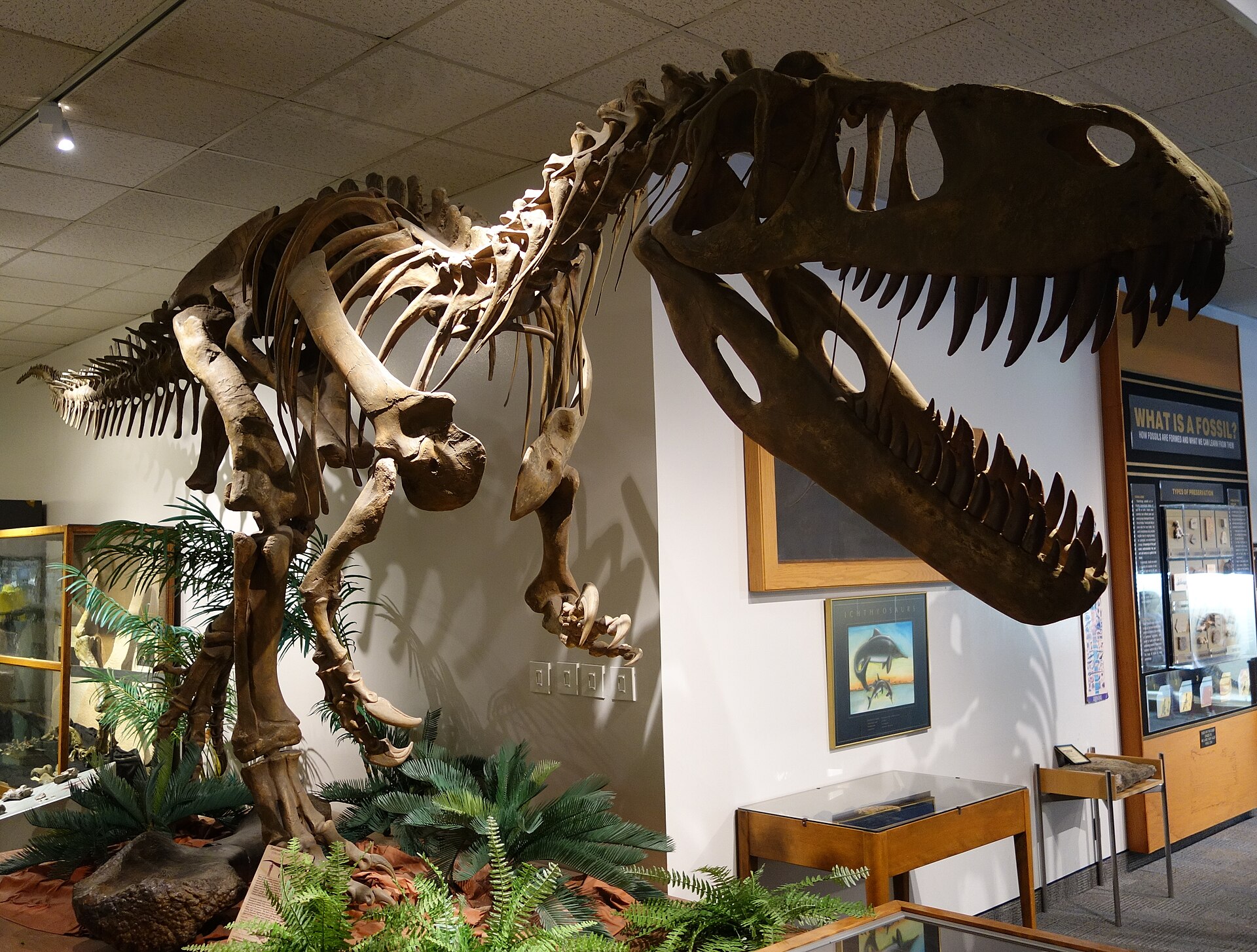
No single complete skeleton exists, so the portrait of Torvosaurus is assembled from several individuals on two continents.
Short description of Torvosaurus
Britt estimated an adult skull about 3.9 feet (1.18 meters) long and 1.5 feet (450 millimeters) high. He described a particularly narrow rostrum (snout) with three, possibly four, premaxillary teeth and probably 13 maxillary teeth. In 2014, Hendrickx and Mateus re-examined a cast of that maxilla and revised the count to 11 or 12. Its skull bones were the most robust of any known Morrison theropod. Moreover, one empty socket shows a front tooth root about 4 inches (100 millimeters) long.
According to Britt, all but the last two presacral vertebrae (those ahead of the hips) were markedly opisthocoelous—convex in front and hollow behind, like a ball-and-socket joint. The massive, nearly straight humerus bore a large deltopectoral crest (muscle ridge). It measured 16.7 inches (424 millimeters) for Galton and Jensen, but 16.9 inches (429 millimeters) for Britt. By contrast, the forearm was short, since the humerus is 2.2 times the length of the radius. Even so, Galton and Jensen stressed that the arm was proportionally large rather than reduced as in tyrannosaurids.
The hand had at least three stout metacarpals (hand bones), and the first thumb bone was short, stout, and twisted. The pubis and ischium (lower hip bones) were about equal in length and met in an almost continuous midline joint.
Size and Weight of Type Species
Galton and Jensen gave Torvosaurus a total length of up to about 33 feet (10 meters), without stating how they reached it. In 1991, Britt proposed a slightly shorter adult length of about 30 feet (9 meters), again with no method given. Hendrickx and Mateus later judged that both species’ largest maxillae belonged to same-sized, likely fully adult animals over 29.5 feet (9 meters). None of these studies, however, gives a height.
Weight is harder to pin down. In 2024, paleontologist Romain Pintore and colleagues estimated about 2.3 metric tons (5,060 to 5,190 pounds) for one Wyoming specimen, GPM 0012. They applied an equation by Campione and colleagues (2014) to the narrowest circumference of its two thigh bones—an indirect method with a prediction error of about 25 percent. For T. gurneyi, Hendrickx and Mateus estimated approximately 4 to 5 metric tons, scaled from skull length after an earlier study. Since the two were similar in size, the gap reflects method rather than bulk.
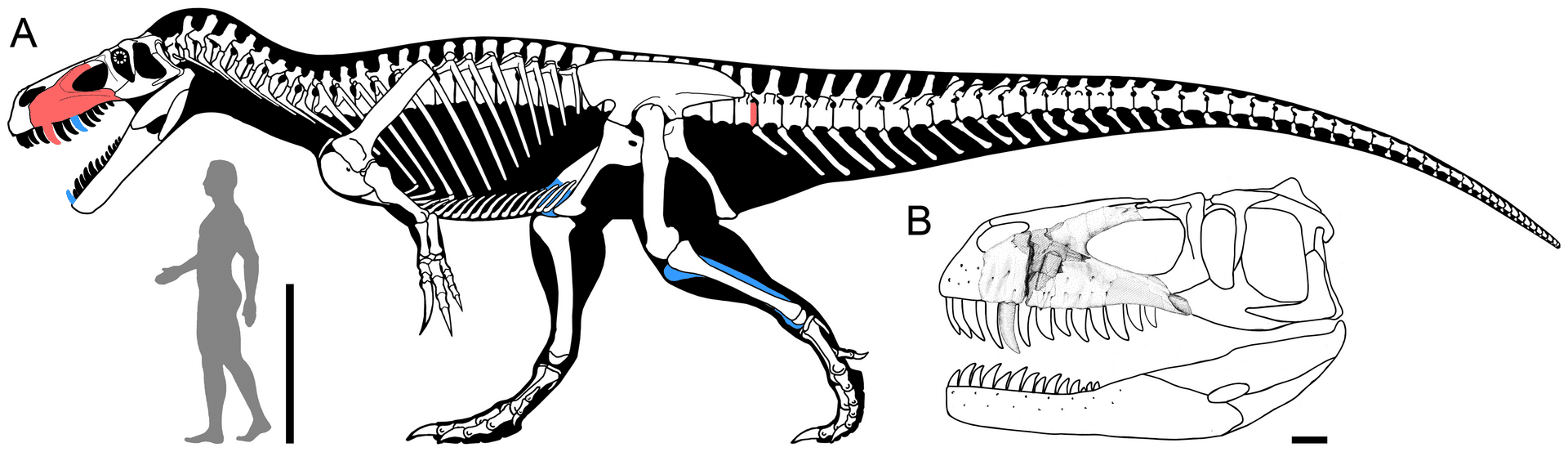

By maxilla length, T. gurneyi fell short of Tyrannosaurus, Carcharodontosaurus, and Giganotosaurus. Instead, its describers thought it likely matched Daspletosaurus, Gorgosaurus, and Tarbosaurus in size. Even so, they called it the largest land predator found in Europe up to 2014.
The Dinosaur in Detail
To its describers, Torvosaurus looked strikingly old-fashioned. Galton and Jensen called its forelimb and pelvic girdle “extremely conservative for a carnosaur.” The pubis even enclosed a complete obturator foramen—an opening through the hip bone that they called extremely unusual in theropods. The pair argued that these hips strengthened the case for megalosaurids descending from prosauropods (early long-necked plant-eaters). However, later analyses placed Torvosaurus among tetanuran megalosauroids instead.
The two species are told apart mainly by the maxilla. The T. gurneyi holotype pairs a maxilla with part of a tail vertebra, and its describers confidently referred a second maxilla. In that species, the interdental wall (fused bone between the teeth) sits nearly level with the jaw’s outer wall. It also has fewer than eleven maxillary teeth and lacks a ridge on the inner shelf seen in T. tanneri. Hendrickx and Mateus urged caution, since tooth counts vary between individuals and one plate feature was hard to judge. Nonetheless, they argued for a separate species, split off by vicariance—separation by a geographic barrier—on the isolated Iberian Meseta. In 2017, paleontologist Elisabete Malafaia and colleagues described more Portuguese remains and used them to test how these traits vary.
In August 2005, A. Walen found clutch ML1188 at Porto das Barcas. It held more than three crushed eggs, plus embryonic jaw bones, vertebrae, and teeth. In 2013, paleontologist Ricardo Araújo’s team ascribed them to Torvosaurus, calling them the only unequivocal basal theropod embryos then known. Their age remains unsettled—early Tithonian according to Araújo’s team, but late Kimmeridgian according to Hendrickx and Mateus. The latter tentatively assigned them to T. gurneyi, based on geography and stratigraphy alone. Taken together, Torvosaurus emerges as a conservative-looking giant whose second species rests on upper-jaw features still being tested.
Interesting Points about Torvosaurus
- Hendrickx and Mateus list the names Edmarka rex and “Brontoraptor” as synonyms of Torvosaurus tanneri.
- Britt called Torvosaurus a very rare member of the Brushy Basin fauna, yet it was Dry Mesa’s second most common theropod.
- A giant footprint from Porto Dinheiro, Portugal, 31 inches (79 centimeters) long, has been tentatively referred to Torvosaurus.
- The Portuguese maxilla was collected in 2003 from beach boulders that had fallen from a sea cliff.
- Portugal’s embryonic Torvosaurus teeth lacked serrations, and their interdental plates had not yet fused.
Contemporary Dinosaurs
The most common theropod in the Dry Mesa bone bed was Allosaurus, a familiar Morrison predator. Britt counted at least six individuals and nearly 200 bones. No fossil records an encounter, but the two predators shared the same channel deposits.
Prowling the same riverbanks was Ceratosaurus, a ceratosaurid theropod. Britt counted 25 of its bones at Dry Mesa—enough for at least two individuals. He treated it as a proximal component of the community—a local resident rather than bones washed in from elsewhere. Any contact with Torvosaurus goes unrecorded.
Among the plant-eaters, the ornithopod Dryosaurus was the most common ornithischian (bird-hipped dinosaur) at Dry Mesa. Although it shared the deposit with Torvosaurus, no direct evidence links the two.
Towering above the floodplain was Supersaurus, a diplodocid sauropod. Britt wrote that the quarry was well known for its extremely large sauropods, including this one. Its bones share the channel deposit with Torvosaurus, though no interaction is recorded.
Torvosaurus in its Natural Habitat
In Britt’s reading, Torvosaurus roamed a shallow floodplain crossed by medium-to-small streams. A 2004 synthesis by geologists Christine Turner and Fred Peterson describes a dry, semi-arid Morrison landscape likened to a savannah, with seasonal storms, small lakes, and wetlands. However, earlier researchers had disagreed—some argued for warm and humid conditions, others for arid to semiarid ones. According to a 1990 survey cited by Britt, conifers, ferns, cycads, and, to a lesser degree, horsetails dominated the Morrison flora.
Hendrickx and Mateus counted this carnivore among the Late Jurassic’s top predators, functionally and ecologically similar to Carcharodontosaurus and Tyrannosaurus. Britt suggested that touch-sensitive organs in the snout may have sensed prey movement during feeding. At Colorado’s Mygatt-Moore Quarry, paleontologist Stephanie Drumheller and colleagues found one striated bite mark too coarse for any known Allosaurus or Ceratosaurus. They proposed an oversized Allosaurus or another predator like Saurophaganax or Torvosaurus, though neither appears among the quarry’s bones.
Nothing shows how Torvosaurus hunted or whether it lived in groups, but its eggs offer one behavioral clue. Araújo’s team proposed that the highly porous shells were buried for incubation, possibly by a parent. Those eggs came from fluvial overbank deposits—river floodplain sediments—in Portugal, whose rocks Hendrickx and Mateus compared closely with the Morrison.
Frequently Asked Questions
It means “savage lizard,” from the Latin torvus and the Greek sauros.
Both named species lived in the Late Jurassic, from the late Kimmeridgian to the late Tithonian, roughly 152 to 145 million years ago. However, a German jaw fragment, which its describers call the oldest Torvosaurus record, comes from the older, Middle Jurassic Callovian stage.
Estimates put its length at about 30 to 33 feet (9 to 10 meters). Weight estimates run from about 2.3 metric tons for one T. tanneri, based on its thigh bones, to 4 to 5 metric tons for T. gurneyi, scaled from skull length. The two species were probably similar in size, so the gap mostly reflects method.
It was a carnivore, and the describers of T. gurneyi counted it among the top predators of the Late Jurassic.
T. tanneri comes from Dry Mesa Quarry in western Colorado, while T. gurneyi comes from Lourinhã, Portugal.
It had a robust skull and a particularly narrow snout. Its Portuguese embryos were also the only unequivocal basal theropod embryos known in 2013.
Sources
The information in this article is based on various sources, drawing on scientific research, fossil evidence, and expert analysis. The aim is to provide a comprehensive and accurate overview of Torvosaurus. However, please be aware that our understanding of dinosaurs and their world is constantly evolving as new discoveries are made.
- https://geology.byu.edu/0000017c-ec08-d1c3-a7fd-fd199f1c0001/geo-stud-vol-26-part-2-galton-jensen-pdf
- https://geology.byu.edu/0000017c-f2a9-dd9b-a7ff-f2af65580000/geol-stud-vol-37-britt-pdf
- https://doi.org/10.1371/journal.pone.0088905
- https://doi.org/10.1038/srep01924
- https://doi.org/10.1017/pab.2024.6
- https://doi.org/10.1371/journal.pone.0233115
- https://www.lwl.org/wmfn-download/Geologie_und_Palaeontologie_in_Westfalen/GuP_Heft_93_Seite_31-43.pdf
- https://doi.org/10.1007/s41513-017-0003-9
- https://www.usgs.gov/publications/reconstruction-upper-jurassic-morrison-formation-extinct-ecosystem-a-synthesis
- https://paleobiodb.org/data1.2/colls/single.json?id=45975&show=strat,stratext,lith,geo
This article was last fact checked: TheDinosaurs Team, 29-10-2026
Featured Image Credit: Fred Wierum, CC BY-SA 4.0, via Wikimedia Commons
