
On the outskirts of Villa El Chocón, in Argentina’s Neuquén Province, the lower Huincul Formation yielded one of the most complete abelisaurid skulls ever found. It belongs to Skorpiovenator bustingorryi, a carnivore that its describers placed in Brachyrostra, a new group of South American abelisaurids. They assigned the rocks to the late Cenomanian to early Turonian stages of the Late Cretaceous. However, a 2026 dating study argues that these beds are older—Albian, in the Early Cretaceous. With a nearly complete skeleton, the animal offers a rare glimpse of how such a predator was built.
In the summer of 2005, then-doctoral students Juan Ignacio Canale and Agustín Scanferla were prospecting around Villa El Chocón when Scanferla found theropod bones. With Federico Agnolín and Fernando Novas, the pair named the animal in 2009, after online publication in December 2008. In 2026, a skull study by Canale and colleagues corrected several original details. Its story shows how one well-preserved skeleton can keep reshaping a whole lineage.
Skorpiovenator Key Facts
| Keyword | Fact |
|---|---|
| Pronunciation | Not specified |
| Meaning of name | Scorpion Hunter |
| Group | Theropoda |
| Type Species | Skorpiovenator bustingorryi |
| Diet | Carnivore |
| When it Lived | Late Cenomanian to early Turonian, within 100.5 to 89.8 MYA (original description), or younger than about 106 MYA, within the Albian (Maniel and colleagues, 2026) |
| Period | Cretaceous |
| Epoch | Late Cretaceous (late Cenomanian to early Turonian stages), or Early Cretaceous (Albian stage) per Maniel and colleagues, 2026 |
| Length | Not specified |
| Height | Not specified |
| Weight | About 1,964 pounds (891 kilograms), an indirect estimate from the femur by Pintore and colleagues, 2024 |
| Mobility | Not specified |
| First Discovery | 2005 by Agustín Scanferla, on a prospecting trip with Juan Ignacio Canale |
| Described by | 2009 by J.I. Canale, C.A. Scanferla, F.L. Agnolín, and F.E. Novas (published online December 2008) |
| Holotype | MMCh-PV 48 |
| Location of first find | Estancia Bustingorry, lower section of the Huincul Formation, Villa El Chocón, Neuquén Province, Argentina |
Skorpiovenator Origins, Taxonomy and Timeline
According to a fact sheet from CONICET, Argentina’s national research council, the name means “scorpion hunter, dedicated to M. Bustingorry.” We could not access the original paper’s etymology. M. Bustingorry is Manuel Bustingorry, whom a 2023 paper describes as the owner of the land around Villa El Chocón. Fittingly, the ranch where the skeleton lay is called Estancia Bustingorry. Together, the name joins a hunter’s label to the landowner whose ground gave up the bones.
Skorpiovenator is a theropod within Ceratosauria, Abelisauroidea, Abelisauridae, and finally Brachyrostra. In 2009, Canale and colleagues found it deeply nested within Brachyrostra, which they named in the same paper. Later, in 2024, Pol and colleagues recovered it as a basal—or early-branching—brachyrostran. In contrast, Canale’s 2026 team placed it in a small clade with Ilokelesia and Ekrixinatosaurus. That clade, so far known only from Neuquén Province, is the sister group to Furileusauria. Skorpiovenator bustingorryi is the type and only known species.
The original description placed the fossils in late Cenomanian to early Turonian outcrops. Together, those two stages span roughly 100.5 to 89.8 million years ago. In 2026, though, Maniel and colleagues dated an ash bed near Villa El Chocón, just above the formation’s base, to about 106 million years ago. On that basis, they argue that the Huincul Formation is Albian and list Skorpiovenator as an Albian animal younger than that bed. Canale’s skull study, submitted before the new dates appeared and published weeks later, still uses the Cenomanian–Turonian age without discussing them. Earlier dates had already disagreed—a 2004 fission-track age of 88 ± 3.9 million years came from an ash near the formation’s base. So the question remains open.
Discovery & Fossil Evidence
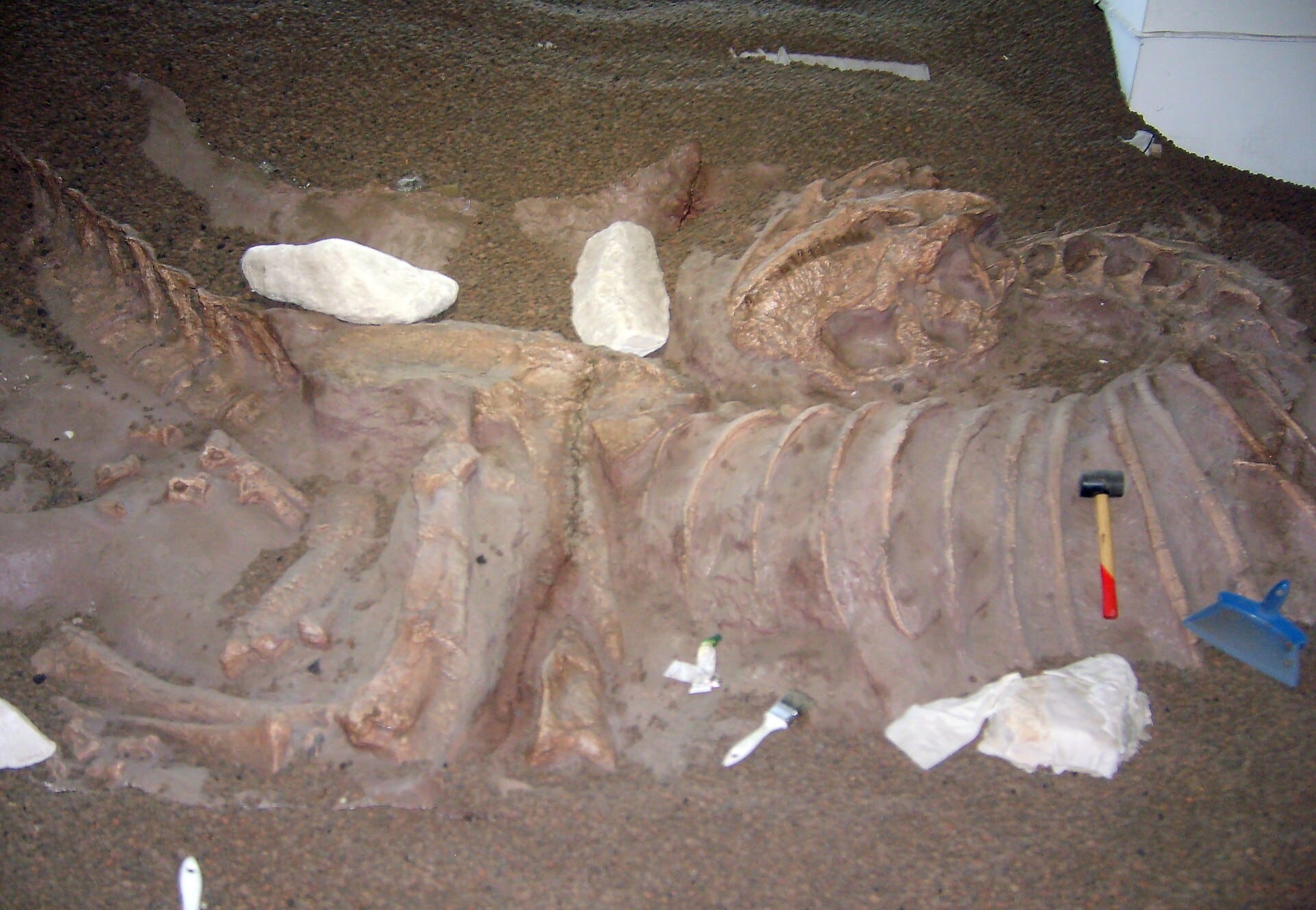
The skeleton came from Estancia Bustingorry, 800 meters (half a mile) north of Route 237 at the entrance to Villa El Chocón. Its rocks belong to the lower section of the Huincul Formation, where brownish and red pelitic (mudstone) levels mix with fine-grained sandstone. Some months later, the team returned to excavate the bones. Because the skeleton lay fully articulated, it came out in one plaster jacket—netted with iron bars and lifted onto a truck by cranes.
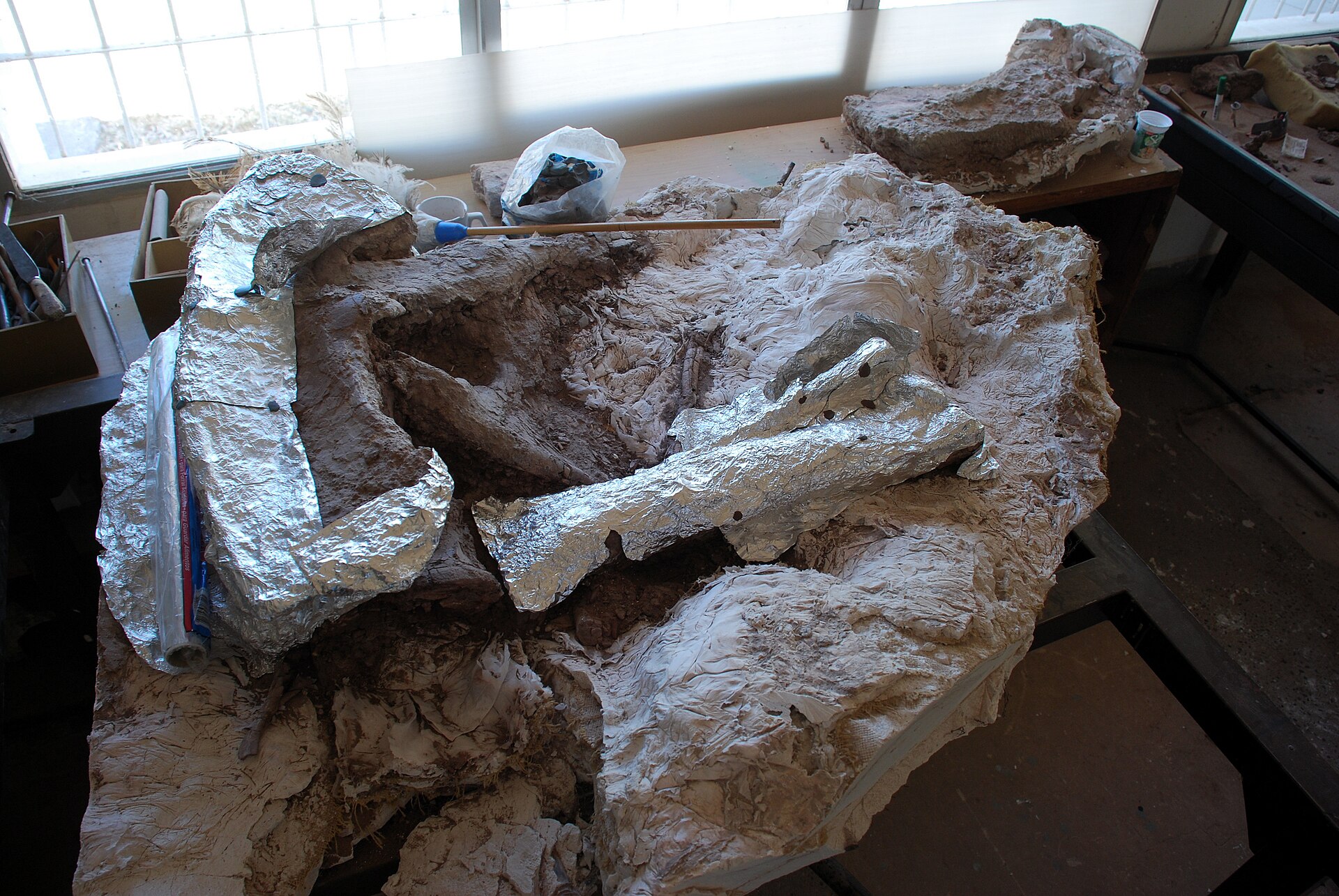

The holotype—the name-bearing specimen—is MMCh-PV 48, housed in the Museo Paleontológico “Ernesto Bachmann” in Villa El Chocón. It lacks both pectoral girdles (shoulder bones), the forelimbs, and the last two-thirds of the tail. The skull, by contrast, is almost complete, with the jaws still closed together. Loose teeth also turned up during preparation.
The 2009 paper drew on the right side of the specimen, the first side to be prepared. Later, preparators freed the skull from the first two neck vertebrae, and a medical scanner in Neuquén captured it in 2,236 slices. Burial had taken its toll—shear deformation pushed the right side of the skull upward. Meanwhile, the left side lay closer to the surface and suffered from water and plant roots. The only other specimen referred to the genus is MMCh-PV 255, the upper end of a right tibia (shinbone). Citing a 2022 study by Cerroni and colleagues, the Paleobiology Database places it about 2 kilometers (1.2 miles) west of the holotype site.
Skorpiovenator Size and Description
Short description of Skorpiovenator
The skull was relatively short, tall, and wide, with proportions closest to those of Majungasaurus and Spectrovenator. Ridges and furrows covered the facial bones, which Canale and colleagues interpret as mineralized dermis—the deeper layer of skin. Two pairs of bumps rose from the frontals (bones of the skull roof), while low paired crests ran along the front of the nasals. Low crowns, long roots, and a narrowing between crown and root suggest teeth that could withstand stress from many directions.
Behind the skull, the ilium (upper hip bone) had deep blades in front of and behind the hip socket, while the tibia bore an enlarged cnemial crest—a ridge at the front of the shin that likely gave leg muscles extra leverage. In a 2025 study, Cerroni and colleagues reconstructed 39 pelvic and hindlimb muscles. Because the shoulders and forelimbs are missing, the fossils say nothing directly about its arms. Beyond the ornamented face, any picture of its skin is speculative.

Size and Weight of Type Species
No length or height appears in any peer-reviewed source we could open, so both remain unspecified. The 2026 team, however, measured the skull directly—585 millimeters (about 23 inches) long on the right side and 612 millimeters (about 24 inches) on the left. At about twice as long as tall, it is proportionally shorter than the skull of Majungasaurus but longer than that of Carnotaurus.
In 2024, Pintore and colleagues estimated its body mass at 891 kilograms (about 1,964 pounds). They used the right femur (thigh bone), 726.9 millimeters (about 28.6 inches) long, and based the estimate on its shaft circumference. Their method, from Campione and colleagues in 2014, carries a stated prediction error of 25 percent.
The same study found that medium-sized abelisauroids such as Skorpiovenator had sturdier femora than Carnotaurus. Meanwhile, Canale’s 2026 team describes its clade as mid- to large-sized. Without a body length, though, any comparison with a modern animal would be guesswork.
The Dinosaur in Detail
What sets this dinosaur apart is its mouth, with 19 tooth positions in the maxilla (main upper tooth-bearing bone) and 21 in the dentary (lower jaw bone)—the highest counts recorded for an abelisaurid. By comparison, the dentary holds 15 teeth in Carnotaurus, 16 in Spectrovenator, and 17 in Majungasaurus. A 2025 study also ranked its short maxilla among the most extreme shapes in the family.
Equally striking is the skull roof, where each frontal carries two prominences—a doubled arrangement that the 2026 team calls unique to the species. The low nasal crests bear a papillary (nipple-like) texture also seen in Rugops. Along the top of the skull runs a double row of large foramina (small openings), about seven on each nasal. In 2020, Cerroni and colleagues traced the nasal foramina into an internal canal on CT scans. They read it as a neurovascular system (blood vessels and nerves), and Carnotaurus has a similar but notably smaller one. Their proposed roles include cooling the brain and nourishing display skin, with sensory organs a more speculative option.
Several original details have since been revised. Originally described as small, the mandibular fenestra—an opening in the lower jaw—proved in 2026 to be large, as in Carnotaurus. The same team identified the antarticular, a small extra bone at the jaw joint, and interpreted it as a sesamoid, a bone formed within a ligament. It is the first such bone recorded outside the Tetanurae lineage of theropods.
The 2026 analysis linked Skorpiovenator to Ilokelesia and Ekrixinatosaurus through six shared traits. In 2018, paleontologist Rafael Delcourt had suggested that its frontals were probably flattened, pointing to a basal position. Canale’s team countered that Skorpiovenator in fact has frontal prominences. Taken together, these studies leave its exact place on the family tree open.
Interesting Points about Skorpiovenator
- The 2026 skull study calls it one of the most complete abelisaurid skulls, and indeed one of the most complete of any South American theropod.
- In 2009, its describers argued that isolated teeth once credited to post-Cenomanian carcharodontosaurids most probably belong to abelisaurids.
- The original paper suggested that horn-like structures and thickened skull bones evolved more than once within Abelisauridae.
- The 2026 study published three-dimensional models of its skull bones on the Internet Archive.
Contemporary Dinosaurs
Sharing the lower Huincul Formation was Meraxes, a giant carcharodontosaurid theropod and the earliest-diverging member of Giganotosaurini. Its skeleton came from Las Campanas Canyon, about 25 kilometers (15.5 miles) southwest of Villa El Chocón. Maniel and colleagues list both as Albian, so the age debate applies to each. The two may have shared a landscape, but no fossil records any contact between them.
Far larger was Bustingorrytitan, a gigantic lithostrotian titanosaur—a long-necked sauropod—estimated at 67.3 metric tons (about 74 short tons). Its remains came from what the 2026 skull study calls slightly higher levels, about 4 kilometers (2.5 miles) to the north. It therefore lived in the same area, though not at exactly the same moment. Its name also honors Manuel Bustingorry.
Adding further diversity was Cienciargentina, a rebbachisaurid sauropod. The 2026 skull study reports it from slightly lower strata at the “La Antena” site, 2.5 kilometers (1.6 miles) to the southeast.
Completing the list is Choconsaurus, a titanosaur from the same slightly lower strata at “La Antena” as Cienciargentina. The 2026 skull study groups both among fossils from nearly equivalent levels. However, no source records an interaction between either sauropod and Skorpiovenator.
Skorpiovenator in its Natural Habitat
The world Skorpiovenator roamed was a land of rivers. The Huincul Formation consists of thick fluvial (river-laid) deposits, and fine sands and muds dominate its lower section. In 2026, Maniel and colleagues described its sandstones as sometimes tuffaceous (ash-bearing), with paleosols (fossil soils). They also traced a shift from the arid to semiarid conditions of the older Candeleros Formation to a temperate subhumid climate in Huincul time.
Skorpiovenator was a carnivore, and its teeth show clear adaptations for that diet. In 2026, Canale and colleagues argued that it was likely a hypercarnivorous ambush predator, feeding almost entirely on meat. Like Majungasaurus and Carnotaurus, it may have used “bite-and-hold” or “head-hunting” strategies. They added that its crown base ratio, lower than in any other known abelisaurid, hints at a more selective feeding style. Already in 2009, its describers linked the short skulls and thickened skull roofs of brachyrostrans to possible shock absorption.
While there is no direct evidence of whether Skorpiovenator hunted alone or in groups, it lived among a rich fauna. The Huincul also preserves theropods such as Gualicho and Mapusaurus, although Mapusaurus comes from younger levels. The lower Huincul Formation is also known from the rebbachisaurid Cathartesaura, found at La Buitrera in Río Negro Province. According to Canale’s 2026 team, the Turonian extinction event likely struck Skorpiovenator‘s small clade. That event, they note, eradicated carcharodontosaurids, spinosaurids, and rebbachisaurids in the Southern Hemisphere.
Frequently Asked Questions
According to a CONICET fact sheet, it means “scorpion hunter,” and the species name is dedicated to M. Bustingorry.
Its describers placed it in the late Cenomanian to early Turonian of the Late Cretaceous. A 2026 dating study instead argues that the rock unit is Albian, with fossils younger than about 106 million years.
No length is verified, but a femur-based estimate puts its weight at about 1,964 pounds (891 kilograms).
It was a carnivore, and a 2026 study suggests it was an ambush predator using bite-and-hold or head-hunting strategies.
It was found at Estancia Bustingorry, near Villa El Chocón in Neuquén Province, Argentina, in the lower Huincul Formation.
It has the highest tooth counts recorded for an abelisaurid, plus two prominences on each frontal bone—a trait unique to the species.
Sources
The information in this article is based on various sources, drawing on scientific research, fossil evidence, and expert analysis. The aim is to provide a comprehensive and accurate overview of Skorpiovenator. However, please be aware that our understanding of dinosaurs and their world is constantly evolving as new discoveries are made.
- https://doi.org/10.1007/s00114-008-0487-4
- https://doi.org/10.5710/AMGH.20.08.2026.3665
- https://www.ameghiniana.org.ar/index.php/ameghiniana/libraryFiles/downloadPublic/174
- https://doi.org/10.1080/14772019.2022.2093661
- https://doi.org/10.1111/joa.13258
- https://doi.org/10.1002/ar.25532
- https://doi.org/10.1017/pab.2024.6
- https://doi.org/10.1038/s41598-018-28154-x
- https://doi.org/10.1038/s41598-025-87289-w
- https://doi.org/10.1016/j.gr.2026.06.020
- https://doi.org/10.4202/app.01086.2023
- https://doi.org/10.5710/AMGH.01.08.2017.3051
- https://doi.org/10.5710/PEAPA.22.04.2022.419
- https://doi.org/10.1016/j.cub.2022.05.057
- https://www.conicet.gov.ar/wp-content/uploads/Skorpiovenator_bustingorryi_Ficha.pdf
- https://paleobiodb.org/data1.2/occs/list.json?base_name=Skorpiovenator&show=strat,loc,time,ref
- https://paleobiodb.org/data1.2/colls/single.json?id=238796&show=loc,ref
This article was last fact checked: TheDinosaurs Team, 12-11-2026
Featured Image Credit: Paleocolour and D-Juan, CC BY-SA 4.0, via Wikimedia Commons
