
In east-central Utah, the floodplain mudstones of the Morrison Formation’s Brushy Basin Member hold the Cleveland-Lloyd Dinosaur Quarry—a bone bed first worked in 1927. Among its fossils is a left ilium, the main bone of the hip. In 1974, James H. Madsen, Jr. named it Stokesosaurus clevelandi. This small predator lived in the Late Jurassic’s Kimmeridgian or Tithonian stage, at least about 147 million years ago. Today paleontologists class it as a tyrannosauroid, an early member of the lineage that later produced the giant tyrannosaurids.
At first, Madsen provisionally referred the animal to Tyrannosauridae, partly because of a vertical ridge on its hip bone. Two years later, P.M. Galton placed it in an English genus, Iliosuchus, as a separate species, I. clevelandi—an idea he later withdrew. Since then, a second English species has gained its own genus, and the family tree keeps shifting. Its story shows how much, and how little, a single bone can reveal.
Stokesosaurus Key Facts
| Keyword | Fact |
|---|---|
| Pronunciation | Not specified |
| Meaning of name | Genus named after geologist William Lee Stokes (per a 1994 obituary), species name clevelandi Not specified |
| Group | Theropoda (Tyrannosauroidea) |
| Type Species | Stokesosaurus clevelandi |
| Diet | Carnivore (inferred) |
| When it Lived | At least about 147 MYA (minimum age, from a K/Ar date of ash above the quarry) |
| Period | Jurassic |
| Epoch | Late Jurassic (Kimmeridgian–Tithonian stages) |
| Length | About 6.6 to 9.8 feet (2 to 3 meters), 2004 estimate from the holotype ilium |
| Height | Not specified |
| Weight | Not specified |
| Mobility | Not specified |
| First Discovery | Year not specified, Cleveland-Lloyd Dinosaur Quarry collection |
| Described by | 1974 by James H. Madsen, Jr. |
| Holotype | UUVP 2938, a left ilium |
| Location of first find | Cleveland-Lloyd Dinosaur Quarry, Brushy Basin Member, Morrison Formation, Emery County, Utah, USA |
Stokesosaurus Origins, Taxonomy and Timeline
The genus honors William Lee Stokes, a Utah geologist who co-organized the University of Utah Cooperative Dinosaur Project with Madsen. Our clearest source for the dedication is his 1994 obituary, but none explains the species name clevelandi.
Stokesosaurus belongs to the theropods, and within them to Tetanurae and Tyrannosauroidea—the tyrant dinosaurs and their early relatives. In 1991, B.B. Britt still listed it under a questioned “?Tyrannosauridae.” In 2003, O.W.M. Rauhut noted that its ilia share many similarities with tyrannosaurids, a group otherwise known only from the Cretaceous. In 2008, Roger B.J. Benson named a second species from Dorset, England, Stokesosaurus langhami. Five years later, Stephen L. Brusatte and Benson found no unequivocal shared traits uniting the two species. As a result, the British animal received a new genus, Juratyrant, and S. clevelandi is now the type and only known species.
Its exact age is debated. Brusatte and Benson placed the type horizon in the lower Tithonian, whereas Rauhut allowed a Kimmeridgian to Tithonian range. T.R. Holtz, Jr., for his part, called it Kimmeridgian. A K/Ar date of 147.2 to 146.8 million years comes from an ash about 1 meter (3.3 feet) above the quarry’s limestone cap. The bones should therefore be at least that old—though the date does not settle the stage. The Morrison Formation as a whole built up roughly 156 to 147 million years ago. Back in 1976, Galton read the likeness between the Utah and English ilia as a sign of a transatlantic connection.
Discovery & Fossil Evidence
A University of Utah field party first worked the Cleveland-Lloyd site in 1927. Then, in 1939, a Princeton University party led by Stokes took up the work for three summers. Between 1960 and 1965, crews of the Cooperative Dinosaur Project quarried there each summer. With most of the Princeton collection, which the project bought in 1964, their finds topped 10,000 bones. Nevertheless, no source we accessed records who collected the holotype, or when.
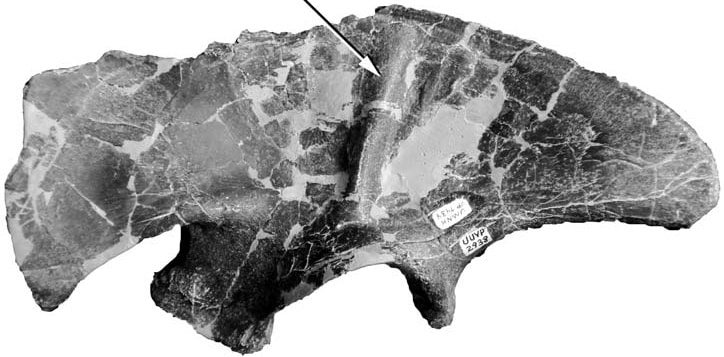
That holotype is UUVP 2938, a left ilium about 220 millimeters (8.7 inches) long. It now belongs to the Natural History Museum of Utah, although published sources disagree on its new catalog number. In his description, Madsen also referred a premaxilla—the tooth-bearing bone at the tip of the upper jaw. As in tyrannosaurids, its lower part is much deeper than it is long, and it held four teeth.
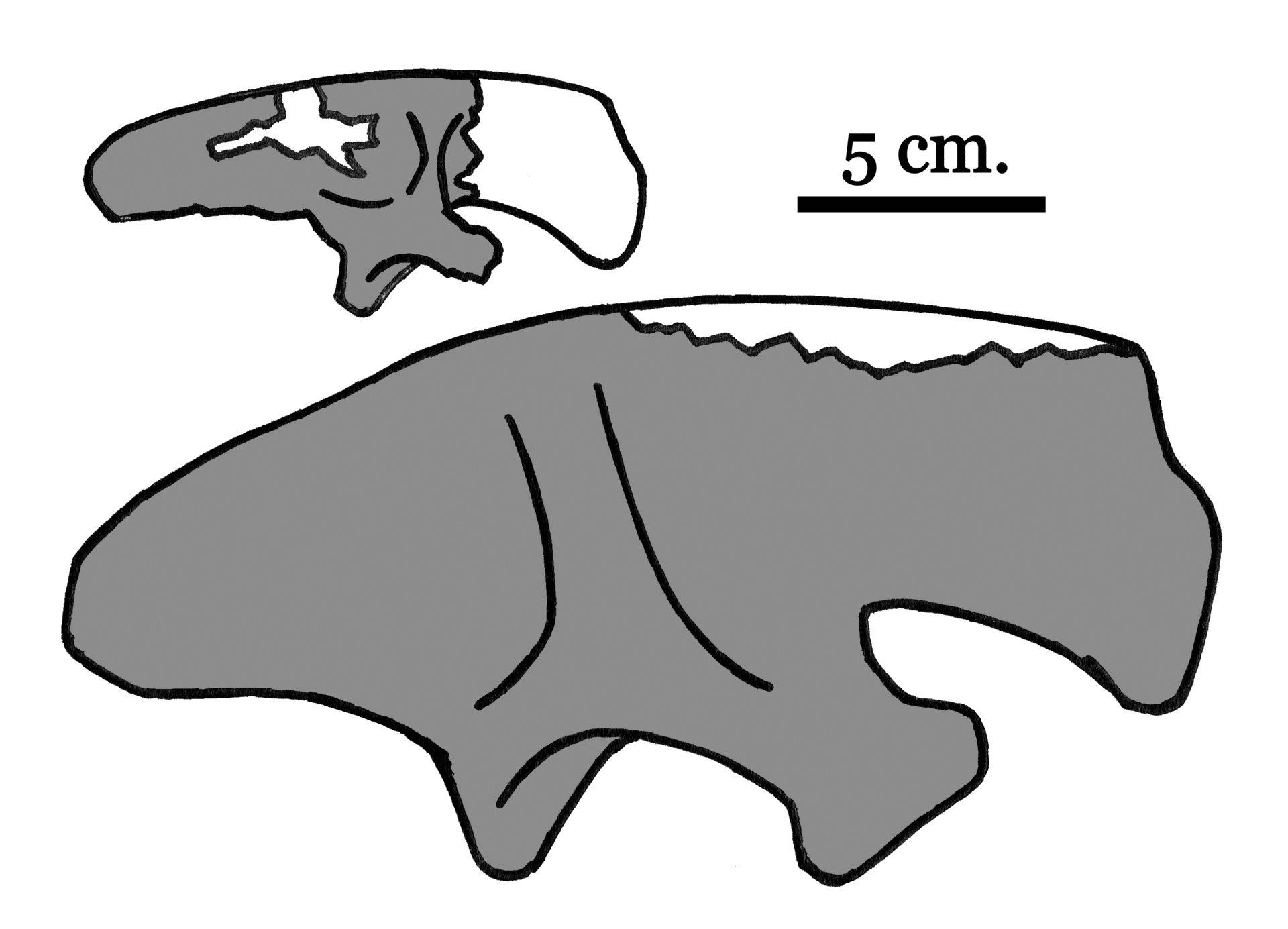

A second, larger ilium from the same quarry measures 330 millimeters (13 inches), and Madsen took the pair to represent two individuals. In 1998, D.J. Chure and Madsen tentatively referred a heavily air-filled braincase from the quarry to the species. Two years later, J.R. Foster and Chure described a small ilium from Wonderland Quarry in Meade County, South Dakota. Foster found it in 1991 inside a Barosaurus block collected in 1980—and it went missing before anyone could catalog it. Britt had also tentatively referred three tail vertebrae from Dry Mesa Quarry, Colorado, which Foster and Chure, citing a 1996 study, called unjustified. In 2008, however, Benson argued that no material beyond the holotype can confidently be assigned to the species, and Brusatte and Benson’s 2013 analysis followed him.
Stokesosaurus Size and Description
With so little of the skeleton secure, any portrait of Stokesosaurus starts and largely ends at the hip.
Short description of Stokesosaurus
The ilium has a semi-oval blade and a narrow notch at its front end, features it shares with Juratyrant. A similar blade shape also appears in Dilong, Sinotyrannus, and Xiongguanlong. As originally described, its defining feature is a distinct median vertical ridge. This ridge climbs from the supra-acetabular hood—the bony roof over the hip socket—to the top edge of the blade. According to a 2002 study by Carrano and Hutchinson, this kind of tyrannosauroid ridge probably separated major hindlimb muscles.
At the rear, the brevis fossa—a groove under the back of the hip blade—ends in a squared-off margin. If the referred premaxilla belongs here, the snout tip was deep, with teeth serrated along the front edge. Small-bodied Morrison coelurosaurs, Stokesosaurus among them, had tooth crowns no larger than 30 millimeters (1.2 inches). No accessible study discusses its posture or skin, so any outer covering is speculative.

Size and Weight of Type Species
In 2004, Holtz wrote that the 22-centimeter ilium suggested an animal only 6.6 to 9.8 feet (2 to 3 meters) long. That figure is an indirect estimate based on a single bone—there is no skeleton to measure.
If the larger quarry ilium belongs to Stokesosaurus, as Madsen thought, at least one individual was considerably bigger—it is half again as long as the holotype. In 1976, Madsen remarked that this larger animal and his new theropod Marshosaurus were “essentially the same size.” At the other extreme, the South Dakota ilium referred to the genus in 2000 measures about 8 centimeters (3.1 inches) as preserved. Complete, it would have reached an estimated 12 centimeters (4.7 inches).
None of the studies we consulted gives a height at the hips or a body weight. However, Brusatte and Benson described Late Jurassic tyrannosauroids as intermediate in size between small early forms and later tyrannosaurids.
The Dinosaur in Detail
In 2000, Foster and Chure called Stokesosaurus the only Morrison theropod with a vertical ridge on the ilium’s outer face. Brusatte and Benson’s 2013 diagnosis, by contrast, rests on a single autapomorphy, a trait unique to the species. Noted by Benson in 2008, it is a swollen rim around the pubic peduncle’s joint—the hip bone’s lower front projection. It is also the only tyrannosauroid whose thick ridge slants up and back to reach the blade’s top edge.
Chure and Madsen described the quarry braincase as extensively pneumatized, or riddled with air spaces, with large pockets on its underside. If it is Stokesosaurus, they suggested, the animal may be the earliest itemirid, the earliest tyrannosaurid, or a lineage that reached that design independently. Rauhut, in contrast, declined to accept the referral. He granted it might be right, but nothing ties it to the ilium in a quarry with several theropod species.
Its family tree remains unsettled. In 2013, Brusatte and Benson recovered Juratyrant and Eotyrannus as sister taxa, with Stokesosaurus as their closest outgroup. They called the support weak—almost certainly because the animal is so fragmentary. That same year, M.A. Loewen and colleagues placed it with Juratyrant and Sinotyrannus inside Proceratosauridae. In 2016, Brusatte and T.D. Carr found a clade with Eotyrannus by parsimony. Their Bayesian analysis, on the other hand, set it closer to the tyrannosaurids.
In 2017, Carr and colleagues first used the name Stokesosauridae for this recurring grouping, and in 2020 C.-G. Yun and Carr formally defined it. In 2022, however, D. Naish and A. Cau placed the Juratyrant–Stokesosaurus pair outside all other tyrannosauroids, again with weak support. Taken together, these studies describe a valid genus whose exact branch is still an open question.
Interesting Points about Stokesosaurus
- According to his obituary, geologist William Lee Stokes had eight fossils named after him, Stokesosaurus among them.
- Madsen’s 1976 census of the quarry counted just two Stokesosaurus individuals, compared with at least 44 of its most common dinosaur.
- Though only about 220 millimeters (8.7 inches) long, the holotype ilium carries the single unique trait that diagnoses the genus.
- The family name Stokesosauridae, first used in 2017 and formally defined in 2020, is built on this genus. As defined, it also takes in Juratyrant and, in some analyses, Eotyrannus.
Contemporary Dinosaurs
Dominating the quarry was Allosaurus, a large theropod and the most common member of the Cleveland-Lloyd fauna. Madsen counted at least 44 individuals from 83 thigh bones—almost three-quarters of the deposit’s dinosaurs. It shares a single mudstone bone bed with Stokesosaurus, but no fossil records contact between them.
Far rarer was Ceratosaurus, a theropod of the family Ceratosauridae that the quarry preserves as one large adult specimen. The two shared the landscape, although no interaction is known.
Close in size to the larger quarry ilium was Marshosaurus, a theropod Madsen named in 1976 from the same collection. The quarry holds two Marshosaurus individuals, but nothing links them to Stokesosaurus beyond their shared bone bed.
Among the plant-eaters was Stegosaurus, the plated ornithischian. Madsen’s census includes at least two Stegosaurus cf. stenops, plus material identified only to genus. It lived in the same time and place as Stokesosaurus, though no evidence connects them directly.
Stokesosaurus in its Natural Habitat
The world Stokesosaurus roamed was one of rivers, floodplains, and lakes. Late Jurassic Utah saw strong seasonality, swinging between arid and monsoonal conditions. The quarry itself formed in a poorly drained overbank setting, where floods washed carcasses into an ephemeral pond. Freshwater ostracods (tiny shelled crustaceans), snails, and charophytes (a kind of green alga) occur in its limestone cap. The turtle Glyptops also turns up there, while crocodilians are known only from two reported shed teeth. Other dinosaurs from the quarry include the sauropod Camarasaurus and the ornithopod Camptosaurus.
In 2023, Lei and colleagues listed Stokesosaurus among the Morrison’s smaller terrestrial carnivores. No direct evidence shows what it hunted. Even so, Brusatte and Benson summed up its wider standing bluntly—Jurassic tyrannosauroids “lived in the shadow of other giant predatory dinosaurs.”
Two Stokesosaurus at one quarry say little about social life. After all, a 2017 study interpreted the deposit as gathering bones over time rather than in a single event. Madsen also put the ratio of carnivorous to herbivorous “kinds” at three to one, out of balance with typical populations. Still, if the South Dakota ilium belongs to it, as Foster and Chure argued, Stokesosaurus, though rare, was not geographically restricted. The quarry braincase also hints that Morrison theropods were more diverse than suspected.
Frequently Asked Questions
The genus honors Utah geologist William Lee Stokes, but the sources we accessed do not explain the species name clevelandi.
It lived in the Late Jurassic, in the Kimmeridgian or Tithonian stage, at least about 147 million years ago.
T.R. Holtz, Jr. estimated a length of about 6.6 to 9.8 feet (2 to 3 meters) from its hip bone. No weight estimate exists in the sources we consulted.
It was most likely a carnivore, one of the Morrison’s smaller meat-eaters, though no direct evidence of its diet survives.
Its holotype comes from the Cleveland-Lloyd Dinosaur Quarry in Emery County, Utah, in the Morrison Formation.
It is the only Morrison theropod with a vertical ridge on the outer surface of its ilium.
Sources
The information in this article is based on various sources, drawing on scientific research, fossil evidence, and expert analysis. The aim is to provide a comprehensive and accurate overview of Stokesosaurus. However, please be aware that our understanding of dinosaurs and their world is constantly evolving as new discoveries are made.
- Madsen, J. H., Jr. (1974). A new theropod dinosaur from the Upper Jurassic of Utah. Journal of Paleontology 48(1): 27–31. (Not consulted directly, cited through later sources.)
- https://doi.org/10.4202/app.2011.0141
- https://archive.org/details/biostor-165248
- https://doi.org/10.34191/ug-3-1_51
- https://ugspub.nr.utah.gov/publications/bulletins/B-109.pdf
- https://geology.byu.edu/0000017d-0710-d1f8-a37f-6778c55e0001/geo-stud-vol-45-foster-chure-pdf
- https://doi.org/10.1080/02724634.1998.10011038
- https://doi.org/10.1671/0272-4634(2008)28[732:NIOSAT]2.0.CO;2
- https://tb.plazi.org/GgServer/html/77323C29FFDCB42DFF1C99F3FC5FFE2A
- https://tb.plazi.org/GgServer/html/012B87EDFF8BD81A4DBE226FD930B78E
- https://geology.byu.edu/0000017c-f2a9-dd9b-a7ff-f2af65580000/geol-stud-vol-37-britt-pdf
- https://doi.org/10.1038/srep20252
- https://doi.org/10.1371/journal.pone.0079420
- https://doi.org/10.7717/peerj.12727
- https://doi.org/10.11646/zootaxa.4755.1.13
- https://doi.org/10.7717/peerj.16327
- https://doi.org/10.7717/peerj.7803
- https://doi.org/10.7717/peerj.3368
- https://spiral.imperial.ac.uk/handle/10044/1/73346
- https://doi.org/10.1002/cne.70056
- https://paleobiodb.org/classic/checkTaxonInfo?taxon_no=38629
- https://www.deseret.com/1994/12/13/19147820/william-l-stokes-dies-pioneer-utah-geologist/
This article was last fact checked: TheDinosaurs Team, 13-11-2026
Featured Image Credit: Tom Parker, CC BY-SA 4.0, via Wikimedia Commons
