
In the Nemegt Basin of Mongolia’s Gobi Desert, the sandstones of the Nemegt Formation hold a site called Altan Ula IV. There, in 1965, a huge sauropod skeleton came to light. Named in 1977, Opisthocoelicaudia skarzynskii is usually placed in the Maastrichtian stage of the Late Cretaceous, roughly 72 to 66 million years ago. Yet, as Fanti and colleagues noted in 2024, no published evidence pins down the age of these rocks. The skeleton was almost complete but had no neck or head. Today this titanosaur sits at the center of a lively question about how many sauropods the Nemegt beds really hold.
Expedition geologist R. Gradziński found the bones while the Polish-Mongolian Palaeontological Expedition explored Altan Ula IV between 10 and 23 June 1965. Within weeks, the team had cut out about 12 metric tons (13 short tons) of bone and rock. Twelve years later, paleontologist Magdalena Borsuk-Białynicka described the animal and placed it among the camarasaurids. Later researchers moved it to Titanosauria.
Opisthocoelicaudia Key Facts
| Keyword | Fact |
|---|---|
| Pronunciation | Not specified |
| Meaning of name | Opisthocoelous Tail (for its tail vertebrae) |
| Group | Sauropoda (Titanosauria) |
| Type Species | Opisthocoelicaudia skarzynskii |
| Diet | Herbivore |
| When it Lived | Roughly 72 to 66 MYA, possibly a little older (not directly dated) |
| Period | Cretaceous |
| Epoch | Late Cretaceous (Maastrichtian stage, possibly late Campanian) |
| Length | Not specified |
| Height | Not specified |
| Weight | About 56,000 pounds (25.4 metric tons), indirect estimate by Benson et al. 2014 |
| Mobility | Moved on all four legs (quadrupedal) |
| First Discovery | 1965 by R. Gradziński, Polish-Mongolian Palaeontological Expedition |
| Described by | 1977 by Magdalena Borsuk-Białynicka |
| Holotype | ZPAL MgD-I/48 (now MPC-D 100/404) |
| Location of first find | Altan Ula IV (also spelled Altan Uul IV), Nemegt Formation, Nemegt Basin, Ömnögovi Province, Mongolia |
Opisthocoelicaudia Origins, Taxonomy and Timeline
The name Opisthocoelicaudia points straight at the tail. Borsuk-Białynicka coined it “because of the opisthocoelian structure of the anterior caudals”—the front tail vertebrae. In an opisthocoelous vertebra, the front face of the centrum (vertebral body) bulges while the rear face is hollowed into a cup. The species name skarzynskii honors Wojciech Skarzynski, who prepared the specimen.
In 1977, Borsuk-Białynicka tentatively placed the genus in the family Camarasauridae and the subfamily Euhelopodinae. She also recognized features shared with titanosaurids and atlantosaurids but rejected an atlantosaurid placement because of the opisthocoelous tail. Since the 1990s, however, researchers such as Wilson and Sereno have treated it as a titanosaur. Many analyses since the late 1990s have also placed it in Saltasauridae, often in a subgroup called Opisthocoelicaudiinae, a name coined in 1990. In 2024, one of Mocho and colleagues’ analyses grouped it there with Alamosaurus, Abditosaurus, and the Spanish Qunkasaura—though only “perhaps,” in the authors’ words. Opisthocoelicaudia skarzynskii is the type and only known species.
Borsuk-Białynicka gave the type horizon as the Nemegt Formation, of “?Upper Campanian or Lower Maastrichtian” age. Later authors usually treat the formation as Maastrichtian. Fanti and colleagues, however, called the usual early Maastrichtian label a convention without biostratigraphic or radioisotopic backing. The age is therefore a working estimate, not a measured date.
Discovery & Fossil Evidence
Gradziński spotted the skeleton in the northern Altan Ula IV outcrops, and excavation ran from 25 June to 7 July 1965. It lay on a raised rock shelf, more than half a kilometer (a third of a mile) from the nearest point vehicles could reach, so the crew dragged the blocks out on “stone boats” made from empty fuel drums.
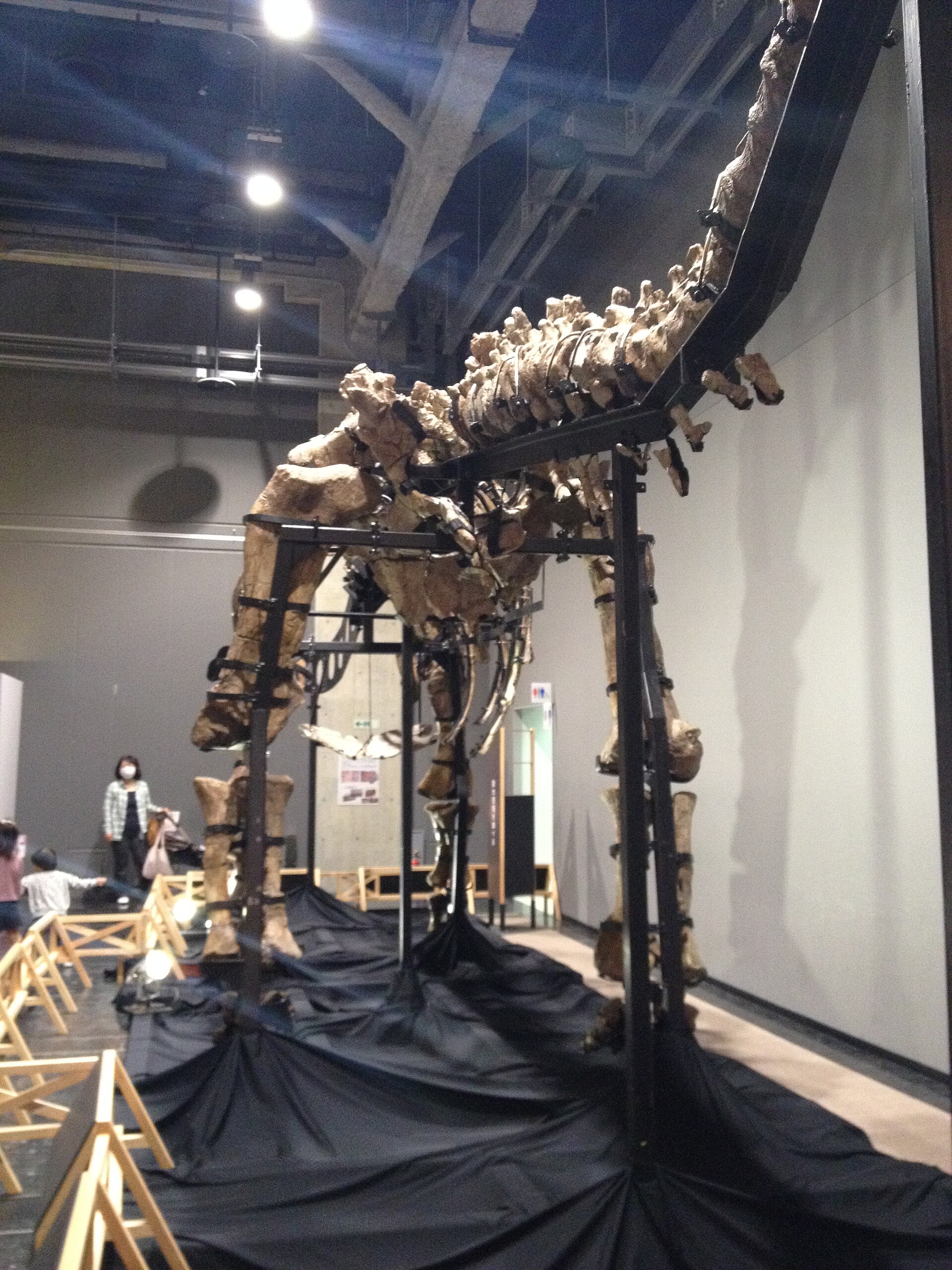
The holotype, ZPAL MgD-I/48, first went to Warsaw’s Institute of Paleobiology—today it is MPC-D 100/404 at the Institute of Paleontology and Geology in Ulaanbaatar. Borsuk-Białynicka described “an almost complete postcranial skeleton lacking cervicals,” or neck vertebrae. It includes the dorsal (back) vertebrae, sacrum (hip vertebrae), tail, forelimbs with the shoulder girdle and sternal (breastbone) plates, pelvis, and partial hindlimbs. These bones belonged to an old individual, and she also referred a young animal’s scapula (shoulder blade) and coracoid, ZPAL MgD-I/25c, to the species.
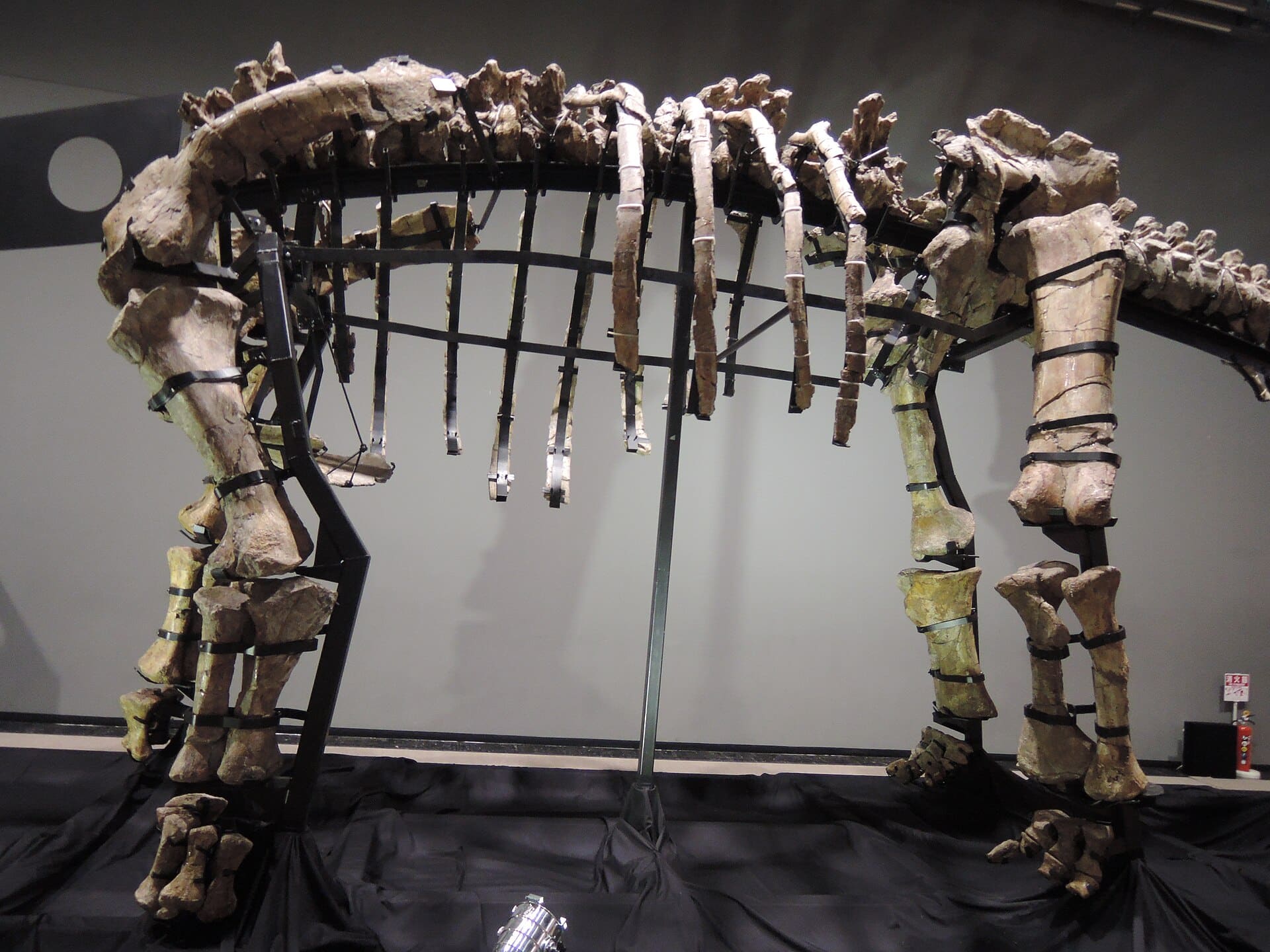

Borsuk-Białynicka described the skeleton in “a ventral attitude” with spread limbs, and in her view the neck and head “must have been separated before burial.” Gradziński, whom she cited, had described it “in a dorsal position,” with the ribs in one horizontal plane. Neither author defined the terms, so how it lay is not entirely clear. She saw gnawing marks on the pelvis and right femur as the work of carrion feeders but named no scavenger.
In 2018, Currie and colleagues reported relocating the quarry, giving 2007 in one passage and 2009 in another. Windblown sand had filled it, so it is impossible to tell whether more holotype bones remain. They also suggested, only conditionally and on relative size, that a pair of claws from near the Nemegtosaurus site belongs to Opisthocoelicaudia.
Opisthocoelicaudia Size and Description
Short description of Opisthocoelicaudia
Borsuk-Białynicka called it a “species of medium size and of straight-backed type.” Its back vertebrae carried neural spines split into two low prongs, a bifid (forked) arrangement. Six vertebrae formed the sacrum, and about 35 tail vertebrae followed without pleurocoels—the hollows that pierce the sides of many sauropod vertebrae. Beneath the tail, the chevrons (small spined bones) were unforked and stopped at the 19th caudal. She reconstructed the tail as held horizontally, clear of the ground.
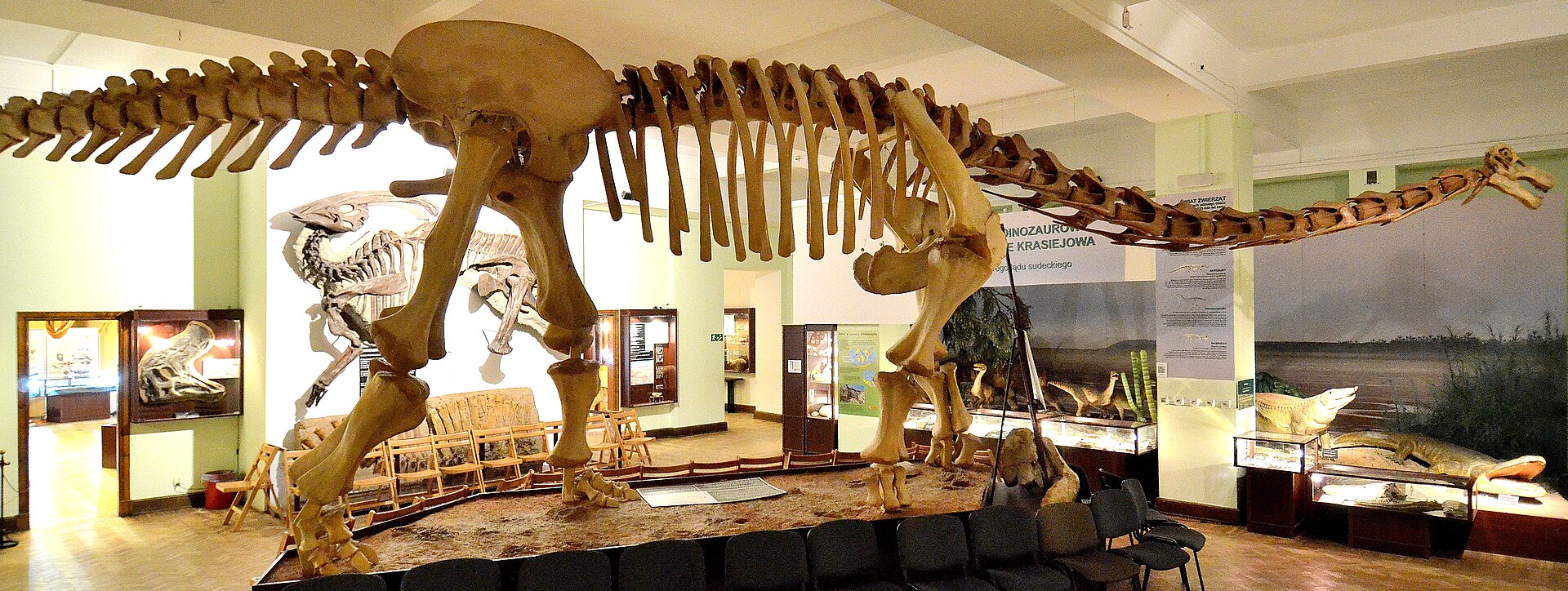

Its forelimb was about three-quarters the length of the hindlimb, with the humerus about 72 percent of the femur’s length. No carpals (wrist bones) were found. She thought they had never ossified, or turned to bone, but allowed that excavation might have lost them. The ankle lacked a calcaneum (heel bone), and its main bone, the astragalus, was reduced. Overall, she judged the limbs “pillar-like, graviportal”—built to carry great weight. She also ranked the sternal plates among the largest known in sauropods relative to body size.
The neck and skull remain unknown—Borsuk-Białynicka reconstructed a neck of medium length, about 5 meters (16 feet), carried low, from inferred muscles and ligaments. Any restored head is therefore speculative, as is any skin texture or color.
Size and Weight of Type Species
The original description gives no total length. Instead, Kielan-Jaworowska and Dovchin’s 1968 narrative of the expeditions calls it “a huge sauropod, about 20 m long” (66 feet), an impression that predates any study and is not a scientific estimate. Measured bones give firmer ground—the right femur is 139.5 centimeters (4.6 feet) long, and the humerus 100 centimeters (3.3 feet).
As mounted, the forelimb stands 2.74 meters (9 feet) to the scapula’s top and the hindlimb 2.46 meters (8.1 feet), though these are mount measurements rather than true body heights. For weight, Benson and colleagues in 2014 estimated about 56,000 pounds (25.4 metric tons). They scaled that figure from the shaft circumferences of the humerus and femur, so it is an indirect estimate.
Still, footprints cited by Currie and colleagues point to Nemegt sauropods “much larger” than the holotypes of either genus. Meanwhile, the femur found with Nemegtosaurus is 124 centimeters (4.1 feet) long—about 11 percent shorter than that of Opisthocoelicaudia.
The Dinosaur in Detail
What sets this dinosaur apart is its tail. Many titanosaurs have procoelous front tail vertebrae, cupped at the front, but Opisthocoelicaudia reversed that pattern in the front half of its tail. Wilson in 2002 treated these caudals, and a lamina (bony strut) in the middle and rear back vertebrae, as unique to the genus, later authors report. Currie and colleagues, however, found an opisthocoelous tail vertebra with Nemegtosaurus, so the trait may not be unique. A 2004 study also reported such tail vertebrae in the Chinese titanosaur Borealosaurus. Its split dorsal spines are less distinctive—Mannion and colleagues list similar spines in mamenchisaurids, turiasaurs, many diplodocoids, and Camarasaurus.
Other traits tie it to particular titanosaurs. Its ischium, a lower hip bone, is short relative to the pubis, as in Rapetosaurus and Savannasaurus. Its second toe claw is about as large as the first, unlike in other titanosaurs, a trait Wilson used in 2002 to diagnose the genus. Borsuk-Białynicka also proposed an occasional tripodal stance, with the tail as a prop—what she called “occasional bipediality.” She linked it to feeding and to “Megatherium-like habits,” meaning rearing up like the giant ground sloth.

Its exact branch is still shifting. In 2019, Mannion and colleagues recovered it as the sister taxon of Alamosaurus in some of their analyses. Yet they noted that no phylogenetic analysis had studied it first-hand, and that many features cannot be properly judged from the photographs and drawings in the original and only publication. With a second dataset, Mocho’s team found it in a polytomy—an unresolved branch point—with Mansourasaurus and two saltasaurid subgroups. Overall, several analyses place it near other Laurasian titanosaurs such as Alamosaurus, though its closest relatives shift from one dataset to the next.
The Nemegtosaurus Question
The largest open problem is whether Opisthocoelicaudia and Nemegtosaurus are one animal. Nemegtosaurus was first known from a skull, found by the same 1965 expedition. In 1977, Borsuk-Białynicka wrote that the geology “neither contradicts nor confirms” their identity, and she kept them apart. A 2014 conference abstract by Madzia and Borsuk-Białynicka then reported new material that “supports the conspecificity” of the two. In 2018, Currie and colleagues recovered postcranial bones of Nemegtosaurus and, in a preliminary comparison, found no significant differences in size or shape. They called the two “possibly even synonymous,” but added that “caution leads us to wait” for more of the skeleton.
That same year, Funston and colleagues judged the status of O. skarzynskii “questionable.” In 2019, by contrast, Averianov and Lopatin described five back vertebrae from the Nemegt locality that differ from Opisthocoelicaudia. To them, this “unequivocally” indicates two sauropod taxa in the formation. Mannion and colleagues agreed that year that the new specimens suggest distinct taxa. The question remains open, and Mocho’s 2024 analyses, which left out Nemegtosaurus, still score Opisthocoelicaudia as its own genus.
Interesting Points about Opisthocoelicaudia
- The holotype and its rock weighed about 12 metric tons and filled 35 crates, hauled out on sledges made from empty fuel drums.
- Its name refers to its opisthocoelous front tail vertebrae, the reverse of many other titanosaurs.
- Gnawing marks on the pelvis and right femur came from carrion feeders, its describer argued, though she named no scavenger.
- Borsuk-Białynicka placed it among the camarasaurids, but researchers have classified it as a titanosaur since the 1990s.
- Currie and colleagues suspect the Nemegt Formation held no more than a single sauropod species, while Averianov and Lopatin argue for two.
Dinosaurs from the Same Formation
Also known from the Nemegt Formation (exact level relative to Opisthocoelicaudia not known): Tarbosaurus, Deinocheirus and the troodontid Borogovia, all three also found at Altan Ula IV, plus Saurolophus and Therizinosaurus. No recorded bed ties any of them to the sauropod quarry, and the formation’s age is only broadly known, so these animals may not all have lived at the same time.
Opisthocoelicaudia in its Natural Habitat
The world Opisthocoelicaudia roamed was a plain crossed by numerous, laterally migrating river channels. Gradziński described the dinosaur-bearing Nemegt beds as fossil floodplain deposits dominated by point-bar and channel-bar sediments. He concluded that most dinosaur remains there were buried at or near the place of death. Yet rivers did not build the whole landscape—in 2024, Fanti and colleagues documented well-developed windblown dunes in beds at Guriliin Tsav that they correlated to the middle Nemegt Formation.
Borsuk-Białynicka suggested this herbivore belonged to “a group feeding from high vegetation,” perhaps rearing on its hind legs and tail to reach it, though she offered this only as a hypothesis.
Currie and colleagues read the few species per large-animal family as a sign of “a stressed environment, probably with a relatively restricted geographic area.” Sauropod remains, though less common than those of theropods and hadrosaurs, turn up at 34 Nemegt Formation sites.
Frequently Asked Questions
It refers to the opisthocoelous front tail vertebrae, and the species name skarzynskii honors preparator Wojciech Skarzynski.
It probably lived in the Maastrichtian stage of the Late Cretaceous, about 72 to 66 million years ago, or possibly a little earlier. No published evidence pins down its age directly.
Its original description gives no length, and the published expedition narrative’s “about 20 m” (66 feet) is not a scientific estimate. A 2014 study put its weight at about 56,000 pounds.
It was a herbivore, and its describer proposed that it may have fed from high vegetation.
It was found in 1965 at Altan Ula IV, in the Nemegt Formation of Mongolia’s Gobi Desert.
The front half of its tail had opisthocoelous vertebrae, unlike the front-cupped tail vertebrae of many titanosaurs. An opisthocoelous tail vertebra found with Nemegtosaurus, however, suggests the trait may be shared.
Sources
The information in this article is based on various sources, drawing on scientific research, fossil evidence, and expert analysis. The aim is to provide a comprehensive and accurate overview of Opisthocoelicaudia. However, please be aware that our understanding of dinosaurs and their world is constantly evolving as new discoveries are made.
- https://www.palaeontologia.pan.pl/Archive/1977-37_5-64_1-14.pdf
- https://doi.org/10.1016/j.palaeo.2017.10.035
- https://hdl.handle.net/11585/622592
- https://www.app.pan.pl/archive/published/app64/app005962019.pdf
- https://www.palaeontologia.pan.pl/Archive/1968-19_7-30_1-4.pdf
- https://www.palaeontologia.pan.pl/Archive/1969-21_147-232_35-42.pdf
- https://www.app.pan.pl/archive/published/app32/app32-133.pdf
- https://doi.org/10.1371/journal.pbio.1001853
- https://doi.org/10.1038/s42003-024-06653-0
- https://doi.org/10.1098/rsos.191057
- https://doi.org/10.1016/j.dib.2017.11.086
- https://cris.unibo.it/retrieve/handle/11585/977255/d7461530-70b7-4c26-af05-70e3d7332b6d/1-s2.0-S0195667124000892-main.pdf
- https://stratigraphy.org/ICSchart/ChronostratChart2024-12.pdf
- https://paleobiodb.org/data1.2/taxa/single.json?name=Opisthocoelicaudia&show=attr,app,ecospace,class
- https://doi.org/10.1038/nature13874
- https://paleobiodb.org/data1.2/taxa/opinions.json?name=Opisthocoelicaudia&show=attr
- https://paleobiodb.org/data1.2/taxa/refs.json?name=Borealosaurus&select=taxonomy&show=both
This article was last fact checked: TheDinosaurs Team, 14-11-2026
Featured Image Credit: FunkMonk, CC BY-SA 3.0, via Wikimedia Commons
