
Near Lamadong Town in western Liaoning, the Early Cretaceous rocks of the Jiufotang Formation have yielded a remarkably complete dromaeosaurid. Named Norellraptor barsboldi in 2026, it belongs to the microraptorines—small dromaeosaurids known mainly from the Jehol Biota of northeastern China. In the Jianchang Basin, its formation dates to roughly 122 to 119 million years ago. Its real importance, however, lies in what its skeleton reveals about how flight-related features came together.
A local farmer found the skeleton near Lamadong, and an anonymous donor gave it to the Museum of Hebei GEO University in 2023. Three years later, paleontologist Xuri Wang and six colleagues named it in Nature Communications. Their analysis found that microraptorines and birds acquired many similar features in a different order. On that basis, the authors argue that the two groups assembled their flight apparatus independently.
Norellraptor Key Facts
| Keyword | Fact |
|---|---|
| Pronunciation | Not specified |
| Meaning of name | Norell’s Robber |
| Group | Theropoda (Dromaeosauridae, Microraptorinae) |
| Type Species | Norellraptor barsboldi |
| Diet | Not specified |
| When it Lived | 122 to 119 MYA (formation-level date, Jianchang Basin) |
| Period | Cretaceous |
| Epoch | Early Cretaceous (latest Barremian to Aptian stages) |
| Length | 22.4 inches (57 centimeters), measured skeleton of a not fully grown individual |
| Height | Not specified |
| Weight | Not specified |
| Mobility | Not specified |
| First Discovery | Year not specified, by a local farmer near Lamadong Town, donated to the museum in 2023 |
| Described by | 2026 by X. Wang, Y. Ji, A. Cau, M. Kundrát, Y. Liu, Y. Wang, and Q. Ji |
| Holotype | 130108-MHGU-F4281 |
| Location of first find | Lamadong Town, Jianchang County, western Liaoning, China (Jiufotang Formation) |
Norellraptor Origins, Taxonomy and Timeline
The name Norellraptor honors American paleontologist Mark Allen Norell (1957–2025). To his name, the describers added the Latin raptor, meaning “robber”—in their words, “a frequently used suffix in dromaeosaurid taxonomy.” Meanwhile, the species name barsboldi honors Mongolian paleontologist Rinchen Barsbold (1935–2025). Together, the name ties a familiar dromaeosaurid suffix to two scientists whom the describers credit with “exceptional contributions” to the study of bird-like dinosaurs.
Three features mark this theropod as a dromaeosaurid: ziphodont (blade-like, serrated) teeth, a caudotheca (a sheath of bony rods around the tail), and an enlarged sickle claw on the second toe. Within the subfamily Microraptorinae, it falls in Microraptorini, the largest group that includes Microraptor but not Sinornithosaurus. The analysis nests it “among late-diverging microraptorines,” with Zhongjianosaurus as its sister taxon. However, some branches remain unstable, since Graciliraptor and Sinornithosaurus swap places when every character counts equally. Norellraptor barsboldi is the type and only known species.
The paper itself gives the age only as “Lower Cretaceous.” In 2021, Yu and colleagues dated the Jiufotang Formation in the Jianchang Basin to about 122.0 to 118.9 million years ago. By their reckoning, that window spans the latest Barremian and the Aptian. A 2026 study of another Lamadong dinosaur likewise treats the site as Aptian. Still, none of these studies dates the bed that held Norellraptor. According to Yu and colleagues, the formation records the late phase of the Jehol Biota.
Discovery & Fossil Evidence
The paper places the find near Lamadong Town but gives no year of discovery—only the 2023 donation. These details entered the paper during peer review, after one reviewer asked who found the fossil, when, and how the museum acquired it. The authors also checked the specimen’s integrity and “ascertained the original fossil locality.”
The holotype, 130108-MHGU-F4281, belongs to the Museum of Hebei GEO University in Shijiazhuang, China. It is a complete skeleton with only “moderate disarticulation of the appendicular girdles,” the bones that anchor the limbs. Both hands survive whole, alongside a well-preserved, fused braincase and part of the feather imprints. In the authors’ view, its completeness, near-undisturbed articulation, and microraptorine features in every region “unambiguously support the integrity of the specimen.”

Neither the paper nor its supplementary data lists any referred specimens. No other specimens have been referred to Norellraptor, so it rests on a single individual.
Norellraptor Size and Description
Short description of Norellraptor
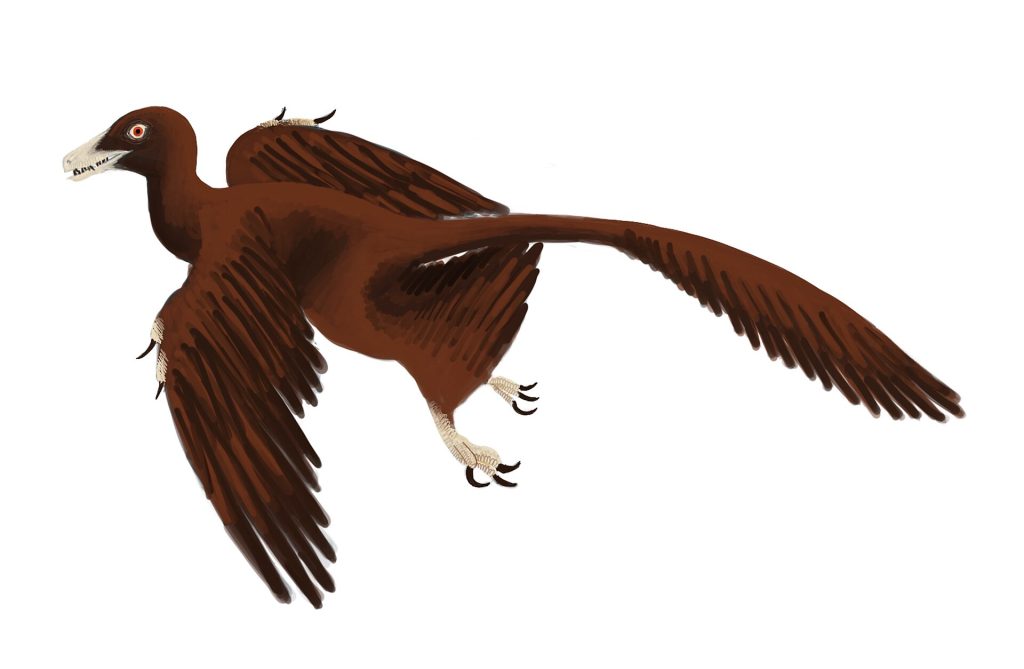
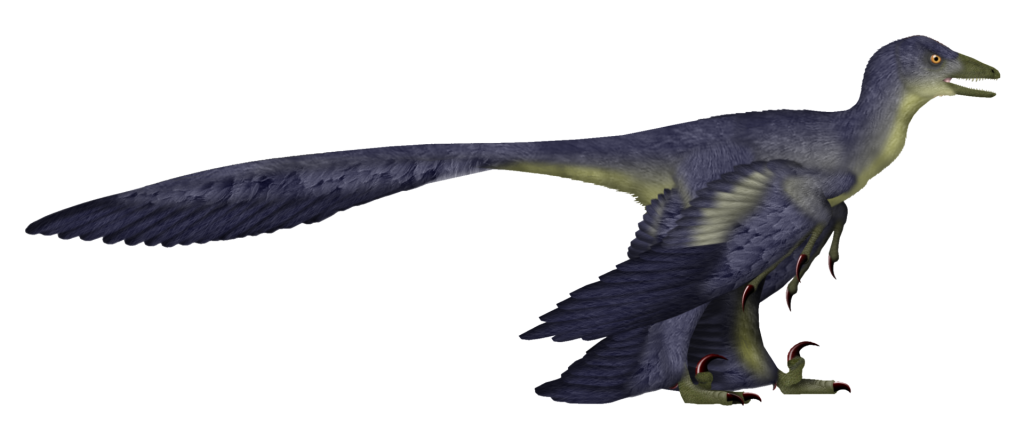
In side view, the skull was subtriangular, with a vaulted frontoparietal region (the rear skull roof) and a moderately long snout. The antorbital fenestra—the large opening in front of the eye—was “D”-shaped and 150% taller than long. Two unserrated teeth show in the premaxilla (the front of the upper jaw), and seven sit in the maxilla. At least 16 more line the left dentary, or lower jaw. These teeth varied strongly in size, and the best-preserved ones carried serrated edges with hooked denticles along the rear margin.
Behind the head, the scapula and coracoid (shoulder blade and its partner bone) had fused together. The sternal plates (breastbone plates) were long, at about 40% of the length of the femur (thigh bone). Unlike in some Microraptor specimens, they stayed separate at the midline. The hind limbs were gracile, and the second toe bore a sickle claw. Feathers survive poorly, though the forelimb probably carried asymmetrical pennaceous (vaned) feathers. Those at the tail tip were rachis-dominated (dominated by the central shaft), while the rest appear straight and simple.

Size and Weight of Type Species
Wang and colleagues report a skeleton 22.4 inches (57 centimeters) long—a direct measurement rather than an estimate. The tail alone accounts for 12.8 inches (326 millimeters). The skull measures 2.6 inches (67 millimeters), and the femur 2.8 inches (71 millimeters).
Neither the paper nor its supplement offers a body mass or hip height.
The measured animal had also not finished growing, since its sampled radius lacks an external fundamental system—the tightly packed outer layers that mark the end of growth. Its adult size is therefore unknown. The paper, however, describes its stage in two ways. The description calls it post-juvenile, citing its bone tissue, fully fused lower-leg and foot bones, and smooth bone surfaces. Yet the histology section concludes that it died “during the late juvenile period.”
The Dinosaur in Detail
One of the most distinctive features of Norellraptor is a window in its snout. Its promaxillary fenestra, one of the openings ahead of the eye, was larger than the maxillary fenestra beside it. This opening also filled the whole front third of the antorbital fossa, the hollow around those openings. The describers count this among its autapomorphies—traits found in no other species. The other two involve the narrow bony struts between the snout openings and a gently curved pubis (a hip bone) ending in a small foot.
Farther back, an elliptical opening pierced the deltopectoral crest (a muscle ridge) of the humerus, or upper arm bone, as in Microraptor, though smaller than the one in Zhongjianosaurus. Like its sister taxon, Norellraptor had a bulbous process at the wrist end of the ulna (a forearm bone). Both also show extensive fusion of the upper metatarsal (foot bone) shafts and an arctometatarsalian foot. In that arrangement, the middle metatarsal pinches in near the ankle—a condition the authors call “absent in other dromaeosaurids” apart from Zhongjianosaurus. Their differential diagnosis also separates it from Changyuraptor, Graciliraptor, Microraptor, Hesperonychus, Sinornithosaurus, and Wulong.
The new skeleton changes how its relatives are read, too. Consider a bony lip over the rear upper corner of the maxillary fenestra, once thought unique to Microraptor. The authors now reinterpret it as a synapomorphy of Microraptorini—a trait the whole group shares. Meanwhile, the fused braincase is better preserved than those of other microraptorines, and its sides are extensively pneumatized (hollowed by air spaces).
Flight Features, Assembled Twice
Traits like these feed the paper’s broadest argument. Of 194 apomorphies (newly evolved traits) the team mapped on microraptorine branches, about 30%—57 features—also arose separately in Avialae, the lineage that includes birds. Forcing microraptorines into Avialae cost 23 extra steps in the family tree. Even then, they fell stem-ward of (farther from modern birds than) Archaeopteryx and the anchiornithines. Moreover, the order in which the shared features appeared showed no significant match between the two lineages. In microraptorines, the finger bones shortened first, while a fused wrist and hand, a pierced deltopectoral crest, and a longer sternum came later—a sequence reversed in birds.
On that basis, the authors “dismiss the common origin” of the two flight apparatuses. They also challenge the idea that one shared developmental program, a single “deep homology,” drove both. Beyond microraptorines, they recovered halszkaraptorines and unenlagiines—the groups of Halszkaraptor and Unenlagia—closer to birds than dromaeosaurids and troodontids are. They call this “the most significant result” of their analysis, although they acknowledge that it challenges several earlier studies. Finally, they float a peculiar, early-developing forelimb pattern in four-winged paravians such as microraptorines, while stressing that the evidence is “preliminary.”
Interesting Points about Norellraptor
- Mark Norell and Rinchen Barsbold, its two honorees, both died in 2025, a year before its description appeared.
- One peer reviewer judged that the material justifies “the assessment of it as a new taxon,” and no published study has questioned it since.
- Its radius shows two growth lines, but the authors suggest it was “minimally three years old” because resorption around the enlarged marrow cavity probably removed at least one earlier zone.
- In that same bone, the marrow cavity lacks spongy bone struts, which the authors read as a sign that air spaces reached deep inside.
Dinosaurs from the Same Formation
Also known from the Jiufotang Formation (exact level relative to Norellraptor not known): Changzhousaurus, Microraptor, Wulong, and Chuanqilong. Changzhousaurus, named in 2026, comes from the same Lamadong area, though neither paper reports the bed. Its describer considers it a small, feathered pennaraptoran, “likely an early-diverging deinonychosaurian,” about 13.4 inches (34 centimeters) long. In 2000, the describers of Microraptor called it the first mature non-avian dinosaur found that is smaller than Archaeopteryx. In 2008, Benton and colleagues listed it among the formation’s dinosaurs. Wulong is a microraptorine known from a complete, articulated immature skeleton, while Chuanqilong is a basal ankylosaurid (an early armored dinosaur) known from a nearly complete skeleton. However, the 122-to-119-million-year dates come from the Jianchang Basin, and other basins differ somewhat. These animals therefore may not all have lived at the same time.
Norellraptor in its Natural Habitat
The world Norellraptor inhabited was likely one of lakes and volcanic ash. Zhong and colleagues (2021) describe the wider Jehol Biota as a “volcanic-influenced” ecosystem whose fossils lie in “lacustrine and occasionally fluvial sediments”—lake and occasional river deposits. In the Jiufotang Formation, tuffs (volcanic ash beds) sit between fossil-bearing layers near Chaoyang and in the Jianchang Basin. Elsewhere in the formation, in the Fuxin Basin, Ying and colleagues described coniferous forests and a “sub-humid warm temperate climate with seasonal changes.” Whether that picture held around Lamadong is not known. Birds were part of this world too—Yu and colleagues credit the formation with “the most abundant fossil records of the Mesozoic birds.”
The describers do not state what Norellraptor ate. Some of its lower tooth crowns narrowed at the base, but the paper draws no dietary conclusion from its teeth. Likewise, the paper makes no claim that Norellraptor itself glided or flew—its flight arguments concern microraptorines as a group.
While there is no direct evidence of whether Norellraptor lived alone or in groups, its bones preserve part of its life story. By the authors’ reckoning, it was older than the Wulong holotype and a Sinornithosaurus specimen, both under two years old. However, it was younger than the Changyuraptor holotype, which was at least five. They also suggest that a mix of fast and slow growth signals “was perhaps related to” unknown physiological troubles. For one small, not-yet-adult skeleton, it carries a large share of the flight story.
Frequently Asked Questions
It means “Norell’s robber,” honoring Mark Norell, while the species name barsboldi honors Rinchen Barsbold.
It lived in the Early Cretaceous, probably in the latest Barremian or Aptian stage. In the Jianchang Basin, its formation is dated to about 122 to 119 million years ago.
The only known skeleton measures 22.4 inches (57 centimeters) long, and no weight estimate has been published.
It was a feathered microraptorine dromaeosaurid, related to Microraptor, with Zhongjianosaurus as its closest relative in the describers’ analysis.
Its describers do not state a diet, although its best-preserved teeth had serrated edges with hooked denticles.
A local farmer found it near Lamadong Town in Jianchang County, western Liaoning, China, in the Jiufotang Formation.
Sources
The information in this article is based on various sources, drawing on scientific research, fossil evidence, and expert analysis. The aim is to provide a comprehensive and accurate overview of Norellraptor. However, please be aware that our understanding of dinosaurs and their world is constantly evolving as new discoveries are made.
- https://www.nature.com/articles/s41467-026-77804-6
- https://static-content.springer.com/esm/art%3A10.1038%2Fs41467-026-77804-6/MediaObjects/41467_2026_77804_MOESM1_ESM.pdf
- https://static-content.springer.com/esm/art%3A10.1038%2Fs41467-026-77804-6/MediaObjects/41467_2026_77804_MOESM3_ESM.pdf
- https://doi.org/10.1016/j.palaeo.2021.110657
- https://doi.org/10.1029/2004GL019790
- https://www.vertpala.ac.cn/EN/10.19615/j.cnki.2096-9899.260616
- https://www.nature.com/articles/35047056
- https://doi.org/10.1002/ar.24343
- https://doi.org/10.1371/journal.pone.0104551
- https://doi.org/10.1016/j.revpalbo.2024.105270
- https://academic.oup.com/nsr/article/8/6/nwab063/6217052
- https://research-information.bris.ac.uk/en/publications/the-remarkable-fossils-from-the-early-cretaceous-jehol-biota-of-c/
This article was last fact checked: TheDinosaurs Team, 18-11-2026
Featured Image Credit: Connor Ashbridge, CC BY 4.0, via Wikimedia Commons
