
Near Sihetun in western Liaoning, China, gray Yixian Formation shales hold the bones of a small, feathered predator. Named Sinornithosaurus millenii in 1999, this dromaeosaurid lived about 125 million years ago—a meat-eating theropod with a strikingly birdlike build. Its describers found it “remarkably similar to early birds” behind the skull. It was also the first dromaeosaurid recognized with a filamentous body covering.
Paleontologists Xu Xing, Wang Xiao-Lin, and Wu Xiao-Chun described the animal in Nature in 1999. It was the first dromaeosaurid described from China and one of the only Jehol theropods collected by professional paleontologists. In 2001, Xu and Wu went further—early dromaeosaurids, they argued, were more birdlike than their later relatives.
Sinornithosaurus Key Facts
| Keyword | Fact |
|---|---|
| Pronunciation | SINE-or-nith-oh-SAWR-us |
| Meaning of name | Chinese Bird Lizard |
| Group | Theropoda (Dromaeosauridae, Microraptorinae) |
| Type Species | Sinornithosaurus millenii |
| Diet | Carnivore |
| When it Lived | Around 125 MYA |
| Period | Cretaceous |
| Epoch | Early Cretaceous (Barremian stage) |
| Length | About 3.3 feet (1 meter) for a referred individual larger than the holotype (Xing et al. 2012) |
| Height | Not specified |
| Weight | About 0.64 to 4.3 pounds (0.29 to 1.94 kilograms), femur-based estimates for NGMC 91 and a smaller specimen (Dececchi et al. 2016) |
| Mobility | Moved on two legs (bipedal) |
| First Discovery | Year not specified, holotype collected by professional paleontologists |
| Described by | 1999 by X. Xu, X.-L. Wang, and X.-C. Wu |
| Holotype | IVPP V12811 |
| Location of first find | Sihetun, Beipiao, western Liaoning, China (lower Yixian Formation, Jianshangou member) |
Sinornithosaurus Origins, Taxonomy and Timeline
The name Sinornithosaurus means “Chinese bird lizard,” according to London’s Natural History Museum and the Australian Museum. Together, the name ties the animal to its homeland and to the birdlike skeleton that made it famous.
Sinornithosaurus belongs to Theropoda and, more specifically, to Dromaeosauridae. In 1999, Xu and colleagues found dromaeosaurids the most birdlike of the feathered theropods—closer to birds than troodontids. They also called it “probably the earliest dromaeosaurid yet discovered.” Later finds such as Shanag, from Mongolia’s Öösh Formation, have since made that claim uncertain. By 2009, Longrich and Currie counted it in Microraptorinae, a subgroup that also includes Microraptor—and Turner, Makovicky, and Norell agreed in 2012. In 2026, Wang and colleagues defined a narrower clade, Microraptorini, that by definition leaves Sinornithosaurus just outside, in a position that varied between trees. Liu and colleagues named a second species, S. haoiana, in 2004. However, Turner’s team later sank it into S. millenii, the type and generally the only species recognized today.
In 2021, Zhong and colleagues used uranium-lead dating to place the Jin-Yang basin’s Yixian Formation between about 125.8 and 124.1 million years ago. Earlier argon dating gave 125.42 million years for the lower Yixian at Sihetun. Both results fall within the Barremian stage of the Early Cretaceous, though the Paleobiology Database uses a broader Barremian–Aptian range. The whole formation spans only about 1.6 million years—yet volcanic ash and quiet lakes recorded that brief window in exceptional detail.
Discovery & Fossil Evidence
Sihetun, near Beipiao, is in the words of the 1999 paper “the famous Mesozoic fish–dinosaur–bird locality” in China. The Institute of Vertebrate Paleontology and Paleoanthropology, or IVPP, excavated its lower sediments in 1997–98. Yet no available source ties the holotype to those digs or names its collector and discovery year. S.-H. Xie prepared the specimen, and Nature received the paper on March 26, 1999.
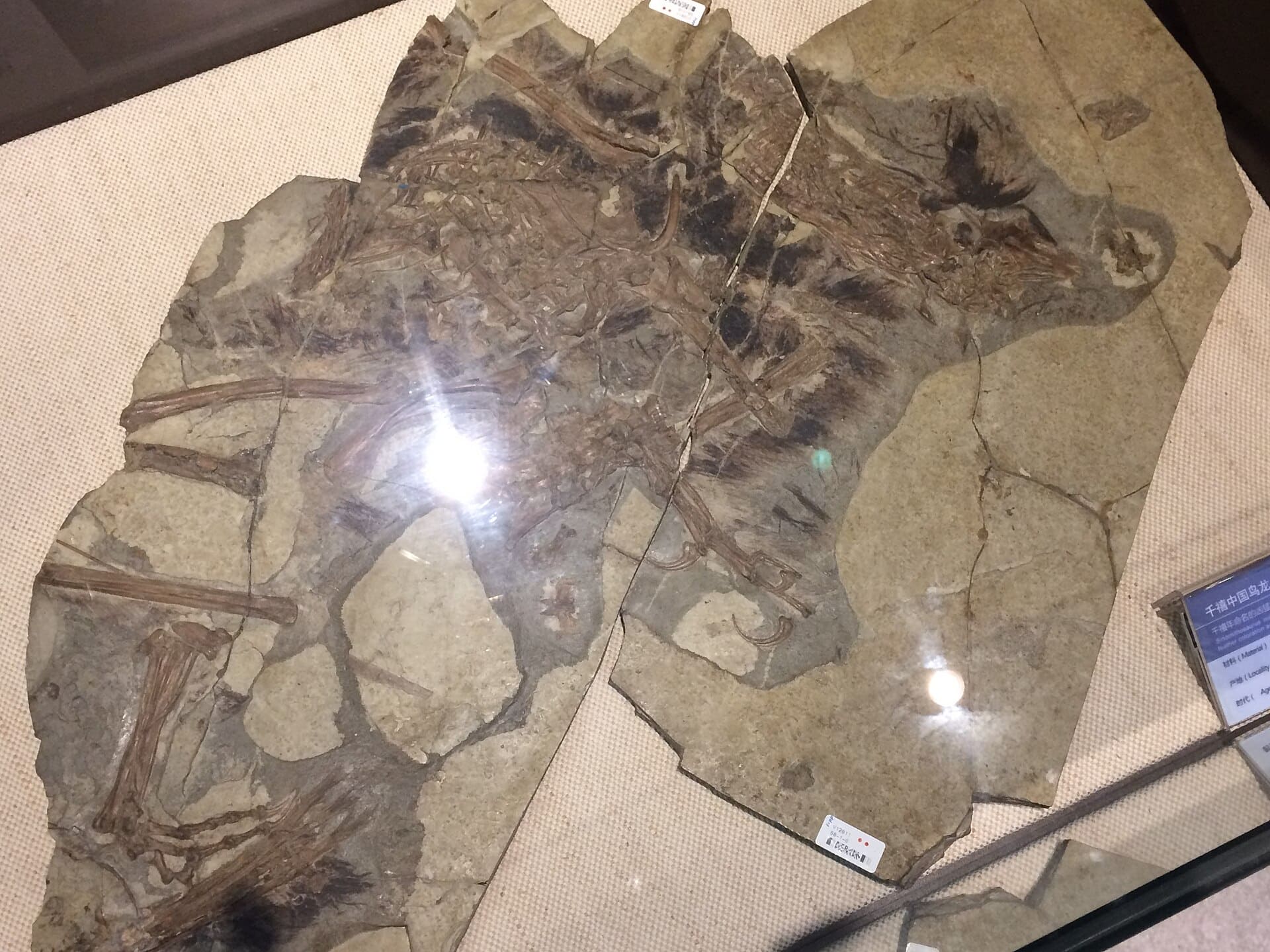
The holotype, IVPP V12811, is housed at the IVPP in Beijing. In the paper’s figures, the back of the skull lay detached from the snout and jaws, turned 180 degrees. Xu and colleagues read its five fused sacral (hip) vertebrae and partly fused ankle bones as signs of adulthood. However, a 2020 bone-tissue study warned that such signs can appear in dromaeosaurids that were still growing. Its scapula and coracoid also remain unfused, and a 2024 study said only that it “may be an adult.” The labels also mark a wishbone, a breastbone, belly ribs, and an “enlarged, slashing ungual” (claw) on the second toe.

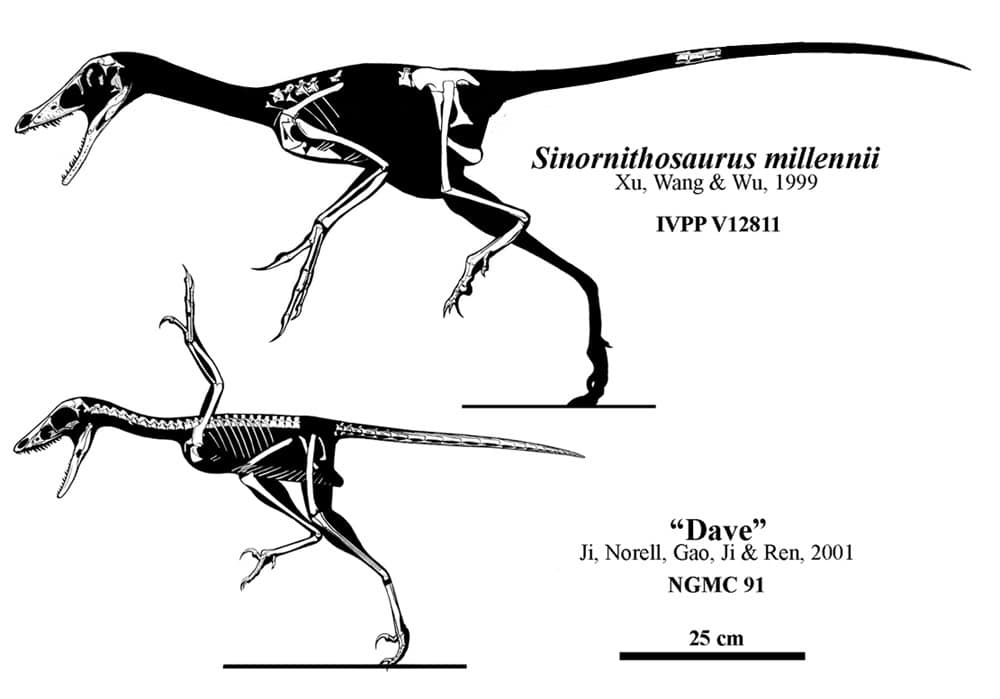
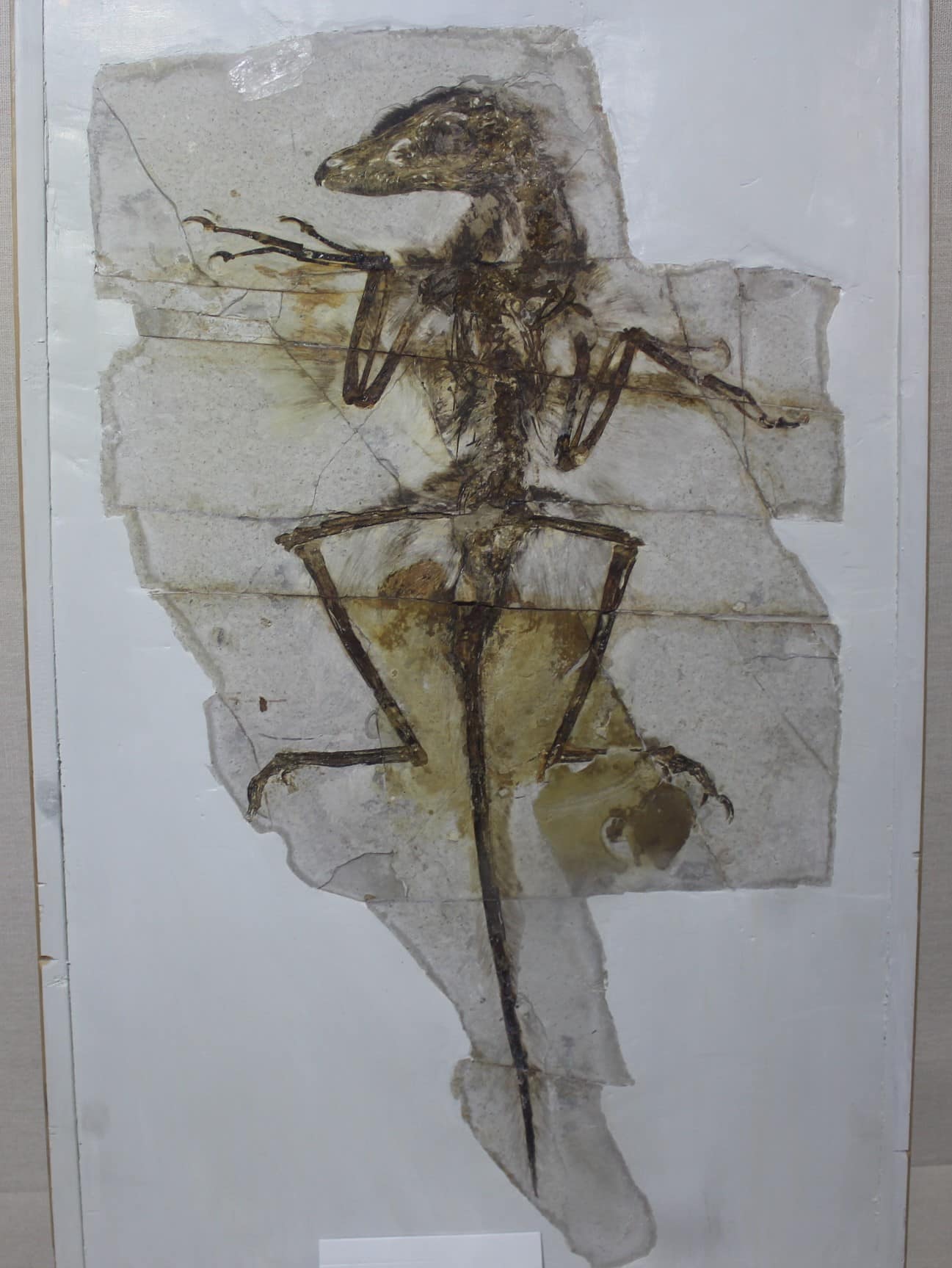
D 2140, the S. haoiana holotype, comes from near Toutai in Yixian County and sits in the Dalian Natural History Museum. A feathered specimen, NGMC 91, was first described in 2001 as an “enigmatic small theropod.” Turner’s team later referred it to S. millenii as a subadult, citing the forked rear of its dentary (the tooth-bearing lower jawbone). An uncataloged IVPP fossil, specimens at the Shandong Tianyu Museum, and a find from Hengdaozi round out the record. So does a partial leg in the gut of the predator Sinocalliopteryx—tentatively referred to Sinornithosaurus in 2012. Still, the Paleobiology Database places D 2140 in the Dakangpu member, so the specimens may not all share one level.
Sinornithosaurus Size and Description
Sinornithosaurus paired a light predator’s frame with feathers and long arms—traits that blur the line between dinosaur and bird.
Short description of Sinornithosaurus
The skull that Gong and colleagues reconstructed, partly from the holotype, is about 3 inches (75 millimeters) long. However, Turner and colleagues argued in 2012 that the lower jaw was straight, not sharply arched as drawn in 2001. Then, in 2024, Tse and colleagues called Xu and Wu’s reconstruction dubious because it rested on a highly fragmented fossil. The antorbital fossa—a hollow in front of the eye socket—bears rough pits and ridges beside a large promaxillary fenestra (an extra skull opening).
The upper teeth were strongly heterodont—changing shape along the jaw—while the front premaxillary teeth lacked serrations and leaned forward. On the holotype, the exposed part of the largest upper tooth measures about 0.5 inches (12 millimeters). Originally, Xu and colleagues described a diastema, or gap, between the premaxillary and maxillary teeth. In 2012, however, Turner’s team read the “gap” as the transition to the premaxilla’s rear process, making the tooth rows continuous.
Behind the head, the forelimbs were nearly as long as the hind limbs, as in Microraptor. The first bone of the third finger was more than twice the length of the second. The foot was also partly arctometatarsalian, with a narrowed middle foot bone. In 2001, Xu and colleagues found that its compound filaments branch in two birdlike ways. They judged them homologous with (sharing an origin with) bird feathers. In 2010, Zhang and colleagues read preserved melanosomes (pigment bodies) as black and rufous coloring. However, Roy and colleagues cautioned in 2020 that no chemical data back that reading, so any color reconstruction remains tentative.

Size and Weight of Type Species
Few studies give a body length for Sinornithosaurus. In 2012, Xing and colleagues estimated a large individual at roughly 3.3 feet (1 meter) long. Only its leg survives, with a 6.1-inch (15.5-centimeter) tibia. The Natural History Museum in London lists about 6.6 feet (2.0 meters) without giving a method—about twice that estimate. With hip height also unrecorded, the firmest numbers come from the holotype’s hind limb. Its femur (thigh bone) is about 5.8 inches (148 millimeters) long—longer than its 4.9-inch (125-millimeter) tibia.
In the specimens Lü and Brusatte compared in 2015, femur length ranges from about 4.3 to 5.8 inches (109.8 to 148 millimeters). They also described Microraptor and Sinornithosaurus as “roughly housecat-sized animals.”

The holotype itself appears to lack a published mass. In 2016, Dececchi, Larsson, and Habib estimated about 4.3 pounds (1.94 kilograms) for NGMC 91, the subadult specimen. A smaller specimen measured by Sullivan and colleagues came out at about 0.64 pounds (0.29 kilograms)—and both are indirect, femur-based estimates.
The Dinosaur in Detail
Its describers read the shoulder girdle as a sign that ground-dwelling dromaeosaurids already had the prerequisites for powered, flapping flight. This, they argued, supported a “ground up” origin of bird flight. In 2009, however, Longrich and Currie called Sinornithosaurus a flightless form. Similarly, in 2016 Dececchi’s team found “little evidence of benefit from flapping assisted locomotion” among small paravians (birds and their closest kin) like it. Persons and Currie also gave its legs a cursorial (running-adapted) score of −20.4, among the lowest in their dataset.
Its teeth sparked a sharper debate. In 2010, Gong, Martin, Burnham, and Falk proposed that Sinornithosaurus was venomous. They pointed to grooved teeth, a “subfenestral fossa” they read as a possible venom-gland pocket, and a groove leading to the tooth bases. They also suggested it probably fed on the “abundant birds of the Jehol forests,” perhaps with a “bite and hold” method.
In response, Gianechini, Agnolín, and Ezcurra found no unambiguous evidence for venom in 2011. In their view, the long teeth had slipped out of their sockets after death. Grooved teeth are also widespread among theropods, and no strong evidence of a gland exists. Gong’s team replied that year with “Evidence for a venomous Sinornithosaurus.” Turner and colleagues then called the venom conclusion “highly suspect,” citing the same loosened teeth.
Taken together, these studies point to a birdlike microraptorine that was probably neither venomous nor much of a flier. Neither question, however, is fully closed.
Interesting Points about Sinornithosaurus
- Sinornithosaurus was the first dromaeosaurid described from China and the first in its family recognized with a filamentous body covering.
- Turner, Makovicky, and Norell found that the eight features once used to separate S. haoiana do not distinguish it from other S. millenii specimens.
- A 2020 bone-tissue study by Poust and colleagues found that specimen D 2140 died at less than two years old—and was still growing.
- Fossil skin survives on the holotype, and McNamara and colleagues found that such dinosaurs shed small skin flakes, much as birds and mammals do.
Contemporary Dinosaurs
Sharing the lower Yixian lake beds at Sihetun was Sinosauropteryx, a small theropod, though no interaction between the two is recorded. In 1998, Chen, Dong, and Zhen judged it closely related to Compsognathus and noted its tail, the longest of any theropod then known.
Adding to this feathered cast was Beipiaosaurus, a therizinosauroid theropod that also bore integumentary filaments. Its remains appear in the same Paleobiology Database collection as the Sinornithosaurus holotype, though any contact between them goes unrecorded.
Also from the Jianshangou Beds near Beipiao came Sinocalliopteryx gigas, a large compsognathid theropod. Its holotype holds the leg Xing and colleagues tentatively referred to Sinornithosaurus, though whether that meal was hunted or scavenged is unknown.
Rounding out the list is Psittacosaurus, a parrot-beaked ceratopsian herbivore known here only to genus level. Wang and colleagues reported abundant psittacosaurid material from these lake sediments, but no interaction with Sinornithosaurus is known.
Sinornithosaurus in its Natural Habitat
The world Sinornithosaurus roamed was shaped by volcanoes, and its animals were buried in lake and occasional river sediments. At Sihetun, about 39 feet (12 meters) of gray-black lake shales alternate with tuffs (layers of volcanic ash). Most of the vertebrate fossils lie in the lower 23 feet (7 meters). In the richest layers, Wang and colleagues saw both a rapid radiation and “a mass mortality event.” The lower Yixian lake beds also preserve insects, fish, frogs, pterosaurs, the bird Confuciusornis, and the early flowering plant Archaefructus.
It was not a warm world. Isotope work by Amiot and colleagues suggests mean air temperatures of about 50 °F (10 °C) at roughly 42 degrees north. For the Sihetun area, Zhang, Yin, and Wang estimated an even colder 43 °F (5.9 °C), with frozen winters. They placed the area 1.7 to 2.5 miles (2.8 to 4.1 kilometers) above sea level. In this chilly world, Sinornithosaurus hunted with what its describers called an “enlarged, slashing ungual” on the second toe. It may have taken birds, as Gong’s team proposed, although that idea rests on their disputed venom hypothesis.
While there is no direct evidence of whether Sinornithosaurus lived alone or in groups, its skin offers a clue to its physiology. McNamara and colleagues suggested that these feathered dinosaurs produced less body heat than modern birds.
Frequently Asked Questions
It means “Chinese bird lizard.”
It lived in the Barremian stage of the Early Cretaceous, around 125 million years ago.
Peer-reviewed size data are scarce, but one large individual is estimated at roughly 3.3 feet (1 meter) long. Mass estimates for two specimens range from about 0.64 to 4.3 pounds.
It was a carnivore, and one disputed hypothesis suggests it hunted the birds of the Jehol forests.
Its holotype comes from the lower Yixian Formation at Sihetun, near Beipiao in western Liaoning, China.
Gong and colleagues proposed venom in 2010, but Gianechini’s team in 2011 and Turner’s team in 2012 found the evidence unconvincing.
Sources
The information in this article is based on various sources, drawing on scientific research, fossil evidence, and expert analysis. The aim is to provide a comprehensive and accurate overview of Sinornithosaurus. However, please be aware that our understanding of dinosaurs and their world is constantly evolving as new discoveries are made.
- https://www.nature.com/articles/45769
- https://ideas.repec.org/a/nat/nature/v401y1999i6750d10.1038_45769.html
- https://zenodo.org/records/5399588
- https://doi.org/10.1139/e01-082
- https://pmc.ncbi.nlm.nih.gov/articles/PMC2818910/
- https://link.springer.com/article/10.1007/s12542-010-0074-9
- https://link.springer.com/article/10.1007/s12542-010-0076-7
- https://www.cgsjournals.com/article/id/dztb_200408143
- https://ideas.repec.org/a/nat/nature/v410y2001i6825d10.1038_35065589.html
- https://ideas.repec.org/a/nat/nature/v410y2001i6832d10.1038_35074079.html
- https://pmc.ncbi.nlm.nih.gov/articles/PMC4941780/
- https://pmc.ncbi.nlm.nih.gov/articles/PMC4728391/
- https://pmc.ncbi.nlm.nih.gov/articles/PMC4504142/
- https://pmc.ncbi.nlm.nih.gov/articles/PMC2664043/
- https://pmc.ncbi.nlm.nih.gov/articles/PMC5970262/
- https://pmc.ncbi.nlm.nih.gov/articles/PMC7004074/
- https://pmc.ncbi.nlm.nih.gov/articles/PMC11020771/
- https://pmc.ncbi.nlm.nih.gov/articles/PMC13623826/
- https://pmc.ncbi.nlm.nih.gov/articles/PMC8288181/
- https://naturalhistory.si.edu/sites/default/files/media/translated_publications/Wang%26amp%3B_99.pdf
- https://ideas.repec.org/a/nat/nature/v400y1999i6739d10.1038_21872.html
- https://ideas.repec.org/a/nat/nature/v391y1998i6663d10.1038_34356.html
- https://ideas.repec.org/a/nat/nature/v399y1999i6734d10.1038_20670.html
- https://ideas.repec.org/a/nat/nature/v393y1998i6687d10.1038_31635.html
- https://pmc.ncbi.nlm.nih.gov/articles/PMC3069172/
- https://doi.org/10.1029/2021GL094370
- https://pmc.ncbi.nlm.nih.gov/articles/PMC3430630/
- https://doi.org/10.1002/ar.24343
- https://pmc.ncbi.nlm.nih.gov/articles/PMC10909347/
- https://paleobiodb.org/data1.2/taxa/single.json?name=Sinornithosaurus&show=attr,parent
- https://paleobiodb.org/data1.2/colls/single.json?id=52888&show=loc,strat
- https://paleobiodb.org/data1.2/occs/list.json?base_name=Sinornithosaurus&show=loc,strat,time
- https://stratigraphy.org/ICSchart/ChronostratChart2024-12.pdf
- https://www.nhm.ac.uk/discover/dino-directory/sinornithosaurus.html
- https://australian.museum/learn/dinosaurs/fact-sheets/sinornithosaurus-millenii/
This article was last fact checked: TheDinosaurs Team, 03-11-2026
Featured Image Credit: Anonymous Dinonerd, CC BY-SA 4.0, via Wikimedia Commons
