
North of Amrapar village, on the Khadir Uplift of Gujarat’s Kachchh Basin, lie beds of the Kaladongar Formation—the basin’s oldest rock unit. From these beds came Ceratocaudia antiqua, a small sauropod named in 2026. It lived sometime between the Pliensbachian and Bajocian stages of the Jurassic—roughly 193 to 168 million years ago. However, the age of the beds is poorly constrained. Even so, its describers call it the earliest diagnosable macronarian from India and one of the earliest anywhere.
A team from IIT Bombay excavated the skeleton near Amrapar. Four researchers—Abhishek Natarajan, Suraj Bhosale, Nibedita Rakshit, and Sudipta Dasgupta—then described it in the Journal of Vertebrate Paleontology. Its most striking feature sits on the tail, where the front tail vertebrae carry a horn-like crest. The bones also come from an old individual, and the authors discuss whether the animal was a dwarf. Beyond India, the find feeds a larger argument, since their analysis suggests macronarians had already spread around the world before the Bajocian.
Ceratocaudia Key Facts
| Keyword | Fact |
|---|---|
| Pronunciation | Not specified |
| Meaning of name | Horn Tail |
| Group | Sauropoda (Neosauropoda, Macronaria) |
| Type Species | Ceratocaudia antiqua |
| Diet | Herbivore |
| When it Lived | About 193 to 168 MYA |
| Period | Jurassic |
| Epoch | Early to Middle Jurassic (?Pliensbachian to Bajocian stages) |
| Length | About 23 feet (7 meters) |
| Height | Not specified |
| Weight | Not specified |
| Mobility | Not specified |
| First Discovery | Year not specified |
| Described by | 2026 by A. Natarajan, S. Bhosale, N. Rakshit, and S. Dasgupta |
| Holotype | IITBR3–IITBR59 (partial skeleton) |
| Location of first find | North of Amrapar village, Kaladongar Formation, Khadir Uplift, Kachchh district, Gujarat, India |
Ceratocaudia Origins, Taxonomy and Timeline
According to the Indian science outlet Research Matters, the genus name joins “cerato,” meaning “horn,” with “caud,” meaning “tail.” That label suits the horn-like crest on the front tail vertebrae, which the describers list among its defining traits. The species name antiqua is Latin for “old” or “ancient,” chosen because it ranks among the earliest macronarians. Together, the name describes an ancient animal best recognized from behind.
Ceratocaudia belongs to Sauropoda, the long-necked plant-eaters, and within it to Neosauropoda and then Macronaria. In 2026, Natarajan and colleagues classified it as an early-branching, non-titanosauriform macronarian. In other words, it sits outside the titanosauriforms, the macronarian branch that went on to include the titanosaurs. Ceratocaudia antiqua is the type and only known species.
The authors place the bones in “?upper Lower Jurassic (Pliensbachian) to Bajocian strata”—the question mark flags the older end as uncertain. On the international timescale, that is roughly 193 to 168 million years ago. In 1991, Biswas assigned the wider Kaladongar Formation to the ?Aalenian to early Bajocian, but its exact age is still debated. Either way, Ceratocaudia lived during the Early to Middle Jurassic. In 2013, Rai and Jain argued from reworked nannofossils that the sea had reached Kachchh by the Pliensbachian. Ammonites, however, point to a later, Early Bajocian flooding.
Discovery & Fossil Evidence
The holotype came from a site north of Amrapar village in Bhachau Taluka, Kachchh district. It lay at the transition between the upper Mouwana Variegated Member and the Lower Flagstone Member of the Kaladongar Formation. Specifically, the bones rested about 20 centimeters (8 inches) below the contact between orange-gray silt and an overlying gray marly packstone (a grain-rich limestone). Several vertebrae were found in clusters, stacked on top of each other.
The holotype is a partial skeleton cataloged as IITBR3–IITBR59 at the Indian Institute of Technology Bombay in Mumbai. According to sci.news, it comprises 181 fragments thought to belong to a single individual. The skeleton includes an anterior cervical (neck) vertebra and a long run of caudal (tail) vertebrae. It also has a chevron—a small bone that hangs beneath the tail—and dorsal (back) ribs. Next come the interclavicle (a midline chest bone), the right ulna (forearm bone), and three metacarpals (hand bones). Finally, the hind limbs include the left femur (thigh bone), both tibiae and fibulae (shin bones), and part of a metatarsal (foot bone).

In addition, the authors referred fragmentary remains from the same strata at a nearby locality to Ceratocaudia. That extra material came from a red shelly packstone at the same level. So far, no other specimens have been referred to the genus.
Ceratocaudia Size and Description
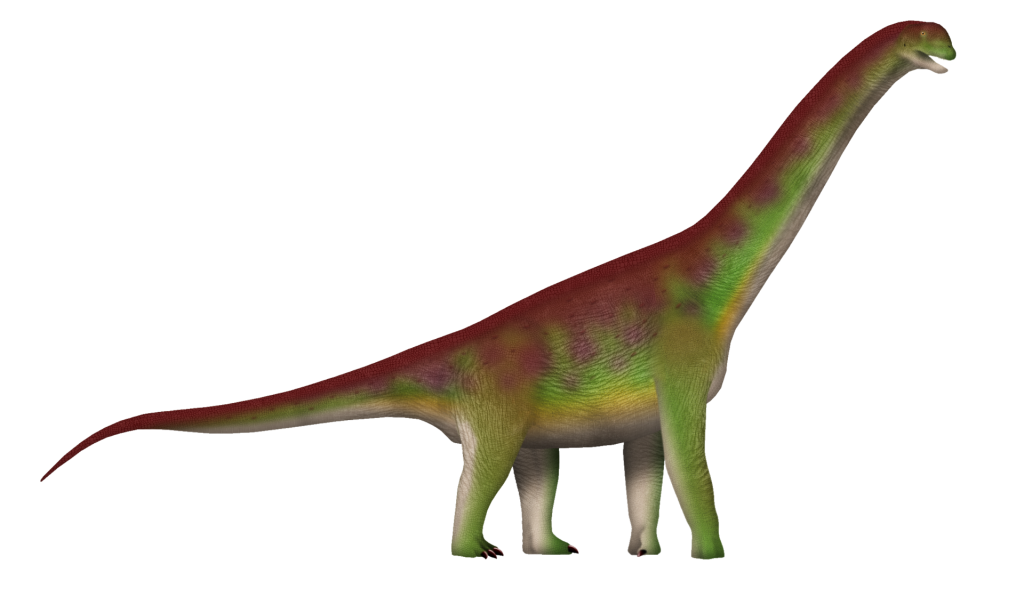
Although only part of the skeleton survives, its bones outline a modest sauropod with an unusual tail.
Short description of Ceratocaudia
Only one neck vertebra is preserved in the holotype, and its centrum (vertebral body) measures 152 millimeters (6 inches) long. It has a camerate build—large internal air chambers—with openings on each side divided by a single bony septum, or wall. A notch on its postzygapophysis, the rear joint surface linking neighboring vertebrae, is one of the traits that diagnose the genus.
The tail tells a different story, since every preserved caudal vertebra is solid and apneumatic, meaning it lacked air spaces. Their neural spines—the blades that rise from the top of each vertebra—are plate-like, and the crest rises abruptly toward the rear. Toward the tail tip, the joint faces also shift step by step from platycoelous (nearly flat) to procoelous (concave in front).
In the hind limb, the lower end of the tibia has a deeply notched front surface. The fibula, meanwhile, carries a strong anteromedial crest and has a subtriangular lower end. Because only bones are preserved, any skin or soft tissue in reconstructions is speculative.
Size and Weight of Type Species
Natarajan and colleagues estimated Ceratocaudia at about 23 feet (7 meters) long. That figure is the authors’ estimate from a partial skeleton, not a measurement of a complete animal. For scale, the damaged left femur measures 540 millimeters (21.3 inches), while the left tibia measures 490 millimeters (19.3 inches).
The describers did model the tail muscles, which came to roughly 203 kilograms (448 pounds). To build that model, the team compared the tail with CT scans of an alligator and an iguana.
By comparison, Research Matters set its length against 20-meter-long relatives such as Brachiosaurus, about 66 feet. The authors discuss whether its small size, in an individual that was already old, could mean Ceratocaudia was a dwarf. Its real oddities, however, lie in the tail.
The Dinosaur in Detail
What sets this dinosaur apart is the crest on its front tail vertebrae—a horn-like rise on the neural spine that inspired its name. Unlike the evenly concave spines of Spinophorosaurus, the crest climbs abruptly toward the back of the spine. The spines themselves are plate-like, not club- or mace-shaped. An anterior chevron with split joint facets is another trait, unique among the relatives compared.
Building on these bones, the authors produced a hypothetical tail from retrodeformed elements—fossils digitally restored to their original shape. That model, they suggest, points tentatively to the tail as a mild deterrent to predators. To judge muscle proportions, they compared it with Giraffatitan, Tyrannosaurus, and living reptiles. There is no direct evidence of the tail in use, and the authors call it only a “mild” deterrent.
Its family tree, however, depends on the analysis, since the authors ran two datasets. One came from Mannion and Moore’s 2025 study. The other combined work by Carballido and by Pérez Moreno and their colleagues. They analyzed each with equal weights and with extended implied weights—two ways of weighting anatomical characters when building the family tree. Under equal weights, the first dataset left Ceratocaudia in a large unresolved cluster of sauropods.
With implied weights, by contrast, it emerged as the earliest-branching member of a clade that includes Camarasaurus, Aragosaurus, and the titanosauriforms. Like the first, the second dataset left it unresolved among neosauropods under equal weights. With implied weights, it fell just outside a group formed by Europasaurus, Galvesaurus, Tehuelchesaurus, and the titanosauriforms, closer to that group than Camarasaurus. These results best support the authors’ reading—an early-branching, non-titanosauriform macronarian.
Interesting Points about Ceratocaudia
- According to Research Matters, the name Ceratocaudia refers to the unique spike on its tail vertebrae.
- Bone histology and a non-traumatic, non-contagious pathology indicate that the holotype individual was senescent, or old for its kind.
- A digital model put the muscle mass of its tail alone at about 203 kilograms (448 pounds).
- The authors’ time-calibrated family tree suggests macronarian sauropods were already spread worldwide before the Bajocian stage.
- Its describers consider it the earliest diagnosable macronarian neosauropod from India and one of the earliest worldwide.
Ceratocaudia in its Natural Habitat
The world Ceratocaudia roamed lay close to the sea. In 1991, Biswas read the gray Amrapar silts, with their beds of brackish-water bivalves, as a backshore lagoon or estuary. In 2004, Fürsich and colleagues likewise interpreted them as estuarine. Shell-rich layers at the base of the succession hold the bivalves Indocorbula and Protocardia. Meanwhile, the Paleobiology Database’s plate model places the site around 17.5 degrees south of the equator at the time.
The silt around the skeleton is rich in fragile plant fossils, so plants were at least washing into the estuary. Like other sauropods, Ceratocaudia was a herbivore. However, researchers infer that diet for the group as a whole, not from its own fossils. Which plants it ate therefore remains unknown.

Natarajan and colleagues note earlier reports of the hybodont shark Strophodus from the same Amrapar units—part of a nearshore to estuarine fauna. Ceratocaudia is not the first dinosaur from Kachchh, however. In 1999, Satyanarayana and colleagues reported more than a dozen vertebrae and limb bones from the Dingi Hill Member of the Kaladongar Formation on Kuar Bet island. Found with petrified tree trunks, the bones were identified only as dinosaur and were not named. Later, in 2002, Jana and Das described part of a sauropod tibia (shin bone) from the Chari Formation at Jumara. Ammonites date that younger, marine unit to the Middle Callovian stage.
Farther afield, the Indian Jurassic sauropods Barapasaurus and Kotasaurus come from the Lower Kota Formation of the Pranhita–Godavari region. There is no direct evidence of its social life. Still, this old individual was buried in a Jurassic estuary, so sauropods likely lived near this coast.
Frequently Asked Questions
According to Research Matters, it means “horn tail,” for the crest on its tail vertebrae, while antiqua means “old” or “ancient.”
It lived in the Early to Middle Jurassic, between the ?Pliensbachian and Bajocian stages, about 193 to 168 million years ago.
Its describers estimated a length of about 23 feet (7 meters). No body-weight or height estimate has been widely reported.
It was an early-branching macronarian sauropod, a herbivore from the group that later included the titanosauriforms.
Its fossils come from the Kaladongar Formation, north of Amrapar village on the Khadir Uplift in Kachchh, Gujarat, India.
A horn-like crest rises from the spine of its front tail vertebrae, and its anterior chevron has split joint facets.
Sources
The information in this article is based on various sources, drawing on scientific research, fossil evidence, and expert analysis. The aim is to provide a comprehensive and accurate overview of Ceratocaudia. However, please be aware that our understanding of dinosaurs and their world is constantly evolving as new discoveries are made.
- https://doi.org/10.1080/02724634.2026.2677749
- https://doi.org/10.6084/m9.figshare.33004587.v1
- https://paleobiodb.org/data1.2/colls/single.json?id=279954&show=full
- https://paleobiodb.org/data1.2/taxa/single.json?id=523879&show=full
- https://epub.ub.uni-muenchen.de/19018/1/zitteliana_2013_53_09.pdf
- https://doi.org/10.1080/08912963.2024.2324430
- https://stratigraphy.org/ICSchart/ChronostratChart2024-12.pdf
- https://researchmatters.in/news/rare-fossil-reveals-new-dinosaur-species-spiky-tail-gujarats-kachchh-basin
- https://www.sci.news/paleontology/ceratocaudia-antiqua-14934.html
- https://nz.news.yahoo.com/unique-indian-fossil-transforms-understanding-113243140.html
- https://www.currentscience.ac.in/Volumes/77/05/0639.pdf
- https://www.currentscience.ac.in/Volumes/82/01/0085.pdf
This article was last fact checked: TheDinosaurs Team, 18-11-2026
Featured Image Credit: Connor Ashbridge, CC BY 4.0, via Wikimedia Commons
