
In Jianchang County in western Liaoning, China, the lake-laid rocks of the Tiaojishan Formation appear to have yielded a very odd little dinosaur. Named Tianyulong confuciusi in 2009, it belongs to Heterodontosauridae. Following recent work, its describers called this family the most basal group of all well-known ornithischians (the “bird-hipped” dinosaurs). Later studies date it to roughly 160 million years ago, near the boundary between the Middle and Late Jurassic. Its skeleton carries long, unbranched filaments on the neck, back, and tail. Its describers called this the first confirmed report of such structures in an ornithischian. Yet Psittacosaurus tail bristles had appeared in print in 2002.
Every known skeleton came from private collecting, and the holotype now resides at the Shandong Tianyu Museum of Nature in Pingyi. In 2009, paleontologist Xiao-Ting Zheng and three colleagues described it in Nature as an Early Cretaceous Jehol Group animal. However, later studies tied it to older Jurassic rocks. Its describers also argued that the filaments may share an origin with feathers—a question that still divides researchers.
Tianyulong Key Facts
| Keyword | Fact |
|---|---|
| Pronunciation | Not specified |
| Meaning of name | Honors the Tianyu museum and a famous Chinese philosopher, according to 2009 news coverage |
| Group | Ornithischia (Heterodontosauridae) |
| Type Species | Tianyulong confuciusi |
| Diet | Herbivore (possibly also insects) |
| When it Lived | Around 160 MYA |
| Period | Jurassic |
| Epoch | Late Jurassic (Oxfordian stage), possibly latest Middle Jurassic (Callovian stage) |
| Length | About 1.5 to 2.3 feet (45 to 70 centimeters), per Sereno (2012) and Butler and colleagues (2012) |
| Height | Not specified |
| Weight | About 1.6 pounds (0.74 kilograms), indirect 2014 estimate |
| Mobility | Long-legged, with cursorial (running-adapted) hind limbs |
| First Discovery | Year not specified—all specimens collected privately |
| Described by | 2009 by X.-T. Zheng, H.-L. You, X. Xu, and Z.-M. Dong |
| Holotype | STMN 26-3 |
| Location of first find | Probably the Tiaojishan Formation, possibly its Daxishan section near Linglongta, Jianchang County, western Liaoning, China—originally reported as the Jehol Group |
Tianyulong Origins, Taxonomy and Timeline
Science writer Ed Yong reported in 2009 that the name honors Zheng’s museum and a famous Chinese philosopher. That museum is the Shandong Tianyu Museum of Nature, which also houses the holotype. Together, the name ties the animal to the institution that holds it and to a famous Chinese thinker.
Tianyulong belongs to Ornithischia and, within it, to Heterodontosauridae. Zheng’s team coded it into an existing data set of 221 anatomical characters and 46 taxa. Their strict consensus tree placed it inside the family. A looser majority-rule tree grouped it with Heterodontosaurus and a specimen cataloged as BMNH A100. Two features linked the trio—an enlarged premaxillary (front upper jaw) tooth and one canine-like front tooth in the lower jaw. Tianyulong confuciusi is the type and only known species.
Zheng and colleagues originally placed Tianyulong in the Early Cretaceous, a period they bracketed at 144 to 99 million years ago. Later work moved it much earlier. Citing Liu and colleagues, paleontologist Paul Sereno traced it in 2012 to an upper level of the Tiaojishan Formation, about 160 million years old. In 2019, Cincotta and colleagues cited uranium-lead dates of about 160.9 to 160.3 million years ago for the Daxishan section. They assigned it to the Oxfordian stage of the Late Jurassic, while Boyd (2015) listed it as Oxfordian–Kimmeridgian. Yet Sereno called the horizon Callovian (latest Middle Jurassic) in one passage and Late Jurassic in another—so the stage remains unsettled.
Discovery & Fossil Evidence
Because every known Tianyulong skeleton came from private collecting, no publication names a collector or discovery date. The 2009 paper reported only a general area—Jianchang County in Liaoning Province—and a horizon in the Early Cretaceous Jehol Group. Sereno’s 2012 monograph then pulled in two directions. Its taxonomic entry suggested the Lujiatun Beds of the Yixian Formation, about 125 million years old, pending confirmation. Its introduction called a Tiaojishan origin definitive. Cincotta’s team later listed it from the Daxishan section near Linglongta, but no published field record ties the specimens there.
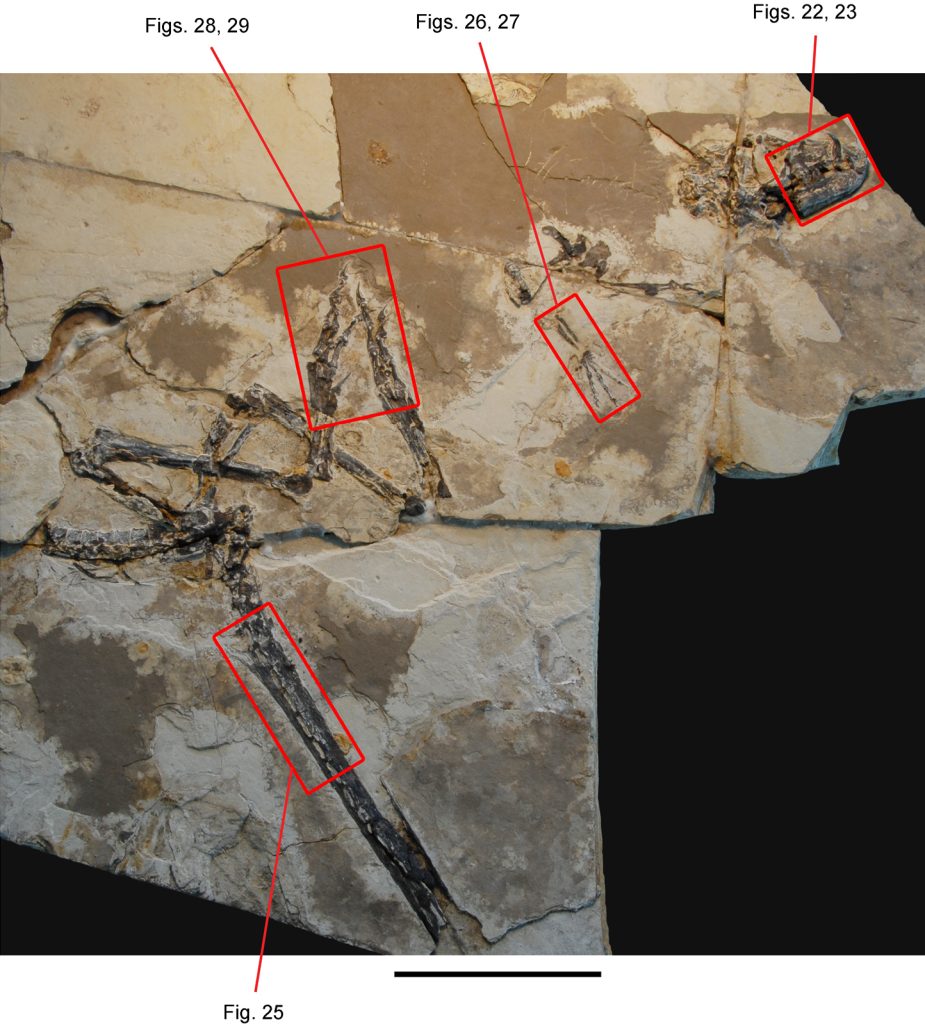
The holotype, STMN 26-3, is an ash-covered skeleton lying on its left side on a slab of lake rock. Still articulated, it preserves most of the skull. It lacks the middle and end of the tail and the left carpus (wrist). Parts of the left hand and right hind limb are missing too. The front neck vertebrae lay on a neighboring slab that no one recovered. Its skull has a basal length of about 60 millimeters (2.4 inches), and its right tibia (shin bone) measures 82 millimeters (3.2 inches).
A second skeleton, IVPP V17090, preserves a nearly complete skull, the rear back vertebrae, and the sacrum (hip vertebrae). It also includes the front half of a tendon-sheathed tail, most of both forelimbs, and both hind limbs. Besides the holotype, Sereno counted at least five partial skeletons in China, including this one and four at the Tianyu museum. None has a documented field locality—at least according to the published record. Writing the same year, however, Butler and colleagues still treated Tianyulong as known from a single specimen.

Tianyulong Size and Description
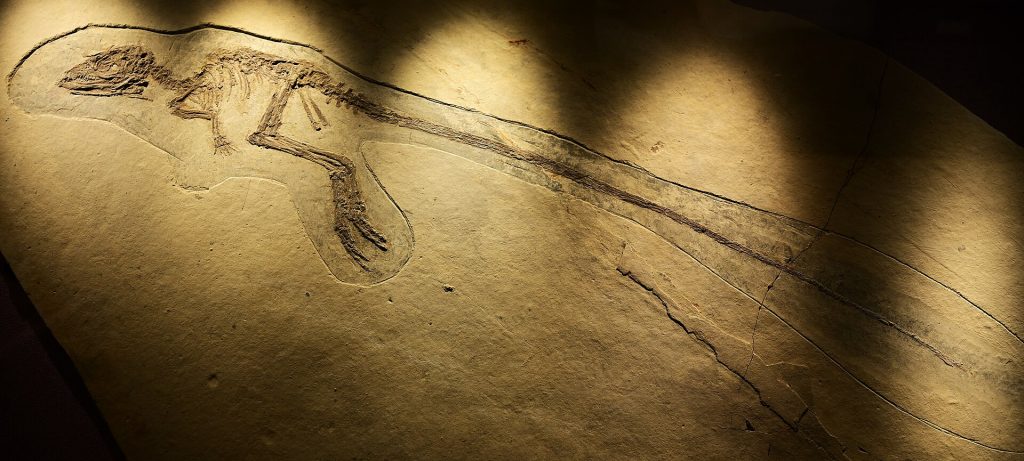
Tianyulong paired a big head and stubby arms with very long legs and a partly filament-covered body.
Short description of Tianyulong
Sereno summed up Tianyulong as a “large-headed, short-armed, long-legged dwarf.” At equal femur (thigh bone) length, its skull was 25 percent longer than in the Eichstätt specimen of Archaeopteryx. At the front of the lower jaw sat an enlarged, canine-like tooth, the first in the dentary (lower jaw bone). Its forelimb was under 30 percent of hind limb length, while the tibia reached 143 percent of femur length—a hind limb that Sereno described as showing cursorial (running) adaptations. The tail was long, and from about the seventh tail vertebra, ossified tendons (bony rods) wrapped it in a stiff sheath.
Three patches of filaments survive—below the neck, above the back, and above the base and middle of the tail. The filaments are single and unbranched with a circular cross-section, and at least one shows a dark midline stripe. Science News put the longest at about 6 centimeters (2.4 inches), while Yong reported about 7 centimeters (2.8 inches). With only these patches to go on, any full-body coat in reconstructions is speculative.
Size and Weight of Type Species
Published body lengths for Tianyulong differ—in 2012, Butler and colleagues gave about 2.3 feet (70 centimeters), citing the original description among other sources. Science News reported the same 70 centimeters, including a 44-centimeter (1.4-foot) tail. By contrast, Sereno’s 2012 estimate for the holotype is shorter, at about 1.5 feet (45 centimeters). He built it from skull, trunk, and tail measurements—with the tail tip still unknown.
Its hip height is unknown, but in 2014 Benson and colleagues estimated about 1.6 pounds (0.74 kilograms) by scaling body mass from limb-bone thickness. That fits Butler’s team, who put Tianyulong and its relative Echinodon under 1 kilogram (2.2 pounds). Yong described it as about the size of a cat.
Researchers disagree on whether the holotype had finished growing. Science News reported that it was probably a young adult because some vertebral bones were not fully fused. Sereno, however, called it mature because of its fused hip vertebrae and ankle bones, whereas Butler’s team considered its growth stage uncertain. Sereno also noted that the known skeletons are nearly identical in size and probably represent maximum adult body size.
The Dinosaur in Detail
One of the most distinctive features of Tianyulong is its filaments. Zheng’s team compared them with the elongated broad filamentous feathers—long, flat, unbranched strands—of the theropod Beipiaosaurus. Although its filaments were round, the describers argued that the resemblance favored a shared origin. In 2025, paleontologists Xing Xu and Paul Barrett listed monofilaments (single-strand filaments) in only three ornithischians—Tianyulong, Kulindadromeus, and Psittacosaurus. Mayr and colleagues had described the Psittacosaurus bristles first, in 2002, and Xu and Barrett noted less consensus on whether such strands match theropod feathers.

Its teeth have drawn conflicting readings, too. The original study reported one premaxillary tooth, whereas Sereno found what appear to be two. Butler’s team noted that the original report described upper cheek teeth without denticles (small serrations). Sereno, however, reported denticles along more than half the crown. Referred skulls suggest about ten dentary teeth, and unlike Heterodontosaurus, it lacked a lowered jaw joint.
The hands and tail add further clues. In Sereno’s view, elongate next-to-last finger bones suggest enhanced grasping, and the claws were narrow, blade-like. He likened the stiff tail to that of dromaeosaurids—the “raptor” theropods—and proposed that it served as a balancing beam to improve maneuverability.
Sereno placed Tianyulong outside the southern heterodontosaurids and, in a reduced analysis, as their closest relative. He grouped it with Echinodon and Fruitadens, northern forms with primitive, subtriangular crowns. Boyd’s analysis put the family outside Genasauria—the clade uniting armored, duck-billed, horned, and dome-headed dinosaurs. In 2020, by contrast, Dieudonné and colleagues recovered heterodontosaurids as early-diverging pachycephalosaurs (the dome-headed group of Pachycephalosaurus), with Tianyulong nearer that group than Heterodontosaurus. In 2024, however, a large analysis by Fonseca and colleagues again placed the family outside Genasauria, rejecting a link with dome-headed and horned dinosaurs. Tianyulong thus sits near the base of a lineage whose placement remains contested.
Interesting Points about Tianyulong
- In Nature in 2009, its describers called Tianyulong the first ornithischian with confirmed filaments, but a 2002 paper had already reported Psittacosaurus tail bristles.
- Its describers first called it Early Cretaceous, but later studies tied it to Jurassic rocks about 160 million years old.
- Private collectors recovered every known skeleton, so no published field record shows where any came from—its Jurassic horizon rests on a 2012 dating study.
- According to its describers, Tianyulong extended the known geographic range of heterodontosaurids to Asia.
- A 2021 Heterodontosaurus study tentatively identified fragments near the Tianyulong holotype’s thigh bone as gastralia (belly ribs).
Dinosaurs from the Same Formation
Also known from the Tiaojishan Formation (exact level relative to Tianyulong not known): Eosinopteryx, Serikornis, Xiaotingia, Caihong, and Pulaosaurus. The first four, small feathered paravians, contrast with Pulaosaurus, an early-diverging neornithischian from northern Hebei. Xiaotingia came via a fossil dealer who named only the Linglongta area, so its Tiaojishan origin is probable, not certain. Anchiornis also comes from the formation. Citing Liu and colleagues, however, Sereno placed its layers about 100 meters (330 feet) below and slightly older than the Tianyulong horizon. Formation dates run from about 165 to 153 million years ago, so these animals may not all have lived at the same time. This list also assumes the later Tiaojishan attribution, since the original paper placed Tianyulong in the Early Cretaceous Jehol Group.
Tianyulong in its Natural Habitat
Lakes and volcanoes likely shaped the world Tianyulong knew. In western Liaoning, the Tiaojishan Formation is 130 to 970 meters (430 to 3,180 feet) thick, mixing volcanic rocks, tuffs, sandstones, and conglomerates. Ash beds from repeated eruptions account for the formation’s fine fossil preservation. Its fossils belong to the wider Yanliao Biota, with 54 genera and 58 species of vertebrates, including nine non-avian dinosaur species.
Tianyulong was probably a herbivore, and Sereno argued that all heterodontosaurids were mainly or entirely plant-eaters. He cited its diminutive forelimbs against the idea that the family hunted opportunistically. Butler’s team took a broader view, describing later heterodontosaurids as ecological generalists that ate select plants and possibly insects. They also suggested that its jaws suited rapid, scissor-like biting at wide gapes. Compared with Heterodontosaurus, its jaw movements were weaker but faster, and it likely processed food by simple puncture-crushing.
Its coloration, posture, and social life are unknown. Citing a 2017 review, Yang and colleagues noted in 2025 that Yanliao non-avian dinosaurs were all small theropods, bar one ornithischian. That one may actually come from the Jehol Biota, and their own Pulaosaurus became the first Yanliao neornithischian. Among the theropods, Godefroit and colleagues proposed in 2013 that varied plumage helped closely related paravians share the same habitat. If Tianyulong did come from these Jurassic beds, it was a rare ornithischian in a theropod-dominated fauna.
Frequently Asked Questions
According to 2009 news coverage, it honors the Tianyu museum where Zheng works and a famous Chinese philosopher.
It probably lived about 160 million years ago, near the Middle–Late Jurassic boundary, though its describers first said Early Cretaceous.
Length estimates run from about 1.5 to 2.3 feet, and one indirect estimate puts its weight at about 1.6 pounds.
It was probably a herbivore, although some researchers suggest that heterodontosaurids like it may also have eaten insects.
Its privately collected fossils come from Jianchang County in western Liaoning, China, probably from the Tiaojishan Formation.
Its describers called it the first ornithischian with confirmed long filaments, though a 2002 study had described bristles on Psittacosaurus.
Sources
The information in this article is based on various sources, drawing on scientific research, fossil evidence, and expert analysis. The aim is to provide a comprehensive and accurate overview of Tianyulong. However, please be aware that our understanding of dinosaurs and their world is constantly evolving as new discoveries are made.
- https://www.nature.com/articles/nature07856
- https://www.nature.com/articles/nature07856/figures/2
- https://static-content.springer.com/esm/art%3A10.1038%2Fnature07856/MediaObjects/41586_2009_BFnature07856_MOESM319_ESM.pdf
- https://zookeys.pensoft.net/article/3152/
- https://doi.org/10.1371/journal.pone.0031556
- https://doi.org/10.1371/journal.pbio.1001853
- https://peerj.com/articles/1523/
- https://peerj.com/articles/6239/
- https://peerj.com/articles/12362/
- https://elifesciences.org/articles/66036
- https://doi.org/10.1098/rsbl.2024.0517
- https://www.nature.com/articles/ncomms2389
- https://doi.org/10.1038/nature08322
- https://doi.org/10.1007/s00114-017-1496-y
- https://www.nature.com/articles/s41467-017-02515-y
- https://peerj.com/articles/19664/
- https://www.nature.com/articles/nature10288
- https://www.sciencenews.org/article/dino-feathers-may-have-had-earlier-origin-thought
- https://www.nationalgeographic.com/science/article/tianyulong-a-fuzzy-dinosaur-that-makes-the-origin-of-feathers-fuzzier
- https://doi.org/10.1007/s00114-002-0339-6
- https://doi.org/10.1080/14772019.2024.2346577
- https://static-content.springer.com/esm/art%3A10.1038%2Fnature10288/MediaObjects/41586_2011_BFnature10288_MOESM297_ESM.pdf
This article was last fact checked: TheDinosaurs Team, 18-11-2026
Featured Image Credit: Connor Ashbridge, CC BY 4.0, via Wikimedia Commons
