
On the southern margin of Lake Kariba in northern Zimbabwe, the Late Triassic rocks of the Pebbly Arkose Formation gave up a partial skeleton from a riverbank in 2018. In 2026, it became the holotype of Musango matusadonaensis, a sauropodomorph—a member of the broad group that includes the long-necked sauropods. The fossils date to the Norian stage, and the publisher’s release places the animal around 210 million years ago. Its describers judged it a small-bodied animal that was at least eight years old when it died.
Paleontologist Paul M. Barrett and 13 colleagues described the skeleton in the Journal of Systematic Palaeontology. It is only the fifth dinosaur named from Zimbabwe. Their analysis also recovered it as the closest relative of Musankwa, a sauropodomorph named in 2024 from the same formation. However, the describers report that no dinosaur species are yet shared between Zimbabwe’s Triassic rocks and those of South Africa’s main Karoo Basin. Each new find from the Kariba shore therefore adds to a regional story that is still being written.
Musango Key Facts
| Keyword | Fact |
|---|---|
| Pronunciation | Not specified |
| Meaning of name | Living in the Bush |
| Group | Sauropodomorpha (Plateosauria, Unaysauridae) |
| Type Species | Musango matusadonaensis |
| Diet | Probably herbivore or omnivore, skull unknown |
| When it Lived | Around 210 MYA |
| Period | Triassic |
| Epoch | Late Triassic (Norian stage) |
| Length | About 14.8 feet (4.5 meters), estimate |
| Height | Not specified |
| Weight | About 489 pounds (222 kilograms), estimate |
| Mobility | Moved on two legs (bipedal) |
| First Discovery | Excavated in 2018 on the southern shore of Lake Kariba |
| Described by | 2026 by P.M. Barrett, J. Botha, L. Sciscio, B.P. Stuart, J. Lovegrove, D. Munyikwa, M. Zondo, T.J. Broderick, S.F. Edwards, E. Mbambo, K.E.J. Chapelle, K.N. Dollman, S. Tolan, and J.N. Choiniere |
| Holotype | NHMZ 2583, a partial associated skeleton |
| Location of first find | Musango Archosaur Site, Pebbly Arkose Formation, Mid-Zambezi Basin, Kariba (Matusadona area), Zimbabwe |
Musango Origins, Taxonomy and Timeline
The name Musango comes from ChiShona, where the word means “living in the bush.” According to the publisher’s press release, it refers to the remote area where the skeleton was found. Barrett also links the name to nearby Musango Island. The species name matusadonaensis honors Matusadona National Park, the protected land around the find site. Fittingly for such a remote shore, the field team lived aboard a houseboat. Together, the name tells of a wild lakeshore and the park that protects it.
Within Dinosauria, Musango belongs to Sauropodomorpha and, more narrowly, to Plateosauria—the clade that also includes Plateosaurus. Barrett and colleagues placed it in the family Unaysauridae as the sister taxon—the closest relative—of Musankwa sanyatiensis. Notably, the authors themselves describe the support for this arrangement as weak. Musango matusadonaensis is the type and only known species.
The fossils date to the Norian stage of the Late Triassic. In the publisher’s release, the team places the animal around 210 million years ago. Earlier, a 2020 study by Barrett and colleagues dated rocks below a phytosaur site elsewhere on the same lakeshore. It gave a maximum depositional age—the oldest the sediments can be—of 209.2 million years, give or take 4.5 million. The authors placed that age in the late Norian or early Rhaetian. At that time, the region lay at about 40 degrees south, well away from the tropics.
Discovery & Fossil Evidence
The skeleton came from a spot its describers call the “Musango Archosaur Site,” on the southern margin of Lake Kariba. In his own account, Barrett places it more precisely in the bank of the Nyamasango River, near Musango Island inside Matusadona National Park. The team mounted two field expeditions to this shore, in 2017 and 2018, and dug up the skeleton in 2018. Barrett credits co-author Steve Edwards, a local safari camp manager, with finding productive sites along the lake.
The holotype—the name-bearing specimen—is a single partial skeleton whose bones lay together in the rock. It preserves vertebrae (backbones), parts of the pectoral (shoulder) and pelvic (hip) girdles, and partial forelimbs and hind limbs. Unfortunately, the skull is missing. After excavation, the bones went to the Evolutionary Studies Institute in Johannesburg for preparation.
Musango joins a short list of Zimbabwean dinosaurs. It includes the theropod “Syntarsus” rhodesiensis (also known as Megapnosaurus), the early sauropod Vulcanodon, Mbiresaurus, and Musankwa. Unlike Musango, the first two come from the younger Forest Formation.
Musango Size and Description
With no skull and only part of the skeleton, the portrait of Musango comes from its body rather than its head.
Short description of Musango
Musango was a small-bodied sauropodomorph, and its describers judged the individual to be either a sub-adult or an adult. Its backbone, shoulder and hip girdles, and partial limbs give the outline of the body. Because the head is missing, nothing can yet be said about the shape of its skull or teeth. According to the publisher’s release, the bones also show that this animal had recovered from a serious infection or injury.
In his article for The Conversation, Barrett describes Musango as bipedal—walking on its hind legs only. The publisher’s release adds that it was quite lightly built. The bones preserve no skin or other soft tissue, so any picture of its outer covering is speculative. Paleoartist Mark Witton created the official life reconstruction.
Size and Weight of Type Species
According to the publisher’s press release, Musango measured around 14.8 feet (4.5 meters) long. Like the weight figure, this is an indirect estimate rather than a direct measurement.
The same release gives a weight of just 489 pounds (222 kilograms), about the same as a fully grown pig. Barrett’s own article rounds this to about 485 pounds (220 kilograms). The paper’s abstract confirms that the team made a body-mass estimate and calls the animal small-bodied.
Its sister taxon Musankwa was heavier—about 851 pounds (386 kilograms), estimated in 2024 from the circumference of its thigh bone, or femur. On those figures, Musango weighed a little under 60 percent as much as its closest relative—although the two estimates used different methods.
The Dinosaur in Detail
What sets this dinosaur apart, according to its describers, is its many autapomorphies—traits found in no other species. They describe Musango as clearly distinct from Musankwa, the other named sauropodomorph from the Kariba shore. Even so, the 2026 analysis groups the two as sister taxa.
Bone histology—the study of bone tissue under the microscope—shows that the individual had reached at least eight years of age. Its growth rate was also slowing at the time of death. This fits the describers’ view that the animal was either a sub-adult or an adult.
Its family tree remains less settled. Originally, Barrett and colleagues recovered Musankwa in 2024 as the earliest-branching lineage of Massopoda, a different branch of sauropodomorphs. In 2026, the same lead author’s team instead placed Musankwa beside Musango within Unaysauridae. Because the authors call the support for that grouping weak, the arrangement may yet change.
In short, the evidence describes a small sauropodomorph that grew for at least eight years and differed clearly from its nearest known relative. Where exactly it sits in the early sauropodomorph family tree is still an open question.
Interesting Points about Musango
- The genus name comes from a ChiShona word meaning “living in the bush,” a reference to the remote place where the skeleton was found.
- Musango is the fifth dinosaur ever named from Zimbabwe, following “Syntarsus” rhodesiensis, Vulcanodon, Mbiresaurus, and Musankwa.
- During fieldwork, the team lived aboard the houseboat ‘Musankwa’—the same boat that gave Musankwa its name in 2024.
- Bone histology shows that the holotype individual was at least eight years old, and its growth was already slowing when it died.
- According to Sci.News, Barrett says the team has one more new species still to describe.
- Its describers report that no dinosaur species are currently shared between Zimbabwe’s Triassic rocks and South Africa’s main Karoo Basin.
Dinosaurs from the Same Formation
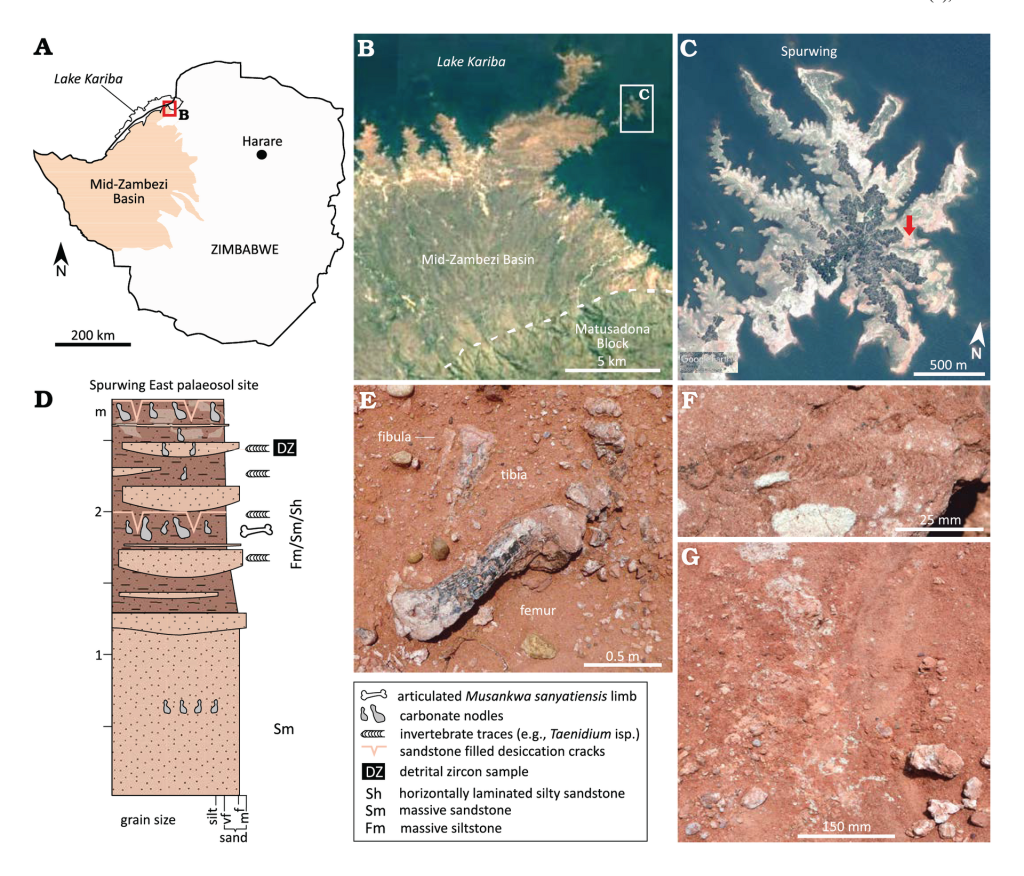
Also known from the Pebbly Arkose Formation (exact level relative to Musango not known): Musankwa sanyatiensis. This sauropodomorph is known from a partial right hind limb—a femur, tibia, and astragalus (ankle bone)—from the Spurwing East Palaeosol site on Spurwing Island, a different locality from Musango‘s. The describers of Musango call the two species “sympatric,” a term for species found in the same area, and Barrett writes that Musankwa was described “from the same beds.” However, only one maximum age has been published for the formation, whose rocks formed at different times in different basins. The two may therefore not have lived at the same time.

Musango in its Natural Habitat
The world Musango roamed held a diverse mix of land and freshwater habitats, according to its describers. In 1994, Oesterlen and Millsteed interpreted the Pebbly Arkose as the deposit of braided rivers with floodplains, short-lived lakes, and vegetation. Barrett pictures a dry landscape with large conifers and green corridors along permanent watercourses. At the Musankwa site, overbank sediments with desiccation (drying) cracks record repeated wetting and drying.
While there is no direct evidence of what Musango ate, the publisher’s release calls it likely a herbivore or omnivore. Without a skull, Barrett notes, its diet is unknown, though its close relatives were largely herbivorous.
In 2020, Barrett and colleagues placed nearby phytosaur sites on the lakeshore in the upper part of the informal Tashinga Formation—most likely its “Fine Red Marly Sandstone” unit rather than the Pebbly Arkose proper. Later work, however, treats their date as a Pebbly Arkose age. These sites yielded the first phytosaurs (long-snouted, crocodile-like reptiles) reported from mainland sub-Saharan Africa, along with lungfish and metoposaurid amphibians. By 2020, the only strictly land-living animals found there were rare teeth of a meat-eating archosaur, either a rauisuchian or a theropod dinosaur.
The 2020 study described a river-and-lake setting in a semi-arid climate prone to monsoon-like conditions. By contrast, climate models suggest humid, cool- to warm-temperate conditions. Meanwhile, the lungfish, amphibians, and abundant fossil wood point to high rainfall for at least part of the year. Large trees with trunks up to 3.3 feet (1 meter) across grew locally in abundance.
The Pebbly Arkose name also covers older rocks elsewhere in Zimbabwe. The sauropodomorph Mbiresaurus, for example, comes from Carnian-age beds in the Cabora Bassa Basin, well before Musango‘s time. For now, no dinosaur species is known from both the Kariba fauna and South Africa’s main Karoo Basin.
Frequently Asked Questions
Musango comes from a ChiShona word meaning “living in the bush,” and the species name honors Matusadona National Park.
It lived during the Norian stage of the Late Triassic, around 210 million years ago.
According to the publisher’s press release, it was about 14.8 feet (4.5 meters) long and weighed about 489 pounds (222 kilograms).
Its diet is unknown because the skull is missing, but it was probably a herbivore or omnivore, and its close relatives were largely herbivorous.
It was found at the Musango Archosaur Site in the Pebbly Arkose Formation, on the southern shore of Lake Kariba in Zimbabwe.
It was an early sauropodomorph in the family Unaysauridae, recovered as the closest relative of Musankwa, though that placement is weakly supported.
Sources
The information in this article is based on various sources, drawing on scientific research, fossil evidence, and expert analysis. The aim is to provide a comprehensive and accurate overview of Musango. However, please be aware that our understanding of dinosaurs and their world is constantly evolving as new discoveries are made.
- https://doi.org/10.1080/14772019.2026.2678610
- https://doi.org/10.4202/app.01100.2023
- https://doi.org/10.1016/j.gr.2019.12.008
- https://par.nsf.gov/servlets/purl/10157533
- https://doi.org/10.1038/s41586-022-05133-x
- https://newsroom.taylorandfrancisgroup.com/new-zimbabwean-dinosaur-species-named-by-museum-scientist-reveals-africas-hidden-history/
- https://sciencedaily.com/releases/2026/10/261012185013.htm
- https://www.sci.news/paleontology/musango-matusadonaensis-14955.html
- https://www.discovermagazine.com/newly-discovered-dinosaur-from-zimbabwe-could-change-what-we-know-about-ancient-southern-african-ecosystems-49463
- https://doi.org/10.17602/M2/L857426
- https://blog.everythingdinosaur.com/blog/_archives/2026/07/29
This article was last fact checked: TheDinosaurs Team, 18-11-2026
Featured Image Credit: Connor Ashbridge, CC BY 4.0, via Wikimedia Commons
