
Among the red river sandstones of La Rioja Province, in northwestern Argentina, lies the upper Los Colorados Formation. Here paleontologists found Riojasaurus incertus, a heavy plant-eater from the Norian stage of the Late Triassic. It was a sauropodomorph—a member of the broad lineage that also includes the giant sauropods. One estimate puts its weight at about 3 metric tons. A 2018 study also classified it as a quadruped—a sign, its authors argued, that four-legged walking had evolved by the mid-Norian.
Argentine paleontologist José F. Bonaparte named the genus in 1969. Yet a skull only turned up in 1986, on an expedition to La Esquina near Pagancillo. Bonaparte’s later studies of that skull and the backbone, along with newer work on its bones and posture, reveal several individuals of different sizes and growth stages.
Riojasaurus Key Facts
| Keyword | Fact |
|---|---|
| Pronunciation | Not specified |
| Meaning of name | Not specified |
| Group | Sauropodomorpha |
| Type Species | Riojasaurus incertus |
| Diet | Herbivore |
| When it Lived | Norian, upper fauna probably no younger than about 213 MYA (Kent et al. 2014) |
| Period | Triassic |
| Epoch | Late Triassic (Norian stage) |
| Length | Not specified |
| Height | Not specified |
| Weight | About 6,700 pounds (3,039 kilograms), Seebacher 2001 estimate |
| Mobility | Probably quadrupedal (classified as a quadruped by McPhee et al. 2018) |
| First Discovery | 1962 (collection date given by the Paleobiology Database) |
| Described by | 1969 by J.F. Bonaparte |
| Holotype | PVL 3808 |
| Location of first find | La Esquina area, upper Los Colorados Formation, La Rioja Province, Argentina |
Riojasaurus Origins, Taxonomy and Timeline
Bonaparte named Riojasaurus incertus in a 1969 paper on two new Triassic reptile “faunas” from Argentina. Even the year needs care—his 1995 skull paper, written with José A. Pumares, gives 1967 instead. However, the Paleobiology Database and Bonaparte’s own 1999 study both give 1969, which this profile follows.
Bonaparte placed Riojasaurus among the prosauropods, in the family Melanorosauridae. In 1995, he and Pumares set it apart from its neighbor Coloradisaurus. Their skulls and necks, they argued, differed enough to justify two families—Plateosauridae for Coloradisaurus and Melanorosauridae for Riojasaurus. Since then, the animal has moved around the family tree. The Paleobiology Database records studies placing it in Plateosauridae and others in Riojasauridae, a family named after it. In 2007, Yates also placed the South African Eucnemesaurus there. Riojasaurus incertus is the type and only known species. Meanwhile, the database lists Strenusaurus procerus as named in the same 1969 paper. It credits Bonaparte himself with sinking it into Riojasaurus in 1971, and later authors agreed. The name is now a junior synonym—ranked below Riojasaurus because both refer to the same animal.
In 2014, Kent and colleagues dated the Los Colorados Formation by magnetochronology—matching the rock’s magnetic signal to the record of Earth’s magnetic reversals. They placed the sampled section entirely within the Norian stage, spanning roughly 227 to 213 million years ago. The upper La Esquina fauna, they judged, is most probably no younger than about 213 million years. However, their samples came from the La Sal section, about 30 kilometers (19 miles) away. They called for direct sampling at La Esquina to confirm the age. Bonaparte, by contrast, had treated these beds in 1972 as Norian to Rhaetian. Either way, Riojasaurus lived late in the Triassic period.
Discovery & Fossil Evidence
The Paleobiology Database places Bonaparte’s original collection along provincial route 26 between Villa Unión and Patquía, south of Cerro Rajado—an area later workers call La Esquina. Bonaparte also referred other individuals, collected by him and his assistants for the Fundación-Instituto Miguel Lillo between 1965 and 1975. The primary descriptions give no collection year for the holotype, but the database dates that original collection to 1962.
The holotype, PVL 3808, is housed at the Instituto Miguel Lillo in Tucumán. It is a large part of a postcranial skeleton—everything behind the head. Missing are the skull and mandibles (lower jaws), along with six presacral vertebrae (backbones in front of the hips). Various tail bones, both scapulae (shoulder blades), the ischia (rear-pointing hip bones) and the hand bones are also absent. Even so, it remains the largest known individual.
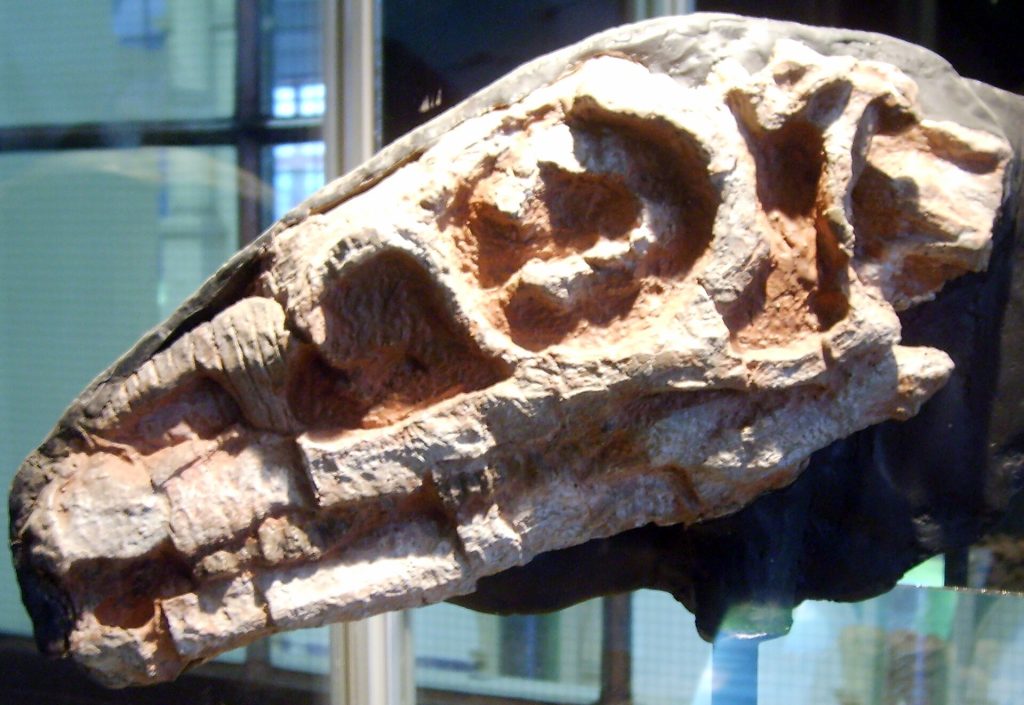

The first skull came from a 1986 expedition by the Museo Argentino de Ciencias Naturales and the Universidad Provincial de La Rioja. Their find, ULR 56, is an almost complete skeleton with most of the skull and lower jaws. It belonged to an individual about 35 percent smaller than the holotype. A second skull, PVSJ 849 in San Juan, now features in cranial comparisons. Other referred bones include a scapula, a hand, a neck vertebra and a small individual with 14 back vertebrae. Arcucci and colleagues also list an unpublished record from the headwaters of the Mañero River.
Riojasaurus Size and Description
Built more heavily than many of its relatives, Riojasaurus combined a low, narrow skull with robust forelimbs.
Short description of Riojasaurus
The skull was low and elongate, especially in front of the eyes, and seen from above it was probably one of the narrowest among prosauropods. A preorbital depression—a hollow in front of the eye socket—was markedly wider than in other prosauropods. Each maxilla (upper tooth-bearing bone) held 24 conical teeth that were not leaf-shaped, with very small denticles (serrations). Bonaparte and Pumares suggested a horny, beak-like covering at the front of the upper jaw, possibly matched at the tip of the lower jaw. They also inferred thick lips along the lower jaw, though none of these soft parts survives.
Behind the head came nine neck vertebrae, sturdier than those of Coloradisaurus or Plateosaurus and without a keel underneath. Next, tall back vertebrae led to a hip with three sacral vertebrae, the front two tightly fused. The humerus (upper arm bone) reached 80 percent of the femur’s length. It also carried a strong deltopectoral crest, a ridge for chest and shoulder muscles. Such sturdy arms fit the 2018 classification of Riojasaurus as a quadruped.
Size and Weight of Type Species
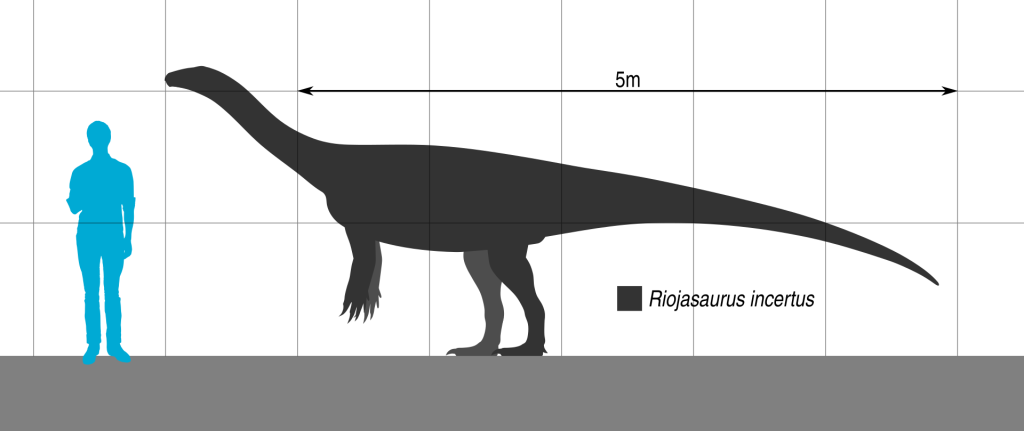
Length and hip height remain open questions, but its weight is better documented. In 2001, Frank Seebacher estimated about 3,039 kilograms (roughly 6,700 pounds) with a polynomial volume model—an indirect method. His figure appears in a 2011 review by Sander and colleagues, which also says Riojasaurus reached masses well over 2 metric tons.
Individuals clearly varied in size. Two referred femora (thigh bones) measure 47.5 and 57 centimeters (about 18.7 and 22.4 inches), or 79 and 95 percent of the holotype’s femur length. Meanwhile, the smaller skull specimen has a skull 25 centimeters (about 9.8 inches) long. Compared with Plateosaurus, its forelimbs and hind limbs were also less unequal in length.

The Dinosaur in Detail
Bonaparte and Pumares read its skull as a window into prosauropod history. In 1995, they argued that it “demonstrates that the melanorosaurid skull is the most primitive among prosauropod dinosaurs.” From the position of the lacrimal (a bone at the front of the eye socket) and the preorbital depression, they also proposed that sauropods may be derived from Melanorosauridae. Unlike in Plateosaurus, where it sits lower, the jaw joint sat level with the upper tooth row. The orbit, or eye socket, measured about 28 percent of skull length.
Bonaparte carried the theme into the backbone. His 1999 study ranked three levels of prosauropod vertebral organization, represented, progressively, by Riojasaurus, Plateosaurus and Lessemsaurus—with Riojasaurus the most primitive. In the mature holotype, the neural arch (the bony upper part of a vertebra) of the front back vertebrae is lower than the centrum, or vertebral body. The smaller ULR 56, by contrast, shows the reverse pattern, which Bonaparte interpreted as a change with growth.
In 2018, McPhee and colleagues—in the paper that named the South African giant Ledumahadi—compared the minimum shaft circumferences of the humerus and femur of PVL 3808. Their analysis classified it as a quadruped with a probability of 0.999.
In 2017, Cerda and colleagues found mostly highly vascularized (richly supplied with blood vessels) bone with growth lines in two femora. Strikingly, the smaller femur came from an animal that had apparently reached full adult body size. The larger one, however, had not yet reached sexual maturity. As possible causes, the authors listed sexual dimorphism, cryptic species and developmental plasticity. Its family ties remain open, too—Arcucci and colleagues called the affinities of the Los Colorados prosauropods “still uncertain.”
Interesting Points about Riojasaurus
- The first Riojasaurus skull turned up in 1986, 17 years after the genus was named.
- According to Bonaparte, the full neck series of ULR 56 was lost in a 1991 robbery.
- The holotype is the largest known individual, yet a smaller femur came from a more mature animal than a larger one.
- Bonaparte and Pumares once proposed a close common ancestor for prosauropods and the early theropod Coelophysis—a historical idea, not today’s consensus.
Contemporary Dinosaurs
Larger even than Riojasaurus was Lessemsaurus sauropoides, named by Bonaparte in 1999. It sat near the base of the sauropod line, though its status as a true sauropod depends on how the group is defined. Its bones come from La Esquina, about 150 meters (490 feet) below the top of the formation. Bonaparte wrote that they came from the same levels that had yielded abundant melanorosaurid and plateosaurid prosauropods. The melanorosaurid he had described from these beds is Riojasaurus. His diagnosis opens by calling Lessemsaurus a “prosauropod larger than Riojasaurus.” No direct interaction between the two large sauropodomorphs is recorded.
Also known from the Los Colorados Formation (exact level relative to Riojasaurus not known): Coloradisaurus, Zupaysaurus and Powellvenator. The first is a medium-sized basal sauropodomorph from the upper third of the formation at La Esquina. However, Bonaparte noted in 1978 that melanorosaurids turn up more often in somewhat higher beds than those that yielded it. Meanwhile, Zupaysaurus is a theropod (meat-eating dinosaur) from the upper levels at Quebrada de los Jachaleros. Powellvenator is a theropod from the same formation. The formation spans about 14 million years, so these animals may not all have lived at the same time.
Riojasaurus in its Natural Habitat
Riojasaurus lived in a landscape of moderately sinuous rivers, floodplains and ponds. These deposits survive as red sandstones, siltstones and mudstones about 600 meters (nearly 2,000 feet) thick. At roughly 48 degrees south, the basin lay in the southern temperate humid belt. Earlier authors interpreted parts of the sequence as ephemeral streams and wind-blown dunes formed under arid conditions. In 2004, however, Arcucci and colleagues concluded in favor of a seasonally humid climate.
The beds lack a fossil plant record, although vertical tubes about 1.5 meters (5 feet) deep were tentatively read as root traces of medium-sized trees. Arcucci’s team argued that so many herbivores suggest an important plant cover, probably low vegetation and forest. Citing earlier work, they also suggested that Los Colorados prosauropods as a group could feed up to 4 meters (13 feet) high. While there is no direct evidence of what it ate, it may have browsed that inferred vegetation.
Reports from the upper formation, at La Esquina and elsewhere, include crocodile-line reptiles—the aetosaur Neoaetosauroides, the ornithosuchid Riojasuchus and the rauisuchid Fasolasuchus, whose skull was almost 1 meter (3.3 feet) long. Small crocodylomorphs (crocodile relatives), the turtle Palaeochersis and the cynodont (mammal relative) Chaliminia are also known from the formation. None of these animals is tied to a level relative to Riojasaurus. In contrast, the dicynodont Jachaleria comes from the older basal levels. According to Kent and colleagues, this upper fauna records the first numerical dominance of herbivorous dinosaurs over other groups. Further basal sauropodomorphs from the formation still await description. Whether Riojasaurus lived alone or in groups remains unknown, but all the formation’s tetrapods were buried partly or fully articulated, which suggests little transport after death.
Frequently Asked Questions
It lived in the Norian stage of the Late Triassic, in an upper Los Colorados fauna probably no younger than about 213 million years.
Its length is not specified, but a 2001 estimate by Frank Seebacher puts its weight at about 6,700 pounds (3,039 kilograms).
It was a herbivore, with 24 conical, non-leaf-shaped teeth in each maxilla, the main upper tooth-bearing bone.
In 2018, McPhee and colleagues classified it as a quadruped from the minimum shaft circumferences of its upper arm and thigh bones.
Its fossils come from the upper Los Colorados Formation around La Esquina, in La Rioja Province of northwestern Argentina.
Bonaparte and Pumares considered its skull the most primitive among prosauropods. A 2018 study also treated it as a sign that four-legged walking had evolved by the mid-Norian.
Sources
The information in this article is based on various sources, drawing on scientific research, fossil evidence, and expert analysis. The aim is to provide a comprehensive and accurate overview of Riojasaurus. However, please be aware that our understanding of dinosaurs and their world is constantly evolving as new discoveries are made.
- https://paleobiodb.org/classic/displayReference?reference_no=13920
- https://naturalhistory.si.edu/sites/default/files/media/translated_publications/Bonaparte%26amp%3BPumares%25201995.pdf
- https://naturalhistory.si.edu/sites/default/files/media/translated_publications/Bonaparte_99.pdf
- https://naturalhistory.si.edu/sites/default/files/media/translated_publications/Bonaparte_78.pdf
- https://staff.mef.org.ar/images/investigadores/diego_pol/papers/20.pdf
- https://staff.mef.org.ar/images/investigadores/diego_pol/papers/68.pdf
- https://doi.org/10.1073/pnas.1402369111
- https://doi.org/10.1371/journal.pone.0179707
- https://doi.org/10.1016/j.cub.2018.07.063
- https://doi.org/10.1111/j.1469-185X.2010.00137.x
- https://doi.org/10.1016/j.geobios.2003.04.008
- https://doi.org/10.1038/s41559-018-0599-y
- https://doi.org/10.5710/AMGH.04.08.2017.3100
- https://www.ameghiniana.org.ar/index.php/ameghiniana/article/download/955/1718
- https://paleobiodb.org/classic/basicTaxonInfo?taxon_no=38649
- https://paleobiodb.org/data1.2/colls/single.json?id=52032&show=full
- https://paleobiodb.org/data1.2/taxa/opinions.json?name=Strenusaurus&show=ref
- https://paleobiodb.org/data1.2/taxa/opinions.json?name=Eucnemesaurus&show=ref
This article was last fact checked: TheDinosaurs Team, 18-11-2026
Featured Image Credit: Nobu Tamura, CC BY-SA 4.0, via Wikimedia Commons
