In Niobrara County, eastern Wyoming, the river-laid rocks of the Lance Formation form the uppermost Cretaceous deposits of the Powder River Basin. Among the tiny fossils washed and screened from them are the teeth of Pectinodon bakkeri, a theropod named in 1982. It belongs to the Troodontidae, the family named after Troodon. It lived in the Maastrichtian stage, roughly 68 to 66 million years ago by correlation with the Hell Creek Formation. No one has yet identified any part of its skeleton—the genus rests on isolated teeth alone.
Paleontologist Kenneth Carpenter named the genus in a paper on baby dinosaurs from the Lance and Hell Creek formations. In 1987, paleontologist Philip Currie sank it into Troodon, but later tooth studies revived it. Its story shows how much a few millimeters of enamel can reveal—and how much they leave unknown.
Pectinodon Key Facts
| Keyword | Fact |
|---|---|
| Pronunciation | Not specified |
| Meaning of name | Comb Tooth |
| Group | Theropoda (Troodontidae) |
| Type Species | Pectinodon bakkeri |
| Diet | Uncertain (studies of troodontid diet disagree) |
| When it Lived | About 68 to 66 MYA (by correlation with the Hell Creek Formation) |
| Period | Cretaceous |
| Epoch | Late Cretaceous (Maastrichtian stage) |
| Length | Not specified |
| Height | Not specified |
| Weight | Not specified |
| Mobility | Not specified |
| First Discovery | Year not specified (Estes published teeth of this kind in 1964 as Saurornithoides sp.) |
| Described by | 1982 by K. Carpenter |
| Holotype | UCM 38445, a single tooth |
| Location of first find | UCMP locality V5711 (“Bushy Tailed Blowout”), Lance Formation, Niobrara County, Wyoming, USA |
Pectinodon Origins, Taxonomy and Timeline
The name Pectinodon means “comb tooth”—Carpenter built it from pectin-, Latin for “comb,” and -odon, Greek for “tooth.” The species name bakkeri honors Dr. Robert T. Bakker, who in Carpenter’s words “has contributed considerably to the study of dinosaurs.” Together, the name describes the animal’s one known feature and salutes a colleague.
In 1982, Carpenter placed Pectinodon “provisionally” in the family Saurornithoididae. His reasons were the strongly compressed crowns and the well-developed serrations, present only on the rear edge. However, Currie concluded in 1987 that the name Troodontidae has priority over Saurornithoididae, and modern studies treat Pectinodon, with its type species P. bakkeri, as a troodontid.
Carpenter described the Lance simply as Late Cretaceous, but later studies place it in the upper Maastrichtian, the period’s final stage. With no direct date for any Pectinodon site, its age comes from correlating the Lance with the Hell Creek Formation. Estimates for the Hell Creek’s base range from about 68.4 to 66.7 million years ago, while its top lines up with the end-Cretaceous impact—about 66.05 million years ago.
Discovery & Fossil Evidence
The holotype comes from UCMP locality V5711, known as “Bushy Tailed Blowout,” in Niobrara County. Earlier, in 1964, Estes had published teeth of this kind as Saurornithoides sp.—an identification he later told Carpenter was incorrect.
The holotype, UCM 38445, is a single tooth at the University of Colorado Museum. Its crown stands 6.2 millimeters (0.24 inches) high. At its widest point, it measures 3.7 millimeters (0.15 inches) from front to back. Three paratypes—extra specimens named alongside the type—are only 1.8 to 3.2 millimeters high and come from V5711 and V5815. Carpenter also referred eight teeth, UCMP 125240 to 125247, all from adults and all from UCMP locality V5620.
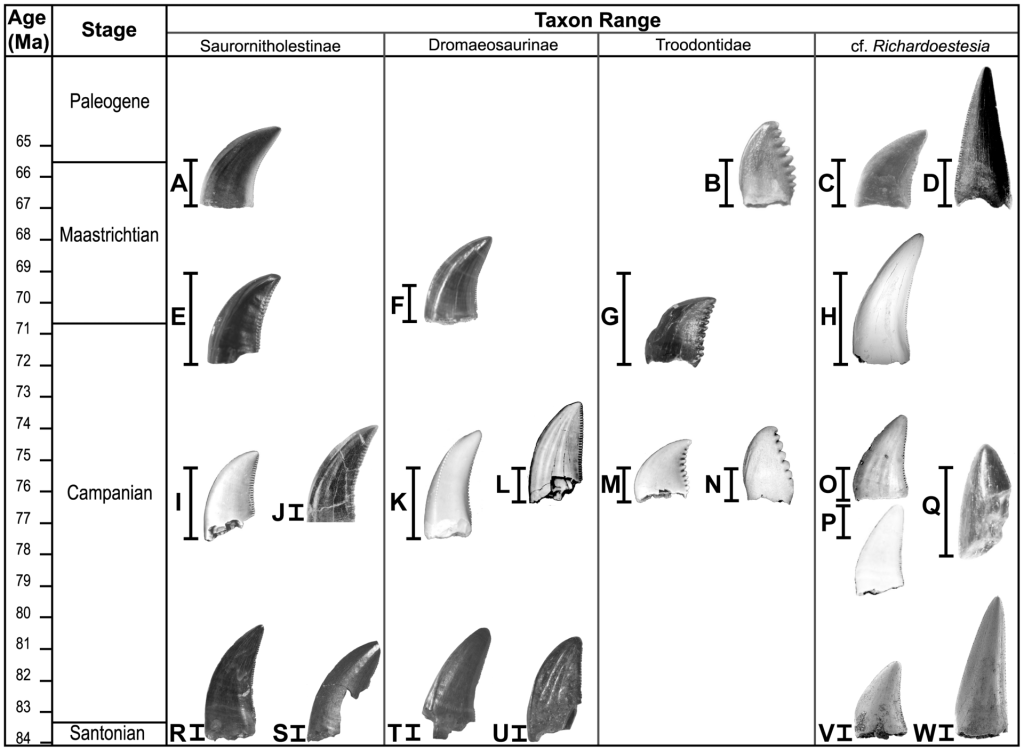

In 1982, Carpenter considered the species “apparently restricted” to the Lance of eastern Wyoming. Since then, teeth of the same type have turned up in the Hell Creek Formation too. In 2008, paleontologist Julia Sankey reported them, along with Lance examples, as a “flattened morphology” of Troodon. Later, in 2013, paleontologist Derek Larson and Currie classed the Hell Creek teeth as cf. Pectinodon—”cf.” marking a tentative identification. Their study analyzed measurements of 40 Lance and five Hell Creek teeth, drawn from Sankey’s data and from raw measurements supplied by paleontologist Nicholas Longrich.
In addition, more teeth come from the Hanson Ranch bonebed, a dense layer of fossil bones in the Lance dominated by Edmontosaurus. In 2020, Snyder and colleagues’ faunal list for this bonebed recorded 52 troodontid elements under the name Troodon.
Pectinodon Size and Description
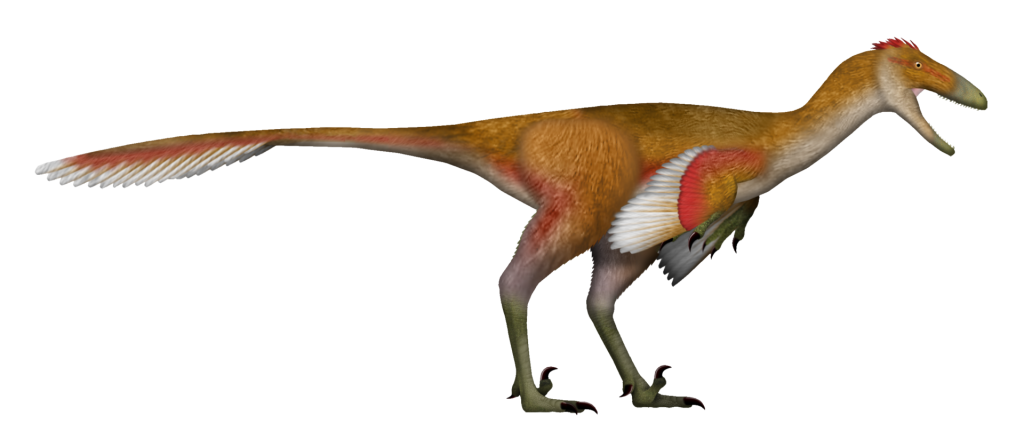
With only teeth to go on, the body of Pectinodon remains a blank—and any picture of it is a guess.
Short description of Pectinodon
Each crown is strongly compressed from side to side and curved backward. The front edge lacks serrations and usually has a rounded profile, though it may bear a low, blunt ridge. In contrast, the rear edge carries large, translucent-edged serrations that peak in size midway along and may rival the crown’s tip. Strangest of all, the tip points backward—so it works, in Carpenter’s words, “as first serration” rather than as a piercing tip. Near the base, two small serrations sit crowded together.
Beyond the teeth, the record falls silent—nothing is known of its posture, gait or body shape. Restorations such as the one below borrow their bodies from relatives, so read them as speculative.

Size and Weight of Type Species
No peer-reviewed estimate of length, height, or weight exists for Pectinodon.
Carpenter judged that the holotype tooth is not from a juvenile. The much smaller paratypes, he wrote, “probably are from babies”—by his definition, young animals weighing less than one-eighth as much as an adult.
The Dinosaur in Detail
What sets this dinosaur apart is the shape of its serrations. In Pectinodon, Carpenter noted, the first serration is not significantly smaller than the crown tip, unlike in other small theropods such as dromaeosaurids. By contrast, teeth he referred to Saurornithoides inequalis had a true piercing tip and a much smaller first serration. That species has a tangled history of its own, merged with Troodon by Currie in 1987. However, in 2017, paleontologists Aaron van der Reest and Currie revived it as Stenonychosaurus inequalis. Then, in 2025, a study led by paleontologist David Varricchio merged it with Troodon again, and the question is still debated.
In 2013, Larson and Currie applied multivariate statistics—methods that compare many measurements at once—to small theropod teeth. Their analyses separated P. bakkeri teeth from every other category except the Hell Creek cf. Pectinodon teeth, which they judged the same morphotype, or shape type. In a 2026 study of the Hanson Ranch bonebed, Siviero and colleagues reported an average of 6.1 rear-edge denticles (tiny serrations) per 2 millimeters, ranging from 4.9 to 7.3.
Its status has swung back and forth since 1982. Currie sank it in 1987, calling Troodon the senior synonym—the older, valid name—of Pectinodon and Stenonychosaurus. Longrich then found it valid in 2008 on qualitative characters. In 2011, paleontologist Lindsay Zanno and colleagues listed “the tooth taxon Pectinodon bakkeri” among North American troodontids.
Most recently, in that 2025 study, Varricchio and colleagues gave its current status as Pectinodon bakkeri. They also kept its material out of their concept of Troodon formosus. Still, a note in their table flags it as fragmentary material whose associations are unclear. These studies treat Pectinodon as a tooth taxon—a name founded on teeth alone.
Interesting Points about Pectinodon
- The holotype of Pectinodon is a single tooth with a crown only 6.2 millimeters (0.24 inches) tall.
- All eight of its referred teeth come from adults, and all come from a single site, UCMP locality V5620.
- Its crown tip points backward and works like an extra serration rather than a piercing point.
- Larson and Currie found that some teeth from the older, Campanian-age Dinosaur Park Formation of Alberta are likely referable to cf. Pectinodon, though they treat them as a distinct morphotype.
Contemporary Dinosaurs
Turning up in both the Hanson Ranch bonebed and Carpenter’s quarries was Thescelosaurus, a small ornithischian dinosaur. In 2020, Snyder and colleagues listed four of its elements from the bonebed. Earlier, Carpenter had reported its teeth from V5711, the holotype locality, and from two other Pectinodon quarries. Still, no fossil records any contact between the two.
Dominating the Hanson Ranch bonebed was Edmontosaurus, a hadrosaurid, or duck-billed dinosaur, with 12,503 elements attributed to probable Edmontosaurus in Snyder’s count. Shed theropod teeth, with troodontid ones among the most common, fit animals scavenging the carcasses, the authors noted—though nothing ties this to Pectinodon specifically.
Also present in that bonebed was Tyrannosaurus, which Siviero and colleagues list alongside Pectinodon among the bonebed’s serrated-toothed theropods. Siviero’s team found the denticles of Pectinodon and the other theropods there too dense to match the striated tooth traces on bone called Knethichnus parallelum. Only T. rex, they concluded, could have made them.
The same bonebed has also produced Triceratops, a ceratopsid, or horned dinosaur, represented by 103 elements in Snyder’s list. Carpenter had earlier found small ceratopsid teeth from young animals at V5711, but he could not say whether they came from Triceratops or Torosaurus. As with the others, however, no fossil records an interaction with Pectinodon.
Also known from the Lance Formation (exact level relative to Pectinodon not known): Torosaurus. The Lance correlates with the Hell Creek Formation. That formation is estimated to span roughly 1 to 2 million years, so these two animals may not have lived at the same time.
Pectinodon in its Natural Habitat
The world Pectinodon inhabited was a coastal plain on the western margin of the Western Interior Seaway. Geologists generally regard the Lance as a river deposit, and its drab sandstones, gray siltstones, and mudstones hold thin seams of lignite, a soft brown coal. Carpenter read these rocks as poorly drained, often waterlogged soils with many marshes or backswamps. Besides dinosaurs, the Hanson Ranch bonebed preserves fish, turtles, crocodylians, squamates (lizards and their kin), mammals, and birds.
What Pectinodon ate is unknown. In 2018, a team led by Torices found troodontid teeth more likely to fail at awkward bite angles. The team suggested that troodontids may have favored softer, smaller, or immobile prey. In contrast, a 2024 chemical study by Cullen and Cousens interpreted troodontids from Alberta’s Oldman Formation as mixed-feeding to plant-dominant omnivores. However, that study did not sample Pectinodon.
While there is no direct evidence of how Pectinodon lived, Carpenter’s tiny paratypes hint that young animals were present. More broadly, he argued that hatchling bones and teeth showing little abrasion suggest some dinosaurs nested near his collecting sites.
Frequently Asked Questions
It means “comb tooth,” and the species name bakkeri honors Dr. Robert T. Bakker.
It lived in the Maastrichtian stage of the Late Cretaceous, about 68 to 66 million years ago by correlation with the Hell Creek Formation.
Nobody knows, because only its teeth have turned up. The holotype crown is just 6.2 millimeters (0.24 inches) tall.
Its diet is uncertain. Studies of other troodontids disagree, pointing either to smaller, softer prey or to omnivory.
Its type tooth comes from Bushy Tailed Blowout, in the Lance Formation of Niobrara County, Wyoming.
It was a troodontid theropod, once merged with Troodon but treated as a valid tooth-based genus in recent studies.
Sources
The information in this article is based on various sources, drawing on scientific research, fossil evidence, and expert analysis. The aim is to provide a comprehensive and accurate overview of Pectinodon. However, please be aware that our understanding of dinosaurs and their world is constantly evolving as new discoveries are made.
- https://zenodo.org/records/3238510
- https://doi.org/10.1080/02724634.1987.10011638
- https://doi.org/10.1371/journal.pone.0024487
- https://doi.org/10.1371/journal.pone.0054329
- https://doi.org/10.1017/jpa.2024.67
- https://centaur.reading.ac.uk/123748/
- https://pmc.ncbi.nlm.nih.gov/articles/PMC13372169/
- https://pmc.ncbi.nlm.nih.gov/articles/PMC7241792/
- https://pmc.ncbi.nlm.nih.gov/articles/PMC13189327/
- https://pmc.ncbi.nlm.nih.gov/articles/PMC3290593/
- https://doi.org/10.1016/j.cub.2018.03.042
- https://doi.org/10.1130/B37077.1
- https://doi.org/10.1139/cjes-2017-0031
- https://doi.org/10.4202/app.2012.0145
- https://paleobiodb.org/data1.2/occs/list.json?base_name=Pectinodon&show=full,ref
This article was last fact checked: TheDinosaurs Team, 18-11-2026
Featured Image Credit: Derek W. Larson, Philip J. Currie, CC BY 2.5, via Wikimedia Commons
