High on southern Utah’s plateaus lies the Kaiparowits Formation, which scientists in 2010 called the area’s most fossil-rich land-laid rock unit. Among its finds is Utahceratops gettyi, a large horned dinosaur named that same year, whose fossils were found in Grand Staircase-Escalante National Monument, designated in 1996. It belongs to Chasmosaurinae, a ceratopsid branch marked partly by a long squamosal—the bone along the frill’s side. According to its describers, it lived in the late Campanian stage of the Late Cretaceous, about 76 million years ago. Its brow horns jut outward, while its frill carries a deep notch at the back. Moreover, it became key evidence for the idea that one small continent held separate regional faunas.
According to the University of Utah, museum paleontologist Mike Getty found the first fossil in 2000. A decade later, paleontologist Scott D. Sampson and six colleagues named it in PLoS ONE. The same paper also named its ornate cousin Kosmoceratops. The six specimens reported in 2010 preserve about 96 percent of the skull and 70 percent of the skeleton behind it. Yet the bigger question these bones raised—whether northern and southern dinosaurs really lived apart—is still open.
Utahceratops Key Facts
| Keyword | Fact |
|---|---|
| Pronunciation | U-tah-SARA-tops (University of Utah, 2010) |
| Meaning of name | Utah Horned Face |
| Group | Ceratopsia |
| Type Species | Utahceratops gettyi |
| Diet | Herbivore |
| When it Lived | Around 76 MYA |
| Period | Cretaceous |
| Epoch | Late Cretaceous (Campanian stage) |
| Length | About 18–22 feet (6–7 meters), University of Utah estimate, 2010 |
| Height | About 6 feet (2 meters) at the hips, University of Utah estimate, 2010 |
| Weight | About 3–4 tonnes, University of Utah estimate, 2010 |
| Mobility | Moved on all four legs (quadrupedal) |
| First Discovery | 2000 by Mike Getty |
| Described by | 2010 by S.D. Sampson, M.A. Loewen, A.A. Farke, E.M. Roberts, C.A. Forster, J.A. Smith, and A.L. Titus |
| Holotype | UMNH VP 16784 |
| Location of first find | Kaiparowits Formation, southern Utah, USA, found in Grand Staircase-Escalante National Monument (designated in 1996) |
Utahceratops Origins, Taxonomy and Timeline
The name Utahceratops is about as plain as dinosaur names get. “Utah” refers to the state of discovery, while the Greek ceratops means “horned face.” The species name gettyi honors Mike Getty, who discovered the holotype.
Utahceratops belongs to Ceratopsia and its family Ceratopsidae. Its describers placed it in Chasmosaurinae partly on traits of the premaxilla (the snout-tip bone), such as a narial strut—a bony bar inside the nostril. Scoring 148 characters across 25 species, they recovered it as the sister taxon of Pentaceratops from New Mexico, near the base of the group holding the other chasmosaurines. In 2020, paleontologists Denver W. Fowler and Elizabeth A. Freedman Fowler grouped the two with Coahuilaceratops and Bravoceratops in their main analysis. They also proposed an anagenetic lineage—one species evolving into the next without branching—from Utahceratops through Pentaceratops, Navajoceratops, and Terminocavus to Anchiceratops. However, their morphometric data supported that idea more strongly than their family tree did. Utahceratops gettyi is the type and only known species.
Originally, Sampson’s team dated the rocks holding Utahceratops and Kosmoceratops to roughly 76.4 to 75.5 million years ago. In 2017, however, Fowler found that the 2010 range chart mixed recalibrated and unrecalibrated radiometric dates. As a result, he argued, Kaiparowits animals plotted about half a million years too old relative to other formations. Using recalibrated argon dates, the 2020 study placed Utahceratops in the middle Kaiparowits, about 75.97 to 75.6 million years ago. In 2022, however, Ramezani and colleagues used high-precision uranium–lead dating to put the formation’s middle unit at about 76.63 to 75.36 million years ago. Since Utahceratops comes from around the boundary of the lower and middle units, this suggests an older age than the 2020 figure. Either way, it lived on Laramidia—the western landmass left when a shallow sea split North America.
Discovery & Fossil Evidence
The holotype and referred fossils span the upper part of the formation’s lower unit and the lower part of its middle unit. Volunteers made up many of the crews from the Utah Museum of Natural History and the Bureau of Land Management. Using traditional methods, the crews recovered the fossils, sometimes with help from helicopter airlifts. Sadly, in July 2026 President Trump signed a proclamation cutting Grand Staircase-Escalante National Monument by about 90 percent, leaving much of its fossil-rich land without monument protection. Conservation groups and scientists have challenged the decision in court.
The holotype, UMNH VP 16784, is a partial skull housed at the Natural History Museum of Utah. A second skull, UMNH VP 12198, is fragmentary but mostly complete. It measures about 7.5 feet (2.3 meters) long and came with an associated postcranium—the skeleton behind the head. Other finds include a fragmentary subadult skull and two partial postorbitals, the bones that carry the brow horns, and each preserves most or all of its bony horncore.
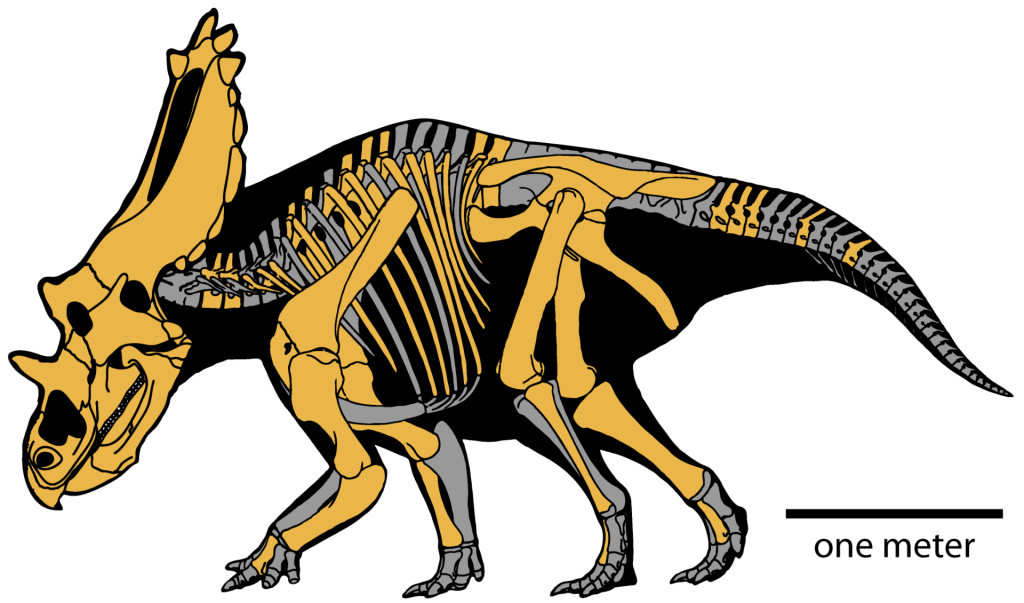

A bonebed, locality 942, also yielded bones from at least two individuals, including a rostrum, premaxilla, nasal fragment, jugal (cheek bone), squamosal, and parietal (the central bone of the frill). Fowler and Freedman Fowler were more cautious about that parietal, sometimes labeling it “cf. Utahceratops” rather than Utahceratops. In 2026, Theurer and colleagues also cited toe bones catalogued as UMNH 20444, a specimen absent from the 2010 paper. In 2012, Gates and colleagues listed Utahceratops among plant-eaters that appear to have been isolated in southern Utah.
Utahceratops Size and Description
With about 96 percent of its skull known, Utahceratops can be pictured from the neck up with real confidence.
Short description of Utahceratops
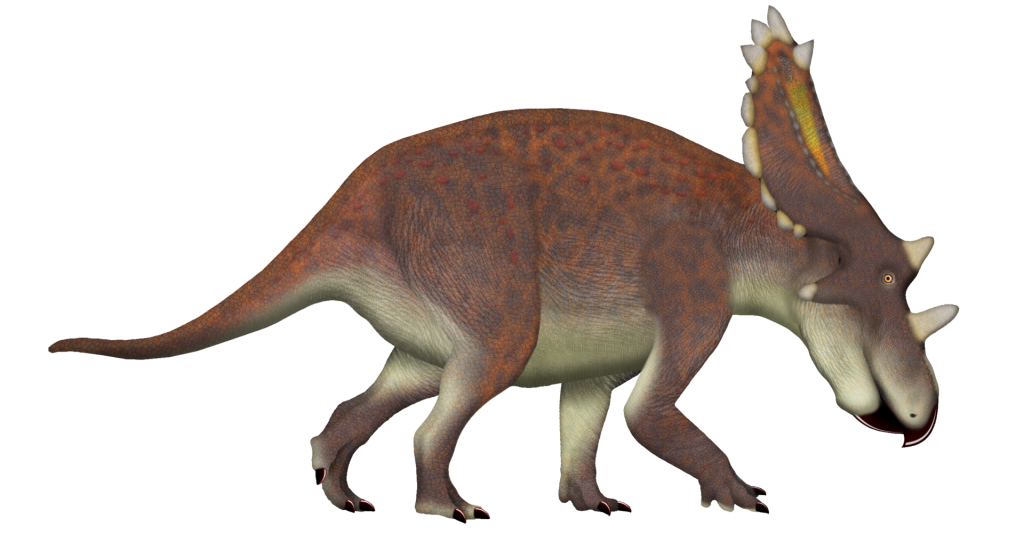
Its skull was enormous—the big referred skull alone runs about 7.5 feet. A large nasal horn rose almost entirely behind the nostril opening, tapering to a pointed tip. Above the eyes sat short, robust brow horns that pointed up and outward and ended bluntly. In front of and between the eyes, a pronounced hump swelled from the skull roof. Relatively large epijugals—bony knobs on the cheeks—completed the face.
Behind the head, an elongate frill tapered toward the rear. Low, extremely elongate episquamosals—bony ornaments along the frill’s edge—lined its midsection, some more than 4 inches (10 centimeters) long. In addition, a deep notch, the median embayment, cut into the back of the frill. Like other ceratopsids, it had a toothless beak at the front of the jaws and walked on all four legs.

Size and Weight of Type Species
No peer-reviewed body length or weight has been published for Utahceratops. The figures in circulation are informal estimates released when the animal was announced.
In 2010, the University of Utah put its length at 18 to 22 feet (6 to 7 meters). The same release also gave a height of about 6 feet (2 meters) at the shoulders and hips. It suggested a weight of about 3 to 4 tonnes—roughly 3.3 to 4.4 short tons. However, the release does not explain these numbers, so they remain rough guides until a formal estimate appears.
The Dinosaur in Detail
Above all, its horns set this dinosaur apart. Its describers likened the up-and-outward brow horns, superficially, to a modern bison’s. In 2016, Mallon and colleagues knew such strong sideways projection only from Albertaceratops, Kosmoceratops, Utahceratops, and their new Spiclypeus. Because four specimens from different localities share this shape, Sampson’s team ruled out distortion or disease.
Similarly, a keel along the nasal horn’s rear edge gives it a tear-drop cross-section, otherwise seen only in Agujaceratops. Meanwhile, few other ceratopsids share the forehead hump, among them the much older Diabloceratops of Utah’s Wahweap Formation. The frill also differs from that of Pentaceratops—its median embayment is deeper and of even width, not tapering. Even the parietal’s rear bar curves unusually forward at its midline.
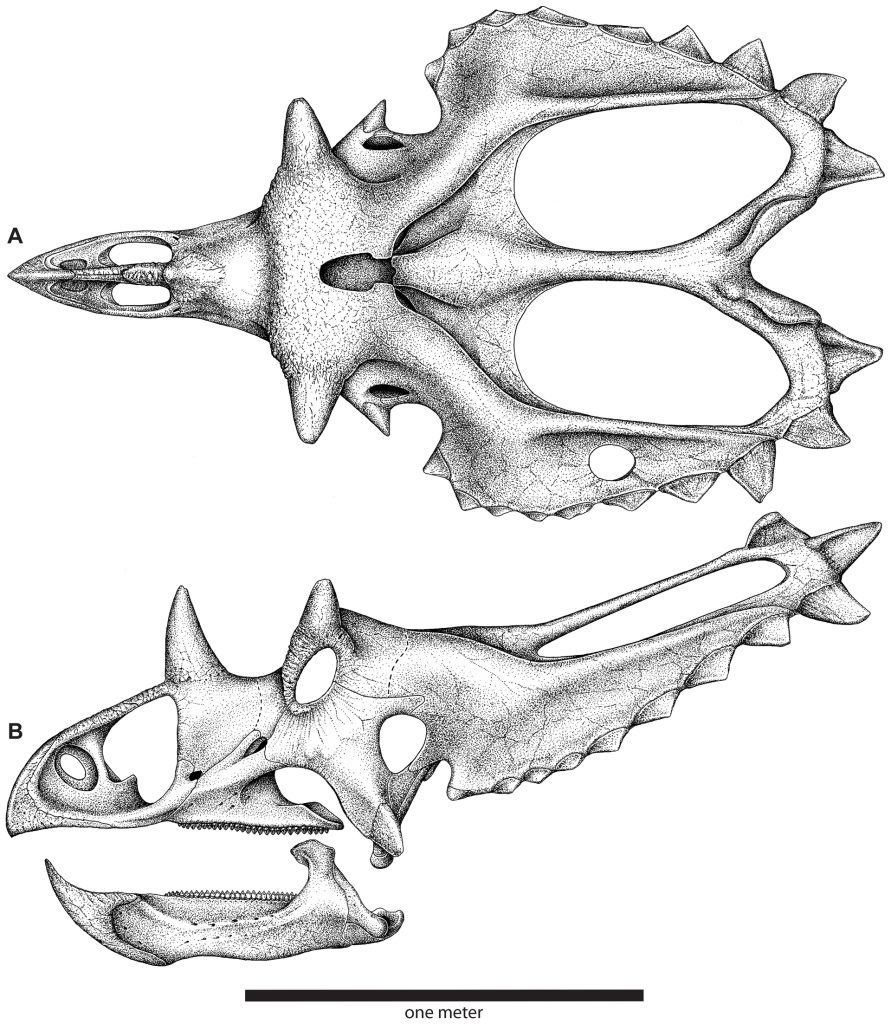

The holotype’s left squamosal also has accessory fenestrae—extra openings—figured in 2010. In 2018, Campbell and colleagues placed them in a wider left-side pattern among chasmosaurines. The big referred skull, Fowler and Freedman Fowler noted, shows fused frill ornaments and resorbed brow horns—signs of an aged animal. Finally, in 2026, Ames, Rowe, and Button suggested in passing, without modeling it, that its reduced brow horns may have limited it to stabbing in combat.
The animal’s widest influence, though, is biogeographic. Sampson’s team argued that both Utah horned dinosaurs showed intracontinental endemism—species confined to one part of a continent. In their view, Laramidia held separate northern and southern faunas, the first documented case in dinosaurs. In 2017, Fowler countered that dating problems weaken this hypothesis. Yet in 2022, Ramezani’s team found that the main fossil-bearing layers of the Kaiparowits and three northern formations overlap significantly in age. Their U–Pb dates, they concluded, refute the idea that the north–south split simply reflects mis-dated rocks, though they called for more fossil collecting. For now, Utahceratops remains a test case in an unsettled debate.
Interesting Points about Utahceratops
- Its name simply means “Utah horned face,” while the species name gettyi honors Mike Getty, who discovered the holotype.
- Utahceratops and Kosmoceratops were named in the same 2010 paper, whose authors called two coeval chasmosaurines in one formation rare.
- Field crews used helicopter airlifts to help recover fossils from Grand Staircase-Escalante National Monument.
- At about 7.5 feet (2.3 meters), its referred skull is longer than the University of Utah’s estimated 6-foot height at the hips.
- Fowler and Freedman Fowler (2020) proposed that Utahceratops sits at the start of an unbranching lineage leading to Anchiceratops.
Contemporary Dinosaurs
Kosmoceratops richardsoni, a fellow chasmosaurine whose short, broad frill bore ten well-developed hooks, appears to have shared the landscape of Utahceratops. Its describers also credited it with the most ornate skull of any known dinosaur. According to the Natural History Museum of Utah, Scott Richardson found it in 2007. Sampson and colleagues reported that the two species’ ranges overlap considerably, indicating that they were coeval and apparently inhabited the same ecosystems. Fowler and Freedman Fowler later put Kosmoceratops at about 76.0 to 75.9 million years ago, also in the middle Kaiparowits. Still, no direct interaction between them is recorded.
Also known from the Kaiparowits Formation (exact level relative to Utahceratops not known): the long-horned centrosaurine Nasutoceratops, the tyrannosaurid Teratophoneus, the hadrosaurine Gryposaurus monumentensis, the ankylosaurid Akainacephalus, the troodontid Talos, and the oviraptorosaur Hagryphus. According to Ramezani and colleagues (2022), the formation’s main fossil-bearing interval spans about 2 million years, from 77.24 to 75.02 million years ago. As a result, these animals may not all have lived at the same time.
Utahceratops in its Natural Habitat
The world Utahceratops roamed was a low-relief alluvial plain of floodplain ponds, lakes, and rivers under a warm, subhumid climate. It lay within 100 kilometers (about 60 miles) of the seaway, at roughly 45 degrees north paleolatitude. Volcanic input was high, and sediment piled up at an anomalously fast 372 meters per million years. Ramezani and colleagues linked the fossil-rich layers to a rise in volcanic input from about 76.4 million years ago. Overall, coastal and alluvial plains like this one formed a narrow north–south belt along Laramidia.
While its exact meals are unknown, this herbivore cropped plants with a toothless beak, like other ceratopsids. According to its describers, a typical Laramidian fauna held at least five giant herbivores over 2,500 kilograms (about 5,500 pounds), two of them ceratopsids. If the University of Utah’s 3-to-4-tonne estimate holds, Utahceratops would fit that giant class.
The wider community was rich. By 2010, researchers recognized 16 dinosaur taxa in the formation, including dromaeosaurids, ornithomimids, dome-headed pachycephalosaurids, and “hypsilophodont” ornithopods. Enantiornithine birds (an extinct group of birds), such as Mirarce eatoni, also lived there. In addition, lizards, snakes, mammals, pterosaurs, amphibians, turtles, fish, and crocodyliforms rounded out the fauna. Sampson and colleagues also noted that Laramidian dinosaurs had small species ranges despite their large bodies. In their view, this may point to low to intermediate physiologies, higher plant productivity, or both.
Frequently Asked Questions
It means “Utah horned face,” and the species name gettyi honors Mike Getty, who discovered the holotype.
It lived around 76 million years ago, during the late Campanian stage of the Late Cretaceous.
No peer-reviewed estimate is known, but the University of Utah suggested 18 to 22 feet (6 to 7 meters) long and about 3 to 4 tonnes.
It was a herbivore that, like other ceratopsids, cropped plants with a toothless beak.
Its fossils were found in the Kaiparowits Formation of southern Utah, in Grand Staircase-Escalante National Monument, designated in 1996.
Blunt, outward-pointing brow horns, a nasal horn set behind the nostrils, and a deep, even-width frill notch set it apart.
Sources
The information in this article is based on various sources, drawing on scientific research, fossil evidence, and expert analysis. The aim is to provide a comprehensive and accurate overview of Utahceratops. However, please be aware that our understanding of dinosaurs and their world is constantly evolving as new discoveries are made.
- https://doi.org/10.1371/journal.pone.0012292
- https://doi.org/10.1371/journal.pone.0188426
- https://doi.org/10.7717/peerj.9251
- https://doi.org/10.1038/s41598-022-19896-w
- https://doi.org/10.1098/rspb.2013.1186
- https://doi.org/10.7717/peerj.5016
- https://doi.org/10.1371/journal.pone.0024487
- https://doi.org/10.1038/s41598-021-89472-1
- https://doi.org/10.1371/journal.pone.0042135
- https://doi.org/10.7717/peerj.5194
- https://doi.org/10.1371/journal.pone.0154218
- https://doi.org/10.1371/journal.pone.0353362
- https://doi.org/10.7717/peerj.21728
- https://doi.org/10.1016/j.palaeo.2022.110876
- https://www.eurekalert.org/news-releases/667677
- https://nhmu.utah.edu/press/amazing-horned-dinosaurs-unearthed-lost-continent
This article was last fact checked: TheDinosaurs Team, 18-11-2026
Featured Image Credit: Jens Lallensack, CC BY-SA 4.0, via Wikimedia Commons
