On the western edge of Niger’s Ténéré Desert lie the river-laid sandstones of the Elrhaz Formation at Gadoufaoua. They hold one of the bulkiest ornithopods yet found. Named Lurdusaurus arenatus in 1999, this iguanodont lived during the Aptian stage of the Early Cretaceous, according to its describers. They called it ponderously constructed and likened its general body form to that of the extinct giant ground sloths. A 2026 study went further, arguing that this was the first known ornithopod with limbs built to bear great weight—a graviportal animal.
French paleontologist Philippe Taquet discovered the skeleton in 1965, and a second French expedition collected it the following year. More than three decades passed before Taquet and paleontologist Dale A. Russell gave it a formal name. Recent work recasts Lurdusaurus as a heavy, wide-stanced quadruped. If that reading holds, obligate four-legged walking among ornithopods arose long before the duck-billed hadrosaurs.
Lurdusaurus Key Facts
| Keyword | Fact |
|---|---|
| Pronunciation | Not specified |
| Meaning of name | Heavy Reptile |
| Group | Ornithopoda |
| Type Species | Lurdusaurus arenatus |
| Diet | Herbivore |
| When it Lived | Aptian (formation age debated) |
| Period | Cretaceous |
| Epoch | Early Cretaceous (Aptian stage) |
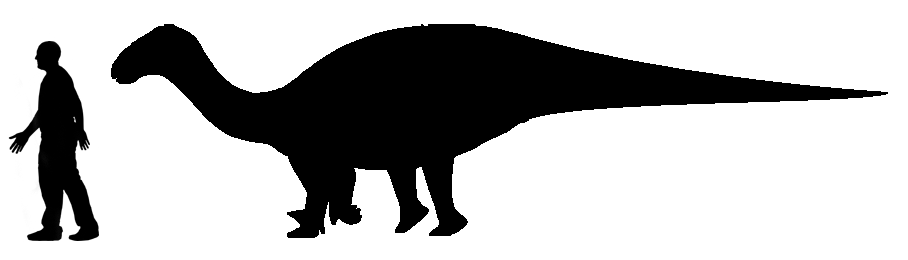
| Length | About 29.5 feet (9 meters) |
| Height | Not specified |
| Weight | About 9,240–13,050 pounds (4,190–5,920 kilograms), depending on method |
| Mobility | Moved on all four legs (quadrupedal) |
| First Discovery | 1965 by Philippe Taquet, collected in 1966 |
| Described by | 1999 by P. Taquet and D.A. Russell |
| Holotype | MNHN GDF 1700 |
| Location of first find | Camp des deux arbres locality, Elrhaz Formation, Gadoufaoua, Ténéré Desert, Niger |
Lurdusaurus Origins, Taxonomy and Timeline
Paleontologist Thomas R. Holtz Jr. translates Lurdusaurus as “heavy reptile.” Before then, the skeleton carried informal labels. Taquet’s 1976 monograph called it the “Iguanodontidé trapu”—the ponderous iguanodontid. In 1988, S. Chabli’s doctoral thesis called it “Gravisaurus tenerensis,” an unofficial name, since the thesis was never published. Ten years later, paleontologist Paul Sereno and colleagues mentioned “the common ‘Iguanodon trapu.'” Together, all these names point to sheer bulk. Lurdusaurus arenatus is the type and only known species.
In 1999, Taquet and Russell saw in its skeleton “a close affinity to European iguanodontids of Early Cretaceous age.” Later work places it in Ankylopollexia and, more narrowly, Styracosterna—a clade that includes Iguanodon, Ouranosaurus and the hadrosaurids (duck-billed dinosaurs). Its exact branch, however, remains unsettled. In 2010, Andrew T. McDonald and colleagues found it too unstable and pruned it from their tree. In 2021, a paper on ornithischian names led by Daniel Madzia noted that its 2020 reference tree placed it in Iguanodontidae, with Barilium and two Iguanodon species. Even so, they warned that the group’s contents are unstable. In 2022, paleontologist K.E. Poole tentatively grouped it with Hypselospinus and Barilium. In a 2026 paper on Muttaburrasaurus, Herne and colleagues simply called it an early-diverging hadrosauriform. That wider group holds both the iguanodontids and the duck-bill lineage.
The 2026 study keeps the Aptian age, but the formation has proved harder to date. Taquet allowed an Aptian–Albian age in 1970 and favored the Aptian in 1976. In 1999, Sereno’s team gave Aptian to Albian, roughly 115 to 105 million years ago. Sereno and Brusatte used about 112 million years in 2008. However, Le Loeuff and colleagues raised a possible Barremian age in 2012. In 2022, Poole also noted that ankylopollexians come mainly from Laurasia, the northern supercontinent, with Lurdusaurus and Ouranosaurus as North African exceptions.
Discovery & Fossil Evidence
In early 1965, the first French expedition to Gadoufaoua found two iguanodontian skeletons at the Camp des deux arbres locality. It lies 7 kilometers (4.3 miles) southeast of Elrhaz. The second expedition dug both out between February 25 and April 7, 1966, and they reached Paris the next year. One became the holotype of Ouranosaurus, while the other—found just 100 meters (330 feet) away—would become Lurdusaurus.
At the Muséum national d’Histoire naturelle in Paris, it became MNHN GDF 1700. Its field number, GDF 381, stayed with an isolated right coracoid (a shoulder-girdle bone) referred to the species. According to paleontologist Filippo Bertozzo and colleagues, that field number was “erroneously used three times,” including for an Ouranosaurus skeleton now in Venice. Taquet judged the Lurdusaurus skeleton two-thirds complete in 1976, whereas the 2026 study calls it nearly complete.
Later studies draw on its braincase, back vertebrae, sacrum (the fused hip vertebrae), hip bones and limbs. In 2026, paleontologists Jordan Gônet, Ronan Allain and Alexandra Houssaye examined the holotype in the Paris collections. They treated it as an adult, based on its skeletal maturity and size. The animal is also far from rare. In 2007, Sereno’s team reported that only Lurdusaurus bones outnumber those of Nigersaurus. By specimen count, that makes it the most common large herbivore at Gadoufaoua.
Lurdusaurus Size and Description
The 2026 study calls its skeleton “excessively robust,” a build unique among ornithopods.
Short description of Lurdusaurus
At the back of the skull, the supraoccipital bone had a flat and nearly vertical rear surface. Its braincase has yielded an endocast (a mold of the brain cavity) of about 167 milliliters. Along the back, the neural spines—bony blades rising from the vertebrae—stood only about as tall as the vertebral bodies, far lower than those of Ouranosaurus. Farther back, the sacrum probably held seven fused vertebrae, and the ilium (main hip bone) had a straight upper edge.
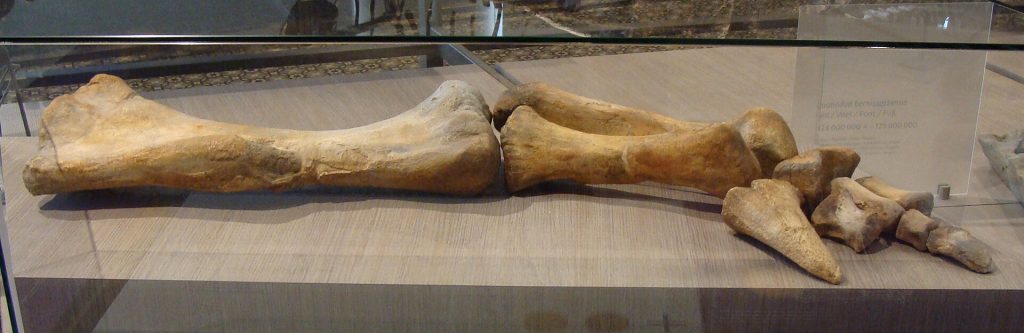
The forelimbs were massive. Poole’s 2022 analysis found two traits only in it and Hypselospinus: an olecranon (elbow process) over 17 percent of the ulna’s length and a radial tubercle for the biceps. She also described their small group as having robust forearms. A well-developed process jutted from the ulna, and the hand ended in hoof-shaped unguals (claw bones). In 2012, McDonald and colleagues noted that the thumb claw was conical. In the hind limb, the femur (thigh bone) was straight and longer than the tibia. Its fourth trochanter—a muscle-attachment ridge—formed a crest at mid-shaft, while the metatarsals (foot bones) were exceptionally short. According to the 2026 study, all of this bulk rested on four legs.

Size and Weight of Type Species
Holtz’s genus list for his popular book gives a length of about 29.5 feet (9 meters). Taquet and Russell’s own figures are in their full 1999 paper, which we saw only as an abstract, so no hip height is given here.
In 2014, Roger Benson and colleagues gave two weight estimates from limb-bone circumferences. Treated as two-legged, the thigh bone alone gives about 9,240 pounds (4,190 kilograms). Treated as four-legged, the upper arm and thigh together give about 13,050 pounds (5,920 kilograms). The 2026 case for four legs may favor the higher figure. Still, David Button and Lindsay Zanno in 2023, and Herne and colleagues in 2026, used the lower figure in their brain studies. Herne’s team gave that figure a margin of plus or minus 25 percent, or roughly 6,930 to 11,550 pounds (3,140 to 5,240 kilograms).
Holtz also places it in his “Rhino” weight class. Among its relatives, the 2026 study ranks Ouranosaurus as slender, Iguanodon as heavy and Lurdusaurus as “super-heavy.”

The Dinosaur in Detail
What sets it apart is how its limbs bore its weight. Gônet and colleagues scored eleven skeletal features linked to two- or four-legged walking, and Lurdusaurus came out as a quadruped on every one. Its forelimbs measured 0.58 times the length of its hind limbs, a typical value for four-legged animals. Compared with the thigh and shin combined, its third metatarsal gave a ratio of 0.05, the lowest of all 47 sampled taxa. Its metatarsals were even shorter than those of the largest hadrosaurs.
The limb shafts tell the same story. Femoral eccentricity—how much wider the thigh bone’s shaft is from side to side than from front to back—reached 1.88, rivaling Stegosaurus and the sauropod Tazoudasaurus. The humerus (upper arm bone) scored 1.75, the fourth highest in the sample, and both bones were strongly arched toward the midline. Its pelvis was broad as well, with an iliac width ratio of 0.35 that far surpasses other ornithopods. From these traits, the authors inferred a wide-gauge stance, with the feet set well out from the body’s midline, as in some titanosaurs. Even so, they stress that further biomechanical work is needed.
Its brain, by contrast, was modest. Using that lower weight, Button and Zanno calculated a reptile encephalization quotient—brain size relative to body mass—of 1.215 to 1.458. Earlier, Pascaline Lauters and colleagues had put the cerebrum at about 19 percent of the endocast’s volume. Herne’s team suggested these low values could reflect its stocky, graviportal, mostly four-legged form. However, they also cautioned that the cerebrum values for it and Iguanodon “seem extraordinarily low,” suggesting that the measuring method differed or needs revision.
Interesting Points about Lurdusaurus
- Its 1999 describers said that in general body form it resembled the extinct giant ground sloths, a group of mammals.
- Its holotype lay just 100 meters from that of Ouranosaurus, a slender relative with tall spines along its back.
- The field number GDF 381 was mistakenly used for three different specimens, but the holotype now carries the catalog number MNHN GDF 1700.
- A 2026 study called it the first graviportal ornithopod and argued that obligate four-legged walking appeared in the group long before the hadrosaurs.
- By specimen count, it is the most common large herbivore at Gadoufaoua, with bones outnumbering even those of the sauropod Nigersaurus.
Dinosaurs from the Same Formation
Also known from the Elrhaz Formation (exact level relative to Lurdusaurus not known): Ouranosaurus, Nigersaurus and Suchomimus. Ouranosaurus was a slender ornithopod whose holotype lay about 100 meters from that of Lurdusaurus at the same site. However, their exact beds have not been correlated. Nigersaurus was a rebbachisaurid sauropod (long-necked plant-eater), while Suchomimus was a long-snouted spinosaurid theropod. The formation’s age is debated, from Barremian to Albian, so these animals may not all have lived at the same time.
Lurdusaurus in its Natural Habitat
Imagine inland floodplains cut by high-energy rivers—the setting Sereno and colleagues described for the Elrhaz Formation. Its rocks are mostly thick, cross-bedded sandstones with few finer layers, and its aquatic fauna is entirely freshwater. In 1970, Taquet reported abundant fossil wood, the fern Paradoxopteris stromeri and freshwater bivalves, some still in life position. Fish such as Lepidotes and Mawsonia shared the waters with lungfish, a hybodont shark, two kinds of turtle and the giant crocodylomorph Sarcosuchus. Pterosaurs, other crocodylomorphs, an unnamed noasaurid theropod and an unnamed titanosaur also appear in the formation’s faunal list. The theropod Eocarcharia was named from the formation as a carcharodontosaurid, but in 2025, Cau and Paterna grouped its holotype skull-roof bone with the spinosaurids.
In 2007, Sereno’s team named Lurdusaurus and Nigersaurus the most common megaherbivores—very large plant-eaters—of their day. For that reason, they argued, any plant food proposed for Nigersaurus must have been fairly widespread. Still, what Lurdusaurus itself ate has not been established. The same authors counted it, with Nigersaurus, Ouranosaurus and an unnamed titanosaur, in one of the few megaherbivore associations balanced between sauropods and large ornithopods.
Holtz’s 2007 popular book depicted Lurdusaurus as semi-aquatic, the 2026 study notes. Its authors instead saw a heavy walker with a probable wide-gauge stance. While there is no direct evidence of whether it lived alone or in groups, it may have been a common sight on the floodplain. According to Sereno’s team, predators of this plant-eating community would have included Sarcosuchus, Suchomimus and similar-sized abelisaurid and carcharodontosaurid theropods.
Frequently Asked Questions
Holtz translates it as “heavy reptile,” a fitting label for this massively built herbivore.
Its describers placed it in the Aptian stage of the Early Cretaceous, but the formation’s age is debated, from the Barremian to the Albian.
Holtz lists about 29.5 feet (9 meters). Limb-bone estimates give 9,240 to 13,050 pounds (4,190 to 5,920 kilograms), depending on the method.
It was a herbivore and, with Nigersaurus, one of the most common large plant-eaters of its ecosystem.
Its holotype comes from the Camp des deux arbres locality in the Elrhaz Formation at Gadoufaoua, in Niger’s Ténéré Desert.
A 2026 study called it the first graviportal ornithopod, a heavy, wide-stanced quadruped with exceptionally short feet.
Sources
The information in this article is based on various sources, drawing on scientific research, fossil evidence, and expert analysis. The aim is to provide a comprehensive and accurate overview of Lurdusaurus. However, please be aware that our understanding of dinosaurs and their world is constantly evolving as new discoveries are made.
- https://doi.org/10.1016/S0753-3969(99)80009-3
- https://fr.pensoft.net/article/173614/
- https://palaeo-electronica.org/content/2022/3707-iguanodontian-phylogeny
- https://peerj.com/articles/3403
- https://naturalhistory.si.edu/sites/default/files/media/translated_publications/Taquet_76.pdf
- https://naturalhistory.si.edu/sites/default/files/media/translated_publications/Taquet%252070.pdf
- https://faculty.washington.edu/gpwilson/Reprints/Sereno_etal_1998.pdf
- https://public.websites.umich.edu/~wilsonja/JAW/Publications_files/Sereno&al1999.pdf
- https://journals.plos.org/plosone/article?id=10.1371/journal.pone.0001230
- https://journals.plos.org/plosone/article/file?type=supplementary&id=10.1371/journal.pone.0001230.s007
- https://www.app.pan.pl/archive/published/app53/app53-015.pdf
- https://www.italianjournalofgeosciences.it/files/download/IJG/IJG%20Vol%20144%20%282025%29%20f2/Assets/162.pdf
- https://pmc.ncbi.nlm.nih.gov/articles/PMC10628235/
- https://pmc.ncbi.nlm.nih.gov/articles/PMC13070326/
- https://pmc.ncbi.nlm.nih.gov/articles/PMC8667728/
- https://pmc.ncbi.nlm.nih.gov/articles/PMC2989904/
- https://pmc.ncbi.nlm.nih.gov/articles/PMC3471925/
- https://pmc.ncbi.nlm.nih.gov/articles/PMC4691198/
- https://pmc.ncbi.nlm.nih.gov/articles/PMC3827337/
- https://www.geol.umd.edu/~tholtz/dinoappendix/HoltzappendixWinter2011.pdf
- https://doi.org/10.1371/journal.pbio.1001853
This article was last fact checked: TheDinosaurs Team, 18-11-2026
Featured Image Credit: Ghedoghedo, CC BY-SA 3.0, via Wikimedia Commons
