
Along Doegie Creek in Wyoming, the river-laid rocks of the Lance Formation gave up a small dinosaur skeleton. It would wait two decades for a name. That animal is Thescelosaurus neglectus, the type species of a genus known only from the late Maastrichtian—roughly 68 to 66 million years ago. It belongs to the neornithischians—a large branch of ornithischian (bird-hipped) dinosaurs—and to a family named after it, the Thescelosauridae.
In July 1891, collectors J. B. Hatcher and W. H. Utterback found a nearly complete skeleton that lacked its skull and neck. It then sat in its original packing boxes until shortly before 1913. When paleontologist Charles W. Gilmore finally examined it, he was surprised to find something new. Since then, a three-dimensional skull, a third species, and CT scans have filled out the picture.
Thescelosaurus Key Facts
| Keyword | Fact |
|---|---|
| Pronunciation | Not specified |
| Meaning of name | Overlooked Marvelous Reptile |
| Group | Neornithischia (Thescelosauridae) |
| Type Species | Thescelosaurus neglectus |
| Diet | Herbivore |
| When it Lived | 68 to 66 MYA |
| Period | Cretaceous |
| Epoch | Late Cretaceous (Maastrichtian stage) |
| Length | 10 to 13.5 feet (3 to 4.1 meters) |
| Height | A little over 3 feet (0.9 meters) at the hips |
| Weight | About 750 pounds (340 kilograms) |
| Mobility | Moved on two legs (bipedal) |
| First Discovery | 1891 by J. B. Hatcher and W. H. Utterback (paratype collected 1889 by O. A. Peterson) |
| Described by | 1913 by Charles W. Gilmore |
| Holotype | USNM 7757 |
| Location of first find | Doegie Creek, Lance Formation, Niobrara County (then Converse County), Wyoming, USA |
Thescelosaurus Origins, Taxonomy and Timeline
Neither of Gilmore’s papers from 1913 and 1915 explains the name. According to paleontologist Clint A. Boyd, writing for the North Dakota Geological Survey in 2016, Thescelosaurus neglectus means “the overlooked marvelous reptile.” Boyd wrote that Gilmore had “quite appropriately named” a skeleton that sat in its packing boxes for two decades. Together, the name tells a story of a fossil collected, shelved, and finally recognized.
In 1913, Gilmore called his find “a small Orthopodous dinosaur” and provisionally placed it in the family Camptosauridae, named for Camptosaurus. Two years later, he moved it to the Hypsilophodontidae and named Hypsilophodon as its nearest relative. Most authors kept that placement for over 60 years, but researchers now regard Hypsilophodontidae as paraphyletic—an artificial grouping that leaves out some descendants of its common ancestor. Today Thescelosaurus gives its name to Thescelosauridae, a group that also includes the smaller Orodromeus and its relatives. Boyd’s 2014 study recognizes three species—T. neglectus, T. garbanii, and T. assiniboiensis.
Modern work places the genus in the late Maastrichtian, the final stage of the Late Cretaceous. Estimates for the base of the equivalent Hell Creek Formation range from about 68.4 to 66.7 million years ago. Its top, however, sits at the end-Cretaceous impact—roughly 66.05 million years ago. Without a direct date for the holotype quarry, the safest range is roughly 68 to 66 million years ago.
Discovery & Fossil Evidence
Hatcher and Utterback collected the holotype in July 1891 at Doegie Creek, in what was then Converse County and is now Niobrara County. Yet the holotype was not the first find. O. A. Peterson had collected USNM 7758 at Lance Creek in 1889, and Gilmore made it the paratype in 1913.
The holotype, USNM 7757, is housed at the Smithsonian’s National Museum of Natural History. Besides the skull and neck, it lacked parts of the humeri (upper arm bones), scapulae (shoulder blades), and coracoids. It lay on its left side, still articulated—which Gilmore read as a natural death, not the work of a predator. He credited its fine preservation to quick burial. Instead of mounting it, he displayed the skeleton in the rock, nearly as found.

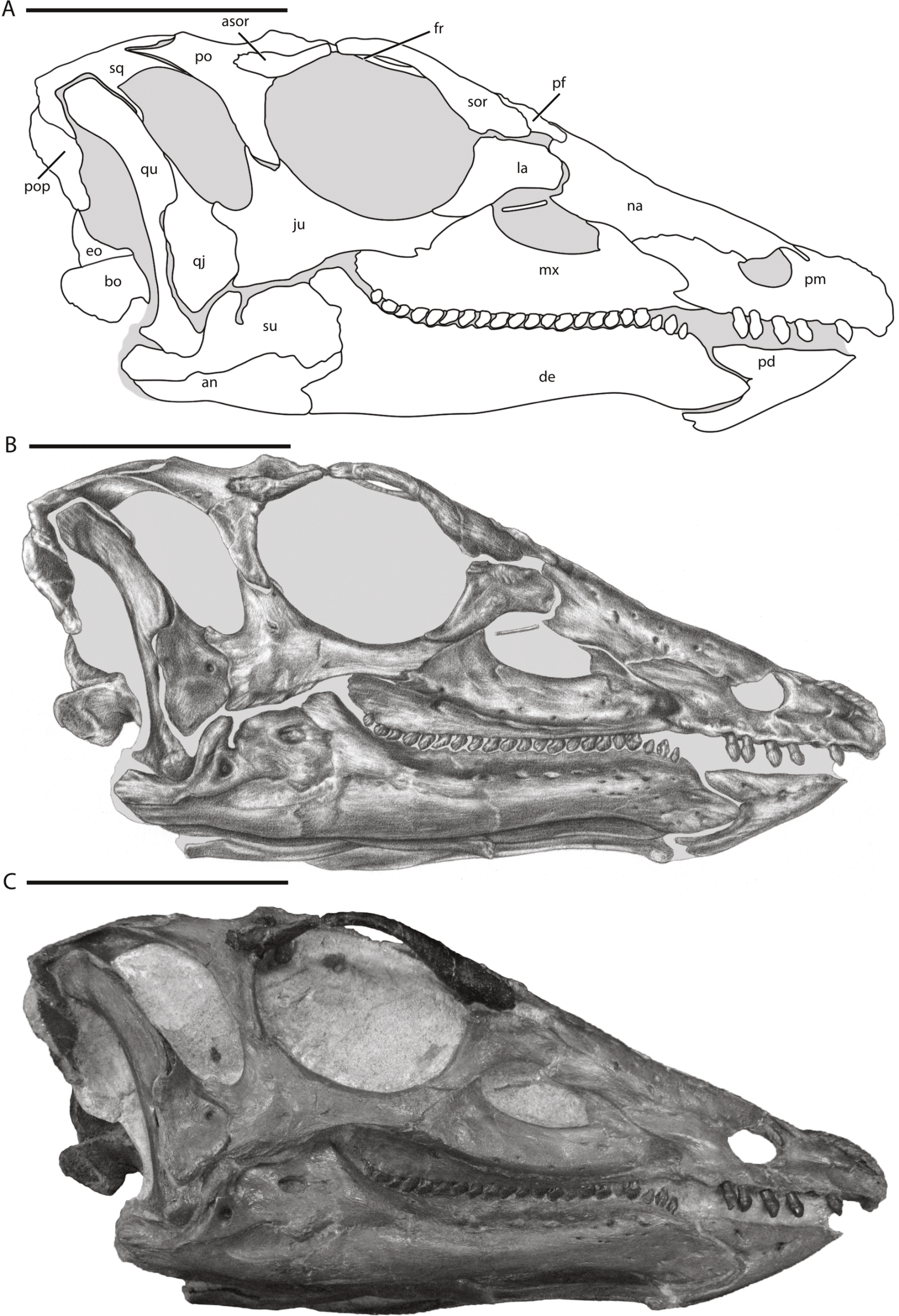
By 1915, Gilmore also knew of bones from South Dakota and Montana, including three partial skeletons Barnum Brown collected in Dawson County. Until 2014, though, the only skull bones confidently referred to T. neglectus were three fragments preserved with the paratype—a partial frontal, postorbital, and squamosal. That changed with NCSM 15728, nicknamed “Willo,” from Harding County, South Dakota. Boyd’s 2014 paper gives 1999 as its collection year. However, his 2016 article dates its discovery to 1993. In 2014, Boyd used it, backed by a second skull from Dewey County, to describe the skull fully for the first time. Today, the genus is known from the Lance, Hell Creek, Frenchman, and Scollard formations.
Thescelosaurus Size and Description
Short description of Thescelosaurus
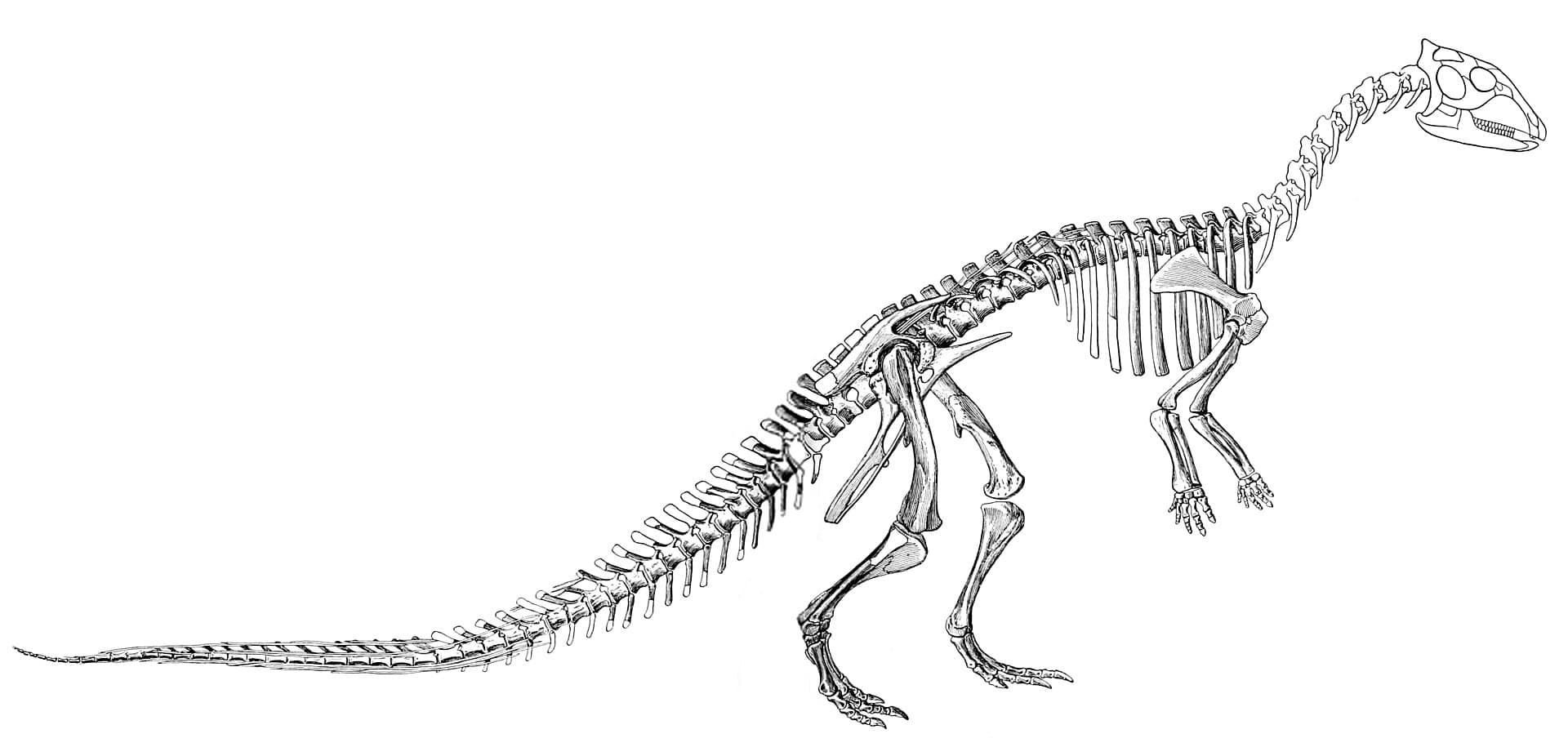
The skull was extremely elongated, which may explain its high tooth counts, according to Boyd. Willo carries six teeth in each premaxilla (front upper jaw bone), 20 tooth positions in each maxilla, and 20 teeth in each dentary (lower jaw). In the holotype, behind the neck came 16 back vertebrae, five sacral (hip) vertebrae, and 48 surviving tail vertebrae. In fact, the tail made up half the skeleton’s length, and Gilmore judged that it served as a balancing organ. Ossified tendons—bony rods along the spine—strengthened the back, hips, and tail along their entire length.
Each hand had five fingers, and the outer two ended in small rounded nodules instead of claws. By contrast, each foot bore four toes tipped with pointed, claw-like unguals. Its forelimbs were somewhat more than half as long as its hind limbs, which Gilmore took as a sign of a normally two-legged gait. On the holotype, he thought two dark patches might be carbonized skin, with no regular pattern and no bony armor. Any picture of its outer covering is therefore speculative.
Size and Weight of Type Species
In 1913, Gilmore guessed the holotype at perhaps 12 feet (3.7 meters) long and a little over 3 feet (0.9 meters) tall at the hips. Two years later, his restored skeleton came out at about 10 feet (3 meters), although he did not explain the cut.
Later researchers described bigger animals. In 2014, Boyd put adult size at over 13 feet (4 meters). Paleontologists David Button and Lindsay Zanno then cited lengths up to about 13.5 feet (4.1 meters) in 2023. That makes it unusually large next to most basal neornithischians, which measured about 3 to 6.5 feet (1 to 2 meters).
Gilmore gave no weight. In 2014, Roger Benson and colleagues estimated about 750 pounds (340 kilograms) from limb-bone circumference. Their figure comes from AMNH 5891, a mature skeleton referred to the species rather than the holotype. The same method gave the small, possibly immature holotype of T. assiniboiensis about 240 pounds (108.5 kilograms) and Orodromeus only about 44 pounds (20 kilograms).
The Dinosaur in Detail
What sets this dinosaur apart is a mix of limb and skull traits. Gilmore separated it from Hypsilophodon by its femur (thigh bone), which was longer than the tibia (shin bone)—355 against 300 millimeters. Boyd and colleagues’ 2009 diagnosis of the genus adds frontals wider at mid-orbit than at the back and a prominent horizontal ridge along the maxilla. In 1915, Gilmore thought the front upper teeth had probably disappeared. Later finds proved otherwise, and Willo shows a full row of them. Boyd suggests that their number may have increased as the animal grew.

Willo’s chest raised a famous debate. In 2000, Paul Fisher and colleagues argued that CT scans of an iron-rich concretion there suggested a four-chambered heart and intermediate-to-high metabolic rates. In 2011, however, Timothy Cleland and colleagues found the structure consistent with cemented sand grains rather than a heart. Boyd’s 2016 article reports that the “heart of stone” idea was rejected.
Using CT data of Willo’s skull, Button and Zanno found a relatively small brain, a narrow hearing range, and unusually well-developed olfactory bulbs. Gilmore had pictured a strong, agile runner, judging from its hind limbs. In contrast, later researchers judged it poorly built for running, and Button and Zanno’s inner-ear data suggest it was not highly agile. They also found its traits consistent with burrowing in the clade. No burrows of Thescelosaurus are known, however—and they called the extent of any digging unclear.
Boyd argued in 2014 that Parksosaurus, first named T. warreni, is a close relative. Brown and colleagues tentatively classed Thescelosaurus as a basal ornithopod in 2011, under the definition of Ornithopoda they followed. By contrast, Boyd’s 2015 analysis placed its clade outside Ornithopoda, as the sister group to Cerapoda. Taken together, its skeleton is well known—its relationships much less so.
Interesting Points about Thescelosaurus
- The third species, T. assiniboiensis, takes its name from the District of Assiniboia, itself named after the Assiniboine First Nations people.
- Because no skull was known in 1915, Gilmore drew the head and neck of his skeletal restoration after Hypsilophodon.
- The partial South Dakota skull that became the type of Bugenasaura infernalis in 1995 now belongs to Thescelosaurus, and its genus name became a junior synonym in 2009.
- In the Frenchman Formation of Saskatchewan, home of T. assiniboiensis, Thescelosaurus may be the most abundant dinosaur, at about 31 percent of skeletons.
- Gilmore called his holotype unique for preserving part of the sternum (breastbone) and most of the sternal ribs.
Contemporary Dinosaurs
Dominating the same landscape by sheer numbers was Triceratops, the horned ceratopsid that makes up 40 percent of the Hell Creek dinosaur census. Its bones also occur with Thescelosaurus in the Lance Formation’s Hanson Ranch Bonebed. In 2011, Tyler Lyson and Nicholas Longrich suggested ceratopsians favored floodplains farther from rivers, unlike Thescelosaurus. No record links them directly.
Adding further diversity was Edmontosaurus, a hadrosaurid (duck-billed) herbivore whose species E. annectens was first named from the Lance Formation. More than 12,000 of its bones fill the Hanson Ranch Bonebed—where Thescelosaurus also turns up. Lyson and Longrich suggested that both animals preferred habitats close to rivers. Any contact between them goes unrecorded.
Prowling the same Lance landscape was Tyrannosaurus, which Lyson and Longrich called the ecosystem’s sole large carnivore. In 2025, however, Zanno and James Napoli argued that Nanotyrannus was a distinct tyrannosaur living alongside it. Shed Tyrannosaurus teeth turn up in the same bonebed, and both animals occur in a lag deposit in the upper Hell Creek Formation. Still, no bite marks or other evidence connect the giant predator to Thescelosaurus.
Among the rarer members of the fauna was Pachycephalosaurus, a dome-headed dinosaur. Gilmore first named its species Troödon wyomingensis in 1931, from a Lance Formation skull found in Niobrara County. A few of its bones also come from the Hanson Ranch Bonebed. With no recorded interaction, it fits best as a neighbor.
Thescelosaurus in its Natural Habitat
The world Thescelosaurus roamed was a low-relief lowland on the western margin of the Western Interior Seaway. Rivers crossed the region, from braided and meandering streams to deltas and lakes, laying down claystone, mudstone, and fine sandstone. Similarly, the equivalent Hell Creek Formation records an extensive floodplain with meandering rivers. Button and Zanno note that wet lowlands were the setting for most Thescelosaurus specimens.
Later studies treat Thescelosaurus as a herbivore, although no fossil gut contents show exactly what it ate. Researchers also disagree about its preferred setting. Lyson and Longrich found a strong association with sandstone, which they read as a preference for river settings. By contrast, Horner and colleagues found it only in mudstones in their census but called the small sample questionable. Button and Zanno even linked its keen smell and possible digging to unearthing buried food, such as roots and rhizomes.
While there is no direct evidence of herds, Button and Zanno suggested its relatively small brain might reflect smaller groups than in other Late Cretaceous ornithischians. It was also common, making up 8 percent of the Hell Creek census. In Saskatchewan’s Frenchman Formation, many specimens are small, probably juvenile or subadult individuals, although whether that reflects biology or preservation bias remains uncertain. Either way, this herbivore was a familiar part of North America’s last Cretaceous ecosystems.
Frequently Asked Questions
A 2016 North Dakota Geological Survey article translates Thescelosaurus neglectus as “the overlooked marvelous reptile.”
It lived in the late Maastrichtian stage of the Late Cretaceous, roughly 68 to 66 million years ago.
Estimates range from about 10 to 13.5 feet long. One mature skeleton gives a weight estimate of about 750 pounds.
It was a herbivore, although no fossil gut contents reveal exactly which plants it ate.
The holotype came from Doegie Creek in the Lance Formation of Niobrara County, Wyoming, in 1891.
Features of its long skull, which held up to 20 teeth per jaw row, set it apart. Its specimen “Willo” also sparked a famous, now rejected, fossil-heart claim.
Sources
The information in this article is based on various sources, drawing on scientific research, fossil evidence, and expert analysis. The aim is to provide a comprehensive and accurate overview of Thescelosaurus. However, please be aware that our understanding of dinosaurs and their world is constantly evolving as new discoveries are made.
- https://archive.org/details/smithsonianmisce611914smit
- https://www.biodiversitylibrary.org/page/7042724
- https://archive.org/details/biostor-79442
- https://peerj.com/articles/669
- https://doi.org/10.1111/j.1096-3642.2011.00735.x
- https://www.nature.com/articles/s41598-023-45658-3
- https://journals.plos.org/plosbiology/article?id=10.1371/journal.pbio.1001853
- https://doi.org/10.1126/science.288.5465.503
- https://doi.org/10.1007/s00114-010-0760-1
- https://doi.org/10.1098/rspb.2010.1444
- https://pmc.ncbi.nlm.nih.gov/articles/PMC3036655/
- https://journals.plos.org/plosone/article?id=10.1371/journal.pone.0233182
- https://pmc.ncbi.nlm.nih.gov/articles/PMC3182183/
- https://pmc.ncbi.nlm.nih.gov/articles/PMC2762616/
- https://archive.org/details/biostor-99461
- https://pmc.ncbi.nlm.nih.gov/articles/PMC4690359/
- https://pmc.ncbi.nlm.nih.gov/articles/PMC8667728/
- https://pmc.ncbi.nlm.nih.gov/articles/PMC13189327/
- https://pmc.ncbi.nlm.nih.gov/articles/PMC11347701/
- https://www.dmr.nd.gov/ndgs/documents/newsletter/2016Winter/The%20Overlooked%20Marvelous%20Reptile.pdf
- https://www.nature.com/articles/s41586-025-09801-6
This article was last fact checked: TheDinosaurs Team, 31-10-2026
Featured Image Credit: Connor Ashbridge, CC BY 4.0, via Wikimedia Commons
