In Dinosaur Provincial Park in southern Alberta, the river-laid Oldman Formation has yielded a tyrannosaur that defies easy placement. Named Tromerosaurus solumons in 2026, it dates to roughly 76.8 to 76.3 million years ago, during the Late Cretaceous, according to its describers. Its skeleton shares features with Daspletosaurus and Gorgosaurus—one a tyrannosaurine, the other an albertosaurine. As a result, it makes a revealing test case for how scientists sort the tyrant family.
The first bones came out of the ground in 2010, and at first researchers assumed they belonged to Daspletosaurus. Only after long comparisons with Daspletosaurus and Gorgosaurus did the specimen emerge as something new. In 2026, paleontologist Mark J. Powers, Philip J. Currie, and eight colleagues named it in the Journal of Vertebrate Paleontology. Their study also moved fossils once filed under Gorgosaurus libratus into the new genus, a reminder that even a well-studied fauna can still be redrawn.
Tromerosaurus Key Facts
| Keyword | Fact |
|---|---|
| Pronunciation | Not specified |
| Meaning of name | Reported in news coverage as Frightful Lizard |
| Group | Theropoda (Tyrannosauridae) |
| Type Species | Tromerosaurus solumons |
| Diet | Carnivore |
| When it Lived | 76.8 to 76.3 MYA |
| Period | Cretaceous |
| Epoch | Late Cretaceous (Campanian stage) |
| Length | Not specified |
| Height | Not specified |
| Weight | Not specified |
| Mobility | Not specified |
| First Discovery | 2010 to 2011 |
| Described by | 2026 by M.J. Powers, J.G. Napoli, C.C. Coppock, H.S. Sharpe, C.W. Garros, A.V. Demers-Potvin, G.S. Raun, J.C. Stock, T. Miyashita, and P.J. Currie |
| Holotype | UALVP 52981 |
| Location of first find | Oldman Formation, Dinosaur Provincial Park, Alberta, Canada |
Tromerosaurus Origins, Taxonomy and Timeline
According to New Scientist, Tromerosaurus means “frightful lizard”—a homage to the similar translations of Daspletosaurus and Gorgosaurus. Speaking to CTV News, lead author Powers also described the name as a combination of those two genera. Both outlets report that the species name solumons means “lonely mountain,” and both link it to the animal’s isolated horn. As Powers told CTV News, “the horn is a mountain on the head.” New Scientist adds that the name also refers to the lair of the dragon Smaug in Tolkien’s The Hobbit, a book the paper itself cites.
Tromerosaurus belongs to Tyrannosauridae, the family that also includes Tyrannosaurus. Its describers called it an albertosaurine, a member of the subgroup containing Albertosaurus and Gorgosaurus, but its exact branch depends on the method used. Parsimony, which favors the tree needing the fewest evolutionary changes, recovers it as the earliest-diverging albertosaurine. In contrast, Bayesian inference—a probability-based approach—places it at the base of Tyrannosaurinae, the lineage of Daspletosaurus and Tyrannosaurus. Tromerosaurus solumons is the type and only known species.
In their time-scaled analyses, the authors gave it an age of 76.8 to 76.3 million years, which falls within the Campanian stage of the Late Cretaceous. At the park, a 2023 dating study by geologist David Eberth and colleagues places the top of the Oldman Formation at about 76.47 million years ago. More broadly, the describers see the Santonian to Maastrichtian stages as a time of rapid change in tyrannosaurid evolution.
Discovery & Fossil Evidence
The holotype came from the Oldman Formation in Dinosaur Provincial Park, and Powers told CTV News it was found in 2010. According to New Scientist, researchers uncovered the first foot fossils in 2010 and 2011, and more of the skeleton followed later. Catalogued as UALVP 52981, the specimen belongs to the University of Alberta collection.
Its skull material includes both premaxillae (front upper jaw bones), the right maxilla—the main tooth-bearing upper jaw bone—and the right jugal (cheekbone). In addition, it preserves the right lacrimal, several palate bones, and the right dentary, or lower jaw bone. Below the neck, it has both humeri (upper arm bones), a complete pelvis, and the right hindlimb, including the fibula.
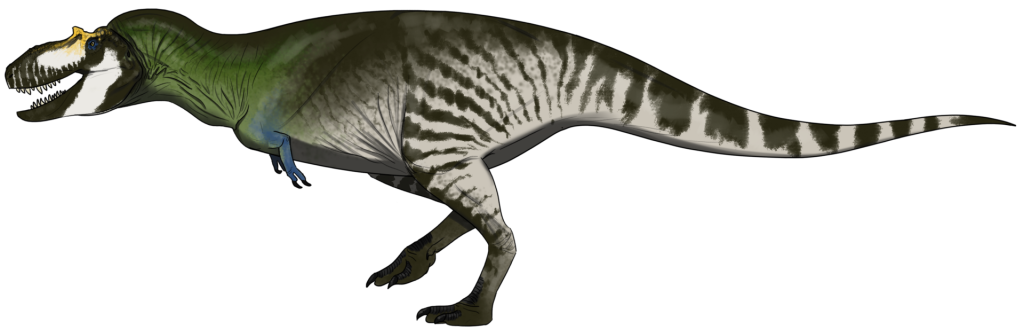

The authors refer four more specimens to the genus, two of them only tentatively. TMP 1994.012.0602 is a relatively complete skeleton, whereas TMP 1995.005.0001 is a partial skull, with a few other bones, from a subadult. Earlier studies had placed both in Gorgosaurus libratus. Finally, two maxillae from the park’s Steveville area complete the list—one from a juvenile, the other from a mature animal.
Tromerosaurus Size and Description
Short description of Tromerosaurus
Its nasal bones, along the top of the snout, were rugose—roughened—with the rugosities concentrated along the midline. In the subadult skull they form a prominent ridge, whereas mature skulls show a subtler one. Near each eye, the lacrimal bone bore a prominent, rounded cornual process, or hornlet, placed toward the front, which Powers describes as “much more forward.” Below the eye, the deep cheekbone also carried a suborbital flange, a small shelf of bone.
Its arms were relatively long, with a humerus more than 30 percent of the femur’s length, as in Daspletosaurus and Gorgosaurus. By comparison, the figure in Albertosaurus and Tyrannosaurus is 25 to 30 percent. At the front of the ilium—the main hip blade—a strong hook points forward and down. New Scientist also mentions “lengthy, lean legs.”
Size and Weight of Type Species
New Scientist reports a length of about 26 feet (8 meters) but gives no basis for the figure. For now, that number should be treated as provisional, and the animal’s weight remains unknown.
Still, the supplementary material describes the holotype as comparable in size to TMP 1994.012.0602. Earlier studies ranked that specimen among the most mature Gorgosaurus libratus because of its relatively large size.
Bone histology, the study of bone tissue under a microscope, adds clues about age. The holotype’s fibula shows about 17 lines of arrested growth—rings that form when growth pauses. The tibia of TMP 1994.012.0602 preserves about 14, although that count leaves out any rings the marrow cavity destroyed. While neither animal had fully stopped growing, the authors consider both mature. Speaking to CTV News, co-author Christiana Garros put the specimen’s age at between 15 and 20 years.
The Dinosaur in Detail
What sets this dinosaur apart is its maxilla. Compared with Gorgosaurus libratus, its maxillary fenestra, an opening in the side of the upper jaw, is longer. Its pila promaxillaris, the bony strut beside that opening, is also narrower and set inward, a trait the authors coded as a new character. In a principal component analysis—a statistical comparison of shapes—its maxillae cluster apart from both Daspletosaurus and an Albertosaurus–Gorgosaurus group. The authors read this as a clearly intermediate form.
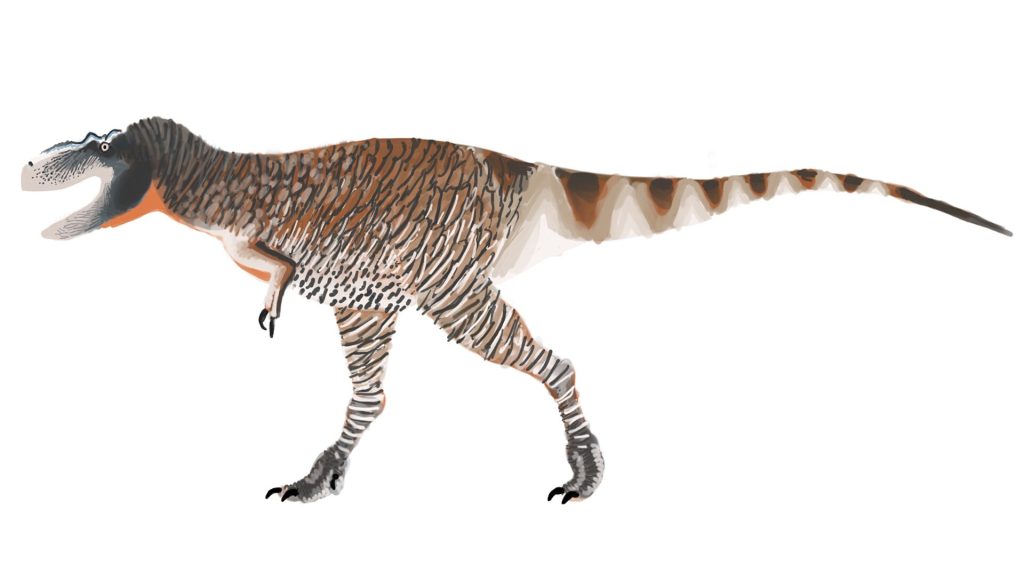

Those mixed signals carry through to its family tree. Specifically, the team built on a 2025 dataset from Voris and colleagues, adding 25 new characters. Under parsimony, Tromerosaurus sits just outside a clade of Gorgosaurus and Albertosaurus. Under Bayesian inference, however, it branches just below tyrannosaurines such as Bistahieversor, Daspletosaurus, and Tyrannosaurus. Other groupings, such as Lythronax plus Teratophoneus, also drew reduced support.
Because its position is so uncertain, the authors argue that it deserves a genus of its own. They also question the view of tyrannosaurid species as long-lived and few compared with the plant-eaters of their time. Recent proposals of chronospecies, single lineages thought to change into successive species, have reinforced that view. The authors argue that the results point to a family that gained new traits quickly, with its two main branches splitting more recently than once thought.
Interesting Points about Tromerosaurus
- News reports say solumons means “lonely mountain,” and the paper itself cites Tolkien’s The Hobbit.
- The paper’s supplementary material notes a small avulsion fracture on the holotype’s right humerus, similar in appearance to one in the famous tyrannosaur “Sue.”
- Notes from George Sternberg’s expeditions of 1920 and 1921 suggest where one referred maxilla, UALVP 56605, was collected.
- Several of its fossils were first identified as other tyrannosaurs, either Daspletosaurus or Gorgosaurus libratus.
Contemporary Dinosaurs
Sharing at least part of its time range were Gorgosaurus specimens from near the top of the Oldman Formation. The describers did not assign them to a species, and in their dating, Gorgosaurus libratus itself appears only after Tromerosaurus. The describers report a restricted stratigraphic overlap between the two genera, which they see as support for keeping them apart. Their supplementary photos also show these Gorgosaurus quarries near the Oldman–Dinosaur Park boundary. There is no evidence of any interaction between the pair.
Also known from the Oldman Formation (exact level relative to Tromerosaurus not known): the tyrannosaurine Daspletosaurus torosus, the hadrosaurine Brachylophosaurus canadensis, and the horned centrosaurine Coronosaurus brinkmani. At the park, Eberth and colleagues place the Brachylophosaurus holotype 7.5 meters (about 25 feet) below the top of the formation. Similarly, they place the Coronosaurus bonebeds more than 10 meters (about 33 feet) below it. D. torosus comes from the upper part of the same fossil zone. Only the top 10 to 20 meters (about 33 to 66 feet) of the formation is well exposed there. That zone reaches back from about 76.47 million years ago to a lower limit not yet fixed. As a result, these animals may not all have lived at the same time.
Tromerosaurus in its Natural Habitat
The world Tromerosaurus roamed was built by rivers. Its rocks are poorly sorted sandstones and mudstones with local iron- and silica-rich concretions. They belong to the Belly River Group, a wedge of land and coastal sediments that interfingers with marine shales of the Western Interior Seaway. At the park, the top of the formation probably records a condensed section or hiatus—a thin or missing slice of time—lasting no more than about 227,000 years.
News reports describe Tromerosaurus as a carnivore. While its diet has not been studied directly, its place among the tyrannosaurids makes a meat-eating lifestyle likely.
Its world also stood on the brink of change. Writing before Tromerosaurus was named, Eberth and colleagues found that none of the three large species then known from the Oldman Formation at the park—Brachylophosaurus, Coronosaurus, and Daspletosaurus torosus—appears in the overlying Dinosaur Park Formation. However, for D. torosus they flag a 2017 study by Carr and colleagues as a caveat. Tromerosaurus itself may have lasted slightly longer. The describers’ range for it runs to 76.3 million years ago, after the 76.47-million-year date for the top of the formation. In addition, two quarries with referred specimens sit in mixed Oldman and Dinosaur Park layers at the contact. Around 76.3 million years ago, sediment also began to pile up faster across the region. Whether Tromerosaurus lived alone or in groups remains unknown.
Frequently Asked Questions
News reports say it means “frightful lizard,” while the species name solumons means “lonely mountain,” after the isolated horn over its eye.
Its describers place it between about 76.8 and 76.3 million years ago, in the Campanian stage of the Late Cretaceous.
New Scientist reports a length of about 26 feet (8 meters), though it gives no basis for that figure.
It was a tyrannosaurid, recovered as the earliest-diverging albertosaurine under parsimony or the earliest-diverging tyrannosaurine under Bayesian inference.
Its holotype came from the Oldman Formation in Dinosaur Provincial Park, Alberta, Canada.
Its upper jaw shape is intermediate between Daspletosaurus and Gorgosaurus, blurring the line between two tyrannosaurid lineages.
Sources
The information in this article is based on various sources, drawing on scientific research, fossil evidence, and expert analysis. The aim is to provide a comprehensive and accurate overview of Tromerosaurus. However, please be aware that our understanding of dinosaurs and their world is constantly evolving as new discoveries are made.
- https://doi.org/10.1080/02724634.2026.2728669
- https://doi.org/10.6084/m9.figshare.34055918.v1
- https://doi.org/10.1139/cjes-2023-0037
- https://utoronto.scholaris.ca/bitstreams/fe003a99-711c-4745-9b70-0554d282cc85/download
- https://www.newscientist.com/article/2594525-discovery-of-t-rexs-cousin-upends-our-understanding-of-tyrannosaur-evolution/
- https://www.ctvnews.ca/edmonton/article/from-weird-specimen-to-new-species-the-story-of-albertas-newest-tyrannosaur/
This article was last fact checked: TheDinosaurs Team, 18-11-2026
Featured Image Credit: Connor Ashbridge, CC BY 4.0, via Wikimedia Commons
