On the outskirts of Qhemegha Village in South Africa’s Eastern Cape lie the rocks of the lower Elliot Formation. There, a bed of mottled purple and red sandstone has given up an extraordinary skull. It belongs to Nyana rooiwalensis, an early sauropodomorph that lived approximately during the Norian and Rhaetian stages of the Late Triassic. According to its describers, this is the first near-complete, articulated dinosaur skull from the South African Late Triassic. The animal was still a youngster when it died—yet it already ranked among the largest juveniles known from that time.
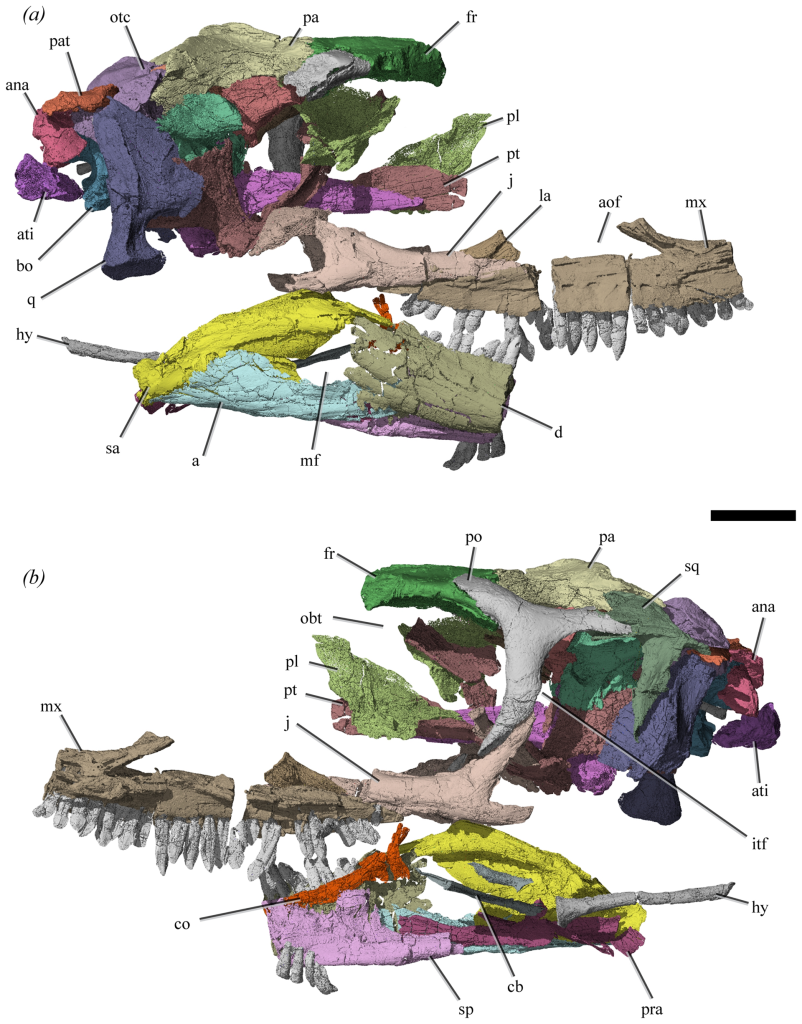
Marie-Claire Koschowitz found the specimen, which came out of the ground in 2018. In 2026, paleontologist Atashni Moopen and six colleagues named the new genus and species in Royal Society Open Science. The skull still holds its braincase, palate and hyoid apparatus (tongue-supporting bones), as well as dozens of scattered scleral ossicles, the small bones that ringed the eyes. Together, these remains help show how early sauropodomorphs grew.
Nyana Key Facts
| Keyword | Fact |
|---|---|
| Pronunciation | Not specified |
| Meaning of name | Son or child (Xhosa), small or little (Sesotho) |
| Group | Sauropodomorpha |
| Type Species | Nyana rooiwalensis |
| Diet | Not specified |
| When it Lived | Approximately Norian to Rhaetian (the authors’ time calibration uses 209 to 201 MYA) |
| Period | Triassic |
| Epoch | Late Triassic (Norian to Rhaetian stages) |
| Length | Not specified |
| Height | Not specified |
| Weight | About 880 pounds (400 kilograms) for the juvenile holotype, indirect estimate |
| Mobility | Probably two-legged (limb material limited) |
| First Discovery | Collected in 2018, found by Marie-Claire Koschowitz |
| Described by | 2026 by A. Moopen, J. Botha, R. Benson, K.E.J. Chapelle, P.M. Barrett, K. Dollman, and J.N. Choiniere |
| Holotype | BP/1/8468 |
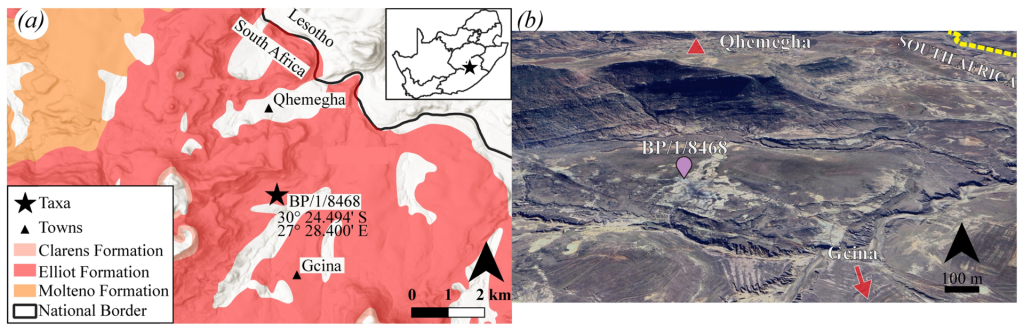
| Location of first find | Lower Elliot Formation, outskirts of Qhemegha Village, Sterkspruit District, Eastern Cape Province, South Africa |
Nyana Origins, Taxonomy and Timeline
The name Nyana draws on two South African languages. In Xhosa, “nyana” means “son” or refers to a child, while in Sesotho it means “small” or “little.” The authors chose it to reflect the animal’s youth and comparably large size. Meanwhile, the species name rooiwalensis refers to Rooiwal, Eastern Cape Tribal Administrative Area 17, where the fossil site lies. Together, the name captures a paradox—a youngster that was already big.
Within Dinosauria, Nyana belongs to Saurischia and then to Sauropodomorpha, the lineage that later gave rise to the giant sauropods. Moopen and colleagues ran a parsimony analysis—a method that favors the family tree needing the fewest evolutionary changes—on 418 characters scored across 83 taxa. The search returned at least 10,000 equally short trees, with low support for most groupings. After the team pruned three unstable taxa, Nyana paired with either the North American Sarahsaurus or the South African Ngwevu. Both pairings sat inside Massospondylidae, the family of Massospondylus. In a third result, however, Nyana and Sarahsaurus together fell just outside that family as early-branching massopodans. Nyana rooiwalensis is the type and only known species.
The fossil comes from the upper half of the lower Elliot Formation, about 460 feet (140 meters) above the contact with the Molteno Formation. Correlation with radiometrically dated tuffaceous (volcanic ash-bearing) layers at Quthing and Maphutseng suggests an approximately Norian to Rhaetian age. For their time-calibrated tree, the authors used roughly 209 to 201 million years ago, near the close of the Triassic. The Elliot Formation as a whole spans about 30 million years and straddles the end-Triassic mass extinction.
Discovery & Fossil Evidence
The site lies about 1.2 miles (2 kilometers) north of Gcina, in the Sterkspruit District. After Koschowitz found the specimen, Mabote Louw and Charlton Dube prepared it.
The holotype—the name-bearing specimen—is BP/1/8468, housed at the Evolutionary Studies Institute of the University of the Witwatersrand in Johannesburg. It includes a partial articulated skull with separate left and right maxillary (upper jaw) fragments, plus the back half of the right lower jaw. Alongside them lie both proatlases, small bones between the skull and the first neck vertebra. From the spine come four neck vertebrae, two back vertebrae, a dorsal neural arch, a sacral centrum (hip vertebra body) and two tail centra. Among the limb bones are the ends of the left ulna (forearm bone) and right femur (thigh bone). The lower end of the left tibia (shin bone), a hand phalanx, a hand claw and a foot claw complete the list.
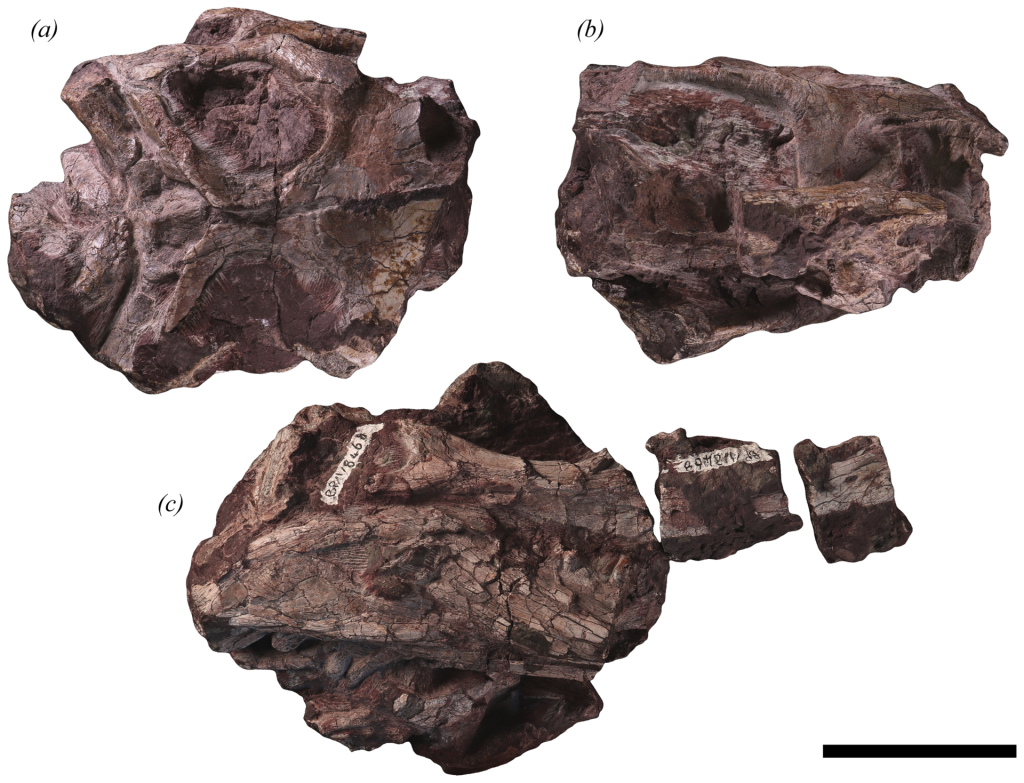

The skull lacks most of the region in front of the eyes, including the prefrontals and the nasals and premaxillae of the snout. Its lower jaw also lacks the front of the dentary (tooth-bearing bone) and the articular, and all of the skull’s sutures are unfused. The team imaged the skull with synchrotron phase-contrast micro-CT, a high-resolution X-ray scan, in Grenoble, France. Thin sections from the ulna and tibia then revealed the bone tissue itself. To date, the holotype remains the only known specimen.
Nyana Size and Description
Even as a youngster, Nyana was a heavyweight—and its skull carries features seen in no other known sauropodomorph.
Short description of Nyana
Even without its snout, the preserved skull measures about 8.4 inches (21.3 centimeters) long. Its overall shape and proportions resemble those of Ngwevu intloko, a sauropodomorph from the Lower Jurassic part of the Elliot Formation. Behind the eye, a T-shaped postorbital bone bordered the infratemporal fenestra—a skull opening whose front margin lay behind the orbit. The teeth were spatulate (broad and spatula-like) and curved inward, overlapping one another en echelon, like slightly offset roof tiles. Each crown carried about 11 small serrations, or denticles, along each cutting edge.
According to Moopen and colleagues, the ratio between the log-transformed shaft circumferences near the upper ends of its ulna and femur is consistent with a two-legged animal. Indeed, that value of 0.86 falls within the range of the bipedal Lufengosaurus and Plateosaurus. Still, the authors caution that too little limb material survives for a firm verdict on posture. Skin and other soft tissues are not preserved, so any restoration of its outward appearance is speculative.

Size and Weight of Type Species
No published study gives a body length or hip height for Nyana. According to the describers, a complete skull would exceed the 8.6-inch (218-millimeter) skull of the largest known adult Massospondylus carinatus.
To weigh a partial juvenile, the team compared its femoral circumference—about 7.6 inches (194 millimeters), taken near the upper end rather than at mid-shaft—and its growth-line count with growth curves for Massospondylus and Mussaurus. On that basis, Nyana probably weighed about 880 pounds (400 kilograms) at its growth stage.
For comparison, the largest known adult M. carinatus had an estimated mid-shaft femoral circumference of 8.4 inches (214 millimeters) and an estimated mass of about 1,200 pounds (543 kilograms). A subadult Mussaurus with a femur 8.1 inches (206 millimeters) around at mid-shaft had an estimated mass close to that of Nyana. Because the Nyana figure was taken nearer the top of the bone, the numbers are not directly equivalent. Meanwhile, Nyana was more than four times the size of juvenile Massospondylus and Mussaurus. Extrapolating these growth curves, the authors suggest that adults may have reached multi-tonne body masses, though they give no figure.
The Dinosaur in Detail
What sets this dinosaur apart are three autapomorphies—traits found in no other known species. First, the ascending branch of its maxilla rises at a 40-degree angle from the bone’s long axis. Second, its postorbital is thickened from side to side and has straight branches. Finally, a small foramen (opening) pierces the back inner surface of the palatine, one of the palate bones.
The upper jaw also held an unusually high number of teeth. Its partial right maxilla preserves 23 tooth sockets, whereas many early sauropodomorphs have 14 to 20. Since the animal was immature and the bone incomplete, the authors think its count may have matched or exceeded the 25 of Plateosaurus. Its inner ear, meanwhile, was longer front to back and shorter top to bottom than in Massospondylus and Sarahsaurus.
Bone histology—the study of bone tissue under the microscope—fills in its life story. A thin cortex, dense blood-vessel canals and open sutures mark it as a juvenile. The bone shows at least one line of arrested growth, a pause in growth, and possibly a second. Since remodeling may hide earlier lines, the authors place it at least in its third year of growth. Its rapidly forming tissue, they argue, supports fast growth arising early in the lineage—foreshadowing the gigantism of later sauropods.
Nyana complicates the story of size in early sauropodomorphs. If it is a massospondylid, the authors note, that would suggest body masses above one tonne (1.1 short tons) evolved more than once among early sauropodomorphs. After all, other massospondylids were much smaller. Alternatively, a place beside the roughly 375-pound (170-kilogram) Sarahsaurus would point to wide differences in mass among close relatives. Such a pairing would also link the early sauropodomorphs of southern Africa and western North America.
Interesting Points about Nyana
- The name Nyana comes from Xhosa and Sesotho words for a child and for something small, chosen to reflect the holotype’s youth.
- Its describers call it one of the largest juvenile dinosaurs known from the Late Triassic, more than four times the size of juvenile Massospondylus.
- Nyana preserves the first near-complete, articulated dinosaur skull from the South African Late Triassic, with its hyoid bones and scattered eye-ring ossicles preserved.
- If it proves to be a massospondylid, the authors say it would be the first Triassic member of that family recovered from South Africa.
- Its partial upper jaw holds 23 tooth sockets, more than the 14 to 20 seen in many early sauropodomorphs.
Dinosaurs from the Same Formation
Also known from the lower Elliot Formation (exact level relative to Nyana not known): Plateosauravus and Melanorosaurus, both sauropodomorphs. Plateosauravus falls outside Massopoda, the group that includes Nyana, and its bones can be traced to the lower Elliot but not to a particular level within it. Melanorosaurus serves as the outside reference point in the current definition of Sauropoda. The lower Elliot spans the mid-Norian to the Rhaetian, so these animals may not have lived at the same time as Nyana.
Nyana in its Natural Habitat
The world Nyana roamed was shaped by rivers. Geologists describe the lower Elliot as a land of perennial meandering rivers, broad floodplains and riverside forests in a humid to semi-arid climate. Olive-gray to purplish mudstones and channel sandstones up to about 65 feet (20 meters) thick record this setting. Nyana‘s bones lay in nodules within a silty sandstone. At the time, this region lay within the supercontinent Pangaea.

Its describers detail its spatulate, finely serrated teeth, yet they do not say what Nyana ate. Sauropodomorphs are by far the most abundant vertebrate fossils in the Elliot Formation, and its lower part is especially known for large-bodied forms. In 2017, paleontologist Blair McPhee and colleagues noted that the lower Elliot lacked any taxa as gracile (slender) as Massospondylus.
Most other named lower Elliot dinosaurs, however, come from lower down. Blikanasaurus lay very low in the unit. Eucnemesaurus comes from about 100 to 165 feet (30 to 50 meters) above the base. Meanwhile, Kholumolumo comes from the Maphutseng bone bed in neighboring Lesotho, within the first 165 feet (50 meters). In 2020, geologist Emese Bordy and colleagues dated these lowest strata to the middle Norian, about 220 to 216 million years ago. Since Nyana came from about 460 feet (140 meters) up, these sauropodomorphs probably lived several million years earlier.
Nyana‘s bed lies within the Scalenodontoides Assemblage Zone, the older of the formation’s two fossil zones. That zone is dominated by sauropodomorphs and is less diverse than the younger zone above it. Across the whole formation, mostly in its upper part, researchers have also found crocodylomorphs (crocodile relatives), chelonians (turtles) and temnospondyls (extinct amphibians). Cynodonts (mammal relatives) and diverse plant remains turn up too.
Frequently Asked Questions
It comes from Xhosa and Sesotho, meaning a son or child and “small” or “little,” a reference to the holotype’s youth.
It lived in the Late Triassic, approximately the Norian to Rhaetian stages. The authors’ time calibration uses about 209 to 201 million years ago.
The juvenile holotype probably weighed about 880 pounds (400 kilograms). Its length and height have not been estimated, and adults may have reached multi-tonne masses.
It was an early-branching sauropodomorph, recovered either as an early massopodan or as a member of Massospondylidae.
It was found in the lower Elliot Formation near Qhemegha Village, Sterkspruit District, in South Africa’s Eastern Cape Province.
It preserves the first near-complete, articulated dinosaur skull from South Africa’s Late Triassic, and it belonged to an unusually large juvenile.
Sources
The information in this article is based on various sources, drawing on scientific research, fossil evidence, and expert analysis. The aim is to provide a comprehensive and accurate overview of Nyana. However, please be aware that our understanding of dinosaurs and their world is constantly evolving as new discoveries are made.
- https://doi.org/10.1098/rsos.261002
- https://pmc.ncbi.nlm.nih.gov/articles/PMC13750947/
- https://doi.org/10.6084/m9.figshare.c.8759005
- https://doi.org/10.4202/app.00377.2017
- https://doi.org/10.1016/j.earscirev.2020.103120
- https://doi.org/10.1080/02724634.2019.1732996
This article was last fact checked: TheDinosaurs Team, 18-11-2026
Featured Image Credit: Connor Ashbridge, CC BY 4.0, via Wikimedia Commons
