
At the north end of Utah’s San Rafael Swell, south of the town of Price, the Cedar Mountain Formation holds the bones of a gigantic armored dinosaur. Named Peloroplites cedrimontanus in 2008, it belonged to the ankylosaurs—the armored, plant-eating dinosaurs that walked on all four legs. Later geological work places it about 110 million years ago, in the early Albian stage of the Early Cretaceous. At roughly 16 to 18 feet (5 to 5.5 meters) long, it matched the better-known Sauropelta in size.
Excavations at the Price River quarries that produced it began in the 1990s. According to a 2009 campus news report, College of Eastern Utah faculty, staff, and students worked its quarry for years. In 2008, paleontologist Kenneth Carpenter and three colleagues described the animal from a partial skull and skeleton. Since then, geologists have reconsidered the age of its quarry—a reminder that rocks can be re-read as often as bones.
Peloroplites Key Facts
| Keyword | Fact |
|---|---|
| Pronunciation | Not specified |
| Meaning of name | Not specified |
| Group | Ankylosauria |
| Type Species | Peloroplites cedrimontanus |
| Diet | Herbivore |
| When it Lived | Around 110 MYA |
| Period | Cretaceous |
| Epoch | Early Cretaceous (Albian stage) |
| Length | 16.4 to 18.0 feet (5 to 5.5 meters) |
| Height | Not specified |
| Weight | Not specified |
| Mobility | Moved on all four legs (quadrupedal) |
| First Discovery | Year not specified (Price River quarries excavated since the 1990s) |
| Described by | 2008 by K. Carpenter, J. Bartlett, J. Bird, and R.E. Barrick |
| Holotype | CEUM 26331 |
| Location of first find | PR-2 Quarry, Cedar Mountain Formation, Price River area, San Rafael Swell, Utah, USA |
Peloroplites Origins, Taxonomy and Timeline
The meaning of Peloroplites is harder to pin down than its bones. News reports have offered two versions—”gigantic monster from Cedar Mountain” in 2009 and “armored monster from the Cedar Mountain” in 2013. However, both glosses come from news releases, so the formal meaning is left unspecified here. Together, they agree that the name points to a monster from Cedar Mountain.
In 2008, Carpenter and colleagues named it a large nodosaurid ankylosaur—a member of one family of armored dinosaurs. In 2016, Kirkland and colleagues summarized that view as a “gigantic nodosaurine nodosaurid… perhaps related to Sauropelta.” However, Raven and colleagues’ 2023 “preferred” tree placed it in Polacanthidae, a different lineage. In 2026, a tooth study by Cross and colleagues instead linked it with Panoplosauridae. Peloroplites cedrimontanus remains the type and only known species.
Originally, the 2008 team placed the quarry at the base of the Mussentuchit Member, which dates to the earliest Late Cretaceous (Cenomanian stage), about 99 million years ago. Later work, however, assigned the quarry to the upper, Albian part of the older Ruby Ranch Member. On that view, Peloroplites lived about 110 million years ago. According to Kirkland and colleagues, this fell in the interval when flowering plants first radiated and came to dominate the world’s floras.
Discovery & Fossil Evidence
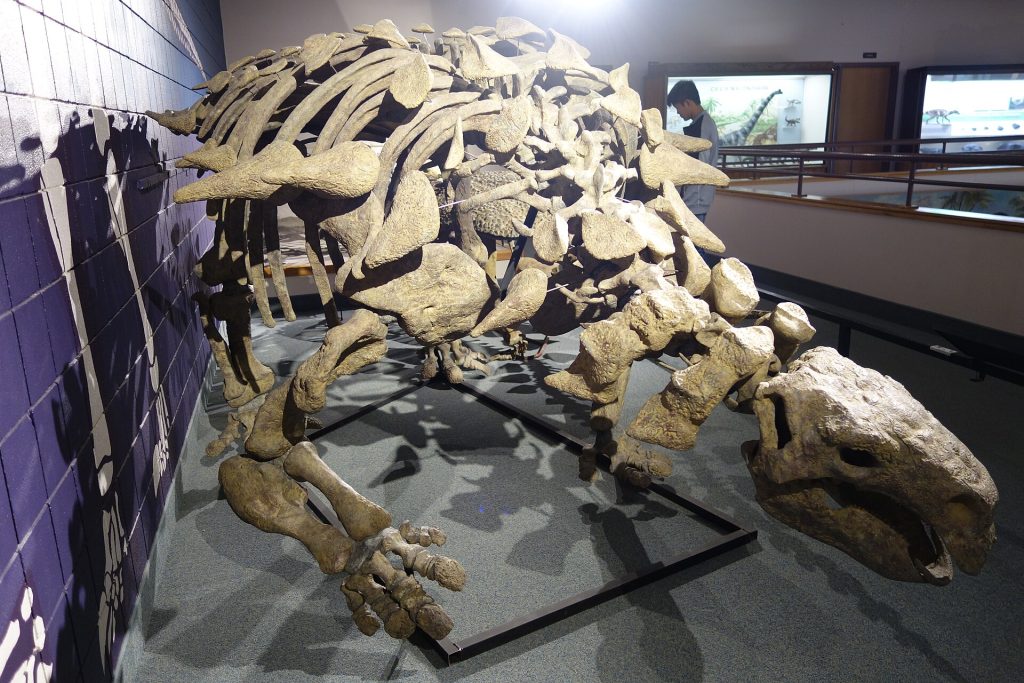
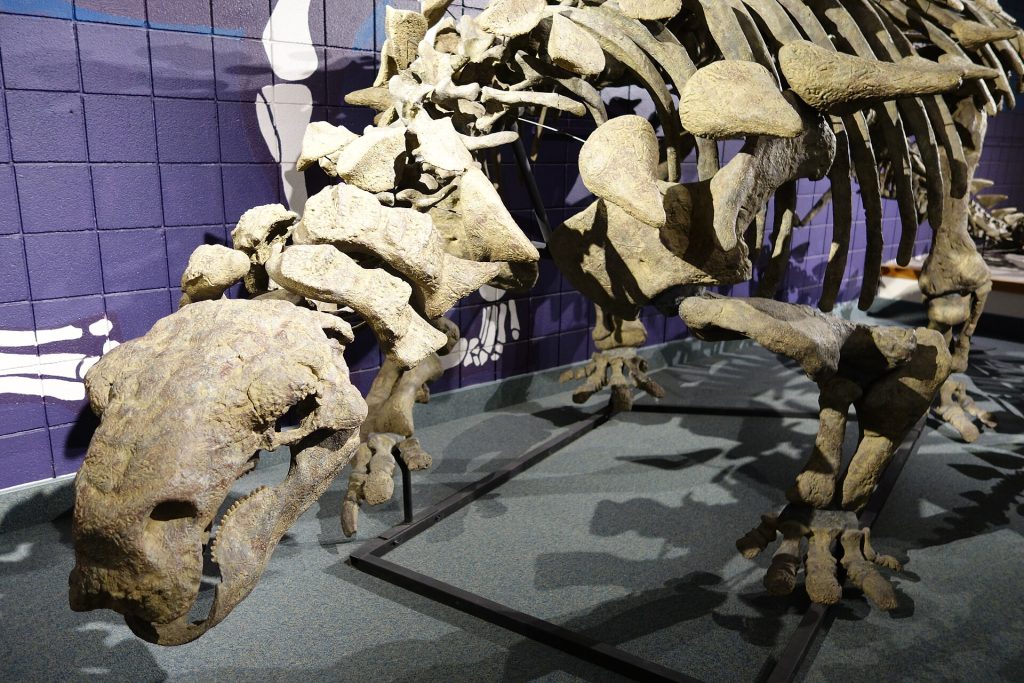
The fossils come from the PR-2 Quarry in the Price River area. The 2009 report counts over 1,000 bones from the quarry as a whole—a tally that includes many animals besides Peloroplites. In 2013, the museum in Price unveiled a mounted skeleton, built from bones that staff and volunteers had excavated, according to a university report.
The Prehistoric Museum of Utah State University Eastern in Price holds the holotype, CEUM 26331. According to the 2008 paper, the material includes a partial skull and postcranial skeleton—the bones behind the head. In 2013, Kirkland and colleagues listed the holotype together with “extensive paratype material,” meaning additional specimens designated alongside the type.
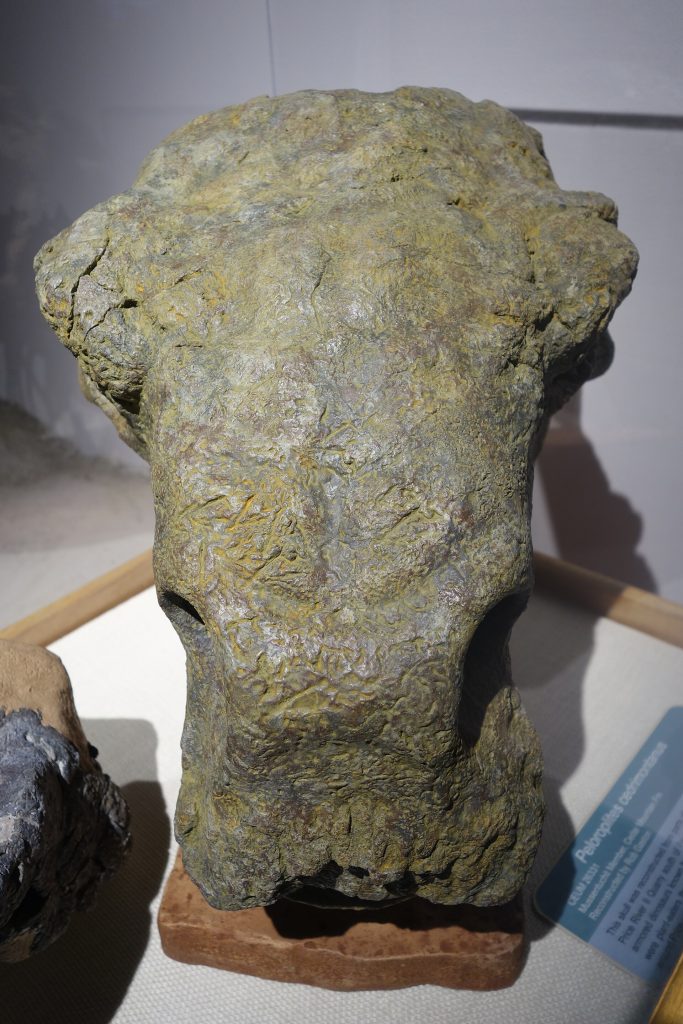

The quarry’s age is the main point of debate. In 2010, Ludvigson’s team found that a carbon-isotope feature ends just below the quarry and dated its top to the early Albian. That puts the bone beds at “at least 109.5” million years old—an estimate from correlation, not a direct radiometric date. Even so, their measured section still drew the quarry just inside the Mussentuchit.
In 2016, Kirkland and colleagues moved it to the Ruby Ranch, noting carbonate nodules typical of that member’s top. Additionally, detrital zircons (mineral grains washed in from older rocks) near the quarry give maximum ages of 109 to 116 million years. According to Kirkland’s team, the lowest sample may fit the isotope correlation, while the highest seems too old for its strata. In 2021, Suarez and colleagues still listed Peloroplites in strata described as Mussentuchit. Two years later, however, a conference abstract by Zanno and colleagues, with Suarez among its authors, agreed that the PR-2 ankylosaurs come from the Ruby Ranch.
Peloroplites Size and Description
Published comparisons focus on its skull and hind limbs.
Short description of Peloroplites
The skull of Peloroplites ended in a broad, square premaxillary beak at the front of the upper jaw. Its cranium was not domed, and the suspensorium—the bony strut that hangs the lower jaw from the skull—stood vertically. Behind each orbit (eye socket), a wall of bone extended back along the side of the skull, while above the eyes it thickened without forming a distinct boss, or knob.
Farther back, its hind limbs had unusual proportions for an ankylosaur. Its tibia (shin bone) was 0.82 times the length of the femur (thigh bone), giving it a relatively long shin. The layout of its armor in life is not known, so any reconstruction remains speculative.

Size and Weight of Type Species
The 2008 paper describes the holotype as an individual about 16.4 to 18.0 feet (5 to 5.5 meters) long. The 2008 team also judged it about the same size as Sauropelta edwardsorum.
News reports, however, have offered larger figures. A 2009 campus news report gave 18 to 20 feet (5.5 to 6 meters) and around four metric tons, calling it the “biggest example of a nodosaur ever.” In 2013, Carpenter described the museum mount as 23 feet (7 meters) long, 6½ feet (2 meters) tall and about five tons. These figures are not peer-reviewed, and they disagree with each other, so its mass remains an open question.
Kirkland and colleagues later called Peloroplites “gigantic.” They also noted that Cedarpelta bones from the same quarry show it reached the same large size.
The Dinosaur in Detail
What sets this dinosaur apart is a set of skull traits that the 2008 team used to separate it from Sauropelta. These were the vertical suspensorium, the non-domed cranium, and that broad, square beak. In 2013, Kirkland and colleagues added more comparisons while describing the Spanish nodosaurid Europelta. They noted that a lateral skull wall behind the orbit occurs in Peloroplites but not in polacanthids and most nodosaurids. Meanwhile, its skull roof, roughened by remodeling of the bone surface, matches the texture of Cedarpelta and Sauropelta.
Its hind limb carries several telling details. The tibia shares its 0.82 ratio to the femur with Cedarpelta, but its shaft is more narrowly waisted. At the ankle, the astragalus (an ankle bone) stayed separate from the tibia, as it also did in Mymoorapelta, Gastonia, and Hylaeosaurus. In the tail, the outer ends of the caudal ribs—side projections of the tail vertebrae—expanded in height.

Its place in the family tree has shifted between analyses. In 2023, Raven and colleagues recovered it among polacanthids in their “preferred” tree, alongside Gastonia, Polacanthus, Hylaeosaurus, and others. That clade formed the earliest-diverging ankylosaur lineage, although its membership varied between analyses. Then, in 2026, Cross and colleagues ran seven phylogenetic analyses, and none recovered Polacanthidae, Panoplosauridae or Struthiosauridae. Their tooth measurements, however, linked Peloroplites with Panoplosauridae.
These studies describe a giant armored herbivore whose skull and hind limbs invite detailed comparison. Its placement—nodosaurid, polacanthid or panoplosaurid—remains a matter of competing hypotheses rather than settled fact.
Interesting Points about Peloroplites
- A mounted skeleton of Peloroplites stands in the Prehistoric Museum in Price, not far from the quarry that produced its bones.
- As of 2016, the museum displayed Cedar Mountain ankylosaur skulls of Peloroplites, Cedarpelta, and Gastonia together in one exhibit.
- Its shin bone was relatively long for an ankylosaur, with a tibia-to-femur ratio of 0.82 that it shared with Cedarpelta.
- The 2008 description placed its quarry in the Mussentuchit Member, but later studies moved it into the older Ruby Ranch Member.
- Kirkland and colleagues have openly asked how two gigantic ankylosaurs, Peloroplites and Cedarpelta, could have divided up the same habitat.
Contemporary Dinosaurs
Sharing its world most closely was Cedarpelta, a long-skulled armored dinosaur described in the 2008 paper as a primitive ankylosaurid. According to that paper, its holotype quarry lies near PR-2 and roughly at the same level. Its postcranial bones also turn up at PR-2 itself. No interaction between the two is recorded. Instead, Kirkland and colleagues have left open how two such giants partitioned the same habitat.
From a neighboring region came Sauropelta, a nodosaurid from the Cloverly Formation of Montana and Wyoming that the 2008 paper called “contemporary” with Peloroplites. In 1970, paleontologist John Ostrom reported it through most of the Cloverly’s Units V to VII—the Little Sheep Mudstone and Himes members. In 2019, D’Emic and colleagues dated these to about 124 to 109 and 109 to 98 million years ago, a span that overlaps the early Albian age proposed for Peloroplites. Kirkland and colleagues add that the Ruby Ranch faunas “overlap the better known Aptian-Albian faunas of the Cloverly Formation.” It appears here for that shared age and fauna, not as a neighbor of Peloroplites.
Also from the Cloverly Formation came Tenontosaurus, a plant-eating ornithopod named by Ostrom in 1970. Ostrom also reported that it appears to occur at all levels of Units V to VII. In Utah, the upper Ruby Ranch fauna includes only material compared with it, listed as “cf. Tenontosaurus.” Like Sauropelta, it shares the age and broader fauna of Peloroplites rather than its landscape.
Peloroplites in its Natural Habitat
Rivers crossed the world Peloroplites roamed, leaving ribbon-like channel sandstones that now stand out as inverted ridges. Beneath the PR-2 locality, a footprint-bearing sandstone lens overlies the Price River marker calcrete—a hardened soil layer. Lower still, a red-bed interval may record a drying of the climate that peaked about 114 to 113 million years ago. In contrast, the overlying Albian strata may reflect wetter conditions as an inland seaway expanded, according to Kirkland and colleagues.
As a herbivore, Peloroplites probably fed close to the ground, since ankylosaurs in general were low feeders. Sauropods dominate the PR-2 bone bed, among them brachiosaurids whose articulated feet record animals that became mired. The same quarry produced some ornithopod material and a pterosaur phalanx (finger or toe bone). The Price River sites also yielded limited remains of a large allosauroid theropod. A large, finely serrated tooth from the nearby PR-3 Quarry seems closest to the older genus Acrocanthosaurus.
While there is no direct evidence of herding, multiple individuals of both Peloroplites and Cedarpelta come from correlative sites. Aquatic goniopholid crocodilians, turtles, and bony fish also shared the waterways. In Kirkland’s view, several animals here were known only from North America, which suggests the continent was isolated. Its exact role in that ecosystem, however, remains an open question.
Frequently Asked Questions
News reports translate it as “gigantic monster from Cedar Mountain” or “armored monster from the Cedar Mountain.”
Later studies place it around 110 million years ago, in the early Albian stage of the Early Cretaceous.
Its describers estimated it at about 16.4 to 18.0 feet (5 to 5.5 meters). Larger figures in news reports are not peer-reviewed.
It was a herbivore, and like other ankylosaurs it was probably a low feeder.
Its fossils come from the PR-2 Quarry in the Cedar Mountain Formation, south of Price, Utah.
It was an ankylosaur, first classified as a nodosaurid. A 2023 analysis placed it among polacanthids, but a 2026 study linked it with panoplosaurids.
Sources
The information in this article is based on various sources, drawing on scientific research, fossil evidence, and expert analysis. The aim is to provide a comprehensive and accurate overview of Peloroplites. However, please be aware that our understanding of dinosaurs and their world is constantly evolving as new discoveries are made.
- https://doi.org/10.1671/0272-4634-28.4.1089
- https://giw.utahgeology.org/index.php/GIW/article/view/11
- https://doi.org/10.2110/jsr.2010.086
- https://www.kgs.ku.edu/General/Personnel/klm/GAL/Ludvigson_etal_2010_in_JSR.pdf
- https://doi.org/10.1371/journal.pone.0080405
- https://doi.org/10.1080/14772019.2023.2205433
- https://doi.org/10.1093/zoolinnean/zlag068
- https://doi.org/10.7717/peerj.12242
- https://par.nsf.gov/servlets/purl/10652155
- https://doi.org/10.1130/G51278.1
- https://doi.org/10.7717/peerj.5883
- https://doi.org/10.1016/j.cretres.2020.104384
- https://archive.org/details/mobot31753003646368
- https://doi.org/10.3374/014.060.0101
- https://doi.org/10.1038/s41598-023-45444-1
- https://doi.org/10.1186/1472-6785-13-14
- https://paleobiodb.org/classic/basicTaxonInfo?taxon_no=147029
- https://usueasterneagle.com/2009/02/12/largest-nodosaur-found
- https://www.usu.edu/today/story/armored-monster-invades-usu-eastern-prehistoric-museum
This article was last fact checked: TheDinosaurs Team, 18-11-2026
Featured Image Credit: Jens Lallensack, CC BY-SA 4.0, via Wikimedia Commons
