
In the San Juan Basin of northwestern New Mexico, the Kirtland Formation’s De-na-zin Member preserves a Late Cretaceous floodplain. From these rocks comes Dinevenator robustus, a troodontid theropod known from a single bone of the skull roof. Troodontids were bird-like dinosaurs, and its describers date this one to about 73.4 to 73.0 million years ago, in the late Campanian. Because earlier troodontid records from the San Juan Basin rested on teeth alone, even one bone adds a great deal.
Its path to a name of its own took two decades. In 2006, paleontologist Robert M. Sullivan described the bone as Saurornitholestes robustus, a new species of dromaeosaurid. Later studies first doubted the name, and then one co-written by Sullivan himself moved the fossil into the troodontid family. Finally, in 2026, Steven E. Jasinski and Sullivan gave it a genus of its own. As a result, its story sheds light on southern Laramidia—the western landmass of Cretaceous North America—a region that has historically seen less collecting.
Dinevenator Key Facts
| Keyword | Fact |
|---|---|
| Pronunciation | Not specified |
| Meaning of name | Diné Hunter |
| Group | Theropoda (Troodontidae) |
| Type Species | Dinevenator robustus (originally Saurornitholestes robustus) |
| Diet | Not specified |
| When it Lived | 73.4 to 73.0 MYA |
| Period | Cretaceous |
| Epoch | Late Cretaceous (Campanian stage) |
| Length | No published scientific estimate (press release: 8 to 10 feet, or 2.4 to 3.0 meters) |
| Height | Not specified |
| Weight | No published scientific estimate (press release: 150 to 300 pounds, or 68 to 136 kilograms) |
| Mobility | Moved on two legs (bipedal) |
| First Discovery | 2005 by Robert M. Sullivan |
| Described by | 2006 by R.M. Sullivan (as Saurornitholestes robustus), genus named in 2026 by S.E. Jasinski and R.M. Sullivan |
| Holotype | SMP VP-1955 |
| Location of first find | SMP locality 388, Alamo Wash, De-na-zin Member, Kirtland Formation, San Juan Basin, New Mexico, USA |
Dinevenator Origins, Taxonomy and Timeline
The name Dinevenator blends two languages, starting with the Navajo word “Diné”—a reference to the people of the Navajo Nation. Its second half is the Latin venator, meaning “hunter.” Meanwhile, the species name robustus dates back to Sullivan’s 2006 description and carries over unchanged. Together, the name pairs a Navajo word with a hunter’s title—even though the bone itself says nothing about diet.
In their 2026 study, Jasinski and Sullivan place Dinevenator within Theropoda, in Troodontidae, the family that includes Troodon. More narrowly, they assign it to the subfamily Troodontinae and the tribe Troodontini. Their analysis found it to be the sister taxon—the closest relative—to a pair formed by Albertavenator curriei and Xenovenator espinosai. Albertavenator comes from Alberta’s Maastrichtian Horseshoe Canyon Formation, whereas Xenovenator comes from the Cerro del Pueblo Formation of Mexico. Together, the three form what the authors call a clade of robust troodontins, with Dinevenator as its basal-most member. Dinevenator robustus is the type species of the genus.
Its describers date the holotype to the upper Campanian, within the Kirtlandian land-vertebrate age (a time unit defined by fossils), at roughly 73.4 to 73.0 million years ago. However, the paper does not say which calibration it used, and dated ash beds within the De-na-zin Member have been given different ages. Ash J, near the top of the member, was dated to about 73.0 million years ago. One recalibration puts Ashes H and J at about 73.0 to 72.7 million years, whereas in 2020, Denver W. Fowler and colleagues gave about 73.8 to 73.5 million years. The fossil belongs to the Willow Wash local fauna, which the paper places in the latest Kirtlandian. Its describers also suggest that faunal links point to migrations, possibly between northern and southern Laramidia, particularly as the Western Interior Seaway was receding.
Discovery & Fossil Evidence
According to a museum press release, Sullivan came across the bone in the summer of 2005. The scientific paper itself, however, does not record who collected it or when. Later, paleontologist Hector E. Rivera-Sylva and colleagues gave the find site as SMP locality 388 at Alamo Wash, in the De-na-zin Member. Jasinski and Sullivan also report that Turner and colleagues, in 2012, treated it as a nomen dubium—a “doubtful name”—lacking dromaeosaurid features.
The holotype, SMP VP-1955, is housed at the State Museum of Pennsylvania in Harrisburg. Jasinski and Sullivan describe it as a nearly complete left frontal, the skull-roof bone that forms the top of the eye socket. In contrast, Rivera-Sylva and colleagues list it as a right frontal. Its upper surface is slightly weathered, and the postorbital process—a projection behind the eye socket—is broken and missing.
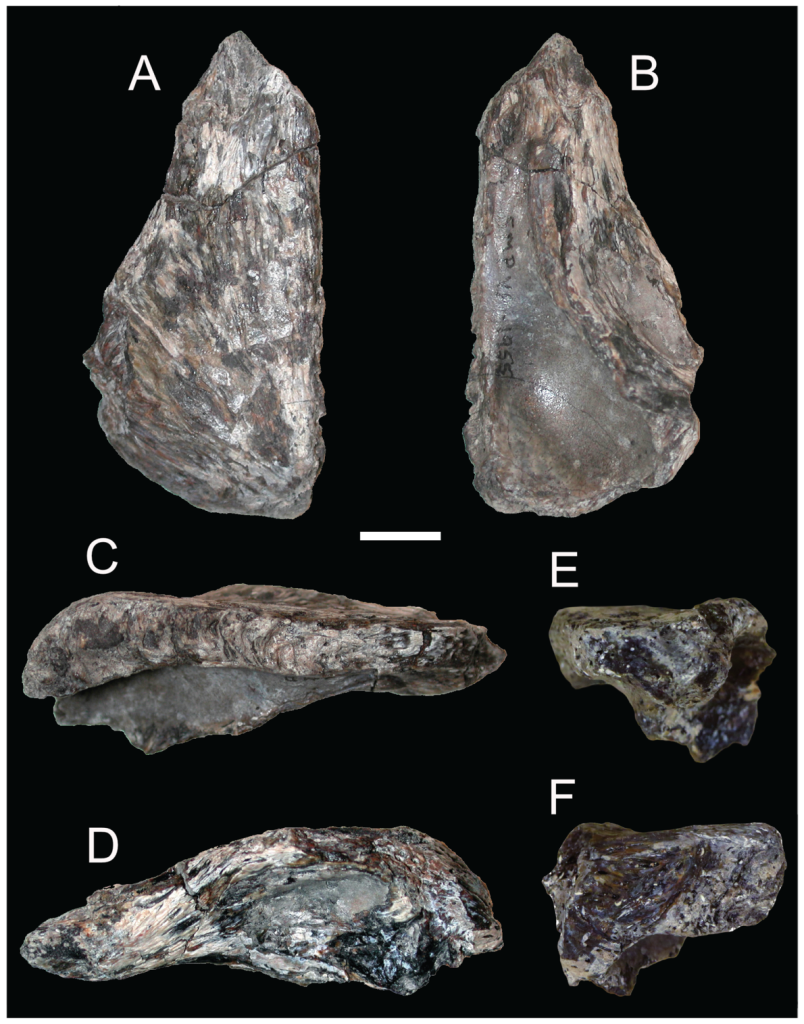

In 2006, Sullivan also tentatively referred an isolated tooth, SMP VP-1901, to the species. Writing in 2014, Williamson and Brusatte noted that the tooth resembles their most common dromaeosaurid tooth type. However, they had not examined it themselves, and the name it was referred to was then considered doubtful. The only other troodontid record from the De-na-zin Member is a single tooth, NMMNH P-68395, identified simply as Troodontidae indet. No study has confirmed further bones of Dinevenator—the species still rests on one frontal.
Dinevenator Size and Description
With only one bone to work from, any picture of the rest of Dinevenator is borrowed from its relatives.
Short description of Dinevenator
The frontal measures about 2.4 inches (62 millimeters) long and about 1.2 inches (30.7 millimeters) wide at the postorbital process. It is thick from top to bottom and nearly flat, lacking a well-developed trough and ridge along the midline. The sagittal suture is the seam where the left and right frontals met. Along it, the bone is twice as thick at the back (10 millimeters) as at the front (5 millimeters).
Underneath, a deep depression marks the roof of the eye socket. The underside also shows a large, sub-oval cerebral fossa (a hollow for the forebrain) and an incipient olfactory fossa. According to the describers, the olfactory tract was relatively thin from side to side. Beyond this, the skeleton remains unknown.
Skin and feathers are not preserved, so any discussion of its covering is speculative. The press release describes troodontids as two-legged, so Dinevenator probably walked that way—though the fossil itself cannot show it.
Size and Weight of Type Species
The scientific paper gives no body length, height or mass for Dinevenator. Instead, Jasinski and Sullivan call it a “large, robust troodontid” on the basis of its frontal. At 62 millimeters, that bone is larger than in Albertavenator and comparable to some of the larger individuals of Stenonychosaurus inequalis.
Still, a New Mexico museum press release offers rough figures drawn from related species. It estimated a length of 8 to 10 feet (2.4 to 3.0 meters) and a weight of 150 to 300 pounds (68 to 136 kilograms). Neither figure appears in the paper.
Earlier, in 2014, Evans and colleagues found the bone’s size and shape consistent with late Campanian troodontid material from Alberta. Without more of the skeleton, though, any estimate of its full size remains an educated guess.
The Dinosaur in Detail
What sets this dinosaur apart is the shape of its frontal. Jasinski and Sullivan list eight distinguishing features, and two of them are autapomorphies—traits found in no other species. One is the thickening of the frontal toward the back. The other is a nasal projection between the frontals that is wider than long—in the holotype, at most 13 millimeters long and 21 millimeters wide.
The pair also identify classic troodontid traits, such as a raised orbital rim and a shallow side wall to the olfactory fossae. In addition, the supratemporal fossa (a depression on the rear skull roof) stays off the frontal’s upper surface. Evans and colleagues had pointed to these same three features in 2014. At that time, though, they judged the bone indistinguishable from comparable Alberta material and left it as an indeterminate troodontid.
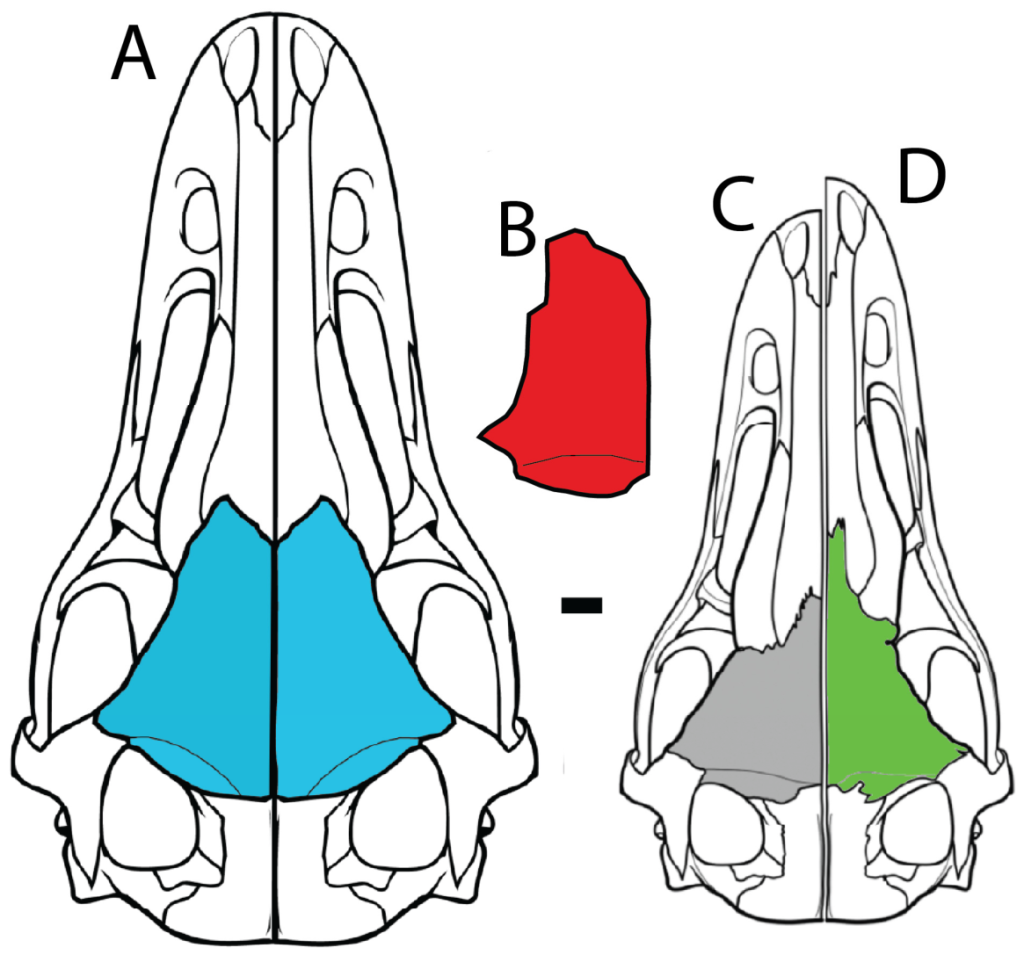

Comparisons with Mexico’s Xenovenator have produced two different answers. In early 2026, Rivera-Sylva and colleagues tentatively placed the species in that genus as Xenovenator(?) robustus. They recovered the two as sister taxa that share an L-shaped contact between the frontal and the lacrimal bone. Even so, they noted that its frontals are not fused or highly domed, unlike those of Xenovenator.
Jasinski and Sullivan reached a different result. Using TNT software, eight taxa and 118 characters, their main analysis found it “not sister to Xenovenator espinosai.” In their larger 32-taxon analysis, by contrast, the three robust troodontins fall into a polytomy—an unresolved branching point. Both 2026 studies find the bone diagnostic but disagree on where it sits among its robust relatives.
Interesting Points about Dinevenator
- Before it received its own genus, the species was treated in turn as a dromaeosaurid, a nomen dubium, an indeterminate troodontid, and a possible species of Xenovenator.
- Evans and colleagues described its frontal in 2014 as the first troodontid skeletal fossil other than teeth from the Kirtland Formation.
- The robust troodontin clade that includes Dinevenator has its oldest members in southern Laramidia, according to Jasinski and Sullivan.
- Speaking to the Albuquerque Journal, Jasinski said that “if it had not been at a museum,” the research would not have been possible.
Dinosaurs from the Same Formation
Also known from the Kirtland Formation (exact level relative to Dinevenator not known): the crested hadrosaurid Parasaurolophus tubicen, the ankylosaurids Nodocephalosaurus and Ziapelta, and the dromaeosaurid Saurornitholestes sullivani. All four are reported from the De-na-zin Member itself, although none is tied to the bed that yielded Dinevenator. Dated ash beds place the formation at roughly 75 to 73 million years ago, and some recalibrations give ages near 72.7 million years for the top of the De-na-zin Member. These animals may therefore not all have lived at the same time.
Dinevenator in its Natural Habitat
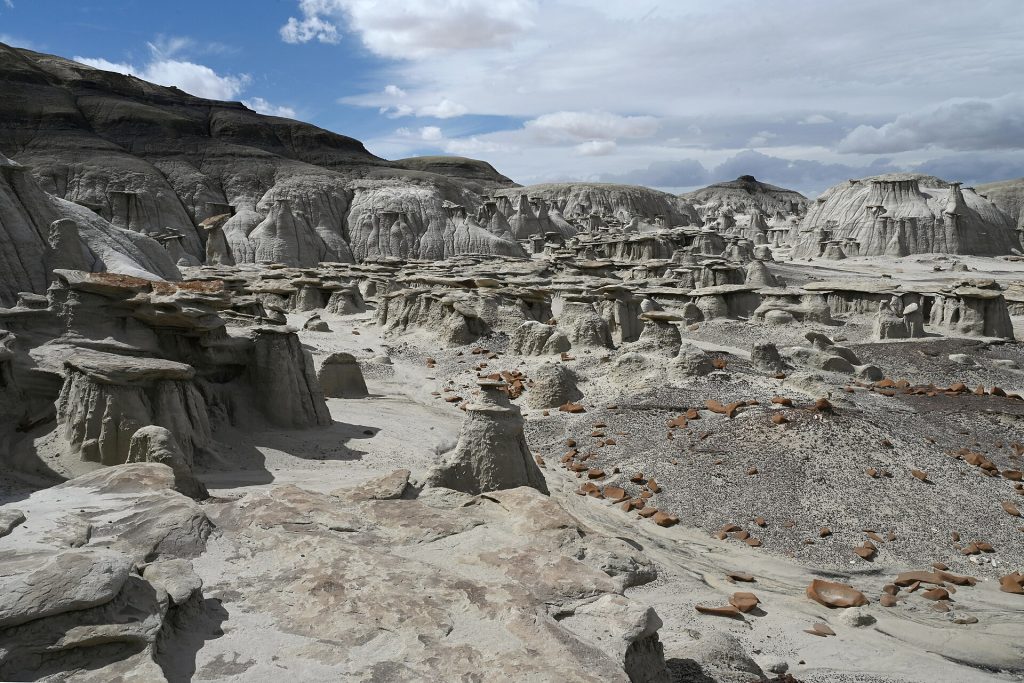
The world Dinevenator inhabited was a well-drained alluvial floodplain crossed by low-sinuosity, or fairly straight, streams. Sandstone, siltstone, mudstone, coal and shale make up the formation, which reaches 1,950 feet (594 meters) thick locally. Similarly, a museum press release describes the setting as a sub-tropical floodplain.

The scientific paper makes no claims about the diet, senses or behavior of Dinevenator. By contrast, the press release calls troodontids omnivorous and says they had unusually large brains relative to other dinosaurs—statements about the family, not this fossil. A life reconstruction by artist Sergey Krasovskiy, in the paper’s supplementary material, shows it preying on Mesodma, a multituberculate mammal. However, that scene is artwork, not a tested finding.
While there is no direct evidence of whether Dinevenator lived alone or in groups, the rocks that held it preserve other theropods. Apart from the dromaeosaurid Saurornitholestes sullivani, named from a frontal, other theropods from the De-na-zin Member are known only from teeth, including tyrannosauroids, further dromaeosaurids, and Richardoestesia-like forms. The tyrannosauroid Bistahieversor is known from the older, underlying Fruitland Formation and lower Kirtland members. No diagnostic tyrannosauroids have turned up in the De-na-zin, although Williamson and Brusatte suggested that small shed teeth there may belong to young Bistahieversor. The describers call the Willow Wash local fauna a “unique vertebrate assemblage.” Collecting in New Mexico has grown over the past three decades, yet only more finds can show where this troodontid fit.
Frequently Asked Questions
It combines the Navajo word “Diné,” referring to the people of the Navajo Nation, with the Latin venator, meaning “hunter.”
It lived in the late Campanian, about 73.4 to 73.0 million years ago according to its describers.
The scientific paper gives no body size. A press release estimated 8 to 10 feet long and 150 to 300 pounds, based on related species.
It was a troodontid theropod and, in its describers’ main analysis, the basal-most member of a clade of robust troodontins.
Its only known bone comes from the De-na-zin Member of the Kirtland Formation in the San Juan Basin of northwestern New Mexico.
According to its describers, its frontals thicken toward the back, and a nasal projection between them is wider than long—two features they found in no other troodontid.
Sources
The information in this article is based on various sources, drawing on scientific research, fossil evidence, and expert analysis. The aim is to provide a comprehensive and accurate overview of Dinevenator. However, please be aware that our understanding of dinosaurs and their world is constantly evolving as new discoveries are made.
- https://www.mdpi.com/2813-6284/4/3/21
- https://doi.org/10.1139/cjes-2014-0073
- https://www.mdpi.com/3674690
- https://pmc.ncbi.nlm.nih.gov/articles/PMC3977837/
- https://pmc.ncbi.nlm.nih.gov/articles/PMC4177562/
- https://pmc.ncbi.nlm.nih.gov/articles/PMC7278894/
- https://pmc.ncbi.nlm.nih.gov/articles/PMC7842145/
- https://pmc.ncbi.nlm.nih.gov/articles/PMC7099077/
- https://nmgs.nmt.edu/meeting/abstracts/view.cfm?aid=1569
- https://nmgs.nmt.edu/meeting/abstracts/view.cfm?aid=1552
- https://ladailypost.com/museum-of-natural-history-science-researchers-identify-new-bird-like-dinosaur-species-in-northwest-new-mexico/
- https://www.abqjournal.com/news/new-mexicos-fossil-roars-back-after-20-years-of-mistaken-identity/3097971
This article was last fact checked: TheDinosaurs Team, 18-11-2026
Featured Image Credit: Connor Ashbridge, CC BY 4.0, via Wikimedia Commons
