
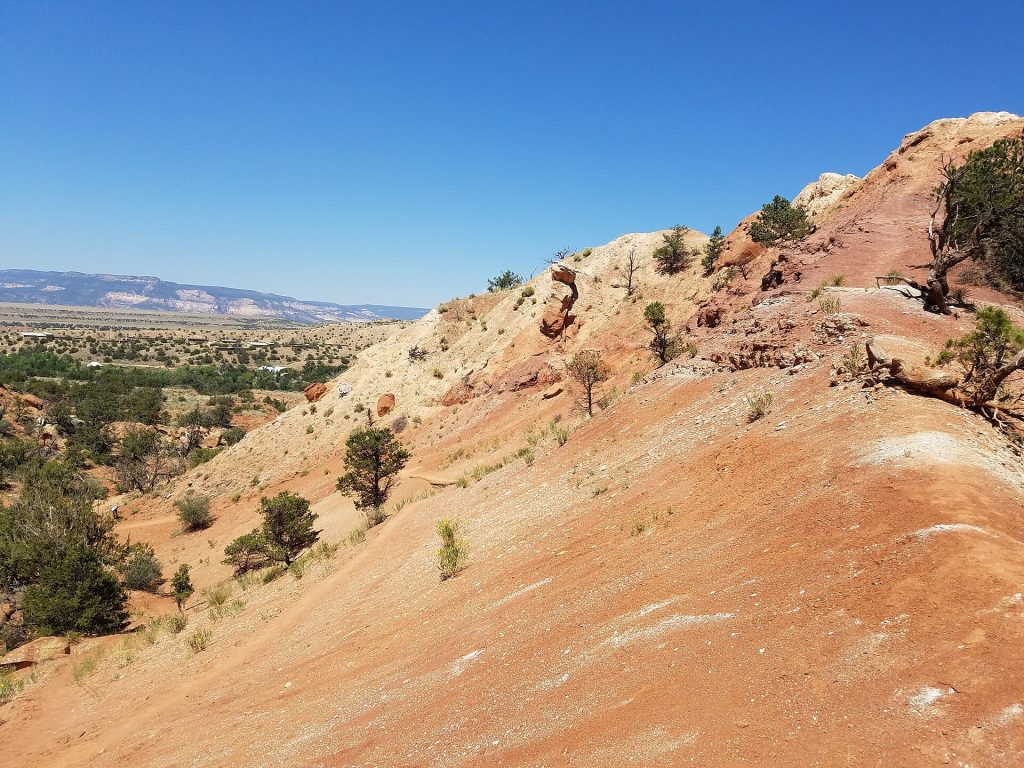
At Ghost Ranch in northern New Mexico, the Coelophysis Quarry cuts into the “siltstone member” of the Chinle Formation. The site is famous for its many skeletons of the small predator Coelophysis. Yet it also yielded Ptychotherates bucculentus, a saurischian dinosaur known from a single skull. This meat-eater lived at the very end of the Triassic, in the latest Norian or Rhaetian stage. Its describers suggest that its lineage held on at low latitudes long after neotheropods had taken over elsewhere—a pattern that may change how we read the end-Triassic extinction.
A crew from the Carnegie Museum of Natural History dug up the skull in 1982. Thirty-some years later, paleontologist Sterling J. Nesbitt pulled it out of a drawer and eventually brought it to Virginia Tech in Blacksburg. In April 2026, undergraduate Simba Srivastava and Nesbitt named it in Papers in Palaeontology. Their study places it in a new group, Morphoraptora, together with Tawa and Chindesaurus. According to Everything Dinosaur, the paper also places Daemonosaurus in Morphoraptora. In the end, its story shows how much a forgotten fossil can still reveal once someone looks again.
Ptychotherates Key Facts
| Keyword | Fact |
|---|---|
| Pronunciation | Not specified |
| Meaning of name | Folded Hunter with Full Cheeks |
| Group | Saurischia (Morphoraptora, presented as herrerasaurian; placement debated) |
| Type Species | Ptychotherates bucculentus |
| Diet | Carnivore (inferred from its teeth) |
| When it Lived | About 206 to 201 MYA |
| Period | Triassic |
| Epoch | Late Triassic (latest Norian or Rhaetian stage) |
| Length | Not specified |
| Height | Not specified |
| Weight | Not specified |
| Mobility | Not specified |
| First Discovery | 1982 by a Carnegie Museum of Natural History crew |
| Described by | 2026 by S. Srivastava and S.J. Nesbitt |
| Holotype | CM 31368 |
| Location of first find | Coelophysis Quarry, Chinle Formation, Ghost Ranch, Rio Arriba County, New Mexico, USA |
Ptychotherates Origins, Taxonomy and Timeline
The name Ptychotherates joins two Greek roots. “Ptycho” means “fold,” because of the numerous and challenging axes along which the holotype’s bones had to be reoriented. Meanwhile, “therates” means “hunter,” for the carnivorous habits its teeth suggest. The species name bucculentus is Latin for “with full cheeks”—a reference to its exceptionally tall jugal (cheekbone). Together, the name reads, in Srivastava’s own words, as the “folded hunter with full cheeks.”
Srivastava and Nesbitt placed Ptychotherates in Dinosauria and Saurischia, within a new clade, Morphoraptora. In the abstract they call it the “Chindesaurus–Tawa” clade, and their paper presents its members as herrerasaurians. Chindesaurus itself is older—it comes from middle–upper Norian levels of the Chinle in Arizona’s Petrified Forest National Park. Virginia Tech describes Herrerasauria as one of the earliest-evolving groups of carnivorous dinosaurs. A later 2026 study notes that recent analyses, including the Ptychotherates paper, generally place the group outside the split between theropods and sauropodomorphs. Ptychotherates bucculentus is the type and only known species.
That placement remains open to debate. Tawa‘s describers originally called it a theropod. In 2011, Sues and colleagues judged Daemonosaurus closer to neotheropods than to herrerasaurids. In 2021, however, Nesbitt and Sues placed it at the base of Dinosauria, without a firm nearest relative. Analyses by Novas and colleagues in 2021 and Garcia and colleagues in 2024 then recovered Tawa, Chindesaurus, and Daemonosaurus in a broad Herrerasauria. In 2025, Ezcurra and colleagues found it again, although some of their analyses still recovered all three as theropods.
The paper dates the quarry to the latest Norian or Rhaetian—the uppermost Triassic, roughly 206 to 201 million years ago. Similarly, a 2022 bone-tissue study rounds the site to about 200 million years old. Srivastava and Nesbitt think the end-Triassic extinction that followed hit dinosaur diversity harder than previously hypothesized.
Discovery & Fossil Evidence
The skull came out of the ground at Ghost Ranch in 1982, during a Carnegie Museum dig at the Coelophysis Quarry. The quarry lies about 20 kilometers (12 miles) northwest of Abiquiú, in Rio Arriba County. Thirty-some years after the dig, Nesbitt rediscovered the specimen in a drawer and took it to Virginia Tech.

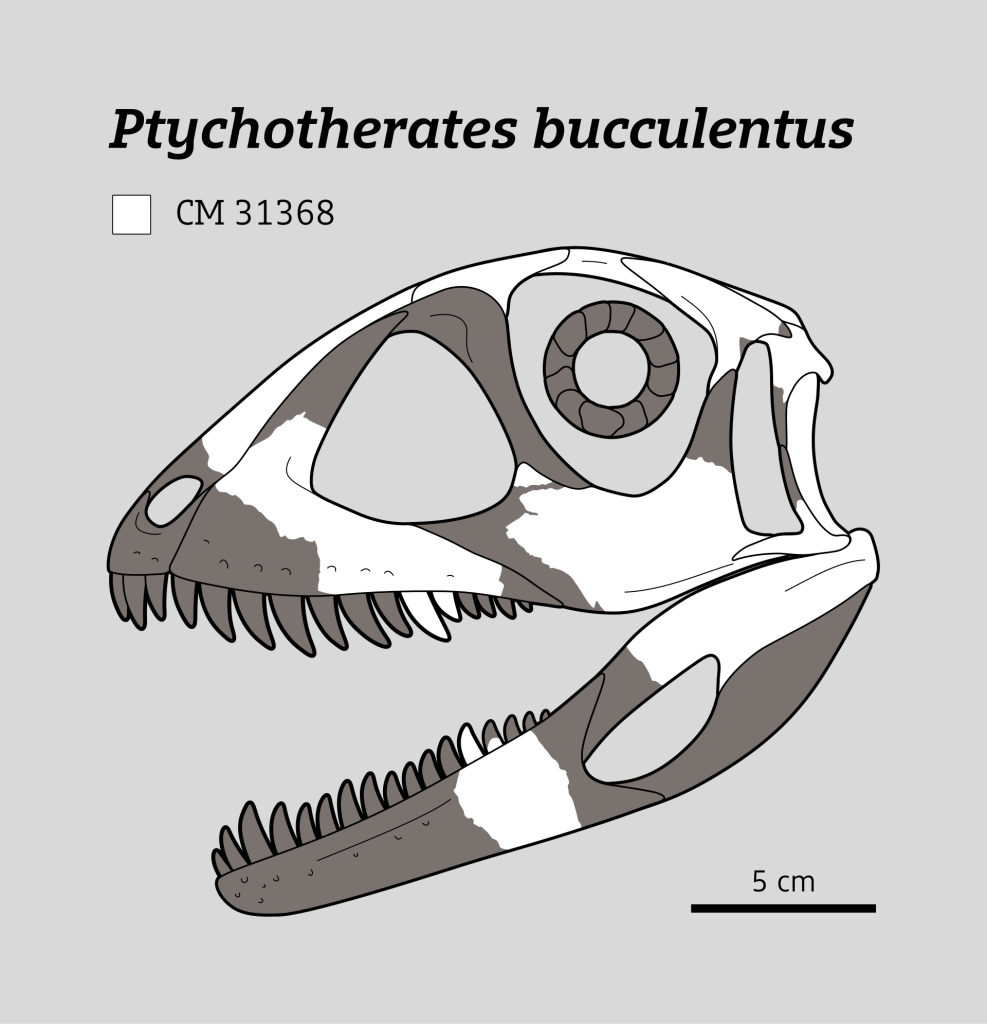
The holotype, CM 31368, carries the Carnegie Museum’s catalog prefix, and its describers call it “an incomplete but well-preserved skull.” In a later news report, Sci.News called it mostly complete, with a full braincase—the bony box around the brain—and much of the skull roof. Virginia Tech calls it a mangled skull, and the authors faced numerous, difficult axes of reorientation in restoring it—the very folds the genus name recalls.
Using CT scan data, Srivastava isolated the specimen digitally and 3D printed a reconstruction. The paper itself illustrates a digital reconstruction of the skull in left side view. According to Virginia Tech, the skull is still the only one of its kind anyone has found. No other specimens of Ptychotherates have been reported.
Ptychotherates Size and Description
Only the skull of Ptychotherates survives, so its portrait begins—and ends—at the head.
Short description of Ptychotherates
According to Virginia Tech, the skull shows that the animal had “massive cheekbones, a wide braincase, and probably a short, deep snout.” The authors’ diagnosis adds finer detail, starting with flat nasal and frontal bones on top of the skull. A supratemporal fossa (a shallow depression on the skull roof) reached onto both the frontal and the parietal. Behind the eye, the front outer part of the postorbital bone overhung the eye socket.
In the upper jaw, the maxilla had a tapering upward branch. Its rear part also lacked an antorbital fossa (a hollow) beneath the antorbital fenestra, the opening in front of the eye. At the back of the lower jaw, the retroarticular process—a bony lever behind the jaw joint—turned upward immediately behind the joint. Its teeth curved backward and bore fine serrations, each of which ended in a point.
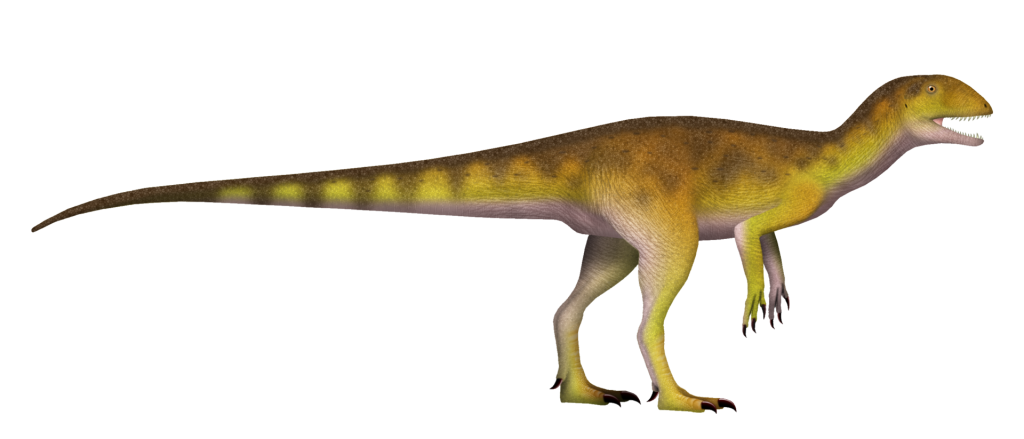
No bones from behind the head have turned up, so its posture remains a mystery. Likewise, no skin or other soft tissue survives, and any discussion of its outer covering is therefore speculative.

Size and Weight of Type Species
No peer-reviewed length, height, or weight has been published for Ptychotherates. In 2026, Sci.News reported a skull length of about 22 centimeters (9 inches). However, the paper’s abstract gives no such figure, so it is best treated as provisional.
Without a neck, limbs, or tail, any body-size figure would rest on comparisons with relatives rather than on the fossil itself. Until more of the skeleton turns up, Ptychotherates remains a head without a body.
The Dinosaur in Detail
What sets this dinosaur apart is its cheek. According to Srivastava and Nesbitt, its jugal is “the proportionally dorsoventrally deepest jugal known for any Triassic-aged dinosaur”—in plain terms, the tallest for its size. In their diagnosis, the jugal was more than three times as deep as its own rear branch. It was also deeper than the downward branch of the postorbital was long. On top of that, it reached more than half the height of the quadrate’s main body.
Other telltale features sit at the back of the skull. There, the crista interfenestralis—a ridge on the otoccipital bone—spread unusually far sideways. In addition, the posttemporal fenestra was as wide as the foramen magnum (the hole for the spinal cord). Even the small prefrontal bone above the eye looked symmetrical from the side, a trait the authors list as unique to this genus among its relatives.
Several features also link Ptychotherates with Tawa hallae, an older relative from Ghost Ranch’s Hayden Quarry. That site has yielded a date of about 212 million years ago. Both share distinctive fossae (shallow pits) on the quadrate and otoccipital, along with a tall, flattened jugal. In their abstract, the authors treat these as synapomorphies (shared derived traits) that the new taxon clearly shares with Tawa. The clade name Morphoraptora itself refers to how closely its members converged on the build of theropods, as if “stealing” their shape.
The wider pattern matters as much as the skull. At higher paleolatitudes, the authors note, neotheropods had completely replaced earlier carnivorous dinosaurs during the Norian and Rhaetian. Near the tropics, however, morphoraptorans “coexisted with neotheropods possibly until the End-Triassic Extinction Event.” As a result, the authors suggest a low-latitude “museum” where early lineages held on far longer than elsewhere.

Interesting Points about Ptychotherates
- The clade name Morphoraptora loosely translates as “bodysnatcher,” in honor of a 2007 Radiohead song from the album In Rainbows.
- A Carnegie Museum crew dug up the holotype skull in 1982, but Nesbitt only pulled it out of a drawer thirty-some years later.
- Nesbitt and Michelle Stocker recruited Srivastava as a first-year student, and he spent two years working out the skull.
- According to Srivastava, one paleo-artist said that the deep-cheeked predator looked like a “murder muppet.”
- Its teeth carried fine serrations, with four to five per millimeter in the upper jaw and five to six in the lower jaw.
Dinosaurs from the Same Formation
Also known from the Chinle Formation (exact level relative to Ptychotherates not known): Coelophysis, the slender neotheropod whose skeletons crowd the same quarry, and Daemonosaurus, a short-snouted early saurischian with enlarged front teeth. The holotype skull of Daemonosaurus (CM 76821) also came from the quarry, and several recent analyses group it with herrerasaurians. Dated levels in the formation run from about 223 million years ago up to this latest Triassic quarry—a span of roughly 20 million years. That earlier date comes from the base of the Blue Mesa Member in Arizona, not from the bottom of the formation. These animals, then, may not all have lived at the same time.
Ptychotherates in its Natural Habitat
The world Ptychotherates inhabited was one of rivers and overbank floodplains in the Chama Basin of north-central New Mexico. During the late Norian and Rhaetian, the region drifted from about 10° to 14° north, and its rocks suggest a semiarid climate. Pollen and spores record rapid swings in local plant life, charcoal points to frequent wildfires, and plant diversity drops in the upper siltstone member. The quarry itself preserves a mass death of Coelophysis—a catastrophic assemblage. In 2022, Barta and colleagues noted that drought or other harsh conditions may have preceded or caused those deaths.
Srivastava and Nesbitt inferred meat-eating habits from its serrated, recurved teeth. While there is no direct evidence of its prey, the quarry also preserves several non-dinosaurs. They include the shuvosaurid Effigia, crocodylomorphs, and phytosaurs referred to “Redondasaurus.” In the Chama Basin record, dinosaurs and their close relatives made up less than 15% of specimens—except at this unusual quarry. Indeed, Virginia Tech notes that Late Triassic dinosaurs were still vying for resources with the forerunners of crocodiles and mammals.
Its social life remains a blank, so its larger importance lies in timing. Virginia Tech notes that no herrerasaurians have been found anywhere else this late in the Triassic. For this reason, its release suggests the American Southwest may have been where the group survived longest and made its last stand. If so, the find “forces us to reconsider the impact of the end-Triassic extinction,” as Srivastava put it.
Frequently Asked Questions
It combines Greek words for “fold” and “hunter,” and bucculentus is Latin for “with full cheeks.”
It lived in the latest Norian or Rhaetian stage of the Late Triassic, roughly 206 to 201 million years ago.
Scientists have published no peer-reviewed length, height, or weight, because only its skull survives.
It was a carnivore, judging from its serrated and recurved teeth, according to the scientists who named it.
Its only skull comes from the Coelophysis Quarry at Ghost Ranch in northern New Mexico, USA.
Its jugal, or cheekbone, is the proportionally deepest known for any Triassic-aged dinosaur.
Sources
The information in this article is based on various sources, drawing on scientific research, fossil evidence, and expert analysis. The aim is to provide a comprehensive and accurate overview of Ptychotherates. However, please be aware that our understanding of dinosaurs and their world is constantly evolving as new discoveries are made.
- https://doi.org/10.1002/spp2.70069
- https://doi.org/10.1098/rspb.2011.0410
- https://pmc.ncbi.nlm.nih.gov/articles/PMC3177637/
- https://doi.org/10.1038/s41598-022-22216-x
- https://doi.org/10.1206/352.1
- https://doi.org/10.1073/pnas.1505252112
- https://doi.org/10.1098/rsos.250081
- https://doi.org/10.1080/02724634.2019.1645682
- https://doi.org/10.4202/app.00143.2014
- https://doi.org/10.1002/ar.70076
- https://doi.org/10.1007/s00114-026-02185-1
- https://stratigraphy.org/ICSchart/ChronostratChart2024-12.pdf
- https://news.vt.edu/articles/2026/01/science-murder-muppet.html
- https://www.sci.news/paleontology/ptychotherates-bucculentus-14703.html
- https://doi.org/10.1093/zoolinnean/zlaa080
- https://doi.org/10.1016/j.jsames.2021.103341
- https://doi.org/10.1002/ar.25342
- https://blog.everythingdinosaur.com/blog/_archives/2026/05/11/new-triassic-carnivorous-dinosaur-identified-from-ghost-ranch.html
This article was last fact checked: TheDinosaurs Team, 20-11-2026
Featured Image Credit: Connor Ashbridge, CC BY 4.0, via Wikimedia Commons
